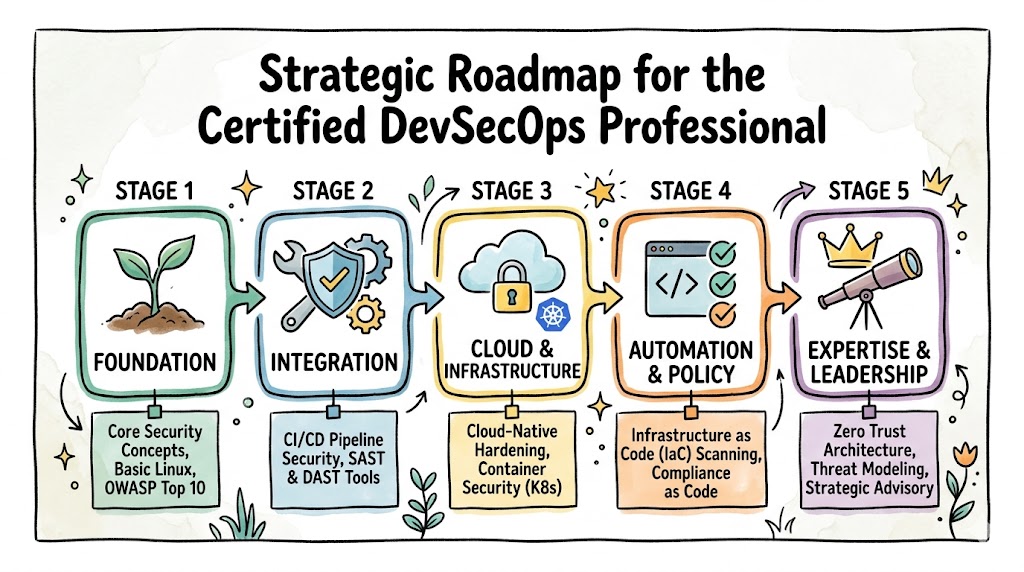
The Certified DevSecOps Professional program empowers engineers to build security directly into their automated deployment pipelines. Modern software delivery moves at a lightning pace, making traditional manual security checks a major bottleneck for agile teams. This comprehensive guide helps developers and security enthusiasts understand how to transition into a “shift-left” culture using DevSecOpsschool resources. By following this roadmap, you gain the technical skills required to protect cloud-native applications while maintaining high release velocity.
What is the Certified DevSecOps Professional?
This certification represents a gold standard for professionals who automate security across the entire development lifecycle. It exists to bridge the gap between rapid feature delivery and robust protection against modern cyber threats. The curriculum emphasizes hands-on, production-focused learning rather than just abstract concepts or high-level theory. It aligns perfectly with enterprise environments where engineers must bake security into every container, script, and cloud configuration. Most organizations now prioritize candidates who can demonstrate these practical skills in real-world infrastructure scenarios.
Who Should Pursue Certified DevSecOps Professional?
System administrators, software developers, and cloud architects find immense value in this specialized training. It specifically targets those who manage infrastructure as code and want to eliminate vulnerabilities before they reach production. Beginners use it to establish a strong technical foundation, while senior engineers and managers use it to lead large-scale digital transformations. The certification carries significant weight in both the Indian tech market and the global engineering landscape. Technical leaders especially benefit by learning how to foster collaboration between once-isolated development and security departments.
Why Certified DevSecOps Professional is Valuable and Beyond
Industry demand for secure automation experts continues to skyrocket as data breaches become more frequent and costly. This credential ensures long-term career relevance by teaching a methodology that transcends specific software versions or cloud providers. It helps professionals stay competitive even as the tool landscape shifts toward AI-driven operations and platform engineering. Investing time in this certification provides a massive return through increased job stability and access to high-tier engineering roles. It effectively turns a generalist engineer into a specialized asset capable of defending complex enterprise systems.
Certified DevSecOps Professional Certification Overview
The program delivers training via the official portal and resides on the hosting site. It utilizes a practical assessment model that tests your ability to solve actual security challenges in a live environment. The structure includes various levels of mastery, ensuring a clear progression path from novice to expert. Industry veterans own and maintain the curriculum to reflect the most current security best practices and compliance standards. This approach guarantees that your certification remains respected by hiring managers and technical peers alike.
Certified DevSecOps Professional Certification Tracks & Levels
The certification features foundation, professional, and advanced tiers to support every stage of an engineer’s career. Specialist tracks allow you to focus on niche areas like SRE, FinOps, or specialized cloud security architectures. These levels align with typical career advancement, moving from basic tool implementation to high-level strategic governance. By offering these distinct paths, the program ensures that learners can tailor their education to their specific job roles. This modular structure makes it easier to achieve micro-credentials while working toward a master-level designation.
Complete Certified DevSecOps Professional Certification Table
| Track | Level | Who it’s for | Prerequisites | Skills Covered | Recommended Order |
| Core DevSecOps | Foundation | Junior Developers | Linux Basics | SAST, SCA, Git | 1 |
| Core DevSecOps | Professional | DevOps Engineers | Foundation Level | DAST, Vault, IAST | 2 |
| Security Ops | Advanced | Security Lead | Professional Level | RASP, Governance | 3 |
| Infrastructure | Specialist | SRE / Platform | IaC Knowledge | Terraform Security | 1 |
| Cloud Defense | Specialist | Cloud Engineer | Cloud Concepts | IAM, VPC Hardening | 2 |
Detailed Guide for Each Certified DevSecOps Professional Certification
Certified DevSecOps Professional – Foundation
What it is
This entry-level validation confirms your grasp of “shift-left” security and the basic automation tools used in early pipeline stages.
Who should take it
Aspiring DevOps engineers and developers who want to start their journey into secure software delivery should enroll.
Skills you’ll gain
- Running Static Analysis (SAST) checks on source code.
- Identifying vulnerabilities in open-source libraries (SCA).
- Integrating security triggers into basic CI/CD tools.
Real-world projects you should be able to do
- Build a GitHub Action that scans code for passwords and secrets.
- Configure a dependency checker that alerts teams to outdated packages.
Preparation plan
- 7–14 days: Study the DevSecOps manifesto and fundamental security terminology.
- 30 days: Practice with basic scanning tools in a lab environment.
- 60 days: Build three unique pipelines that incorporate automated security gates.
Common mistakes
Many candidates ignore the cultural aspect of DevSecOps and focus solely on the technical tools.
Best next certification after this
- Same-track option: Professional DevSecOps.
- Cross-track option: Cloud Security Basics.
- Leadership option: Team Lead Foundations.
Certified DevSecOps Professional – Professional
What it is
The professional level proves your ability to secure running applications and manage sensitive data in production environments.
Who should take it
Middle-level engineers who manage complex deployments and need to implement deep security monitoring should take this.
Skills you’ll gain
- Implementing Dynamic Analysis (DAST) for live apps.
- Securing secrets with enterprise-grade vaulting solutions.
- Hardening Docker containers and Kubernetes clusters.
Real-world projects you should be able to do
- Deploy a secure HashiCorp Vault cluster for an application.
- Set up runtime security monitoring for a Kubernetes pod.
Preparation plan
- 7–14 days: Focus on API security and secret injection methods.
- 30 days: Conduct deep-dive labs on container orchestration security.
- 60 days: Design and deploy a full-stack secure infrastructure from scratch.
Common mistakes
Engineers often fail to automate secret rotation, leaving long-lived credentials as a major security risk.
Best next certification after this
- Same-track option: Advanced Security Orchestration.
- Cross-track option: Certified SRE Professional.
- Leadership option: Security Engineering Manager.
Choose Your Learning Path
DevOps Path
This path prioritizes the seamless integration of security into the existing automation culture. Engineers learn to treat security as a quality metric rather than a separate phase. You will focus on making security checks fast and non-intrusive for developers. This track is perfect for those who want to accelerate delivery while reducing risk.
DevSecOps Path
The dedicated security automation track focuses on becoming a specialist in defense-in-depth. You will master the entire lifecycle of vulnerability management, from the first line of code to the production server. This path prepares you for high-impact roles in cybersecurity departments. It is the best choice for professionals who want to lead security initiatives.
SRE Path
Site Reliability Engineers use this path to ensure that security does not compromise system uptime or performance. You will learn to apply SRE principles like “Error Budgets” to security vulnerabilities. The focus remains on building resilient systems that can withstand attacks without failing. This track bridges the gap between reliability and protection.
AIOps Path
Engineers in this track apply machine learning to security operations to predict and prevent threats. You will learn how to use AI to analyze massive amounts of security log data in real-time. This path is ideal for those working with large-scale, complex distributed systems. It represents the cutting edge of automated defense.
MLOps Path
This path addresses the unique security challenges of machine learning pipelines and model deployments. You will learn how to secure data sets, protect model integrity, and monitor for adversarial attacks. It is essential for data engineers who want to deploy AI safely in production. This track ensures that your machine learning models remain trustworthy.
DataOps Path
Data professionals use this track to secure data pipelines and ensure privacy compliance throughout the lifecycle. You will focus on encryption, access control, and masking sensitive information in transit. This path is vital for organizations handling regulated data like financial or medical records. It secures the most valuable asset in the modern enterprise.
FinOps Path
The FinOps track connects security automation with cloud cost optimization and financial accountability. You will learn how security configurations, like oversized firewalls or unoptimized logging, impact the cloud bill. This path helps you build secure systems that are also cost-effective. It is perfect for engineers who care about the bottom line.
Role → Recommended Certified DevSecOps Professional Certifications
| Role | Recommended Certifications |
| DevOps Engineer | Foundation + Professional DevSecOps |
| SRE | Infrastructure Specialist + SRE Track |
| Platform Engineer | Advanced DevSecOps + Cloud Security |
| Cloud Engineer | Cloud Defense Specialist |
| Security Engineer | Full DevSecOps Professional Track |
| Data Engineer | DataOps Track + Foundation |
| FinOps Practitioner | FinOps Track + Professional Level |
| Engineering Manager | Leadership Track + Foundation |
Next Certifications to Take After Certified DevSecOps Professional
Same Track Progression
Deepen your expertise by pursuing master-level certifications in security orchestration and governance. These credentials focus on architecting enterprise-wide security frameworks and leading large teams. You will move from being a “doer” to a “designer” of secure systems. This specialization makes you an indispensable lead engineer.
Cross-Track Expansion
Broaden your skill set by exploring related fields like SRE or DataOps to become a versatile platform engineer. Understanding how security interacts with reliability and data integrity gives you a holistic view of modern tech. This expansion makes you more adaptable to different organizational needs. It is a great way to future-proof your career.
Leadership & Management Track
Transition into leadership roles by focusing on the business and strategic side of technology. These certifications teach you how to manage budgets, lead people, and align security goals with business objectives. You will learn to communicate technical risks to non-technical stakeholders effectively. This is the path for those who want to reach the C-suite.
Training & Certification Support Providers for Certified DevSecOps Professional
DevOpsSchool
This provider offers extensive hands-on labs and expert-led sessions for all major DevOps credentials. They focus on practical skills that engineers can apply immediately in their daily jobs. Their trainers bring years of industry experience to the classroom.
Cotocus
This organization specializes in specialized consulting and high-end technical training for enterprise teams. They help organizations adopt modern workflows through customized learning paths and deep technical support. Their focus remains on scalability and performance.
Scmgalaxy
As a community-driven platform, this provider offers a wealth of resources, tutorials, and certification guides. They are a go-to source for troubleshooting and learning the latest automation tools. The site hosts one of the largest knowledge bases for DevOps.
BestDevOps
This portal focuses on curated content and certification roadmaps for professionals seeking career growth. They simplify complex topics through well-structured guides and clear explanations. Many engineers use their resources for quick exam preparation.
devsecopsschool.com
This official site serves as the primary hub for DevSecOps-specific training and certification details. It provides the most accurate and up-to-date information regarding exam structures and curriculum changes. It is the starting point for every candidate.
sreschool.com
This platform focuses exclusively on Site Reliability Engineering and system resilience training. They offer deep-dive courses on monitoring, incident response, and performance tuning. It is the best place to learn how to keep systems running.
aiopsschool.com
This provider leads the way in teaching how to apply artificial intelligence to infrastructure operations. Their courses cover machine learning models, predictive analytics, and automated incident remediation. They focus on the future of autonomous systems.
dataopsschool.com
This site specializes in the intersection of data engineering and automated operations. They teach learners how to build secure, scalable, and high-quality data pipelines. It is essential for modern data professionals.
finopsschool.com
This organization helps engineers understand the financial impact of their technical decisions in the cloud. They offer training on cloud billing, cost optimization, and financial governance. It bridges the gap between engineering and finance.
Frequently Asked Questions
- How difficult is the Certified DevSecOps Professional exam?
The exam maintains a moderate to high difficulty level because it requires practical tool configuration. You must demonstrate that you can actually build secure pipelines, not just memorize facts.
- How long does it take to complete the training?
Most professionals complete the core training within four to eight weeks, depending on their prior experience. Dedicated study and hands-on lab practice significantly speed up the process.
- What are the prerequisites for this certification?
You should have a basic understanding of Linux commands and Git version control. Experience with at least one CI/CD tool like Jenkins or GitLab is highly recommended.
- Will this certification help me get a higher salary?
Yes, specialized security skills typically command a premium in the tech market. Organizations often pay significantly more for engineers who can protect their infrastructure and data.
- Is the exam based on multiple-choice questions?
The assessment usually involves a mix of conceptual questions and hands-on lab tasks. This ensures that you have both the knowledge and the practical skills to succeed.
- Do I need to renew the certification?
Most industry-standard certifications require renewal every two to three years to ensure your skills remain current. This keeps the credential valuable as technology evolves.
- Can I take the exam online?
Yes, the program offers a remote proctored exam option for global accessibility. You can complete the certification from your home or office with a stable internet connection.
- Which tools will I learn during the course?
You will work with a variety of tools like SonarQube, Snyk, HashiCorp Vault, and OWASP ZAP. The course covers the most popular open-source and enterprise security solutions.
- Is there a community for certified professionals?
Yes, you gain access to a network of alumni and experts for ongoing support and networking. This community is a great resource for job leads and technical troubleshooting.
- What is the return on investment for this program?
The ROI is very high given the current shortage of DevSecOps talent in the industry. The cost of the course is usually recovered through a single salary increase or career jump.
- Does the course cover Kubernetes security?
Yes, the professional and advanced levels include deep-dives into container and orchestration security. You will learn how to secure pods, clusters, and network policies.
- Can my company pay for this training?
Many enterprises have training budgets for employee upskilling and actively encourage this certification. You should check with your HR or manager about reimbursement options.
FAQs on Certified DevSecOps Professional
- How does this program handle cloud-specific security?
The curriculum teaches you to apply security principles across AWS, Azure, and Google Cloud Platform. You learn how to use cloud-native security tools alongside third-party automation software.
- What makes this certification different from standard security exams?
Standard exams often focus on theory and manual auditing, while this one focuses on automation. You learn to write code that secures other code, which is the heart of DevSecOps.
- Are there any lab environments provided?
Yes, the program includes access to cloud-based labs where you can practice tool configurations. These environments simulate real-world production scenarios without risking actual company data.
- Does the training include compliance as code?
Yes, you will learn how to automate compliance checks using tools like InSpec or Open Policy Agent. This allows teams to remain “audit-ready” at all times without manual effort.
- Is the content suitable for Indian tech standards?
The program aligns with global standards used by major Indian IT firms and tech startups. It addresses the specific security needs of the large-scale distributed teams common in the region.
- How does the certification address AI security?
The advanced modules introduce concepts of securing AI models and using AI for threat detection. This ensures you are prepared for the next wave of technological innovation.
- Can I specialize in a specific track like FinOps?
Yes, the modular structure allows you to take specialized tracks that align with your career goals. You can combine the core certification with niche specialties for a unique profile.
- What kind of support is available if I get stuck?
Students have access to dedicated mentors and technical forums to help resolve any issues. You are never left to figure out complex technical challenges entirely on your own.
Final Thoughts: Is Certified DevSecOps Professional Worth It?
Securing a career in the modern tech landscape requires more than just knowing how to deploy code. Every senior engineer I mentor eventually realizes that security is the foundation of professional trust and system reliability. This certification provides the tangible skills you need to become the person who solves problems before they become crises. It replaces marketing hype with actual technical capability, making you a much more attractive candidate for high-level roles. If you want to move beyond basic automation and lead the way in secure engineering, this investment is absolutely worth your time. Focus on the labs, master the tools, and you will see your career trajectory shift upward.