Real-time cloud billing and reporting have become essential for organizations that rely heavily on cloud infrastructure. As cloud environments continue to expand, companies often struggle to understand where money is being spent, which teams consume the most resources, and how cloud costs affect business profitability. Traditional monthly billing reports often arrive too late, making it difficult to take corrective action before costs escalate.
Real-time cloud billing and reporting solve this challenge by providing immediate visibility into cloud spending, resource utilization, budget consumption, and cost trends. Instead of waiting for end-of-month invoices, organizations can continuously monitor expenses, identify anomalies, optimize workloads, and make informed financial decisions.
For professionals looking to master cloud financial management, Finopsschool provides specialized learning paths that help engineers, architects, financial analysts, and cloud administrators understand modern FinOps practices, cloud governance, and real-time cost optimization strategies.
Understanding Real-Time Cloud Billing and Reporting
Real-time cloud billing and reporting refer to the continuous collection, processing, analysis, and visualization of cloud spending data as it occurs. Unlike traditional billing systems that generate reports after resource consumption has already happened, real-time systems provide immediate insights into usage patterns and financial impacts.
Organizations operate across multiple cloud services, including compute instances, storage systems, databases, networking resources, security services, and application platforms. Every action performed within these services generates usage records and associated costs. Real-time reporting platforms collect this information continuously and transform it into meaningful dashboards, alerts, forecasts, and recommendations.
This capability enables technical teams and financial stakeholders to collaborate more effectively. Engineers gain visibility into the cost implications of architectural decisions, while finance teams receive accurate and up-to-date information for budgeting and forecasting. Consequently, organizations achieve greater accountability, transparency, and efficiency in cloud spending management.
Real-time reporting also supports faster decision-making. Instead of reacting to unexpected invoices, businesses can proactively identify waste, optimize resources, and prevent budget overruns before they become significant financial problems. As cloud adoption increases, this level of visibility becomes a competitive advantage for organizations seeking operational excellence.
Why Real-Time Cloud Billing Matters in Modern Enterprises
Cloud spending has become one of the largest operational expenses for many organizations. As infrastructure scales dynamically, costs can change rapidly throughout the day. Without real-time visibility, companies often discover excessive spending only after receiving monthly billing statements.
Real-time billing enables organizations to track expenditures at the moment they occur. Teams can immediately detect unusual resource consumption, unexpected workload spikes, or misconfigured services that generate unnecessary expenses. This rapid awareness significantly reduces financial risk and improves cost control.
Additionally, modern businesses operate in highly competitive markets where efficiency directly affects profitability. Real-time reporting helps leaders evaluate whether cloud investments deliver expected business outcomes. By linking technical usage data with financial metrics, organizations can measure return on investment more accurately.
Furthermore, real-time insights encourage accountability across departments. Teams become more conscious of resource consumption when they can see costs associated with their actions. As a result, organizations develop stronger financial discipline while maintaining innovation and operational agility.
Architecture Behind Real-Time Cloud Billing Systems
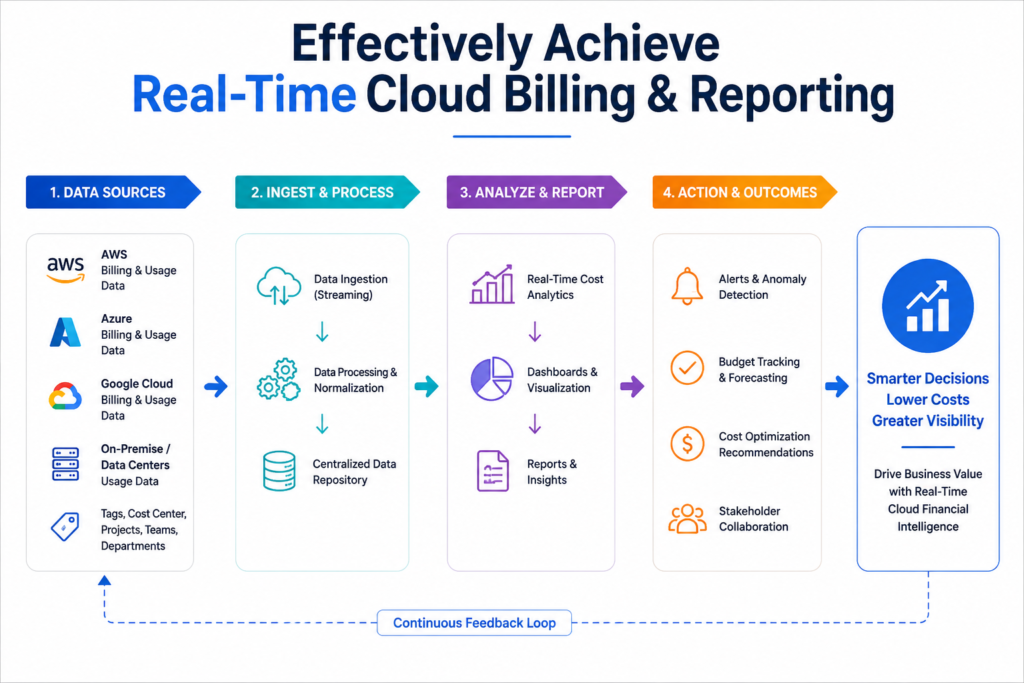
A successful real-time billing platform relies on multiple integrated components working together seamlessly. Data collection begins at the cloud provider level, where usage records, metrics, logs, and billing events are generated continuously.
These events are transmitted through data pipelines that ingest information from multiple cloud services. Streaming technologies process the incoming data in near real time, ensuring that cost information remains current and accurate. Data transformation mechanisms then normalize information from different services and providers.
The processed information enters centralized repositories where analytics engines calculate spending patterns, resource efficiency metrics, and budget utilization rates. Visualization platforms transform complex datasets into dashboards and reports that stakeholders can understand easily.
Alerting systems operate alongside reporting platforms. They monitor predefined thresholds and trigger notifications whenever spending anomalies occur. This layered architecture ensures that organizations receive actionable insights quickly while maintaining data accuracy and scalability across large cloud environments.
Key Operational Concepts You Must Know
Understanding real-time cloud billing requires familiarity with several fundamental operational concepts. These concepts form the foundation of effective cloud financial management and reporting practices.
Cost Allocation
Cost allocation assigns cloud expenses to specific teams, departments, projects, products, or business units. Accurate allocation helps organizations understand which groups consume resources and generate costs. This visibility promotes accountability and supports more informed budgeting decisions.
Effective allocation depends on tagging strategies, resource labeling standards, and governance policies. Organizations that implement strong allocation practices can analyze profitability more accurately and identify optimization opportunities across business functions.
Chargeback and Showback
Chargeback involves directly billing departments for cloud resources they consume. Showback provides visibility into costs without actual financial transfer. Both approaches encourage responsible resource usage and improve organizational awareness regarding cloud expenditures.
Showback often serves as the first step toward building a cost-conscious culture. Once teams understand spending patterns, organizations may transition to chargeback models that strengthen financial accountability.
Cost Anomaly Detection
Cost anomaly detection identifies unusual spending behavior before it becomes a significant problem. Machine learning models and statistical algorithms analyze historical usage patterns and flag unexpected changes automatically.
For example, if a workload suddenly consumes ten times more compute resources than normal, anomaly detection systems generate alerts immediately. This proactive approach enables teams to investigate issues quickly and prevent financial waste.
Budget Governance
Budget governance establishes spending limits, approval processes, monitoring frameworks, and escalation procedures. Real-time reporting enhances governance by providing continuous visibility into budget consumption.
Organizations can create automated controls that notify stakeholders when spending approaches predefined thresholds. These controls help maintain financial discipline while supporting operational flexibility.
Unit Economics
Unit economics measure the cost of delivering a product, service, transaction, or customer experience. Real-time billing data allows organizations to calculate these metrics more accurately and frequently.
Understanding unit economics enables leaders to evaluate business performance, optimize pricing strategies, and make better investment decisions based on actual cloud consumption patterns.
Building a Real-Time Cloud Billing Framework
A successful billing framework requires a structured approach that combines technology, governance, processes, and stakeholder collaboration. Organizations must first establish clear financial objectives and reporting requirements.
The next step involves identifying data sources across cloud environments. Usage records, billing exports, performance metrics, and resource inventories must be collected consistently. Data quality plays a critical role because inaccurate information can lead to misleading financial insights.
Organizations should then define reporting structures aligned with business goals. Different stakeholders require different views of cloud spending. Executives may focus on high-level financial summaries, while engineers need granular resource-level cost analysis.
Automation should be integrated wherever possible. Automated data collection, processing, reporting, and alerting reduce manual effort while improving accuracy. Furthermore, automation enables organizations to scale financial operations as cloud environments grow.
Regular reviews and continuous improvement initiatives help maintain effectiveness. As business requirements evolve, reporting frameworks must adapt to provide relevant insights and support strategic decision-making.
Essential Metrics for Real-Time Cloud Reporting
Effective reporting depends on selecting meaningful metrics that support operational and financial objectives. Organizations should focus on metrics that provide actionable insights rather than overwhelming stakeholders with excessive data.
Total cloud spending remains one of the most important metrics. Real-time visibility into overall expenditure helps leaders monitor financial performance continuously. However, total spending alone provides limited context.
Resource utilization metrics reveal how efficiently infrastructure operates. Low utilization often indicates waste and optimization opportunities. Monitoring utilization alongside cost data improves decision-making.
Cost per application, cost per customer, and cost per transaction provide valuable business context. These metrics connect cloud investments directly to organizational outcomes and profitability.
Budget consumption rates help teams understand spending velocity. Real-time tracking ensures that stakeholders can respond quickly when expenditures exceed expectations. Forecasting metrics further enhance visibility by estimating future spending based on current trends.
Combining these metrics creates a comprehensive view of cloud financial performance while supporting proactive management and continuous optimization.
Platform Implementation vs. Culture — What’s the Real Difference?
Many organizations believe purchasing a cloud cost management platform automatically solves financial visibility challenges. However, technology alone rarely delivers lasting results. The true difference lies in the relationship between platform implementation and organizational culture.
Platform implementation focuses on tools, dashboards, automation systems, reporting mechanisms, and technical integrations. These capabilities provide visibility and analytical power. They enable organizations to collect data, generate reports, and monitor spending in real time.
Culture, on the other hand, determines how people use these capabilities. A strong operational culture encourages accountability, collaboration, ownership, and continuous improvement. Teams actively review cost reports, investigate anomalies, and optimize resources because they understand the business impact of their actions.
Without cultural alignment, even sophisticated platforms produce limited value. Teams may ignore dashboards, overlook alerts, or treat cloud costs as someone else’s responsibility. Conversely, organizations with strong cost-conscious cultures often achieve impressive results even with relatively simple tools.
The most successful organizations combine robust platforms with disciplined operational behaviors. Technology provides visibility, while culture transforms visibility into action. Together, they create sustainable financial governance and operational excellence.
Real-Time Reporting Across Multi-Cloud Environments
Many enterprises operate across multiple cloud providers to improve resilience, flexibility, and service diversity. While this strategy offers numerous benefits, it also introduces reporting complexity.
Each cloud provider uses unique billing structures, pricing models, service categories, and reporting formats. As a result, comparing costs across environments becomes challenging without centralized reporting capabilities.
A unified reporting framework consolidates data from all providers into a single platform. Normalization processes convert provider-specific information into consistent formats, enabling meaningful analysis and comparison.
Organizations can then evaluate spending across providers, identify optimization opportunities, and make strategic decisions regarding workload placement. Real-time visibility further enhances agility by allowing teams to respond quickly to changing cost conditions.
Centralized reporting also supports governance initiatives by establishing common standards, policies, and accountability mechanisms across diverse cloud environments. This consistency strengthens financial management and reduces operational complexity.
Real-World Use Cases of Modern Operations
Real-time cloud billing and reporting deliver value across a wide range of operational scenarios. Organizations use these capabilities to improve efficiency, reduce waste, and enhance decision-making.
Application Cost Optimization
Engineering teams often struggle to understand the financial impact of application architectures. Real-time reporting reveals resource consumption patterns, helping teams identify expensive components and optimize performance-to-cost ratios.
Organizations can evaluate whether infrastructure investments align with business objectives and adjust architectures accordingly. This visibility promotes more efficient application development and operations.
Budget Protection
Unexpected spending spikes can quickly exhaust budgets. Real-time monitoring identifies abnormal behavior immediately, allowing teams to investigate and resolve issues before costs escalate significantly.
This capability protects financial plans and prevents unpleasant surprises during budget reviews. Consequently, organizations maintain stronger control over operational expenses.
Capacity Planning
Real-time utilization and spending data support more accurate capacity planning decisions. Organizations can forecast future resource requirements based on actual consumption patterns rather than assumptions.
Improved forecasting reduces overprovisioning while ensuring sufficient capacity for business growth. As a result, organizations balance performance, reliability, and cost efficiency more effectively.
Executive Decision Support
Business leaders require accurate financial insights to guide strategic decisions. Real-time reporting provides current information regarding cloud investments, operational efficiency, and spending trends.
Executives can evaluate initiatives more confidently because they understand the financial implications of technology decisions. This alignment strengthens collaboration between technical and business stakeholders.
Automation Strategies for Continuous Cost Visibility
Automation plays a central role in modern cloud financial management. Manual reporting processes cannot keep pace with dynamic cloud environments where thousands of billing events occur every minute.
Automated data collection ensures that reporting systems receive current information continuously. Data pipelines eliminate delays and reduce human error associated with manual extraction processes.
Automated tagging enforcement improves cost allocation accuracy. Policies verify that resources contain required metadata before deployment. Consequently, organizations maintain cleaner datasets and more reliable reporting.
Alerting automation provides immediate notifications when predefined conditions occur. Teams receive warnings regarding spending spikes, budget threshold violations, or resource inefficiencies without constant manual monitoring.
Automated remediation further enhances operational efficiency. In some scenarios, organizations configure systems to shut down unused resources or scale workloads automatically when specific cost conditions are detected. These capabilities reduce waste while improving responsiveness.
Common Mistakes in Operations Engineering
Many organizations encounter challenges when implementing real-time cloud billing and reporting programs. Understanding common mistakes helps avoid unnecessary setbacks and accelerates success.
Focusing Only on Technology
Organizations often invest heavily in tools while neglecting process development and stakeholder engagement. Technology provides visibility, but people and processes determine whether insights lead to meaningful action.
Successful programs balance platform capabilities with governance frameworks, accountability structures, and cultural initiatives.
Poor Resource Tagging
Inconsistent tagging creates significant reporting challenges. Resources without proper metadata become difficult to allocate accurately, reducing visibility and accountability.
Organizations should establish standardized tagging policies and enforce compliance through automation whenever possible.
Ignoring Small Cost Increases
Minor spending increases may appear insignificant initially. However, repeated inefficiencies often accumulate into substantial financial waste over time.
Continuous monitoring helps organizations identify and address issues before they grow into larger problems.
Lack of Executive Support
Financial optimization initiatives require leadership commitment. Without executive sponsorship, teams may struggle to prioritize cost management activities.
Strong leadership support reinforces accountability and encourages cross-functional collaboration.
Reporting Without Action
Some organizations generate extensive reports but fail to act on insights. Reporting alone does not create value. Actionable recommendations, ownership, and follow-through drive meaningful improvements.
Teams should establish clear processes for reviewing findings and implementing optimization initiatives.
Governance Best Practices for Sustainable Reporting
Governance ensures that real-time billing and reporting initiatives remain effective as organizations scale. Strong governance frameworks define roles, responsibilities, policies, and performance expectations.
Organizations should establish clear ownership for cloud financial management activities. Dedicated stakeholders oversee reporting accuracy, optimization initiatives, and policy compliance. Defined responsibilities reduce confusion and improve accountability.
Regular review meetings help maintain visibility and alignment. Teams can evaluate spending trends, discuss anomalies, and prioritize optimization opportunities. These discussions encourage collaboration across technical and financial functions.
Policy enforcement mechanisms further strengthen governance. Automated controls ensure compliance with tagging standards, budget limits, and resource management practices. Consistent enforcement reduces operational risk and improves reporting quality.
Governance should also evolve alongside organizational growth. As cloud environments become more complex, governance frameworks must adapt to support new requirements and business objectives.
How to Become an Operations Expert — Career Roadmap
Operations engineering continues to evolve rapidly as organizations embrace cloud technologies, automation, and financial accountability. Professionals seeking expertise should develop both technical and business competencies.
Step 1: Learn Cloud Fundamentals
Begin by understanding compute services, storage systems, networking, security principles, and cloud architecture concepts. Strong foundational knowledge supports more advanced operational skills.
Step 2: Master Monitoring and Observability
Develop expertise in metrics collection, logging, tracing, alerting, and performance analysis. Observability forms the foundation of effective operational decision-making.
Step 3: Study Cloud Financial Management
Learn budgeting, forecasting, cost allocation, optimization strategies, and financial governance principles. Understanding cost management differentiates modern operations professionals.
Step 4: Gain Automation Skills
Develop proficiency in scripting, infrastructure automation, configuration management, and workflow orchestration. Automation improves scalability and operational efficiency.
Step 5: Build Analytical Thinking
Operations experts must interpret complex datasets and identify meaningful trends. Strong analytical skills support better decision-making and problem-solving.
Step 6: Develop Business Awareness
Technical expertise alone is insufficient. Learn how cloud investments affect revenue, profitability, customer experience, and organizational strategy.
Recommended Skill Areas
- Cloud platforms and architecture
- FinOps practices
- Cost optimization methodologies
- Data analytics and reporting
- Monitoring and observability
- Infrastructure automation
- Governance and compliance
- Business communication
- Incident management
- Leadership and collaboration
Professionals who combine these competencies become valuable contributors to modern cloud operations teams and financial governance initiatives.
FAQ Section
What is real-time cloud billing?
Real-time cloud billing is the process of continuously tracking cloud resource consumption and associated costs as they occur, providing immediate visibility into spending patterns and financial performance.
Why is real-time reporting important?
Real-time reporting enables organizations to identify spending anomalies quickly, optimize resources proactively, improve budgeting accuracy, and make faster business decisions.
How does cost anomaly detection work?
Cost anomaly detection analyzes historical usage patterns and identifies unusual spending behavior using statistical models, machine learning techniques, and predefined thresholds.
Can real-time billing reduce cloud costs?
Yes. Real-time visibility helps organizations detect waste, optimize resource utilization, prevent budget overruns, and improve financial accountability across teams.
What role does automation play in cloud reporting?
Automation collects billing data, processes information, generates reports, enforces governance policies, triggers alerts, and supports proactive optimization efforts.
Is real-time reporting useful for multi-cloud environments?
Yes. Unified reporting platforms consolidate data from multiple cloud providers, enabling centralized visibility, governance, and cost optimization across environments.
Which teams benefit from real-time billing insights?
Engineering teams, finance departments, executives, product managers, operations teams, and cloud architects all benefit from improved visibility into cloud spending and resource utilization.
What skills are required for cloud financial operations?
Professionals should understand cloud architecture, cost management, automation, analytics, governance, observability, budgeting, and business strategy concepts.
Final Summary
Real-time cloud billing and reporting have become critical capabilities for organizations seeking greater control over cloud spending, operational efficiency, and financial accountability. By continuously collecting and analyzing usage data, businesses gain immediate visibility into resource consumption, budget performance, and optimization opportunities.
Successful implementation requires more than technology alone. Organizations must combine robust reporting platforms with strong governance frameworks, automation strategies, and a culture of financial responsibility. When these elements work together, teams can identify anomalies faster, improve forecasting accuracy, reduce waste, and align cloud investments with business goals.