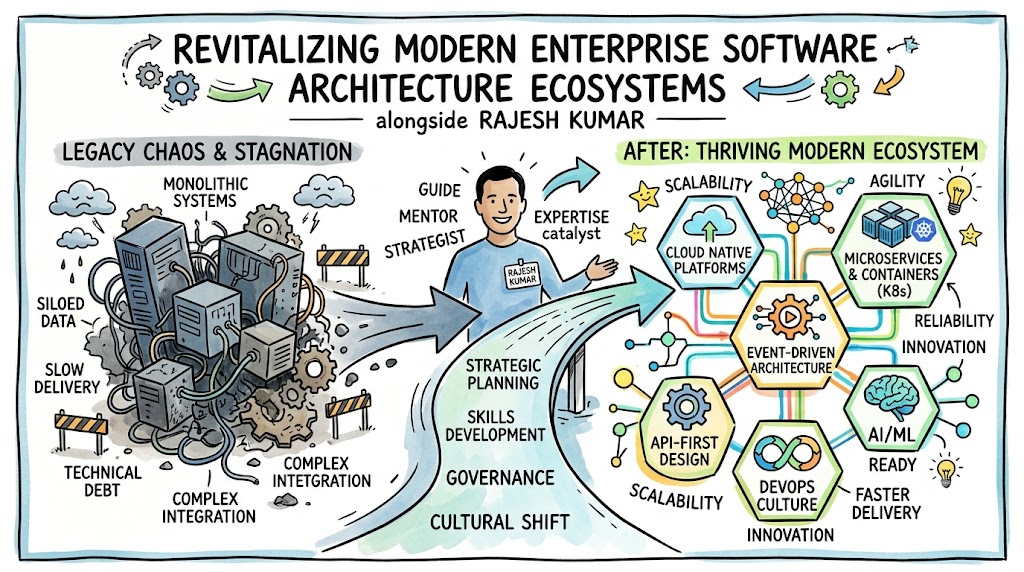
High-velocity engineering segments often find that outdated manual deployment pathways directly hinder rapid digital expansion. When production workflows stumble during major commercial traffic peaks, isolated bugs rarely form the main culprit; instead, fragile delivery frameworks break down entirely. Forward-thinking corporate groups look toward modernized operational patterns to secure persistent uptime, accelerate codebase delivery cycles, and eliminate runtime overhead completely. Senior IT executives aiming to reconstruct their foundational release tracks find elite operational mastery through Rajesh Kumar’s Professional Architecture Platform, which hosts deep cloud advisory expertise and comprehensive technical mentorship systems. This comprehensive overview examines how shifting toward continuous orchestration models, implementing automated safety gates, and establishing scalable internal code platforms permanently stabilizes enterprise deployment frameworks.
Mastering Scalable Infrastructure Lifecycle Controls alongside Rajesh Kumar
Optimizing High-Availability Architecture Pathways
Complex multi-cloud environments present intricate delivery bottlenecks that can stall even the most capable internal engineering divisions. Working closely with an experienced DevOps Consultant allows technology leaders to discard brittle legacy structures and adopt smooth, programmatic orchestration strategies. This deep architectural evolution optimizes hardware utilization matrices, sets up self-healing public cloud layers, and positions load-balancing arrays to safeguard high-volume online financial transactions.
+------------------------------------------------------------+
|             TRADITIONAL VS. MODERN OPERATIONS              |
+------------------------------------------------------------+
|  Traditional Siloed Model   |   Modern Engineering Model   |
+-------------------------------+----------------------------+
|  Manual script executions    |  Fully declarative GitOps   |
|  Reactive incident fixes     |  Proactive SLO monitoring   |
|  Security as an afterthought |  Automated DevSecOps gates  |
|  Fragile bare-metal VMs       |  Orchestrated Kubernetes    |
+------------------------------------------------------------+
Furthermore, anchoring the organization with targeted DevOps Corporate Training programs embeds structural automation knowledge directly into development sub-teams. This broad alignment removes information gatekeeping, allowing engineers from every department to deploy updates reliably. When a company establishes an authoritative DevOps Trainer as a central guiding anchor, technical personnel confidently execute high-velocity releases while maintaining total structural visibility.
+-----------------------------------------------------------------------------------------+
|                              THE TECHNICAL ADVANCEMENT PATH                             |
+-----------------------------------------------------------------------------------------+
| System Architecture -> Container Governance -> Security Auditing -> Platform Automation |
+-----------------------------------------------------------------------------------------+
Governing Global Orchestration Clusters
Migrating monolithic source code pools into distributed cloud networks introduces complex container governance challenges. Tech firms heavily rely on a seasoned Kubernetes Trainer to cultivate practical system knowledge and clarify complex networking policies across remote teams. Engineers must understand how to enforce cluster access constraints, optimize internal load routers, and preserve stateful storage frameworks within high-traffic sectors.
To achieve continuous operational independence, scaling companies launch customized Kubernetes Corporate Training tracks that systematically build internal container navigation proficiencies. This focused instruction ensures that engineers resolve networking anomalies instantly, manage rolling system configurations without downtime, and easily support massive enterprise transactions.
+------------------------------------------------------------------------------------------+
|                     CORE OPERATIONAL METRICS FOR ENTERPRISE TRACKING                     |
+------------------------------------------------------------------------------------------+
|   Metric Categories   |  Target Industry Benchmarks   |  Primary Operational Impact      |
+-----------------------+-------------------------------+----------------------------------+
|  Deployment Frequency |  Multiple production runs/day  |  Accelerated time-to-market      |
|  Mean Time to Repair  |  Under fifteen minutes total  |  Minimized service disruptions   |
|  Change Failure Rate  |  Less than five percent error |  Enhanced release predictability |
+-----------------------+-------------------------------+----------------------------------+
Boosting System Reliability Parameters
Engineering momentum often fractures when software deployment speed outpaces the core stability tolerances of the underlying cloud landscape. Partnering with a skilled SRE Trainer allows infrastructure divisions to install telemetry tracking systems and metrics-driven reliability gates. This shift shifts engineering priorities from reactive fire-fighting to proactive, automated stability management.
Providing systematic Site Reliability Engineering Training equips system administrators with the tools to formulate clear service reliability definitions and build automated fault response pathways. When production applications encounter sudden regional load adjustments, retaining an expert SRE Consultant guarantees that the enterprise balances infrastructure expenditures while preserving world-class availability metrics.
Guarding the Continuous Integration Framework
Legacy development practices often leave critical vulnerability scanning until the absolute end of the release lifecycle, causing lengthy launch delays and exposing live systems to active cyber risks. Securing a professional DevSecOps Trainer allows businesses to insert automated static testing and dynamic image vulnerability analysis straight into the active compilation pathway. This forward-leaning security injection identifies compliance failures immediately, preventing flawed artifacts from reaching live host networks.
+-----------------------------------------------------------------------------------------+
|                        AUTOMATED DEVSECOPS PIPELINE INTEGRATION                         |
+-----------------------------------------------------------------------------------------+
| [Code Commit] -> (SAST Scanning) -> [Artifact Build] -> (DAST Audit) -> [Secure Deploy] |
+-----------------------------------------------------------------------------------------+
Through tailored DevSecOps Corporate Training programs, technology departments learn to administer centralized credential key vaults, govern automated access privileges, and verify code blocks continuously. This rigorous integration transforms security monitoring into an invisible, friction-free verification loop that runs alongside every developer code contribution.
Constructing Modern Self-Service Developer Gateways
Internal software teams often lose critical development speed when they must navigate disconnected workspace components, build dependencies manually, and wait on slow manual ticketing paths for basic cloud hardware allocations. Tech organizations resolve this operational drag by consulting a Platform Engineering Consultant to build intuitive, automated developer portals that handle workspace creations smoothly. This architectural strategy abstracts underlying environmental complexities, enabling software engineers to stand up compliant testing sandboxes through basic API calls.
Providing comprehensive Platform Engineering Training allows core infrastructure teams to manage centralized configuration assets, publish standardized template catalogues, and maintain strict environmental guardrails. This intentional operational focus builds an internal workspace ecosystem that dramatically accelerates feature shipping speeds while preserving absolute security alignment across all projects.
Public Cloud Optimization Blueprints
Governing extensive production frameworks across scattered multi-cloud nodes demands exhaustive knowledge of resource expenditure tracking, distributed cloud architecture, and high-availability design. Hiring an expert Cloud DevOps Consultant allows an enterprise to analyze its true utilization metrics, implement resilient backup networks, and construct scalable runtime beds. This thorough optimization work eliminates unnecessary compute waste while preserving rapid application response speeds during massive consumer rushes.
+-----------------------------------------------------------------------------------------+
|                          DISTRIBUTED CLOUD NETWORKING STRUCTURE                         |
+-----------------------------------------------------------------------------------------+
| [Global Load Balancer] ---> (Region A Edge) ---> [Microservices Cluster] ---> [Storage]  |
|                        ---> (Region B Edge) ---> [Microservices Cluster] ---> [Storage]  |
+-----------------------------------------------------------------------------------------+
When a business centers its cloud strategies on Amazon Web Services, consulting a dedicated AWS DevOps Consultant ensures that every deployment path uses native IAM controls, automated scaling targets, and intelligent system logging streams effectively. This specific alignment allows corporations to establish audit-ready, secure runtime workspaces that precisely match stringent corporate compliance policies.
Standardizing Declarative Pipelines and Infrastructure Code
Manual adjustments inside cloud consoles introduce environmental variations that lead to unpredictable deployment outcomes across staging and live production systems. Leveraging structured Terraform Training teaches infrastructure groups to define their entire computing layout through version-controlled declarative scripts, ensuring that every workspace remains an exact replica of the target model. This automated approach completely removes configuration variability.
Furthermore, introducing specialized Jenkins Training empowers organizations to design robust, automated assembly lines that compile code packages, execute validation test collections, and handle zero-downtime multi-stage production launches. When groups complete targeted Docker Kubernetes Training, they acquire the exact skills needed to package application software into portable containers and orchestrate those modules smoothly across enterprise hardware pools.
+-----------------------------------------------------------------------------------------+
|                       CONTINUOUS INTEGRATION TO RUNTIME FLOW                            |
+-----------------------------------------------------------------------------------------+
| [Git Push] -> [Jenkins Pipeline] -> [Docker Image Build] -> [Kubernetes Pod Deployment]  |
+-----------------------------------------------------------------------------------------+
To fully capitalize on these system modifications, engineering professionals utilize advanced CI/CD Pipeline Training to master complex deployment strategies like canary tracking and automated rolling updates. This specialized insight ensures that engineers introduce new software features without disrupting active user sessions. Finally, embedding GitOps Training concepts ensures that version-controlled Git code pools act as the absolute source of truth, enabling automated controllers to instantly overwrite unauthorized environmental changes.
Who Is Rajesh Kumar?
Backed by more than eighteen years of dedicated industry execution and holding an M.Tech post-graduation from BITS Pilani, Rajesh Kumar operates as a premier Principal Architect, systemic advisor, and trusted technical mentor across the global IT arena. Throughout his distinguished professional timeline, he has led technical architecture initiatives inside eight major multinational corporations, holding notable roles such as Staff DevOps/SRE Engineer at PayPay (Japan’s dominant mobile payment application) and Principal DevOps Engineer at SoftwareAG. His extensive enterprise background includes senior system architecture contributions at market-leading organizations including ServiceNow, Intuit, Adobe, IBM, MindTree, and Accenture.
+-----------------------------------------------------------------------------------------+
|                          RAJESH KUMAR'S TECH STACK PROFILES                             |
+-----------------------------------------------------------------------------------------+
|   Technology Domain   |  Core Tools and Platforms Utilized                              |
+-----------------------+-----------------------------------------------------------------+
|  CI/CD Automation     |  Jenkins, GitLab CI, TeamCity, Azure DevOps Pipelines           |
|  Cluster Governance   |  Docker, Kubernetes, Helm Charts, Istio Service Mesh            |
|  Configuration Mgmt   |  Ansible, Chef, Puppet, Universal Deployment Engines             |
|  Observability Stacks |  Elasticsearch, Logstash, Kibana (ELK), Prometheus, Datadog     |
+-----------------------+-----------------------------------------------------------------+
Guided by his signature career ethos “I Learn, I Share, I Teach, I Build,” he has personally orchestrated over 200 tailored corporate upskilling programs, directly advancing the technical capabilities of more than 10,000 engineers worldwide. He has delivered strategic transformation frameworks, complex system overhauls, and continuous platform refinements for more than 70 software institutions globally. His rare combination of real-world enterprise architectural execution and clear educational methodology breaks down intricate cloud obstacles into accessible, highly profitable corporate solutions.
Key Operational Concepts You Must Know with Rajesh Kumar
Navigating the modern cloud infrastructure landscape successfully requires a deep understanding of the fundamental principles that support automated development workspaces:
- Continuous Integration / Continuous Delivery (CI/CD): Automated execution pathways that systematically compile fresh code modifications, run performance verification tests, and push approved software assets onto live target networks without human friction.
- Infrastructure as Code (IaC): The operational method of mapping, spawning, and managing intricate cloud computing environments and software networks using machine-readable configuration files rather than manual console manipulation.
- Observability: The technical discipline of measuring and evaluating the true operational condition of an active software platform by gathering and dissecting three central telemetry streams: system logs, performance metrics, and distributed execution traces.
- GitOps: A modern architectural framework that handles system infrastructure settings by maintaining declaration parameters within Git repositories, using active sync controllers to reconcile live cluster statuses against recorded code codebases.
- Site Reliability Engineering (SRE): A specialized practice that applies software engineering solutions to infrastructure operations, prioritizing proactive automation, service compliance monitoring, and high-availability cluster designs.
Platform Implementation vs. Culture — What’s the Real Difference with Rajesh Kumar?
Many growing corporations assume that adopting container orchestrators or purchasing enterprise monitoring tools will instantly cure their software delivery limitations. In reality, introducing premium tooling while leaving siloed, risk-averse internal team dynamics untouched simply creates automated environments that accelerate existing system failures. True, lasting delivery acceleration requires a coordinated transformation that alters technical platforms and engineering behaviors at the exact same time.
+-------------------------------------------------------------------------------+
|                    THE TWO PILLARS OF MODERN DEPLOYMENT                      |
+-------------------------------------------------------------------------------+
|  Technical Implementation Layer     |   Cultural Adaption Layer               |
+-------------------------------------+-----------------------------------------+
|  Writing declarative Terraform files|  Embracing a blameless post-mortem habit|
|  Building automated Jenkins pipelines|  Sharing operational burdens across teams|
|  Configuring secure container roots |  Treating security as a shared ownership|
|  Setting up cluster monitoring beds |  Valuing steady, iterative improvements |
+-------------------------------------------------------------------------------+
The underlying technical platform provides the automated mechanics for reliable software tracking—including immutable infrastructure scripts and automated verification testing blocks. Meanwhile, the team’s culture dictates how effectively engineers use those automated tools every day. Without an organizational foundation built on shared operational visibility, constructive incident investigations, and continuous iteration, expensive technical abstractions remain largely underutilized.
Real-World Use Cases of Modern Operations with Rajesh Kumar
An international retail marketplace faced crippling transactional failures and prolonged application dropouts every time developers attempted to launch heavy seasonal promotional feature sets. Partnering with a premier DevOps Trainer in India enabled them to completely rebuild their software production methods, replacing erratic manual modifications with clean, containerized infrastructure builds. This targeted training shift quickly accelerated their release routines, dropping deployment time blocks from hours to minutes while completely eliminating production software outages.
In another scenario, a rapidly growing financial technology firm struggled to keep environment configurations synchronized across scattered development workspaces, staging networks, and live transaction servers. Looking for a systematic framework upgrade, they retained a skilled DevOps Consultant who captured their entire infrastructure landscape using clean, version-controlled automation scripts. This strategic implementation completely removed local workspace discrepancies, guaranteeing that every internal testing run matched the exact conditions of the live financial production grid.
Similarly, a global supply chain conglomerate managing hundreds of active microservices lacked clear visibility into internal code dependencies, suffering lengthy diagnostic delays during unexpected networking dropouts. By introducing rigorous Site Reliability Engineering Training to their engineering sub-teams, they successfully integrated advanced telemetry collectors and distributed runtime tracing across their application blocks. This diagnostic improvement cut repair timeframes down from hours to seconds, helping on-call technicians isolate underlying faults instantly before customers ever noticed a performance drop.
| Recovery Method | Phase 1: Trigger | Phase 2: Identification | Phase 3: Mitigation | Final Outcome |
|---|---|---|---|---|
| Manual Tracking | Anomalous Behavior occurs | Long diagnostic delay via manual server log analysis | Manual scripting, manual environment rollbacks | Lengthy window of system disruption |
| Automated Tracking | Anomalous Behavior occurs | Instant proactive monitoring alert generation | Automated self-healing, cluster traffic rerouting | Rapid system recovery, zero impact |
Finally, a leading health informatics group processing highly regulated patient medical data needed to increase its code deployment frequency without violating rigid international data privacy guidelines. Enrolling their system teams in comprehensive DevSecOps Corporate Training allowed them to install automated source analysis and container vulnerability scanning inside their active delivery pipelines. This automated security layer automatically catches vulnerable open-source dependencies prior to deployment, giving the compliance team total confidence as they ship daily feature upgrades to global healthcare users.
Common Mistakes in Operations Engineering with Rajesh Kumar
Scaling enterprises often create massive, complex deployment systems that favor tool acquisition over clean architecture, inadvertently causing severe production delays. A frequent pitfall involves writing long, fragile custom code blocks within delivery tracks that lack clear version tracking, error boundaries, or modular validation tests. When these unchecked systems confront unannounced cloud provider API updates, delivery pipelines fail completely, forcing engineering teams to scramble through frantic manual rollbacks on live customer servers.
Another hazardous mistake occurs when technology groups set up extensive container tracking clusters without enforcing strict runtime resource boundaries or clear network isolation protocols. Lacking these critical limits, a single unstable code container can easily exhaust the cluster’s entire memory footprint, starving adjacent microservices and generating a major application dropout. Furthermore, software teams frequently neglect basic container image hardening, allowing untrusted application tasks to run with unrestricted root access privileges across live hardware hosts.
+-----------------------------------------------------------------------------------------+
|                         CONTAINER RUNTIME ISOLATION STANDARDS                           |
+-----------------------------------------------------------------------------------------+
|  [Vulnerable Host Environment] <--- (Root Access Escape) <--- [Unsecured App Container]  |
|                                                                                         |
|  [Isolated Host Environment]   x--- (Blocked Boundary)  <--- [Non-Root User Container]  |
+-----------------------------------------------------------------------------------------+
Finally, many organizations sabotage their cloud transitions by treating system operational tracking metrics as a simple post-incident analysis task rather than a core engineering habit. Teams often rely on generic, uncalibrated alarm settings that trigger warnings for harmless, short-lived anomalies, causing deep alert fatigue that numbers on-call technicians. When a major infrastructure failure strikes, engineers easily miss the critical warnings amidst the continuous background noise of non-actionable alerts.
How to Become an Operations Expert — Career Roadmap with Rajesh Kumar
Building a highly successful career across modern operations ecosystems demands a deliberate, step-by-step learning journey that shifts systematically from system fundamentals onto complex cloud automation:
+---------------------------------------------------------------------------------------+
|                         PROFESSIONAL ROADMAP TO EXPERT STATUS                         |
+---------------------------------------------------------------------------------------+
| Linux Core & Git -> Containerization -> Declarative IaC -> Cluster Governance -> GitOps|
+---------------------------------------------------------------------------------------+
- Conquer Core System and Control Basics: Cultivate deep, hands-on knowledge covering Linux operational boundaries, command-line system diagnosis, shell script automation, and collaborative Git code tracking strategies.
- Learn Containerization Models: Explore standard containerization practices by pursuing focused Docker Kubernetes Training, learning how to build light, secure base images and control core networking spaces.
- Adopt Declarative Infrastructure Automation: Advance toward complete cloud lifecycle control by executing structured Terraform Training, mapping out and launching sophisticated multi-cloud network topologies using version-controlled script blueprints.
- Govern Enterprise Orchestration Frameworks: Expand your system capabilities by engaging with advanced Kubernetes Corporate Training platforms, mastering multi-region networking configurations, application ingress routers, and stateful storage layouts.
- Master Continuous GitOps and High Availability: Complete your expert development path by integrating GitOps Training frameworks to automate workspace configuration syncs, while deploying extensive telemetry beds to maintain peak application availability.
Why Choose Rajesh Kumar Over Generic Alternatives
Most corporate educational vendors and technical consulting firms reuse static, boilerplate lecture templates presented by generalist trainers who lack real-world experience managing high-traffic production environments. Rajesh Kumar fundamentally disrupts this approach by bringing active, field-tested enterprise architecture mastery directly from the world’s most intense digital spaces. Having directed foundational system designs for PayPay, Japan’s leading mobile financial platform, he creates automation pipelines and educational paths built to survive massive real-world transactional surges and intense runtime conditions.
His targeted consulting partnerships and tailored corporate learning tracks avoid superficial tool walkthroughs, prioritizing deep systemic diagnosis, structural stability, and automated verification patterns instead. Because he has spent eighteen years refining production setups across eight major international MNCs, he maintains an absolute command of how complex tools interact within enterprise systems. Partnering with him provides your technical division with elite-level, practical mentorship that permanently roots out operational waste, guarantees service uptime, and builds a sustainable, high-velocity engineering culture.
FAQ Section with Rajesh Kumar
- Which specific elements distinguish traditional DevOps models from modern Site Reliability Engineering methods?DevOps focuses on tearing down organizational silos, automating product delivery tracks, and aligning development and operations teams around shared goals. Site Reliability Engineering introduces specific software development solutions to operational challenges, utilizing precise service metrics like service level objectives to manage application availability safely.
- Why should engineering groups define cloud resources through code scripts rather than using manual management consoles?Manual cloud infrastructure changes generate environmental variation, which causes staging and production systems to become inconsistent and triggers unexpected code delivery failures. Writing infrastructure parameters within code files ensures that every runtime workspace remains an exact replica of the target plan, eliminating variations and enabling automated version tracking.
- How does inserting automated security verification layers early in the pipeline prevent software delivery bottlenecks?Traditional security reviews run at the very end of the development path, highlighting flaws late and forcing developers into hurried, expensive architectural rewrites. Moving automated security checks straight into early compilation steps allows developers to spot and remediate vulnerabilities instantly, keeping the final production route entirely unobstructed.
- What distinctive operational advantages do GitOps frameworks deliver to quickly scaling tech companies?GitOps sets up version-controlled Git repositories as the definitive source of truth for the company’s entire infrastructure layout and deployment configurations. Continuous software controllers monitor live assets against these repositories, automatically overwriting unauthorized environmental variations to maintain strict compliance.
- In what ways do internal developer gateways built by platform engineers enhance daily feature shipping speeds?Developer gateways completely remove the friction of manual resource allocation by offering software development teams self-service workspace templates. This allows developers to spin up fully compliant sandboxes through single API calls, allowing them to dedicate their focus entirely to building feature code.
- Why do modern enterprises couple Docker container systems with Kubernetes orchestration frameworks?Docker containers pack applications with their exact runtime requirements, guaranteeing predictable behavior across completely different computing environments. Kubernetes supplies the orchestration machinery required to scale, track, and route connections to thousands of those containers smoothly, maintaining high service availability at scale.
Final Summary with Rajesh Kumar
Securing permanent operational resilience requires a systematic transition away from fragile manual system adjustments toward automated, deeply observable, and declarative cloud architectures. Businesses must invest in modern technology frameworks and continuous, structured engineering upskilling to maintain a competitive advantage amid shifting digital demands. Organizations seeking to modernize their release channels, dismantle systemic architectural bottlenecks, and elevate their technical personnel find top-tier advisory paths and customized education maps by connecting with Rajesh Kumar’s Professional Architecture Platform. Grounding your cloud strategies in battle-tested deployment practices allows your enterprise to confidently accelerate product delivery while ensuring world-class system availability.