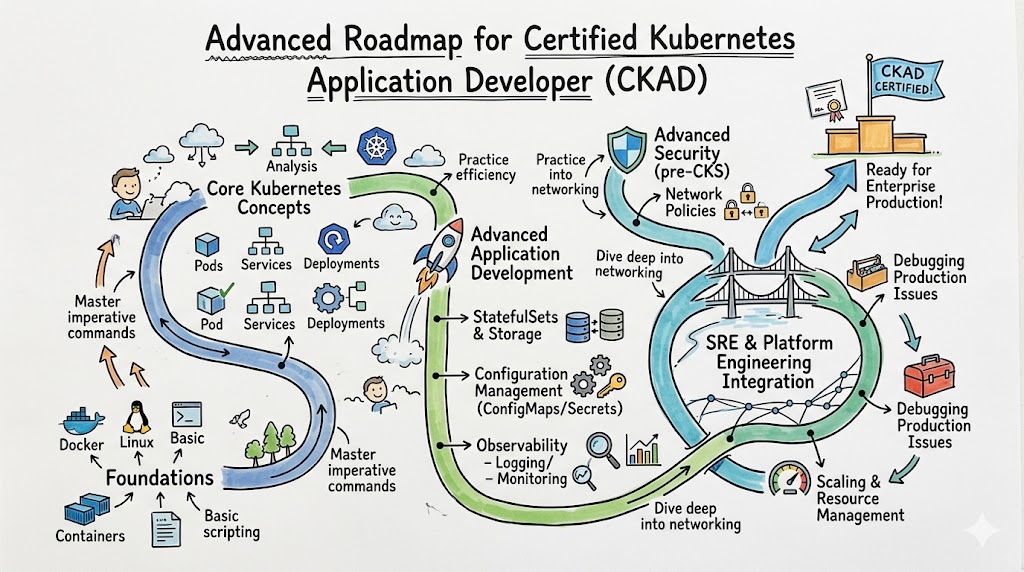
Cloud-native development transforms how teams deliver software, and the Certified Kubernetes Application Developer (CKAD) sits at the heart of this shift. This professional guide helps engineers navigate the complex landscape of container orchestration through the lens of DevOpsSchool standards. You will learn to move beyond basic scripts and embrace production-grade deployment strategies that define modern platform engineering. By mastering these specific domains, you position yourself as a vital asset in any high-growth technical organization.
What is the Certified Kubernetes Application Developer (CKAD)?
The Certified Kubernetes Application Developer (CKAD) exam challenges your ability to solve hands-on problems within a live, command-line environment. It moves away from theoretical testing and instead demands that you design, build, and troubleshoot applications on a functional Kubernetes cluster. This performance-based approach ensures that every certified professional possesses the practical skills to handle real-world traffic and deployment hurdles.
Enterprises today rely on these skills to maintain the agility of their microservices architectures. The program focuses on the core responsibilities of a developer, such as pod design, networking, and storage, rather than low-level cluster administration. By completing this certification, you prove that you can effectively translate architectural requirements into scalable, containerized solutions.
Who Should Pursue Certified Kubernetes Application Developer (CKAD)?
Backend developers and software engineers who interact with cloud infrastructure find the most value in this credential. Systems Reliability Engineers (SREs) also utilize these skills to ensure application stability across distributed environments. Even data scientists and security professionals benefit, as they often need to containerize their workloads or secure the application layer within a shared cluster.
Technical leaders in India and across the global market prioritize candidates who hold this practical certification. Managers who understand the nuances of Kubernetes can better guide their teams through complex migrations and resource planning. Whether you are a newcomer to containers or a seasoned veteran, this roadmap provides the technical depth required to excel in modern engineering roles.
Why Certified Kubernetes Application Developer (CKAD) is Valuable and Beyond
Kubernetes remains the undisputed standard for container orchestration, making the CKAD a future-proof investment for your career. As organizations move toward serverless and microservices, the ability to manage the lifecycle of an application becomes a fundamental requirement. This certification validates that you can work across any major cloud provider, including AWS, Azure, and Google Cloud, by focusing on universal Kubernetes primitives.
Professionals who earn this certificate often see immediate improvements in their project involvement and career trajectory. The rigorous nature of the exam builds a level of technical confidence that translates directly into faster deployment cycles and more stable production environments. In an industry where tools change rapidly, the architectural principles you learn through CKAD provide a permanent professional advantage.
Certified Kubernetes Application Developer (CKAD) Certification Overview
The Linux Foundation delivers this program through Certified Kubernetes Application Developer (CKAD) and hosts it on DevOpsSchool Candidates must complete a series of technical tasks in a proctored, timed environment, emphasizing speed and accuracy. This ownership of the terminal ensures that you can actually perform the work required in a high-pressure production setting.
The curriculum covers critical areas such as container orchestration, observability, and application troubleshooting. Because the exam is hands-on, it eliminates the “braindump” culture and protects the integrity of the credential. You walk away with a verified ability to manage secrets, configure persistent storage, and implement complex network policies.
Certified Kubernetes Application Developer (CKAD) Certification Tracks & Levels
The ecosystem offers a clear path starting from foundational container knowledge and moving toward specialized mastery. While the CKAD focuses on application delivery, the CKA (Administrator) and CKS (Security) tracks offer deeper dives into infrastructure and hardening. This modular structure allows you to tailor your learning journey based on your specific daily tasks and long-term career aspirations.
Advancing through these tracks demonstrates a commitment to technical excellence and a broad understanding of the cloud-native stack. For example, a developer might first secure their CKAD to master deployments and then pursue a CKS to focus on zero-trust security. This progression builds a comprehensive profile that satisfies the high standards of modern SRE and Platform Engineering teams.
Complete Certified Kubernetes Application Developer (CKAD) Certification Table
| Track | Level | Who it’s for | Prerequisites | Skills Covered | Recommended Order |
| App Delivery | Professional | Developers | Linux & Docker | Pods, Deployments, YAML | 1 |
| Infrastructure | Professional | SRE / Ops | CKAD Knowledge | Cluster Setup, Networking | 2 |
| Security | Advanced | Security Pros | CKA Credential | Hardening, Secrets, RBAC | 3 |
| Monitoring | Advanced | SRE / Platform | CKAD or CKA | Logs, Metrics, Probes | 4 |
Detailed Guide for Each Certified Kubernetes Application Developer (CKAD) Certification
Certified Kubernetes Application Developer (CKAD) – Professional Level
What it is
This credential confirms your ability to build and configure cloud-native applications using Kubernetes primitives. It validates that you can deploy scalable tools and troubleshoot them effectively in a live cluster.
Who should take it
Backend engineers and cloud-focused developers should prioritize this exam. It serves as the perfect benchmark for anyone with a year of experience in Linux and container environments.
Skills you’ll gain
- Building and scaling applications with Deployments.
- Managing configuration via ConfigMaps and Secrets.
- Implementing Sidecar and Adapter pod patterns.
- Setting resource limits and requests for efficiency.
- Orchestrating traffic through Services and Ingress.
Real-world projects you should be able to do
- Containerizing a legacy app and deploying it with high availability.
- Configuring persistent volumes for stateful data storage.
- Automating application updates through rolling deployments.
- Designing health checks to enable self-healing microservices.
Preparation plan
- 7–14 days: Master imperative kubectl commands to minimize YAML editing time.
- 30 days: Build a local lab to practice Network Policies and Persistent Volumes.
- 60 days: Run timed mock exams to perfect your troubleshooting speed.
Common mistakes
- Over-relying on documentation during the exam window.
- Forgetting to verify changes with a quick “get” command.
- Mismanaging time on high-difficulty, low-weight questions.
- Ignoring the context-switching commands provided in the tasks.
Best next certification after this
- Same-track option: Certified Kubernetes Administrator (CKA).
- Cross-track option: Certified Kubernetes Security Specialist (CKS).
- Leadership option: Cloud Architecture Strategy.
Choose Your Learning Path
DevOps Path
You will focus on the automation of the entire software delivery lifecycle. This path emphasizes the integration of Kubernetes into CI/CD pipelines to achieve rapid, reliable releases. By mastering these workflows, you eliminate manual bottlenecks and ensure consistency across development, staging, and production environments.
DevSecOps Path
Security takes center stage in this specialized learning track. You will learn to implement granular network policies, manage sensitive secrets, and ensure image integrity. This path is critical for engineers working in finance or healthcare, where protecting data within the cluster is a non-negotiable requirement.
SRE Path
The Site Reliability Engineering track prioritizes system uptime and performance. You will explore advanced probes, resource management, and observability tools to build resilient applications. This path prepares you to manage massive scale while maintaining the service level objectives (SLOs) required by modern enterprises.
AIOps Path
Engineers in this path use artificial intelligence to enhance infrastructure operations. You will learn how AI models can predict cluster failures and automate capacity management. This track suits those who want to manage complex, global-scale clusters with intelligent automation.
MLOps Path
This track bridges the gap between data science and production engineering. You will learn to deploy and scale machine learning models using specialized Kubernetes tools like Kubeflow. This path ensures that your data models are reproducible, scalable, and integrated into the broader application ecosystem.
DataOps Path
You will master the management of stateful applications and data pipelines within containers. This path tackles the challenges of persistent storage, database orchestration, and data consistency. It is essential for engineers moving heavy, data-intensive workloads into cloud-native architectures.
FinOps Path
The FinOps path focuses on the financial optimization of cloud-native infrastructure. You will learn to track resource consumption by namespace and implement strategies to reduce cloud waste. This expertise helps technical leaders prove the business value of their Kubernetes investments.
Role → Recommended Certified Kubernetes Application Developer (CKAD) Certifications
| Role | Recommended Certifications |
| DevOps Engineer | CKAD, CKA, Terraform Associate |
| SRE | CKAD, CKA, Prometheus Specialist |
| Platform Engineer | CKAD, CKS, Cloud Architect |
| Cloud Engineer | CKAD, AWS/Azure DevOps Professional |
| Security Engineer | CKAD, CKS, CISSP |
| Data Engineer | CKAD, DataOps Professional |
| FinOps Practitioner | CKAD, FinOps Certified Practitioner |
| Engineering Manager | CKAD, PMP, Cloud Strategy |
Next Certifications to Take After Certified Kubernetes Application Developer (CKAD)
Same Track Progression
Graduating to the Certified Kubernetes Administrator (CKA) represents the most logical next step for many. It expands your view from the application layer to the underlying infrastructure, covering cluster installation and node maintenance. This transition makes you a complete Kubernetes expert capable of handling both code and clusters.
Cross-Track Expansion
Broadening your expertise into security or cloud-specific architecture adds significant market value. Learning how Kubernetes interacts with managed services like EKS or GKE allows you to build more efficient, cloud-native solutions. You might also explore Infrastructure as Code (IaC) to automate the environment where your containers run.
Leadership & Management Track
If you aim for leadership roles, combine your technical CKAD skills with project management credentials. Understanding the business impact of cloud-native transitions allows you to lead high-stakes digital transformations. You will gain the ability to manage technical teams while communicating effectively with executive stakeholders.
Training & Certification Support Providers for Certified Kubernetes Application Developer (CKAD)
DevOpsSchool
This platform offers intensive, instructor-led bootcamps that focus on the CKAD syllabus. They provide students with access to real-world labs that mirror the exam environment, ensuring you build the muscle memory needed for the test. Their mentors provide deep context that goes beyond basic documentation.
Cotocus
You can access high-end technical consulting and training through Cotocus to master Kubernetes at scale. They emphasize production-ready skills, teaching you how to manage enterprise clusters effectively. Their training programs are highly regarded for their practical, hands-on approach to modern infrastructure.
Scmgalaxy
This community-driven hub provides extensive study guides and mock exams for the CKAD. They focus on building a strong foundation in configuration management before moving into orchestration. Their resources are excellent for candidates who prefer a community-supported learning experience.
BestDevOps
This provider delivers curated learning paths designed to help you pass the CKAD on your first attempt. They offer specialized modules on networking and persistence, which are often the most challenging parts of the exam. Their training ensures you understand the “why” behind every “kubectl” command.
devsecopsschool.com
You will find the best resources here for integrating security into your Kubernetes development workflow. This site teaches you how to secure the application layer while preparing for your CKAD. It is an essential resource for developers who want to specialize in the growing field of DevSecOps.
sreschool.com
This site focuses on the reliability and observability aspects of running applications on Kubernetes. You will learn how to implement monitoring and logging that keep production systems healthy. Their curriculum perfectly complements the troubleshooting sections of the CKAD exam.
aiopsschool.com
Engineers looking to automate cluster management with AI will find targeted courses here. You will explore how intelligent tools can simplify the deployment and scaling of Kubernetes workloads. This training prepares you for the future of automated, self-healing cloud infrastructure.
dataopsschool.com
This provider specializes in the management of data-intensive workloads within containers. You will learn the best practices for database orchestration and stateful sets on Kubernetes. It is a vital resource for data engineers who need to deploy scalable analytics tools.
finopsschool.com
You will learn to manage the costs of your Kubernetes clusters through this specialized platform. They provide the tools and frameworks needed to track cloud spend and optimize resource usage. This knowledge makes you a more valuable asset to any organization looking to control its cloud budget.
Frequently Asked Questions (General)
- Does the CKAD exam require a lot of study time?
Most engineers with container experience need about 4 to 6 weeks of focused practice. Beginners should plan for at least 3 months to master the Linux basics and Docker fundamentals before moving to Kubernetes.
- Can I use a search engine during the exam?
No, the rules forbid the use of search engines or outside resources. You can only access the official Kubernetes documentation website to find YAML templates or command syntax.
- Is the certification recognized globally?
Yes, the Linux Foundation manages this credential, and companies worldwide recognize it as the gold standard for Kubernetes proficiency. It carries significant weight in India and international tech hubs.
- How do I handle the exam proctoring?
You must have a clear room, a working webcam, and a stable internet connection. The proctor monitors your screen and your physical environment throughout the session to ensure academic integrity.
- What happens if the internet cuts out during my test?
The proctoring software usually allows you to resume if the disconnection is brief. However, a stable connection remains a requirement, and you should always check your network before starting.
- Can I take the exam in a language other than English?
The exam is primarily offered in English, but some localizations may be available. You should check the official Linux Foundation portal for the most current language options.
- How long does it take to get my results?
You will typically receive your results via email within 24 to 36 hours after completing the exam. The email will provide your final score and details on how to claim your digital badge.
- Is Vim the only editor available in the exam?
Most exam environments include Vim and Nano. Knowing the basics of at least one command-line text editor is mandatory for editing the YAML files during the tasks.
- Do I need to know how to set up a cluster for CKAD?
No, the CKAD focuses on application-level tasks. While knowing how a cluster works is helpful, you won’t be asked to install or bootstrap a cluster from scratch.
- Are the questions the same for everyone?
The exam draws from a pool of tasks, so while the topics are consistent, the specific questions vary between candidates. This helps maintain the security and value of the certification.
- Can I use my own notes during the test?
No outside notes, digital or physical, are permitted during the exam. You must rely on your memory and the official Kubernetes documentation provided within the browser.
- Does the CKAD help with salary negotiations?
Yes, holding a practical, performance-based certification often gives you more leverage during salary discussions. It provides concrete proof of your technical capabilities to potential employers.
FAQs on Certified Kubernetes Application Developer (CKAD)
- Which Kubernetes version does the current exam use?
The exam usually tracks the most recent stable releases, staying within one or two versions of the current upstream release. You should always verify the exact version listed in the Linux Foundation handbook before your test date to ensure your practice environment matches the exam.
- Does the exam include questions on Helm charts?
The core CKAD exam focuses on Kubernetes primitives rather than third-party tools like Helm. However, understanding how to deploy resources from YAML is the fundamental skill you need to eventually master Helm and other package managers.
- How do I effectively manage my time during the test?
You should skip high-effort, low-point questions and return to them later. Using imperative commands instead of writing YAML by hand saves a significant amount of time, allowing you to finish all tasks within the two-hour limit.
- Can I use multiple monitors during the exam?
No, the proctoring rules usually restrict you to a single monitor. This ensures the proctor can clearly see everything you are accessing on your screen and prevents the use of unauthorized resources.
- Is a retake included in the exam purchase?
Most standard exam registrations include one free retake. This provides a safety net, allowing you to experience the pressure of the live environment before your final successful attempt.
- How often should I renew my CKAD certification?
The certificate typically expires after two or three years. You must retake the exam to maintain your active status, which ensures you stay current with the fast-moving Kubernetes ecosystem.
- Do I need to know how to write code in Python or Go?
The exam does not require you to write application code. You only need to understand how to containerize an existing application and configure its environment within the Kubernetes cluster.
- What is the most difficult part of the CKAD?
Most candidates find the networking and persistence sections the most challenging. Mastering Network Policies and Persistent Volume Claims requires a deep understanding of how Kubernetes interacts with the underlying infrastructure.
Final Thoughts: Is Certified Kubernetes Application Developer (CKAD) Worth It?
Practical experience always outweighs theoretical knowledge, and the CKAD provides the best platform to prove your hands-on worth. After years of mentoring engineers, I have seen this certification transform careers by providing the technical confidence needed to lead complex projects. It forces you to move beyond the surface level of Kubernetes and truly understand the mechanics of cloud-native deployment.
Earning this badge signals to the industry that you can handle the pressure of a production environment. You aren’t just reading about containers; you are building the systems that power modern business. If you want to solidify your position in the DevOps or SRE space, the CKAD remains one of the most valuable investments you can make. The effort you put into preparation will result in a set of skills that stay relevant for the long haul.