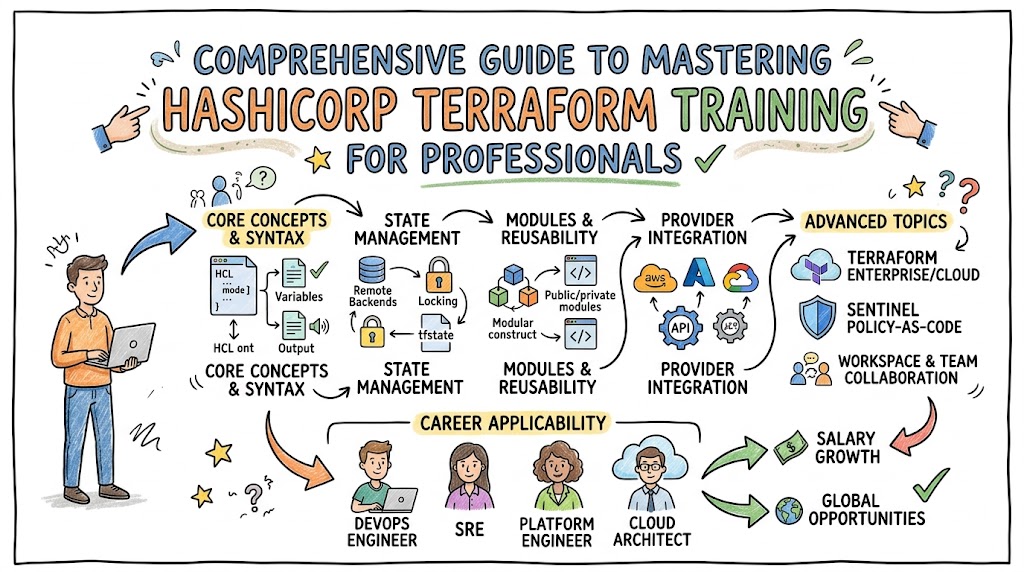
Hashicorp Terraform training serves as the foundational pillar for modern infrastructure management in the rapidly evolving cloud-native ecosystem. This guide targets software engineers, systems administrators, and platform architects who aim to automate infrastructure deployment across diverse cloud environments like AWS, Azure, and Google Cloud. By mastering these skills through DevOpsSchool, professionals can transition from manual configuration to scalable, code-driven environments. Understanding the nuances of infrastructure as code allows technical leaders to make informed decisions that directly impact organizational agility and deployment frequency.
What is the Hashicorp Terraform training?
Hashicorp Terraform training represents a comprehensive educational framework designed to teach engineers how to build, change, and version infrastructure safely and efficiently. It exists to bridge the gap between traditional manual provisioning and modern automated workflows that define the current engineering landscape. The curriculum emphasizes a production-focused approach, ensuring that learners do not just understand syntax but also grasp state management and modular design. By aligning with enterprise practices, this training prepares individuals to handle complex, multi-tier architectures within large-scale organizational structures.
Who Should Pursue Hashicorp Terraform training?
DevOps engineers and Site Reliability Engineers benefit most from this training as it forms the core of their daily operational toolkit. Cloud architects and security professionals also find immense value in learning how to codify compliance and governance through policy-as-code integration. Beginners looking to enter the cloud domain find it a necessary starting point, while experienced engineers use it to standardize cross-team workflows. In both the Indian market and the global tech industry, managers who understand these concepts can better lead digital transformation initiatives and resource planning.
Why Hashicorp Terraform training is Valuable and Beyond
The demand for Hashicorp Terraform training continues to grow as organizations move away from vendor lock-in toward multi-cloud and hybrid cloud strategies. It offers long-term career longevity because the underlying principles of declarative configuration remain constant even as specific cloud provider features evolve. Professionals who master this tool stay relevant by providing the automation necessary for rapid scaling and disaster recovery. Ultimately, the return on time invested is significant, leading to higher salary brackets and more influential roles within engineering departments.
Hashicorp Terraform training Certification Overview
The program is delivered via the official course at DevOpsSchool and is hosted on the primary website. This certification approach focuses on practical application, testing a candidate’s ability to solve real-world infrastructure problems using the Hashicorp Configuration Language. It typically covers various levels of expertise, moving from basic resource provisioning to advanced workspace management and enterprise-grade features. The ownership of the certification ensures that the curriculum remains updated with the latest versions of the software and industry best practices.
Hashicorp Terraform training Certification Tracks & Levels
The certification tracks are structured to support professional growth from a foundation level to advanced mastery. Foundation levels focus on core concepts like providers, resources, and variables, making them ideal for those new to automation. Professional and advanced levels dive deeper into modules, remote backends, and integration with CI/CD pipelines to support SRE and FinOps goals. These levels align perfectly with career progression, allowing an associate to eventually take on lead architect responsibilities by proving technical depth.
Complete Hashicorp Terraform training Certification Table
| Track | Level | Who it’s for | Prerequisites | Skills Covered | Recommended Order |
| Infrastructure Automation | Associate | Junior DevOps/SysAdmins | Basic Cloud Knowledge | CLI, State, Providers | First |
| Enterprise Scaling | Professional | Senior DevOps/SRE | Associate Level | Modules, Sentinel, Workspaces | Second |
| Cloud Architecture | Advanced | Solutions Architects | Professional Experience | Multi-cloud, Migration | Third |
Detailed Guide for Each Hashicorp Terraform training Certification
Hashicorp Terraform training – Associate Certification
What it is
This certification validates a professional’s fundamental knowledge of infrastructure as code concepts and their ability to use the open-source version of the tool. It confirms that the individual can navigate the command line and manage basic resource lifecycles.
Who should take it
It is designed for individuals in junior to mid-level engineering roles who are starting their journey into automation. Managers who want a technical grounding in how their teams deploy resources also find this level highly beneficial.
Skills you’ll gain
- Proficiency in writing declarative configuration files.
- Understanding of the state file and its importance in tracking resources.
- Ability to use variables and outputs to create dynamic configurations.
- Knowledge of how to initialize, plan, and apply changes safely.
Real-world projects you should be able to do
- Deploying a VPC with multiple subnets and security groups on a public cloud.
- Setting up a load-balanced web application across different availability zones.
- Managing remote state in an S3 bucket or Azure Blob storage for team collaboration.
Preparation plan
- 7–14 days: Focus on intensive labs and memorizing the core CLI commands and syntax rules.
- 30 days: Review documentation thoroughly and build three distinct infrastructure projects from scratch.
- 60 days: Engage in deep-dive troubleshooting and explore enterprise features like Sentinel and Terraform Cloud.
Common mistakes
- Neglecting to understand how the state file works, leading to resource corruption.
- Hardcoding values instead of using variables, which limits configuration reusability.
- Failing to practice the specific syntax required for complex data types like maps and lists.
Best next certification after this
- Same-track option: Professional Terraform Certification.
- Cross-track option: Certified Kubernetes Administrator.
- Leadership option: Cloud Architecture Professional.
Choose Your Learning Path
DevOps Path
The DevOps path focuses on integrating infrastructure code into the broader software delivery lifecycle. Professionals learn to trigger infrastructure updates via version control systems and automated pipelines. This ensures that the environment is always in sync with the application code. Consequently, teams can achieve faster release cycles and higher environment stability.
DevSecOps Path
In the DevSecOps path, the emphasis shifts toward security-first automation and policy enforcement. Engineers learn to use tools that scan configurations for vulnerabilities before they are deployed to production. This path involves implementing “Policy as Code” to ensure that every resource meets corporate compliance standards. It effectively reduces the risk of data leaks caused by misconfigured cloud settings.
SRE Path
The Site Reliability Engineering path focuses on using automation to improve system uptime and reliability. SREs use these tools to create reproducible environments that act as “golden signals” for system health. This path emphasizes state management, disaster recovery drills, and automated scaling based on performance metrics. It bridges the gap between development speed and operational stability.
AIOps Path
The AIOps path explores the intersection of artificial intelligence and infrastructure automation. Engineers learn to feed infrastructure telemetry into machine learning models to predict potential failures. Automation tools are then used to remediate these issues before they impact the end user. This proactive approach relies heavily on consistent and programmatic infrastructure definitions.
MLOps Path
In the MLOps path, the focus is on providing the underlying compute resources required for heavy data processing and model training. Professionals learn to spin up and tear down expensive GPU clusters automatically to save costs. This ensures that data scientists have the environment they need without manual intervention from IT teams. It streamlines the lifecycle of machine learning models from development to production.
DataOps Path
The DataOps path applies the principles of automation to data engineering pipelines and database management. Engineers use code to provision data warehouses, ETL clusters, and storage buckets in a consistent manner. This reduces the manual errors often associated with managing large-scale data environments. It ensures that data is accessible, secure, and flowing through a validated infrastructure.
FinOps Path
The FinOps path centers on cloud financial management and cost optimization through automated resource tagging. Professionals learn to write code that automatically identifies and shuts down underutilized resources. This path uses automation to provide granular visibility into cloud spending across different departments. It helps organizations balance technical performance with budgetary constraints.
Role → Recommended Hashicorp Terraform training Certifications
| Role | Recommended Certifications |
| DevOps Engineer | Associate + Professional |
| SRE | Professional + Specialist |
| Platform Engineer | Advanced Infrastructure Expert |
| Cloud Engineer | Associate + Cloud Provider Certs |
| Security Engineer | DevSecOps Automation Specialist |
| Data Engineer | DataOps Infrastructure Associate |
| FinOps Practitioner | Cloud Cost Management Specialist |
| Engineering Manager | Associate + Leadership Track |
Next Certifications to Take After Hashicorp Terraform training
Same Track Progression
Deep specialization involves moving toward Hashicorp Certified Professional levels or focusing on specific ecosystem tools like Vault and Consul. This allows an engineer to become a subject matter expert in the full Hashicorp stack, which is highly valued in enterprise environments. Mastering the integration between these tools ensures a seamless and secure automated environment.
Cross-Track Expansion
Skill broadening often means pursuing certifications in Kubernetes or specific cloud provider architectures like AWS SysOps or Azure Solutions Architect. Understanding how infrastructure as code interacts with container orchestration provides a more holistic view of modern systems. This makes a professional more versatile and capable of leading complex, multi-layered technical projects.
Leadership & Management Track
For those transitioning to leadership, certifications like PMP or ITIL, combined with high-level cloud strategy courses, are recommended. Leaders need to understand the ROI of automation and how to build teams that embrace DevOps culture. This path focuses on resource management, strategic planning, and aligning technical capabilities with business objectives.
Training & Certification Support Providers for Hashicorp Terraform training
DevOpsSchool
This organization provides extensive hands-on training sessions that focus on real-world scenarios rather than just theoretical knowledge. Their instructors are industry veterans who bring years of practical experience to the classroom environment. They offer a structured curriculum that covers everything from basic syntax to advanced enterprise modules. Students receive continuous support and access to a vast library of technical resources.
Cotocus
Cotocus specializes in providing tailored corporate training programs that help teams adopt automation tools effectively. Their approach is highly collaborative, ensuring that the training aligns with the specific technical stack of the organization. They focus on practical labs and live projects to ensure that the skills learned are immediately applicable. This makes them a preferred choice for companies looking to upskill their workforce quickly.
Scmgalaxy
Scmgalaxy is a well-known community-driven platform that offers a wealth of tutorials and guides for infrastructure automation. They provide a space for professionals to share knowledge and solve complex technical challenges together. Their training programs are designed to be accessible and updated frequently to reflect industry changes. It is an excellent resource for self-paced learners and community enthusiasts.
BestDevOps
BestDevOps offers comprehensive certification preparation courses that are specifically designed to help candidates pass their exams on the first attempt. They provide mock tests and detailed study materials that cover every aspect of the certification syllabus. Their focus on exam patterns and common pitfalls makes them a valuable partner for certification seekers. They emphasize clarity and conciseness in their teaching methodology.
devsecopsschool.com
This provider focuses specifically on the intersection of security and automation within the infrastructure lifecycle. Their courses teach engineers how to integrate security checks directly into their configuration files. This ensures that infrastructure is not only automated but also compliant and secure by design. They are a go-to resource for security professionals looking to modernize their skill sets.
sreschool.com
Sreschool focuses on the reliability and observability aspects of infrastructure management. Their training covers how to build resilient systems that can automatically recover from failures. They emphasize the use of automation to manage Service Level Objectives and error budgets effectively. This makes their curriculum highly relevant for engineers working in high-uptime environments.
aiopsschool.com
Aiopsschool is at the forefront of teaching how to apply artificial intelligence to IT operations. Their curriculum includes modules on automated remediation and predictive maintenance using infrastructure code. They help engineers transition into the future of operations where AI plays a central role. Their training is ideal for those looking to stay ahead of the curve in tech innovation.
dataopsschool.com
This platform focuses on the unique challenges of managing data infrastructure through automation. They teach how to provision and scale data platforms without compromising on data integrity or performance. Their courses are essential for data engineers who want to apply DevOps principles to their specific domain. They bridge the gap between traditional database administration and modern automation.
finopsschool.com
Finopsschool provides specialized training on cloud financial management and cost-aware infrastructure design. They teach engineers how to write code that prioritizes cost-efficiency alongside performance. Their curriculum is vital for organizations looking to optimize their cloud spend in a systematic way. They provide the tools and knowledge needed to drive financial accountability in engineering teams.
Frequently Asked Questions (General)
- How difficult is the Associate certification for a beginner?
The Associate level is considered moderate; while it requires a solid understanding of cloud concepts, the syntax is intuitive. Most beginners find success after two to three weeks of consistent hands-on practice.
- How much time should I dedicate to studying every day?
Allocating one to two hours daily for a month is usually sufficient for most professionals to grasp the core concepts. Consistency is more important than cramming, as infrastructure concepts require practical application.
- Are there any specific prerequisites before starting the training?
While there are no formal prerequisites, having a basic understanding of cloud providers and command-line interfaces is highly recommended. Familiarity with JSON or YAML formatting will also speed up the learning process.
- What is the typical ROI for this certification in terms of salary?
Certified professionals often see a salary increase of 15% to 25% depending on their location and prior experience level. It is one of the most sought-after skills in the current DevOps job market.
- Should I learn a cloud provider certification before this one?
It is helpful to know at least one cloud provider well, but you can learn them concurrently with your automation training. Understanding what you are automating makes the automation tool much easier to master.
- How often do I need to renew this certification?
Most industry-standard certifications in this domain are valid for two years, after which you should retake the updated exam. This ensures your skills remain current with the fast-paced software updates.
- Is this training relevant for small startups or just large enterprises?
Automation is essential for both; startups use it to scale quickly with small teams, while enterprises use it for governance. The principles learned apply to infrastructure of any size or complexity.
- Can I pass the exam using only free online documentation?
While the documentation is excellent, structured training and labs provide the practical context needed for the exam’s scenario-based questions. Training programs often highlight “gotchas” that are not obvious in documentation.
- What is the difference between the open-source and enterprise versions?
The open-source version focuses on the core engine, while the enterprise version adds collaboration, governance, and security features. Training usually covers the core engine but introduces enterprise concepts for career growth.
- Does the certification involve writing code during the exam?
The exam typically consists of multiple-choice and scenario-based questions that require you to interpret or correct code snippets. While you don’t write long files, you must be very familiar with the syntax.
- How does this skill set fit into a Site Reliability Engineering role?
SREs use these skills to ensure that environments are reproducible and that changes are made through a peer-reviewed process. It is the primary tool for reducing “toil” and manual configuration errors.
- Is it better to learn this or a tool like Ansible first?
They are complementary; this tool is best for provisioning infrastructure, while Ansible is great for configuring the software inside. Most professionals start with infrastructure provisioning as it is the foundation.
FAQs on Hashicorp Terraform training
- What makes this specific training different from generic cloud automation courses?
This training focuses specifically on the declarative nature of infrastructure management, which is distinct from procedural scripting. It teaches you to describe the “end state” rather than the steps to get there, which is a fundamental shift in engineering mindset.
- How do labs help in understanding state management during the course?
Labs allow you to see exactly how the tool tracks resources in the real world. You will experience what happens when state files are lost or corrupted and learn the professional techniques to recover and refactor them safely.
- Does the training cover multi-cloud deployment strategies in detail?
Yes, the curriculum is designed to be provider-agnostic, teaching you how to use the same workflow across AWS, Azure, and others. This versatility is one of the primary reasons why this specific training is so valuable to modern employers.
- Will I learn about “Terraform Cloud” during the training sessions?
The training introduces you to the managed service offerings that facilitate team collaboration and remote runs. You will understand when to move from local CLI usage to a centralized platform for better security and auditability.
- Are there any specific project examples included in the training syllabus?
The syllabus includes projects like building a high-availability architecture and managing DNS records via code. These projects mimic the actual tasks you will be assigned in a professional SRE or DevOps role.
- How does the training address the concept of “Infrastructure as Code” security?
You will learn how to manage secrets securely and avoid committing sensitive data to version control. The training emphasizes the use of environment variables and secure backends to protect your infrastructure’s credentials.
- Is the HCL (Hashicorp Configuration Language) difficult to learn for non-programmers?
HCL is designed to be human-readable and is much easier to learn than general-purpose languages like Python or Java. Most engineers find it very logical, as it reads like a simple configuration file rather than complex code.
- How does the training help with refactoring existing infrastructure into code?
The course covers “import” functions that allow you to bring existing resources under the management of your automation tool. This is a critical skill for engineers working in companies that are migrating from manual setups.
Final Thoughts: Is Hashicorp Terraform training Worth It?
From a mentor’s perspective, investing in Hashicorp Terraform training is one of the most strategic moves an engineer can make. We have moved past the era where manual clicking in a console is acceptable; automation is now the standard requirement. This training doesn’t just teach you a tool; it teaches you a methodology for managing complex systems with confidence and precision. While the learning curve can be steep when dealing with state management and modules, the clarity it brings to your infrastructure is unmatched. If you want to be part of high-performing teams that deploy hundreds of times a day, this is your entry ticket. It is a practical, high-value investment in your technical maturity that will pay dividends for years to come.