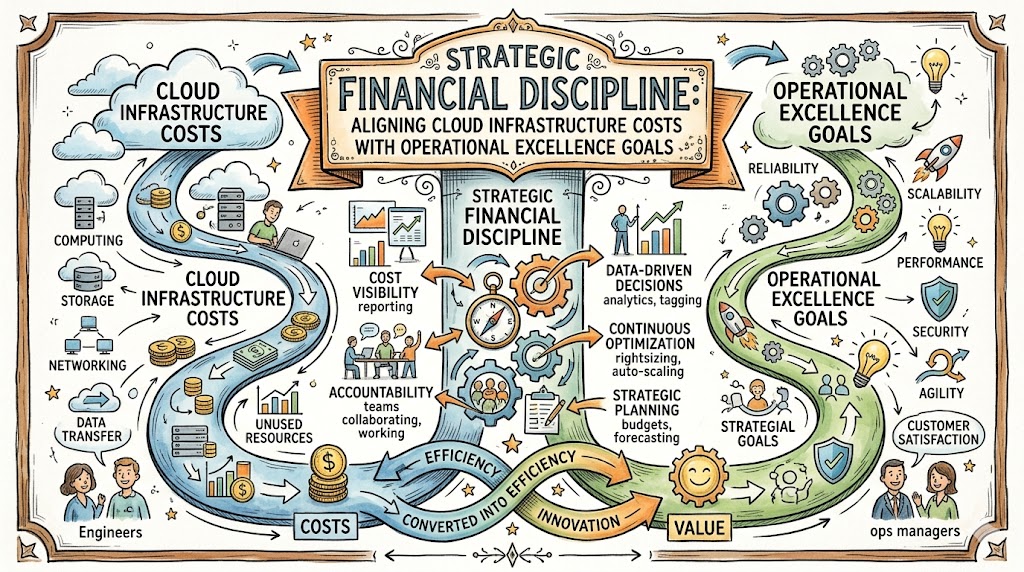
Imagine waking up to an unexpected cloud invoice that obliterates your entire quarterly infrastructure budget within days. This operational nightmare occurs regularly across modern engineering teams because unmonitored resources scale autonomously without financial oversight. Consequently, organizations struggle to reconcile rapid application deployment with fiscal responsibility. Traditional procurement models fail completely in dynamic, auto-scaling environments where every single line of code directly influences expenditures.
Modern teams require a systematic methodology to bridge the gap between engineering velocity and budget management. This discipline combines financial accountability with variable cloud spend architectures to maximize business value. By establishing collaborative frameworks, organizations ensure engineering, finance, and operations teams share accountability for infrastructure consumption. Therefore, scaling applications effectively no longer requires sacrificing corporate profit margins or engineering velocity.
This comprehensive guide covers everything required to master cloud financial management within your infrastructure. You will explore historical infrastructure bottlenecks, core strategic operational practices, and foundational architectural principles. Furthermore, this deep dive analyzes metric variations, deployment safety, platform differentiation, and real-world failure patterns. Ultimately, you will gain a clear roadmap toward maximizing your technology investments while maintaining high system performance.
Ready to transform your cloud financial operations from a cost center into a strategic growth driver? You can master these methodologies and elevate your operational efficiency by exploring the comprehensive learning programs at Finopsschool. Let us begin analyzing the architectural shifts that shaped modern systems management.
The Origin of Systems Infrastructure
The Early Industrial Bottlenecks
Traditional enterprise IT operations depended entirely on static, on-premises data centers. Engineers routinely faced long hardware procurement cycles, which frequently delayed critical software releases by several months. Because predicting exact resource demands was nearly impossible, organizations intentionally over-provisioned hardware to handle rare peak traffic spikes.
Consequently, millions of dollars in compute capacity sat idle for the vast majority of the calendar year. Finance teams managed expenditures through rigid capital depreciation schedules, which conflicted sharply with the fluid needs of software development teams. Siloed departments rarely communicated regarding resource utilization, leading to massive operational friction and misaligned corporate priorities.
Moving Toward Unified Workflow Automation
The emergence of virtualization disrupted these static data center paradigms completely. Suddenly, teams could provision infrastructure via software commands rather than manual hardware installations. This technical breakthrough accelerated development lifecycles but introduced new tracking complications for corporate accounting departments.
As infrastructure became abstract, engineering groups began launching resources independently without financial approval. To prevent runaway expenditures, organizations pioneered unified workflow automation strategies to link infrastructure deployment with governance policies. Breaking down these traditional departmental silos allowed companies to automate compliance checks directly within software delivery pipelines.
Global Expansion Across Commercial Ecosystems
As cloud service providers expanded globally, variable consumption models became the standard across modern enterprise ecosystems. Organizations rapidly shifted expenditures from rigid capital investments to highly flexible operating expenses. This transition allowed startups to compete directly with global conglomerates by accessing massive computational power instantly.
However, the sheer velocity of decentralized cloud provisioning created a pressing need for dedicated operational frameworks. What began as basic cost-tracking practices quickly evolved into a sophisticated engineering and management discipline. Today, large-scale tech enterprises utilize these structured financial frameworks globally to sustain profit margins amidst intense market competition.
Defining Strategic Operations Management
The Core Operational Structure
The foundational architecture of modern operations requires continuous, real-time data flows between disparate software systems. Telemetry agents constantly collect resource consumption metrics, performance data, and billing granularities across multi-cloud environments. This raw information moves swiftly through centralized data pipelines into analytical dashboards for immediate evaluation.
Consequently, decision-makers obtain complete visibility into which architectural components generate specific infrastructure expenditures. This structural visibility ensures that unexpected anomalies receive immediate attention before they compound into major financial liabilities.
Daily Tasks of Systems Coordinators
Systems coordinators execute an array of practical, engineering-focused tasks every single day. They actively monitor real-time utilization graphs to identify underutilized virtual machines, orphaned storage disks, and inefficient database clusters. Additionally, these specialists configure automated alerts that flag sudden, anomalous spending variances across specific application microservices.
[Telemetry Agents] ──> [Data Pipeline] ──> [Analytical Dashboards] ──> [Automated Alerts]
They also collaborate with development groups to right-size infrastructure before pushing new application versions into production environments. By reviewing daily spending patterns, coordinators continuously refine resource allocation algorithms to eliminate waste without degrading user experiences.
Localized Control vs. Broad System Architecture
Managing modern digital infrastructure requires balancing highly localized resource adjustments with high-level system architecture. Localized control focuses on optimizing individual application components, such as tuning specific container parameters or database cache sizes.
Conversely, broad system architecture demands a macro-level evaluation of how multiple interconnected platforms exchange data across regions. Optimizing a single component might inadvertently increase data egress charges elsewhere in the global network topology. Therefore, operations specialists must thoroughly analyze the financial dependencies of the entire ecosystem before implementing localized changes.
The Efficiency Mindset
Achieving long-term infrastructure stability requires a fundamental cultural shift toward an efficiency-oriented mindset. Teams must reject the outdated notion that system reliability requires over-provisioning massive computational resources. Instead, engineers must treat fiscal efficiency as a primary architectural constraint alongside security, availability, and performance.
This cultural evolution encourages developers to write highly optimized code that consumes fewer processor cycles and memory allocations. Ultimately, prioritizing long-term resource efficiency ensures that the underlying system remains highly resilient and financially sustainable over time.
The 7 Core Principles of Finopsschool
1. Embracing Risk and Managing Variability
Modern distributed systems are inherently complex, making absolute perfection and zero spending variance impossible to achieve. Instead of striving for unrealistic static budgets, teams must comfortably manage acceptable systemic risk and fluid variable costs.
Engineers establish dynamic boundaries that accommodate normal operational fluctuations while protecting the infrastructure from catastrophic cost overruns. This pragmatic approach allows systems to scale up dynamically during legitimate customer demand surges while preventing runaway costs during unexpected traffic anomalies.
2. Establishing Service Level Objectives (SLOs)
Teams must define precise, measurable targets for systemic success using concrete operational data. These objectives explicitly balance user experience requirements with the financial costs of maintaining specific availability levels.
For instance, achieving an extra digit of availability might double infrastructure costs without providing noticeable benefits to standard end-users. By anchoring operational decisions to realistic performance targets, organizations avoid wasting money on unnecessary system redundancies.
3. Eliminating Toil and Manual Processes
Repetitive manual administrative tasks consume valuable engineering hours and frequently introduce costly human errors into production environments. Operational frameworks focus intensely on identifying this manual toil and systematically engineering it out of daily workflows.
Whenever an engineer performs a repetitive task, they must prioritize writing code to automate that exact operation permanently. Eliminating this operational friction frees up skilled specialists to focus on high-value optimization tasks that directly reduce long-term infrastructure expenditures.
4. Monitoring & Observability Across the Pipeline
Maintaining total visibility across the entire deployment pipeline is essential to preventing hidden financial blind spots. Comprehensive observability requires collecting logs, metrics, and distributed traces from every architectural layer.
[Application Traces] + [System Metrics] + [Billing Data] = Comprehensive Observability
This unified visibility allows engineers to link specific software feature releases directly to changes in cloud resource consumption. Consequently, teams can immediately pinpoint inefficient code deployments that cause resource utilization metrics to spike unpredictably.
5. Automation Over Manual Coordination
Scaling modern global workflows efficiently requires relying on smart software solutions rather than manual human coordination. Automated systems continuously analyze real-time demand patterns to adjust infrastructure capacity dynamically without human intervention.
For example, automated policies can instantly power down development environments during non-business hours or scale down container clusters when traffic subsides. Utilizing code-driven automation ensures that infrastructure resource supply matches actual user demand perfectly at any hour of the day.
6. Release Engineering and Deployment Stability
Consistent, predictable, and safe infrastructure delivery strategies are foundational to maintaining operational stability and fiscal control. Release engineering teams utilize progressive deployment methodologies, such as canary releases or blue-green deployments, to mitigate risk.
These controlled strategies allow teams to test the financial and performance impacts of new code updates on a small user segment first. If the update introduces resource inefficiencies, automated rollbacks instantly restore the previous stable version before expenses escalate globally.
7. Simplicity in Network Architecture
Keeping cloud network environments clean, modular, and minimal directly reduces unexpected failure surfaces and hidden data transit fees. Complex multi-region architectures often introduce convoluted routing paths that accumulate significant data egress charges.
By deliberately simplifying network topologies and utilizing localized data endpoints, engineers eliminate unnecessary hops across cloud availability zones. This rigorous architectural minimalism makes systems significantly easier to troubleshoot while structurally minimizing monthly network communication expenditures.
Key Operational Concepts You Must Know
SLA vs. SLO vs. SLI — Explained Simply
Understanding the distinct relationships between agreements, objectives, and indicators is crucial for managing operational performance effectively.
- Service Level Agreement (SLA): The formal, legally binding commitment made directly to external customers regarding overall system uptime and performance parameters.
- Service Level Objective (SLO): The internal target metric specified by engineering teams to ensure the infrastructure consistently meets or exceeds the external SLA parameters.
- Service Level Indicator (SLI): The actual, real-time measurement of a specific system performance metric, such as latency or error rate, at a given moment.
| Metric | Target Audience | Legal/Financial Consequences |
| SLA | External Customers / Business Executives | Yes (Credits, refunds, contractual penalties) |
| SLO | Internal Engineering / Operations Teams | No (Triggers internal alerts and prioritization shifts) |
| SLI | Monitoring Systems / On-Call Engineers | No (Provides raw data for SLO calculations) |
Error Budgets — The Game Changer for Operational Risk
An error budget represents the exact amount of systemic instability or downtime that an application is safely permitted to accumulate. For instance, an internal objective of 99.9% uptime provides a 0.1% budget for planned maintenance or unexpected bugs.
This concept balances rapid feature innovation with baseline system safety by dictating when teams can deploy new code. If a development team completely exhausts their allocated error budget due to frequent system crashes, all new feature releases pause instantly. The entire engineering group must then redirect their attention toward fixing underlying infrastructure instabilities and optimizing resource consumption.
Toil — The Silent Productivity Killer in Infrastructure
Toil encompasses manual administrative tasks that are repetitive, tactical, scalable, and lack long-term engineering value. Examples include manually resetting user passwords, running routine backup scripts, or manually approving basic infrastructure provisioning requests.
To systematically eliminate toil, teams must first calculate the percentage of time engineers spend on these repetitive manual activities. If manual tasks consume more than half of an engineer’s weekly schedule, operational velocity stalls completely. Organizations solve this issue by writing declarative automation scripts and building self-service internal developer portals.
Incident Management & Postmortems
When unexpected infrastructure failures occur, teams must rely on highly structured incident response frameworks to restore services quickly. Once the system returns to a stable state, engineers conduct a rigorous, blameless postmortem to evaluate what occurred.
The primary objective is analyzing the systemic root causes of the issue rather than assigning blame to individual human operators. This supportive culture encourages transparency and ensures that teams build robust technical safeguards to prevent identical failures from reoccurring.
Capacity Planning
Predictive capacity planning allows modern enterprises to forecast resource growth trajectories and prepare infrastructure well ahead of major demand spikes. Engineers carefully analyze historical consumption trends, marketing calendars, and seasonal user patterns to project future computational requirements.
This proactive strategy prevents sudden resource starvation events during high-traffic enterprise marketing campaigns. Furthermore, accurate capacity forecasting enables finance teams to negotiate substantial volume discounts with cloud vendors through long-term resource commitments.
The Four Golden Signals of Pipeline Performance
Effectively monitoring large-scale distributed architectures requires focusing intensely on four critical system metrics.
- Latency: The precise time it takes for a system component to process a specific user request successfully.
- Traffic: The overall volume of demand being placed upon the system, measured in requests per second or concurrent users.
- Errors: The percentage of incoming customer requests that fail to process correctly due to system issues.
- Saturation: The total fraction of system resources, such as memory or processor capacity, currently utilized by the application.
Platform Implementation vs. Culture — What’s the Real Difference?
The Philosophy Difference
Implementing automated optimization platforms is a highly technical task centered on deploying software tools, configuring APIs, and setting up dashboards. These automated tools excel at scanning cloud environments to surface unutilized storage volumes and recommend smaller virtual machine sizes.
Conversely, cultivating an enduring operational culture requires shifting how human beings think about resource consumption across the entire organization. A software platform can point out waste, but only a collaborative culture empowers engineers to alter their design habits permanently.
Roles & Responsibilities Compared
Understanding how different operational philosophies divide daily duties ensures that team members avoid stepping on each other’s toes.
- Platform Implementation Specialists: * Deploy automated cloud monitoring agents across distributed container clusters.
- Maintain the centralized billing data pipelines and integrate cost dashboards.
- Configure automated alert thresholds for infrastructure budget overruns.
- Culture-Driven Operations Advocates:
- Conduct collaborative cross-departmental workshops between finance and engineering teams.
- Establish shared accountability models for monthly application expenditures.
- Encourage development teams to prioritize architectural efficiency during early design phases.
| Focus Area | Platform Implementation | Culture-Driven Operations |
| Primary Goal | Deploying tooling and automating metrics collection | Shifting human behavior and sharing accountability |
| Core Activities | API integrations, dashboard creation, alert configuration | Workshops, shared governance, architectural reviews |
| Success Metric | Tooling adoption rates and system visibility | Sustained reduction in architectural waste over time |
Can You Have Both Disciplines?
Modern enterprises do not have to choose between advanced automated tooling and a strong collaborative culture. In fact, these two disciplines complement each other perfectly within high-growth engineering environments.
Automated platforms provide the objective, data-driven transparency that finance and engineering teams need to make informed decisions. Meanwhile, a strong collaborative culture ensures that engineers possess the motivation to act upon the optimization recommendations surfaced by those platforms.
Which One Should Your Team Adopt?
Choosing where to focus your initial energy depends heavily on organizational size and current engineering maturity levels. Early-stage startups operating minimal cloud environments should prioritize establishing a cost-conscious culture before purchasing complex optimization platforms.
Conversely, massive global enterprises managing thousands of microservices must deploy automated platforms immediately to gain control over their sprawling infrastructure. Once visibility is established, these larger organizations can systematically introduce long-term cultural governance frameworks.
Real-World Use Cases of Modern Operations
How Tech Leaders Use Operational Metrics
Major global streaming platforms track microservice infrastructure expenditures down to individual user viewing sessions. By combining application performance telemetry with granular cloud billing APIs, their systems calculate the exact computational cost of encoding specific video files.
This real-time visibility allows engineers to identify inefficient compression algorithms that inflate storage costs across global content delivery networks. Consequently, development groups can optimize application code directly to maintain high video playback quality while lowering delivery costs.
Chaos Engineering Approaches to Resilient Systems
Prominent e-commerce enterprises intentionally inject controlled failures into their production infrastructure to uncover hidden architectural vulnerabilities. Automated chaos engineering tools randomly terminate active virtual machines or introduce artificial network latency between critical microservices.
This proactive experimentation allows engineers to verify that their automated failover systems activate correctly before real hardware failures occur. Discovering these vulnerabilities during business hours prevents catastrophic service outages during massive global shopping holidays.
Handling Reliability at Massive Scale
Global ride-sharing applications process millions of concurrent location coordinates every second across highly distributed cloud environments. To handle this immense data volume efficiently, their engineering teams utilize dynamic, geography-based container scaling policies.
Infrastructure capacity automatically expands in cities experiencing high passenger demand and instantly contracts as local activity subsides. This fluid resource allocation prevents the organization from paying for unneeded computational capacity in quiet time zones.
High-Availability in Fintech Operations
Digital payment processors operate within zero-tolerance environments where even a single second of system downtime costs millions of dollars. These financial institutions utilize multi-region, active-active cloud architectures to ensure continuous transaction processing capabilities.
If a primary cloud data center experiences a catastrophic network outage, automated traffic routers instantly redirect transactions to an alternative region. This robust architectural redundancy protects the organization’s reputation while maintaining strict compliance with global financial regulations.
Scaled-Down but Essential Systems for Startups
Early-stage software companies with constrained budgets apply these core operational principles by utilizing fully managed serverless architectures. By design, serverless components scale down to absolute zero when no customer requests are actively hitting the application.
This architectural choice ensures that the startup avoids paying for idle virtual machine capacity during early product validation phases. As their customer base grows, the underlying infrastructure scales up automatically, keeping expenditures aligned with actual business growth.
Common Mistakes in Operations Engineering
Mistake 1 — Confusing System Management with Just Being On-Call
Many organizations mistakenly believe they have implemented a modern operations discipline simply by placing their developers on an on-call rotation. This short-sighted approach treats operations as a reactive firefighting exercise focused entirely on surviving system crashes.
True operational engineering requires dedicating substantial time to proactive software development, automated provisioning, and comprehensive architectural optimization. If engineers spend their entire week answering pages, they cannot build the automation required to prevent future incidents.
Mistake 2 — Setting Unrealistic SLOs
Product managers frequently demand perfect system performance, establishing unrealistic targets like 100% availability for non-critical application features. Pursuing these unneeded levels of uptime stalls software feature velocity because engineers must spend all their time building extreme system redundancies.
Furthermore, maintaining excessive availability levels exponentially increases monthly cloud bills without delivering measurable value to standard end-users. Teams must set realistic objectives that accurately reflect actual customer expectations and business requirements.
Mistake 3 — Ignoring Toil Until It’s Too Late
Neglecting to automate repetitive manual tasks allows operational debt to accumulate silently across engineering departments. As an enterprise scales, manual processes like running script database migrations or provisioning test environments begin consuming entire workweeks.
This manual burden severely blocks software delivery velocity and causes widespread burnout among skilled infrastructure specialists. Organizations must proactively allocate engineering capacity every sprint specifically to automate away these repetitive tasks permanently.
Mistake 4 — Skipping Blameless Postmortems
When a major system outage occurs, organizations often default to finding a human scapegoat to blame for the mistake. This toxic reaction causes engineers to hide system flaws and delay reporting critical vulnerabilities out of fear of professional retaliation.
Skipping a truly blameless evaluation ensures that the underlying architectural weaknesses remain unaddressed within the environment. Teams must focus entirely on fixing flawed processes and fragile code rather than penalizing individual engineers.
Mistake 5 — Monitoring Without Actionable Alerts
Configuring monitoring systems to send notifications for minor operational fluctuations quickly desensitizes engineering teams to critical warnings. When automated channels flood engineers with thousands of non-actionable alerts daily, true system emergencies are easily overlooked.
Every single alert wired into a production environment must require an immediate, well-defined human action to resolve an actual issue. If an alert does not require immediate intervention, it belongs in a non-urgent summary report rather than an emergency notification channel.
Mistake 6 — Not Involving Operational Engineers in the Design Phase
Software development teams frequently design complex application architectures in isolation before handing them off to operations for deployment. This structural disconnect results in platforms that are incredibly difficult to monitor, scale, or optimize effectively within production environments.
Excluding operational expertise from early architectural discussions often leads to massive cost overruns and systemic performance bottlenecks later on. Involving infrastructure specialists from day one ensures that software designs are fundamentally observable and cost-efficient.
Essential Infrastructure Tools & Technologies
Monitoring & Observability
Maintaining complete system visibility requires utilizing advanced tracking technologies like Prometheus for gathering time-series metrics. Organizations routinely pair this data collector with Grafana dashboards to create real-time visualizations of global system health.
Additionally, enterprise platforms like Datadog and New Relic provide comprehensive application performance monitoring and distributed tracing capabilities. These integrated toolsets allow engineering teams to track complex data requests as they move through multi-cloud architectures.
Incident Management
When unexpected system anomalies disrupt regular operations, platforms like PagerDuty orchestrate the technical team’s response schedules instantly. These incident management tools integrate directly with monitoring systems to route urgent system alerts to the correct on-call engineer.
By automating the escalation pathway, organizations significantly reduce their overall mean time to resolve critical production outages. These platforms also archive incident timelines to facilitate thorough post-mortem analysis after services return to normal.
CI/CD & Release Engineering
Automating software delivery pathways safely requires relying on robust continuous integration and continuous deployment engines like Jenkins. Modern cloud-native teams also utilize advanced GitOps delivery controllers such as Argo CD to manage infrastructure state configurations automatically.
Furthermore, platforms like Spinnaker enable organizations to execute sophisticated progressive delivery strategies like automated canary deployments. Utilizing these code-driven release systems ensures that all infrastructure changes remain completely trackable and reversible.
Chaos Engineering
Proactively testing infrastructure resilience requires using specialized fault injection technologies like Chaos Monkey to disrupt services deliberately. These tools safely simulate real-world infrastructure disasters, such as sudden server terminations or network partitions, directly within test environments.
By continuously injecting controlled failures, engineers can verify that their automated self-healing mechanisms respond correctly. This intentional testing practice surfaces subtle architectural weaknesses before they cause actual customer-facing outages.
SLO Management
Tracking actual user experiences against internal performance thresholds requires utilizing dedicated reliability platforms like Nobl9. These specialized systems ingest telemetry data from multiple monitoring sources to calculate real-time error budget consumption rates.
By automating the tracking of service objectives, these platforms provide clear warning signals before teams violate external customer agreements. This clear visibility helps software organizations balance rapid feature development with baseline infrastructure stability.
How to Become an Operations Expert — Career Roadmap
Skills Every Specialist Must Have
Entering this highly specialized engineering domain requires mastering core operating system fundamentals, terminal commands, and shell scripting languages. Aspiring engineers must feel completely comfortable navigating Linux environments, managing file permissions, and analyzing network traffic patterns.
Additionally, professionals require a deep structural understanding of cloud infrastructure concepts, containerization technologies, and modern microservice networking. Proficiency with declarative infrastructure-as-code languages is also essential for automating resource provisioning across global cloud environments.
[Linux Fundamentals] ──> [Shell Scripting] ──> [Containerization] ──> [Infrastructure-as-Code]
The Professional Learning Path
The educational journey begins by managing simple standalone web server configurations and writing basic automation scripts. Next, engineers advance to orchestrating multi-container environments and configuring centralized monitoring pipelines for distributed applications.
As professionals mature, they take on complex challenges like designing multi-region failover strategies and optimizing enterprise-wide cloud expenditures. Senior architects eventually focus on designing comprehensive internal developer platforms that bake financial and operational governance directly into software workflows.
Certifications Worth Pursuing
Validating your technical infrastructure expertise to prospective global employers requires earning respected, industry-recognized professional credentials. Obtaining official certifications from major public cloud vendors demonstrates a deep practical knowledge of specific cloud architectural patterns.
Additionally, earning specialized credentials from the FinOps Foundation or the Cloud Native Computing Foundation confirms your mastery of cloud financial management and Kubernetes orchestration. These rigorous examinations verify that you possess the advanced skills required to optimize complex modern enterprise infrastructures.
Educational Resources with Finopsschool
Accelerating your professional development within this competitive domain requires accessing structured, world-class educational curriculums. Industry professionals can explore a wealth of deep-dive courses, hands-on lab environments, and expert-led training programs at Finopsschool.
These comprehensive learning resources are designed specifically to bridge the gap between abstract theoretical concepts and real-world engineering execution. Leveraging these structured materials allows you to master modern cost optimization methodologies and advance your technical career rapidly.
The Future of Systems Management
AI and Automation in System Optimization
The integration of advanced machine learning algorithms is transforming how enterprises manage large-scale cloud infrastructure resources. Automated systems can now analyze terabytes of historical telemetry data to predict upcoming traffic spikes with incredible accuracy.
These intelligent platforms automatically adjust infrastructure capacities ahead of demand shifts, completely eliminating the need for manual human intervention. Furthermore, AI-driven diagnostic tools rapidly isolate the root causes of complex system anomalies, significantly reducing overall incident resolution times.
Platform Engineering — The Evolution of Infrastructure
Platform engineering is rapidly emerging as the standard model for scaling software delivery across modern cloud-native organizations. Instead of managing infrastructure manually, dedicated platform teams build centralized, self-service internal developer portals.
These internal platforms package complex cloud configurations, security guardrails, and cost controls into simple, repeatable templates for development groups. Consequently, software engineers can provision compliant, cost-efficient environments independently without needing to become infrastructure experts themselves.
Management in Cloud-Native & Kubernetes Environments
As organizations migrate heavily toward dynamic containerized microservices, managing large Kubernetes clusters introduces unique orchestration and cost challenges. Container environments scale rapidly and abstract underlying hardware layers, making traditional resource allocation tracking methods obsolete.
The future of infrastructure management requires utilizing advanced open-source tools to map container resource demands directly to specific enterprise business units. Mastering these dynamic cloud-native orchestration ecosystems is essential for maintaining operational control and fiscal efficiency.
Operational Skills That Will Matter Most
The next generation of infrastructure specialists must possess a unique blend of deep technical engineering and financial data analysis skills. Pure system administration expertise is no longer sufficient within highly competitive, fluid cloud-native enterprise landscapes.
Engineers must learn to interpret detailed cloud billing data, calculate unit economics, and design highly efficient application topologies. Cultivating this dual mastery ensures that you can design resilient systems that drive maximum business value over time.
FAQ Section
- What is the typical career path for an individual entering the cloud financial operations domain?Professionals usually begin their careers as junior systems administrators, software developers, or financial analysts within technology-focused organizations. Over time, they develop a unique cross-functional skill set combining deep cloud infrastructure engineering with corporate data analysis methodologies. As they gain experience optimizing complex environments, they progress into dedicated specialist positions, principal architectural roles, or enterprise director spots.
- How do cloud financial management practices differ from traditional IT budgeting workflows?Traditional IT budgeting relies on rigid capital expenditure schedules and static procurement cycles configured months in advance. Conversely, cloud financial management adapts directly to the variable, consumption-based nature of modern cloud computing environments. It replaces centralized, once-a-year financial reviews with decentralized, real-time shared accountability models across engineering groups.
- What are the average salary trends for certified infrastructure optimization specialists?Due to the rapid expansion of multi-cloud enterprise architectures, skilled professionals who can optimize expenditures command premium compensation globally. Salaries vary based on geographical location and experience, but senior specialists frequently outpace traditional system administration roles significantly. Organizations gladly offer top-tier compensation to engineers who demonstrate a proven track record of reducing infrastructure waste.
- Why is a blameless culture considered essential for maintaining overall system reliability?When organizations penalize individuals for unintended technical errors, engineers naturally attempt to hide vulnerabilities to protect their careers. A blameless culture focuses entirely on identifying flawed operational workflows and building automated technical guardrails to prevent future issues. This transparent environment encourages rapid incident reporting, which helps teams resolve problems before they impact customers.
- Can small startups benefit from implementing these structured operational principles early?Yes, early-stage enterprises gain a massive competitive advantage by embedding structural resource efficiency into their initial application designs. By utilizing serverless architectures and setting up basic cost alerts, small teams avoid burning valuable venture capital on idle hardware. Establishing these clean operational habits early ensures the business can scale smoothly without accumulating massive technical debt.
- How often should engineering teams review their internal service level objectives?Service level objectives must be treated as living technical documents rather than static configurations that are set once and forgotten. Teams should formally re-evaluate their performance metrics quarterly or whenever major architectural changes alter the application’s behavior. Regular reviews ensure that internal engineering targets remain perfectly aligned with evolving user experiences and corporate business goals.
Final Summary
Sustaining modern digital infrastructure requires moving far beyond basic uptime tracking and embracing a continuous, data-driven optimization methodology. Organizations must break down legacy departmental silos to unify engineering innovation, financial accountability, and operational excellence goals permanently. By embedding comprehensive visibility, smart automation, and blameless collaboration into daily workflows, companies eliminate systemic waste without sacrificing application velocity. Ultimately, mastering these proactive performance frameworks ensures that your cloud-native infrastructure remains highly resilient, scalable, and fiscally sound over the long term. You can champion this operational transformation within your enterprise by leveraging the expert-led educational programs and resources at Finopsschool.