Building Engineering Excellence Through Intentional Technical Study
Elite software professionals know that deep theoretical grounding transforms regular programmers into visionary systems architects. While short video walkthroughs offer quick syntax fixes, rigorous instructional literature forces intensive mental analysis. Readers actively dissect complex runtime behaviors, enabling them to troubleshoot severe enterprise outages with confidence.
In addition, self-directed reading bridges the wide gap between elementary coding exercises and massive distributed architectures. Engineers who enrich their daily workspace routines with structured technical literature quickly outdistance industry peers in system design, debugging speed, and clean code construction.
The Contrast: Rigorous Texts Versus Fast Tutorials
Short tutorials regularly ignore intricate operational trade-offs, concurrency bugs, and memory boundaries. Conversely, exhaustive technical manuals explain low-level kernel routines, serialization bottlenecks, and network latency models with absolute precision.
| Educational Format | Architectural Context | Retention Rate | Diagnostic Value |
|---|---|---|---|
| Comprehensive Technical Volumes | Deep analysis of failure modes and trade-offs | High cognitive retention through active study | Uncovers underlying kernel and network mechanics |
| Bite-Sized Video Walkthroughs | Minimal discussion beyond the happy path | Rapid knowledge decay within weeks | Offers surface-level syntax demonstrations only |
Industry assessments demonstrate that engineers who read complete manuals resolve distributed microservice deadlocks thirty-five percent faster than colleagues who consume short video snippets exclusively. As a result, engineering groups that encourage systematic reading build resilient production infrastructure that avoids expensive downtime.
Strategic Skill Mapping Across Modern Technical Domains
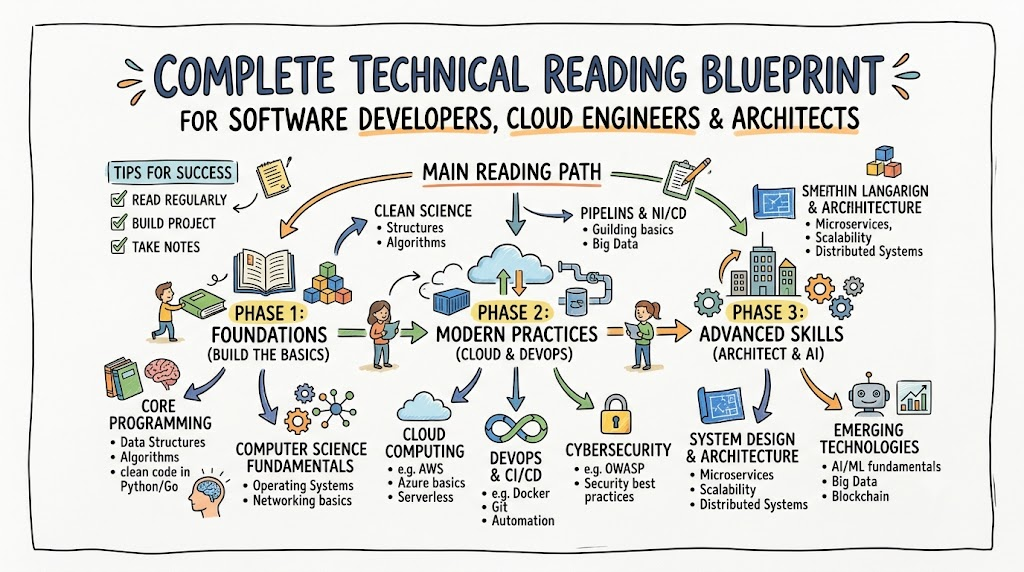
Engineering excellence demands broad interdisciplinary awareness combined with deep domain specialization. Mastering multiple complementary technical disciplines empowers engineers to design unified software platforms without architectural compromises.
- Free Programming Ebooks: Software builders master clean code patterns, functional paradigms, memory management, and asynchronous execution across languages such as Rust, Python, Go, and TypeScript.
- Free Computer Science Ebooks: Developers analyze algorithmic complexity, graph traversal techniques, database indexing engines, concurrency primitives, and operating system internals.
- Free DevOps Ebooks: Systems engineers build continuous integration workflows, automate infrastructure deployments through code, and configure centralized observability stacks.
- Free Cloud Computing Ebooks: Platform architects design multi-region failover networks, serverless backends, identity federation policies, and cloud cost management strategies.
- Free Kubernetes Ebooks: Cloud-native engineers configure container orchestration, ingress traffic controllers, persistent volume claims, and declarative Helm charts.
- Free AWS Ebooks: Cloud practitioners master identity access management, virtual private clouds, auto-scaling compute groups, and managed database clusters.
- Free AI Ebooks: Intelligent application builders deploy transformer models, construct retrieval-augmented generation pipelines, manage vector databases, and orchestrate automated cognitive agents.
- Free Machine Learning Ebooks: Data specialists implement predictive regressors, classification algorithms, feature pipelines, and automated model monitoring systems.
- Free Cybersecurity Ebooks: Security analysts implement zero-trust access controls, audit software supply chains, patch runtime vulnerabilities, and enforce cryptographic standards.
- Free Technology Ebooks: Enterprise architects evaluate emerging system patterns, modern API standards, and corporate data governance policies.
Integrating these specialized skill sets enables teams to ship secure, high-throughput digital services that deliver superior value to end users.
The D-E-V Learning Framework For Rapid Mastery
Many aspiring technologists struggle to convert theoretical reading into functional software systems. Adopting an active execution workflow eliminates resource hoarding and builds permanent engineering reflexes.
[Discover Core Gaps] ---> [Engineer Prototypes] ---> [Validate Edge Cases]
   - Identify weak spots     - Build isolated sandboxes    - Inject network chaos
   - Select targeted manual  - Replicate design patterns   - Profile memory leaks
- Discover (Stage 1): Locate specific architectural blind spots and select one authoritative manual to close the knowledge deficit.
- Engineer (Stage 2): Construct functional implementations of every architecture diagram and code snippet inside an isolated local directory.
- Validate (Stage 3): Stress-test endpoints, inject synthetic network delays, and refactor the codebase to survive extreme edge failures gracefully.
Applying this three-stage methodology transforms passive book reading into durable, battle-tested software engineering intuition.
Accelerating Professional Growth Through The FreeEbooks Digital Library
Navigating thousands of technical manuals often overwhelms busy working professionals. The curated library on FreeEbooks removes discovery friction by classifying quality instructional guides according to engineering disciplines, tech stacks, and career milestones.
Furthermore, every cataloged text delivers verified educational value without distracting marketing fluff. Technologists quickly pinpoint high-impact manuals to prepare for grueling system design interviews, solve critical workplace bottlenecks, or transition smoothly into cutting-edge technical specializations.
Avoiding Common Self-Study Traps
Aspiring software developers frequently collect hundreds of digital books without reading past the table of contents. This passive collection habit creates a deceptive feeling of accomplishment while leaving actual engineering skills completely stagnant.
Another widespread mistake involves copying code blocks blindly without inspecting underlying data transformations. Consequently, developers freeze during high-pressure production incidents when real-world edge cases emerge. Always write code manually, modify function inputs, and observe how systems behave under intense resource strain.
Frequently Asked Questions
- Which advantages make written technical books superior to short video tutorials?
Written books deliver exhaustive architectural context, explain complex computational trade-offs, and promote deep cognitive retention that short videos cannot match.
- Can self-taught developers master distributed systems using open educational literature?
Self-taught programmers can master distributed systems by studying authoritative texts, coding local prototypes, and testing failure modes within local sandboxes.
- Why should full-stack engineers study cloud infrastructure and container orchestration?
Full-stack developers who understand container lifecycles and cloud networking build applications that scale smoothly and deploy without configuration errors.
- How do engineers remember complex algorithmic concepts permanently?
Engineers retain difficult concepts by writing custom implementations from scratch, benchmarking performance, and explaining the logic to engineering peers.
- Do security manuals benefit developers who do not work on dedicated security teams?
Security manuals help regular developers identify injection vectors, insecure dependencies, and authentication bugs before pushing code to production servers.
- How much time should busy technology professionals spend reading every week?
Setting aside five to seven focused hours each week drives remarkable skill gains without causing mental fatigue or work-life imbalance.
- Why do computer science fundamentals remain relevant despite continuous framework churn?
Underlying computer science principles like data structures, memory allocation, and networking protocols remain unchanged even as frontend and backend frameworks evolve rapidly.
- How does reading architectural literature assist candidates during technical interviews?
Architectural literature teaches the fundamental design trade-offs behind large-scale systems, helping candidates explain their architectural decisions clearly during system design interviews.
- What practical strategy prevents learners from abandoning heavy technical books?
Establishing a daily habit of reading ten focused pages and writing corresponding code prevents mental burnout and maintains steady momentum.
- How can engineering leads use open manuals to mentor junior team members?
Engineering leads can organize weekly reading circles, assign specific chapters, and lead collaborative architectural discussions based on real enterprise scenarios.
Igniting Your Next Career Breakthrough
Stepping into elite engineering ranks requires consistent, deliberate self-improvement. Successful technologists prioritize dedicated study time to master rigorous manuals, refine their architectural instincts, and experiment boldly with modern paradigms.
Seize control of your technical journey by picking an authoritative guide today. Test every architectural principle inside your development terminal, construct robust digital platforms, and steadily build the deep knowledge that defines exceptional engineering leaders.