Introduction
Healthcare questions arise without warning during demanding work weeks and busy weekends. Managing professional deadlines alongside sudden physical discomfort makes driving through heavy traffic to a local clinic feel exhausting. Fortunately, modern digital platforms connect individuals directly with qualified practitioners from home. You can ask a doctor online to evaluate symptoms, explain intricate blood tests, or refine everyday wellness routines without waiting in clinic corridors.
Virtual appointments eliminate long commutes, reduce clinic waiting periods, and remove unnecessary appointment anxiety. Patients gain immediate clinical clarity, which lowers stress and encourages proactive health habits. AskDoctorLive serves as a dedicated virtual healthcare platform connecting people directly with board-certified medical experts across numerous clinical fields. This comprehensive guide outlines digital appointments, specialty practices, second opinions, and practical techniques to maximize every remote visit.
What Is an Online Doctor Consultation?
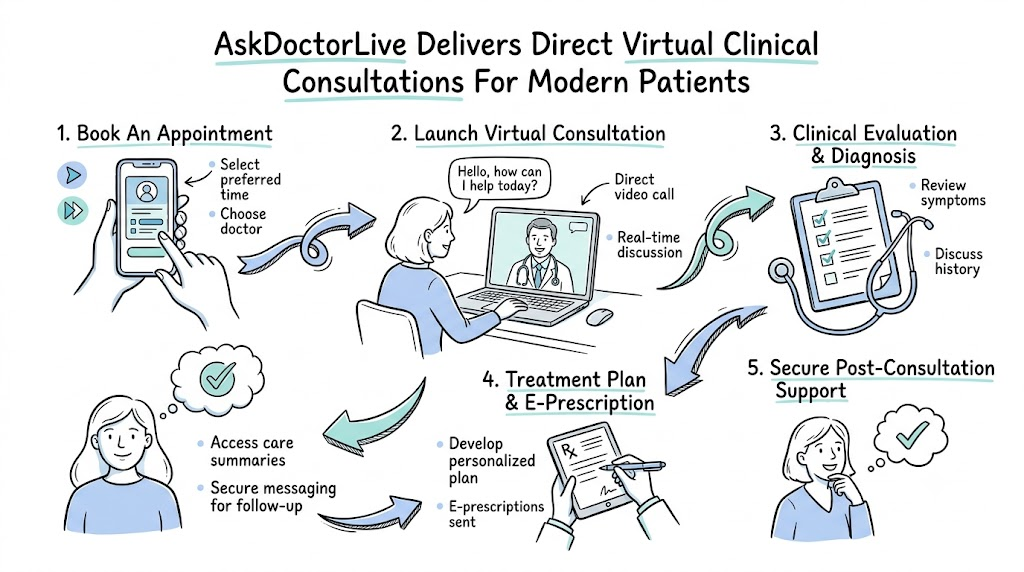
An online doctor consultation connects a patient directly with a licensed physician through encrypted digital pathways. People interact with clinicians using high-definition video calls, direct telephone lines, or real-time text chats. During every session, doctors evaluate physical symptoms, inspect uploaded medical records, and build structured, evidence-based care plans.
+-------------------------------------------------------------------------+
|                  VIRTUAL CARE CONSULTATION WORKFLOW                     |
+-------------------------------------------------------------------------+
|  [ Patient Intake ]  -->  [ Triage & Matching ]  -->  [ Live Session ]  |
|   Enter symptoms &         Select General or           Video, Call,     |
|   upload reports           Specialist Doctor           or Secure Chat   |
+-------------------------------------------------------------------------+
                                     |
                                     v
+-------------------------------------------------------------------------+
|  [ Post-Consult Plan ] <-- [ Medical Assessment ] <-- [ Guidance ]      |
|   Prescription review &    Differential diagnosis &    Clear next steps |
|   follow-up timeline       lifestyle recommendations   and monitoring   |
+-------------------------------------------------------------------------+
Modern clinical platforms enable doctors to recommend over-the-counter remedies, interpret diagnostic reports, and issue digital prescriptions when clinically appropriate. Industry research indicates that remote digital interactions successfully resolve over seventy percent of non-emergency medical questions. This system delivers comprehensive clinical guidance while saving valuable hours for patients and practitioners alike.
Why Talk to a Doctor Online?
Choosing to talk to a doctor online provides immediate convenience, schedule flexibility, and rapid access to quality medical guidance. Traditional clinic visits frequently involve congested roads, parking fees, and long waits in crowded rooms next to sick individuals. Digital healthcare brings the consultation room directly to your personal computer, tablet, or smartphone.
- Immediate Availability: Obtain prompt clinical evaluations without waiting days or weeks for an open clinic appointment slot.
- Geographic Flexibility: Consult with experienced medical specialists regardless of your regional location or local healthcare limitations.
- Cost Efficiency: Cut down expenses associated with vehicular travel, parking rates, child care arrangements, and missed work hours.
- Continuous Support: Utilize a 24/7 online doctor consultation to manage sudden non-emergency symptoms during late evening hours or weekends.
Recent healthcare studies confirm that virtual care saves patients an average of two hours per medical appointment. Consequently, digital consultations empower families to address health concerns early before minor symptoms develop into complicated illnesses.
How an Online Doctor Chat Can Help
An online doctor chat provides a fast, discrete, and highly accessible channel for resolving everyday medical questions. When you develop a mild skin irritation, an unexplained ache, or have doubts regarding medication timing, sending a secure direct message offers immediate clarity and peace of mind.
“Text-based clinical communication allows patients to articulate sensitive symptoms thoroughly while providing clinicians with structured intake notes to determine whether digital therapy or an in-person physical assessment is required.”
— Dr. Sarah Jenkins, Telemedicine Lead Specialist
Consider the scenario of a patient who experienced sudden gastrointestinal distress after taking a new multivitamin. Rather than waiting through the night with growing worry, the patient initiated a secure chat session, submitted an image of the supplement label, and explained the timeline. Within minutes, the physician identified an ingredient sensitivity, recommended immediate discontinuation, and outlined simple dietary steps that completely relieved the discomfort within twenty-four hours.
Choosing the Right Type of Consultation
Selecting the right clinical department ensures an accurate assessment and a targeted recovery strategy. Virtual platforms offer various dedicated specialty tracks tailored to specific patient requirements and medical conditions.
| Specialty Track | Primary Focus Areas | Typical Symptoms Addressed | Recommended Interaction |
|---|---|---|---|
| General Physician | Everyday wellness, chronic disease, preventive care | Cold, flu, fever, headaches, fatigue, blood pressure | Video Call or Chat |
| Dermatology | Skin, hair, nail conditions | Acne, eczema, psoriasis, rashes, hair shedding | High-Res Photo + Video |
| Gynecology | Female reproductive health, hormonal balance | Irregular periods, PCOS, fertility questions, menopause | Secure Video / Private Chat |
| Pediatrics | Infant, child, and adolescent wellness | Teething, mild viral rashes, growth, childhood diet | Video Consultation |
An online general physician consultation handles broad medical questions, manages chronic symptoms, and guides overall wellness. Conversely, an online dermatologist consultation focuses on visual assessments of rashes, breakouts, and chronic skin concerns. For women managing hormonal changes or menstrual irregularity, an online gynecologist consultation provides private, empathetic guidance. Finally, an online pediatrician consultation supports concerned parents by reviewing infant feeding patterns, childhood growth metrics, and common viral infections.
What Is an Online Medical Second Opinion?
An online medical second opinion involves having an independent, qualified specialist review your initial diagnosis, imaging results, laboratory findings, and proposed surgical plans. Medical decisions often involve complex choices, and confirming a diagnosis provides essential peace of mind.
           THE "C.A.R.E." SECOND OPINION FRAMEWORK
┌─────────────────────────────────────────────────────────┐
|  C - Collect Complete Medical Records and Scans         |
├─────────────────────────────────────────────────────────┤
|  A - Analyze Initial Diagnosis & Proposed Treatment     |
├─────────────────────────────────────────────────────────┤
|  R - Review Alternative Therapies with Independent MD   |
├─────────────────────────────────────────────────────────┤
|  E - Execute Confident, Informed Healthcare Choices     |
└─────────────────────────────────────────────────────────┘
Clinical research highlights that independent second opinions lead to refined or altered treatment pathways in up to twenty percent of complex diagnoses. Through this virtual pathway, you can consult premier specialists across the country without dealing with expensive travel logistics, hotel accommodations, or extended time away from work.
How to Prepare for an Online Consultation
Careful preparation significantly enhances the efficiency and depth of your virtual medical appointment. Organizing your symptoms, diagnostic records, and specific questions beforehand allows your physician to evaluate your condition quickly.
- Document Your Symptoms: Note exact onset dates, pain intensity on a scale from one to ten, and any factors that relieve or worsen the discomfort.
- Compile Medication Lists: Write down all prescription drugs, over-the-counter tablets, vitamins, and dietary supplements alongside exact dosages.
- Gather Medical Records: Assemble recent blood test panels, imaging reports, allergy lists, and summaries of past surgeries.
- Prepare Questions: Write down your top three medical concerns to ensure you cover every essential issue during your appointment.
- Optimize Your Tech Setup: Verify that your camera, microphone, and internet connection function smoothly in a quiet, well-lit room before the call begins.
Adhering to this structured preparation checklist prevents missed clinical details and ensures a highly focused, productive discussion with your doctor.
How to Communicate Effectively With a Doctor Online
Clear and precise communication serves as the foundation for accurate virtual diagnostic evaluations. Because the consulting physician cannot physically palpate your abdomen or listen to your lungs with an in-person stethoscope, your verbal descriptions serve as essential diagnostic data.
- Be Specific and Honest: Describe the exact characteristics of your discomfort using clear words such as sharp, dull, burning, or throbbing.
- Maintain Visual Clarity: Position yourself in front of a steady light source so the physician can clearly evaluate your facial expressions, throat, or skin.
- Confirm Understanding: Paraphrase crucial advice back to the practitioner to verify dosage instructions, warning signs, and follow-up milestones.
- Ask Direct Questions: Request immediate clarification if any medical terminology, treatment options, or drug interactions sound confusing.
Active cooperation between patient and doctor ensures that your virtual session translates into a safe, well-understood, and practical care plan.
What Online Consultation Cannot Do
Virtual consultations provide remarkable speed and convenience, but telemedicine operates within distinct clinical boundaries. Understanding these limitations protects your health and ensures you use digital healthcare appropriately.
- Emergency Management: Remote consultations cannot manage acute chest pressure, massive trauma, respiratory distress, or stroke indicators.
- Hands-on Physical Exams: Virtual doctors cannot execute deep reflex checks, abdominal palpations, or inner ear otoscopic examinations.
- Controlled Substances: Telehealth doctors cannot legally prescribe restricted narcotics or controlled sedatives during remote consultations.
- Immediate In-Office Procedures: Virtual clinics cannot perform wound suturing, biopsy collection, bone setting, or abscess drainage.
Recognizing these clinical boundaries ensures you leverage digital care for appropriate non-emergency concerns while visiting physical medical facilities when manual procedures are necessary.
When You Should Seek Emergency Care
Certain severe symptoms require immediate physical evaluation in an emergency department rather than a scheduled digital meeting. Recognizing these critical warning signs is essential for personal safety.
- Sudden numbness, localized weakness, or facial paralysis on one side of the body
- Crushing chest tightness radiating toward the left shoulder, jaw, or neck
- Extreme shortness of breath, gasping, or visible discoloration around the lips
- A sudden, explosive headache distinctly different from any prior headache
- Uncontrolled, heavy bleeding that does not stop after sustained manual pressure
- Sudden confusion, slurred speech, acute dizziness, or unexpected loss of consciousness
If you or a family member develop any of these warning signs, contact local emergency medical services immediately or go to the nearest emergency hospital.
Protecting Your Health Information Online
Data privacy remains a vital requirement for digital healthcare services. Established telemedicine systems use rigorous technological protections to ensure that sensitive health discussions and medical files remain strictly confidential.
- End-to-End Encryption: Virtual consultation platforms utilize advanced encryption protocols to secure live video streams and chat histories.
- Regulatory Compliance: Professional systems adhere to international patient privacy laws and healthcare data security regulations.
- Secure Storage: Medical records, uploaded lab files, and prescription archives are stored in protected databases with strict role-based access.
- Patient Discretion: Ensure you attend virtual appointments on secure, password-protected private home networks instead of unsecured public Wi-Fi.
These combined technical safeguards ensure that your private medical records and personal health conversations remain confidential and protected.
Common Mistakes During Online Doctor Visits
Patients occasionally make avoidable mistakes that can diminish the value of their remote consultation. Being aware of these common pitfalls ensures a productive clinical encounter.
       COMMON TELEHEALTH PITFALLS AND SOLUTIONS
┌──────────────────────────────┬──────────────────────────────┐
|       Common Mistake         |       Effective Solution     |
├──────────────────────────────┼──────────────────────────────┤
| Multi-tasking during call    | Sit in a quiet, private room |
| Withholding lifestyle habits | Disclose full health history |
| Poor lighting on rashes      | Use natural, direct light    |
| Unclear timeline of illness  | Keep written symptom notes   |
└──────────────────────────────┴──────────────────────────────┘
Steering clear of these common missteps allows your consulting physician to assess your symptoms accurately and provide actionable health recommendations.
How to Get More Value From AskDoctorLive
Getting optimal results from AskDoctorLive requires active participation and structured preparation. Approaching your appointments with organized information enables you to maximize the benefits of this modern telemedicine platform.
AskDoctorLive connects you with qualified doctors across general medicine, dermatology, pediatrics, and gynecology, providing access to professional medical opinions around the clock. By reviewing physician credentials, uploading previous lab reports before your call, and maintaining an organized record of your symptoms, you help the consulting doctor deliver precise guidance. Taking advantage of the platform’s flexible scheduling and secure messaging allows you to manage ongoing health concerns smoothly and efficiently.
Online Healthcare for Different Stages of Life
Virtual healthcare platforms adapt smoothly to accommodate the varying medical requirements of every family member across all stages of life.
- Pediatric Years: Parents consult pediatricians regarding infant feeding concerns, mild viral rashes, growth milestones, and routine immunization queries.
- Adulthood & Career Years: Working adults obtain fast medical advice for work-related fatigue, digestive imbalances, tension headaches, and allergy management.
- Women’s Health Journeys: Women access specialized guidance for reproductive wellness, prenatal questions, menstrual irregularities, and menopausal care.
- Senior Years: Older adults monitor chronic conditions like hypertension, review polypharmacy schedules, and evaluate joint discomfort from home.
Telehealth offers personalized, accessible medical support designed to serve your family through every phase of life.
Frequently Asked Questions About AskDoctorlive
- Which steps complete a consultation booking on AskDoctorLive?Patients open an account on the platform, choose the needed medical specialty, pick an available doctor, and launch an instant chat or reserve a video appointment.
- Can physicians on AskDoctorLive provide valid digital prescriptions?Qualified doctors issue official digital prescriptions for standard, non-controlled medications whenever clinical evaluations justify treatment.
- Does an online chat handle sudden medical emergencies?Real-time chat resolves everyday symptoms and general questions, but critical emergencies require immediate in-person emergency room attention.
- Which electronic devices support a remote doctor appointment?Users need a steady internet connection paired with a smartphone, tablet, or laptop containing a functional webcam and microphone.
- How many minutes does a typical telehealth visit take?Most virtual sessions run between ten and twenty minutes, which gives doctors ample time to assess complaints and outline therapeutic steps.
- Can patients upload previous laboratory files for physician review?Users attach blood panels, diagnostic scans, and medical history documents directly inside their encrypted consultation portal before sessions begin.
- Do virtual consultation portals protect personal health records securely?Telehealth networks apply high-grade encryption protocols that fully comply with international medical confidentiality and data privacy standards.
- Can patients request an online medical second opinion for surgery?Board-certified specialists review prior clinical findings, imaging reports, and suggested operations to provide independent clinical assessments.
- Can parents discuss newborn concerns with an online pediatrician?Families consult certified pediatric specialists regarding infant feeding schedules, skin rashes, sleeping issues, and standard developmental markers.
- What happens if an unexpected network drop disconnects the video call?Patients log right back into their personal dashboard to reconnect with their physician or finish the visit via secure messaging.
Final Thoughts
Taking control of personal health becomes straightforward and reliable through virtual medical appointments. Digital telemedicine removes clinic travel delays, congested waiting rooms, and unnecessary appointment friction. Whether you require general guidance from a family physician, targeted care from a dermatologist, or independent clarity from a second opinion, remote consultations offer trustworthy clinical solutions. Connect with licensed healthcare professionals through AskDoctorLive today to experience timely, compassionate medical support from the comfort of home.