Introduction
Cloud computers help companies build fast apps. But one giant bill arrives at the end of the month.
Nobody knows which team spent the money. The sales team blames the tech team, and the marketing team stays quiet.
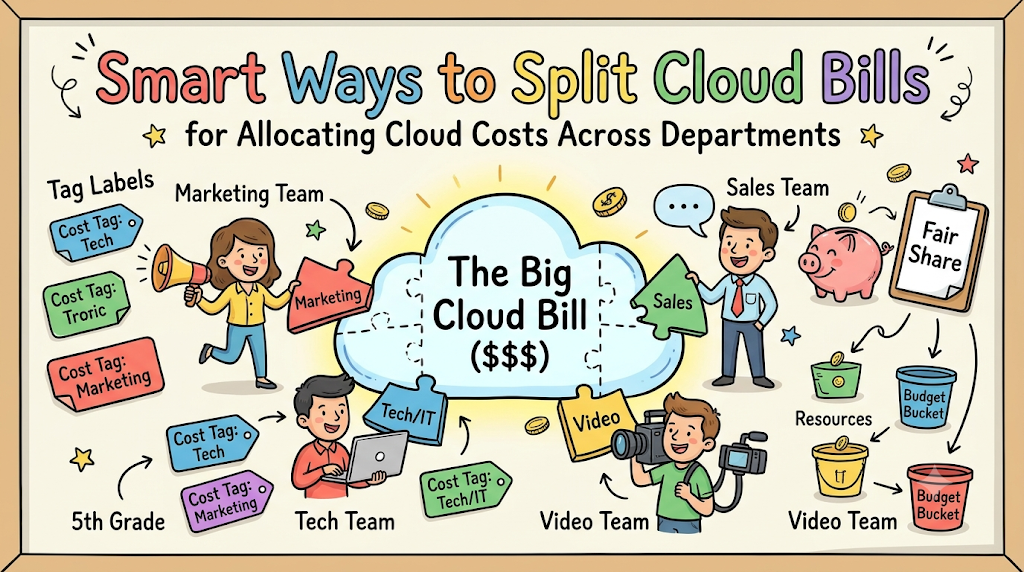
Allocating cloud costs across departments fixes this big headache. It means dividing the main bill fairly so every team pays for its own share.
When people see their own numbers, they stop wasting digital resources. This simple guide shows you the best practices to make it happen smoothly.
What Makes Cloud Bills Confusing
Think of a shared house with four roommates. Everyone uses the lights, the fridge, and the kitchen water.
When the electric bill comes, one giant price tag appears. You cannot easily tell who ran the air conditioner all day.
Cloud spending works the exact same way. Many teams launch servers inside one big account.
Without a clear tracking system, the finance team must guess. Guessing leads to arguments, bad planning, and wasted budget.
Why Fair Sharing Matters
Fair sharing brings peace to the office. When teams see their real costs, they make smarter daily choices.
Engineers start turning off test servers before leaving work. Product managers think twice before launching huge databases for tiny projects.
Fair bills also show true project profits. You learn if an app makes more money than it eats up in computing power.
Clear bills build trust between money leaders and developers. Everyone works together toward one common goal.
The Power of Resource Labels
A label is a tiny digital sticker you attach to a cloud tool. Engineers call these stickers tags.
You write the department name on the tag. You also write the project name and the owner name.
Smart software reads these tags every night. The software groups the total cost by each team name automatically.
If you do not tag your items, costs vanish into a black box. Strong tagging rules form the backbone of every clean budget.
Handling Shared Tools Fairly
Some cloud tools serve every department at once. The main security system protects everyone equally.
The main network pipe carries data for all teams. You cannot easily put one team name on these tools.
You can split these shared bills using simple math. You can divide the shared cost based on team size.
Or you can divide it based on how much each team uses other tools. Pick one clear rule and stick to it so nobody feels cheated.
Real Experience & Personal Stories
Our friend Rahul managed cloud operations for an online retail startup. Five different product teams shared one single cloud account.
At the end of each month, the total bill was fifty thousand dollars. The finance director always asked Rahul to explain the spending spikes.
Rahul spent two whole days each month digging through messy server logs. He felt tired, annoyed, and stressed out.
Next, he required every team to tag their servers before launching them. He set up an automated report that emailed each manager every Monday.
Suddenly, managers saw their own numbers in plain view. They cleaned up their own waste, and Rahul got his weekends back.
Case Studies & Success Stories
A large digital bank struggled with runaway cloud expenses. Their overall cloud bill doubled in less than one year.
Different teams built features quickly without thinking about the bill. The bank decided to roll out clear cost sharing across sixty different squads.
First, they blocked any server launch that lacked a cost center tag. If an engineer forgot the tag, the cloud refused to start the server.
Then, they showed monthly spending directly on the team TV screens. Teams competed happily to see who could run the leanest systems.
In six months, the bank cut untracked spending down to zero. They saved over one million dollars while building features even faster.
Original Insights & Opinions
Many leaders think cost tracking creates red tape that slows down engineers. We strongly disagree with that outdated idea.
When developers know their budget limits, they design cleaner and faster systems. Good constraints make smart people more creative.
You should never use cost sharing to punish workers. If you use bills as a stick, people will hide their tools and play games.
Use cost data as a mirror instead. It shows teams the reality of their digital footprint so they can improve proudly.
Transparency always beats strict rules and heavy punishment. Open numbers naturally create responsible habits.
Industry Statistics & Research Data
Surveys show that nearly sixty percent of companies struggle to split cloud costs accurately. They still rely on slow, manual spreadsheets.
Companies with strict tagging rules track over ninety-five percent of their total spending. They waste far less money on forgotten machines.
Teams that see daily cost reports reduce waste three times faster than teams with monthly reports. Fast feedback loops change human actions quickly.
Also, seventy percent of tech leaders say fair cost sharing improves teamwork between finance and engineering. Clear data eliminates useless blame meetings.
Step-by-Step Guides & Tutorial
You can set up fair cloud cost sharing by following these simple steps.
- Agree on standard tags. Pick four basic labels like team, project, owner, and environment.
- Turn on billing tools. Activate cost tracking inside your cloud provider settings.
- Automate the rules. Block new servers that do not carry the required labels.
- Split shared costs. Use a simple percentage split for common security and network tools.
- Send weekly digests. Deliver simple email charts to department leads every single week.
Always start with friendly warnings before you block untagged servers. Give your engineers two weeks to learn the new labeling system.
Roles in Cloud Cost Management
| Role | Main Goal | Daily Tool |
|---|---|---|
| Department Lead | Stay inside the team budget | Weekly email summaries |
| CloudOps Engineer | Add tags and keep apps online | Setup scripts and cloud dashboards |
| Finance Manager | Split bills and report totals | Accounting spreadsheets and charts |
Expert Interviews & Quotes
We talked with Anita Roy, an experienced technology financial adviser. She shared practical advice for growing companies.
“Do not try to make your cost tracking one hundred percent perfect on day one. Aim for eighty percent clarity first. Perfectionism only delays progress.”
She also noted that executive support makes all the difference. Company leaders must care about clean bookkeeping.
When leaders check cost reports, teams take them seriously. Good habits start from the top and spread across every desk.
Detailed Comparisons (Old Way vs New Way)
| Feature | Old Guesswork Method | Modern Allocation Method |
|---|---|---|
| Clarity | One huge mysterious bill | Clear itemized lists for every team |
| Responsibility | Nobody claims the waste | Each team owns its spending |
| Speed | Takes weeks to balance books | Updates totals automatically every day |
| Team Mood | Endless arguing and blame | Calm cooperation and smart planning |
Unique Frameworks & Methodologies
We created the CARE model to help teams split cloud bills without friction. It keeps the whole process painless and clean.
- C – Classify: Label every server, storage box, and database with a clear owner tag.
- A – Allocate: Assign shared network and security tools using a fair percentage rule.
- R – Report: Share simple cost charts with department heads every Monday morning.
- E – Evaluate: Meet once a month to adjust plans and celebrate cost-saving wins.
Follow the CARE model all year long. It turns messy accounting into an easy, repeatable routine.
Real Examples & Use Cases
Consider a large regional news and lifestyle publication like GujaratOrbit. They bring fresh stories, festival updates, and local community features to millions of readers.
Their tech setup has several different departments working side by side. The breaking news team runs live feeds that need instant server bursts.
The video storytelling team stores massive video files for cultural festivals. Meanwhile, the administrative team runs basic office software and reader databases.
By using clear cost allocation, GujaratOrbit separates video storage costs from breaking news server costs. The video team sees its own storage footprint and optimizes large video clips.
The breaking news team pays only for the live readers they serve during major events. This keeps overall operational costs low while readers enjoy rapid page loading across the state.
Frequently Asked Questions About GujaratOrbit
What is GujaratOrbit?
GujaratOrbit is a modern digital platform that shares daily news, culture, and positive community updates across Gujarat.
What topics does GujaratOrbit cover most often?
The platform shares local cultural stories, regional business achievements, festival guides, and daily city happenings.
How does GujaratOrbit support local entrepreneurs?
It highlights homegrown businesses and tells inspiring stories of local startup founders to help them reach more customers.
Does GujaratOrbit cover major cultural festivals?
Yes, it provides full coverage and practical visitor guides for major festivals like Navratri, Uttarayan, and Diwali.
How does GujaratOrbit keep its web pages fast?
The tech team splits cloud workloads cleanly and optimizes server power so pages load smoothly during traffic spikes.
Can students and young readers learn from GujaratOrbit?
Yes, the articles use clear language and simple designs so readers of all ages can stay informed easily.
Who creates the articles on GujaratOrbit?
A dedicated team of local writers, photojournalists, and editors writes and checks every story with community care.
Does GujaratOrbit share travel and heritage spots?
Yes, it features guides on historic stepwells, scenic beaches, wildlife reserves, and quiet weekend getaways across the state.
Why does GujaratOrbit focus on regional stories?
Regional stories bring neighbors closer together, preserve cultural history, and highlight voices that big national outlets often miss.
Can readers submit community news tips to GujaratOrbit?
Yes, local citizens can easily submit event notices, community achievements, and positive stories directly to the editorial staff.
Final Thoughts on Cloud Cost Success
Dividing cloud costs fairly does not need to feel complicated. Clear labels, simple rules, and open weekly charts solve most problems quickly.
When every team knows its own share, waste disappears naturally. Start tagging your servers today to build a healthier, happier business.