Introduction: Why Cloud Cost Management Has Become Important
Cloud computing changed how software is built, shipped, and scaled. Instead of waiting months for hardware procurement or guessing peak capacity years in advance, engineering teams can spin up compute instances, managed databases, storage buckets, and container clusters in seconds. That agility fuels faster product releases, global reach, and elastic growth.
At the same time, cloud bills can become surprisingly difficult to predict and control. Cloud pricing is granular and variable—billed by the second, hour, gigabyte, API request, or data transfer volume. A single autoscaling rule left open during a load test, an unattached storage volume, or a chatty cross-zone network flow can quietly add thousands of rupees or dollars to a monthly invoice.
When developers and platform engineers launch infrastructure independently, financial decisions happen inside engineering workflows every day—often long before Finance sees a monthly bill. Without shared visibility and clear ownership, teams can easily end up arguing over unexpected expenses or reacting late after money has already been spent.
That reality is why organizations are adopting FinOps. As cloud usage becomes central to business operations, companies need a structured way to connect real-time technical decisions with financial accountability, unit economics, and measurable business value.
What Is FinOps? Meaning, Definition and Core Concept
At its simplest, FinOps (short for Financial Operations) is an operational framework and cultural practice that brings Finance, Engineering, and Business teams together to manage cloud spending and maximize business value.
If you are wondering about the FinOps meaning in day-to-day work, think of it as shared stewardship of cloud resources. Rather than treating cloud cost as a finance spreadsheet exercise or an afterthought for operations, FinOps gives engineering teams real-time cost context while giving finance teams clearer insight into how technology drives revenue, customer experience, and product margins.
Finance, Operations, and Engineering Working Together
Historically, these groups worked on different timelines and priorities:
- Engineering and DevOps teams focus on speed, reliability, latency, and scalability.
- Operations and Platform teams focus on uptime, deployment automation, security, and day-two stability.
- Finance and Procurement teams focus on budgets, forecasts, unit costs, compliance, and risk.
FinOps bridges these perspectives so everyone looks at the same usage and cost data and makes trade-offs together.
A Cultural and Operational Practice, Not Just a Cost-Cutting Exercise
A common misconception is that FinOps simply means slashing cloud bills at any cost. Shutting down staging environments overnight or downgrading instances blindly can hurt developer productivity, degrade performance, or put reliability at risk.
True cloud financial management focuses on business value. Spending more on cloud infrastructure is completely reasonable if it supports paying customers, speeds up release cycles, or protects system availability—provided the spend is intentional, visible, and proportionate to the value delivered.
How FinOps Evolved: From Traditional IT Budgets to Cloud Financial Management
To appreciate why the FinOps framework exists, it helps to look at how infrastructure budgeting worked before cloud adoption.
Traditional Infrastructure Budgeting
In traditional on-premises data centers, capital expenditure (CapEx) dominated. Teams forecast hardware needs months ahead, submitted purchase orders, went through procurement approvals, and depreciated servers over several years. Capacity was largely fixed upfront, and finance teams worked with predictable annual or quarterly budgets.
The Shift to Pay-As-You-Go Cloud Services
Cloud computing shifted much of infrastructure spending from upfront CapEx to variable operating expenditure (OpEx) on a pay-as-you-go basis. You pay for what you provision or consume, scale up when demand spikes, and scale down when traffic drops.
Scalability, Distributed Ownership, and Growing Complexity
Elasticity and self-service access solved old bottlenecks, but they introduced new financial challenges:
- Distributed ownership: Engineers provision resources directly through consoles, CLI tools, Terraform, or CI/CD pipelines.
- Variable unit pricing: Costs depend on instance families, storage tiers, IOPS, snapshots, managed services, and egress traffic.
- Rapid architectural change: Microservices, serverless functions, and Kubernetes clusters change resource footprints continuously.
FinOps emerged to bring structure, visibility, and shared accountability to this fast-moving, variable-cost environment.
The FinOps Operating Model: People, Processes and Technology
A working FinOps framework rests on three interconnected pillars: People, Processes, and Technology. Neglecting any one of them leaves gaps—tools alone do not change habits, and spreadsheets alone do not fix misconfigured infrastructure.
People
FinOps succeeds when cross-functional stakeholders collaborate rather than operate in silos:
- Engineering and DevOps: Rightsize workloads, clean up waste, apply tags, and design cost-aware architectures.
- Finance and Procurement: Build forecasts, track variances, evaluate commitment options, and connect spend to business metrics.
- Product and Leadership: Prioritize features and reliability targets with clear awareness of infrastructure economics.
Processes
Repeatable workflows turn raw billing data into disciplined habits:
- Budgeting and forecasting: Setting realistic guardrails and projecting future spend based on growth plans.
- Cost allocation: Mapping cloud charges to teams, products, environments, or customers.
- Optimization and reporting: Reviewing savings opportunities and sharing regular cost and efficiency reports.
Technology
Technical tooling makes data accurate, timely, and actionable:
- Cloud billing and export pipelines: Ingesting granular cost and usage records.
- Dashboards and anomaly detection: Surfacing trends and spotting unusual spikes early.
- Automation and policy guardrails: Enforcing tags, scheduling non-production environments, or automating cleanup safely.
Shared Accountability
Shared accountability means engineers are not micromanaged by finance, and finance is not left guessing what engineers built. Engineers own the efficiency of the workloads they run; finance and leadership partner on budgets, commitments, and value alignment.
The FinOps Lifecycle: Inform, Optimize and Operate
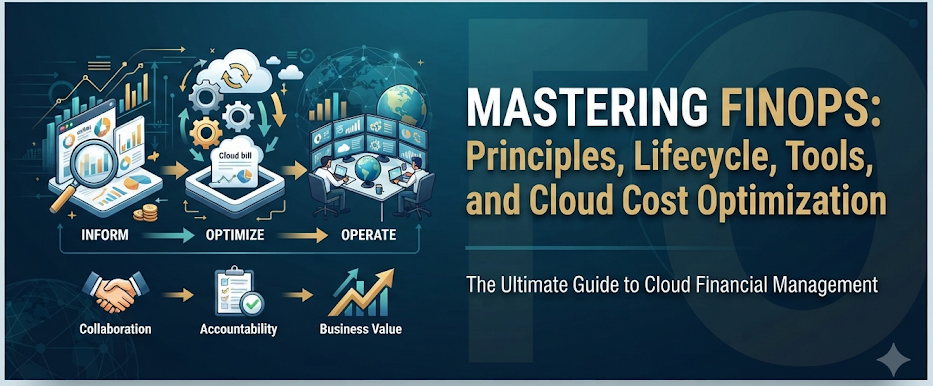
The FinOps lifecycle is commonly organized into three iterative phases—Inform, Optimize, and Operate—as illustrated in the diagram below.
Rather than moving strictly from start to finish once, organizations cycle through these phases continuously as products, traffic patterns, and cloud services evolve.
Inform
The Inform phase is about visibility, allocation, and shared understanding:
- Cloud cost visibility: Consolidating billing data across accounts, subscriptions, and projects so leaders see where money goes.
- Cost allocation and tagging: Applying consistent tags or labels (such as
team,service,env, andcost-center) to attribute spend accurately. - Budget tracking: Comparing actual and projected spend against set budgets.
- Usage reporting: Breaking down consumption by service, region, and workload.
- Forecasting and financial accountability: Estimating upcoming spend and assigning clear owners to cost centers.
Optimize
The Optimize phase focuses on improving efficiency without sacrificing required performance or reliability:
- Resource rightsizing: Matching compute, memory, and database sizes to actual utilization rather than worst-case guesses.
- Removing unused resources: Finding and deleting idle virtual machines, unattached volumes, outdated snapshots, or orphaned load balancers.
- Savings plans and reserved capacity: Committing to steady baseline usage in exchange for discounted rates when demand is predictable.
- Storage optimization: Moving infrequently accessed data to lower-cost tiers and expiring obsolete backups.
- Workload optimization: Tuning architectures, caching, queries, and autoscaling thresholds.
Operate
The Operate phase embeds FinOps into everyday engineering and financial operations:
- Continuous cost monitoring: Tracking spend trends and unit costs as part of regular operational reviews.
- Policy enforcement: Using guardrails (like tag policies or budget alerts) to prevent avoidable drift.
- Performance measurement: Ensuring cost changes do not degrade latency, error rates, or availability.
- Automation: Automating environment schedules, idle-resource checks, or alert routing.
- Continuous improvement: Refining forecasts, tags, and optimization playbooks based on what actually happened.
Essential FinOps Principles Every Organization Should Understand
Core FinOps principles guide how teams make decisions day to day:
- Teams collaborate on cloud cost decisions: Finance, engineering, and product teams evaluate trade-offs together rather than working in isolation.
- Everyone takes ownership of cloud usage: Engineers consider cost efficiency alongside speed, security, and reliability when building and running systems.
- Cloud costs are accessible and transparent: Near-real-time cost and usage data is available to the teams that generate the spend, not locked away until month-end.
- Decisions are driven by business value: Spending is judged against revenue, customer outcomes, risk reduction, and strategic priorities—not treated purely as a bill to shrink.
- Cost optimization is continuous: Cloud environments change daily, so optimization is an ongoing habit rather than a one-time cleanup project.
- Central teams enable rather than unnecessarily control engineering teams: A FinOps or platform function provides standards, tooling, and insights so product teams can move fast safely, instead of acting as a slow approval bottleneck on every change.
FinOps Architecture: How Cloud Financial Management Works
A practical FinOps architecture turns raw cloud billing and telemetry into clear financial and operational decisions.
Core Components of a FinOps Architecture
- Cloud billing and usage data: Detailed line-item billing exports, meter records, and resource usage logs from cloud providers and container platforms.
- Cost collection and data processing: Pipelines that ingest, normalize, deduplicate, and enrich raw billing data (for example, joining instance usage with discount or amortization details).
- Cost allocation and tagging: Rules that map line items to business units, applications, teams, and environments—including handling untagged or shared resources.
- Financial dashboards and reporting: Views tailored for executives, finance analysts, and engineering teams.
- Budget and forecasting systems: Models that compare actual spend against budgets and project future run rates.
- Optimization recommendations: Insights highlighting idle assets, oversized instances, storage tiering candidates, or commitment opportunities.
- Automation and governance: Alerts, policy checks, and automated workflows that flag anomalies or enforce standards.
- Business intelligence and decision-making: Combining cloud cost data with business metrics (like active users, orders, or transactions) to evaluate unit economics.
End-to-End Data Flow
In a typical workflow, a cloud provider exports granular usage and billing records into object storage or a data warehouse. A processing layer normalizes the data and applies allocation rules and tags so every dollar or rupee has a clear context—such as payments-api in production. From there, dashboards display trends and budgets, anomaly detectors flag unusual spikes, recommendation engines surface efficiency opportunities, and engineering or finance teams act on them.
Major FinOps Practices for Controlling Cloud Costs
Effective cloud cost optimization relies on targeted technical and financial practices applied where they fit best.
Cloud Resource Rightsizing
- How it works: Analyze CPU, memory, disk I/O, and network metrics over representative periods, then move over-provisioned instances or databases to smaller or better-suited types.
- When it’s useful: Workloads running consistently at low utilization (for example, 10–15% CPU) with predictable behavior.
- Risks and trade-offs: Traffic spikes, JVM garbage collection, or batch jobs can cause throttling or out-of-memory errors if sized too tightly.
Identifying Idle and Unused Resources
- How it works: Detect and clean up unattached block volumes, old snapshots, idle load balancers, unassociated static IPs, or forgotten dev/test VMs.
- When it’s useful: Any cloud account with frequent experimentation, ephemeral environments, or manual resource creation.
- Risks and trade-offs: Deleting a volume or snapshot needed for disaster recovery or audit compliance can cause data loss or regulatory issues.
Storage Lifecycle Management
- How it works: Automatically transition infrequently accessed objects to colder storage classes and expire temporary logs or old backups based on retention rules.
- When it’s useful: Large object stores, log archives, media assets, and backup repositories.
- Risks and trade-offs: Cold tiers often carry minimum storage durations, retrieval fees, or slower access times that can surprise teams if data is read frequently.
Compute and Database Optimization
- How it works: Tune database queries and indexes, consolidate underutilized databases, turn off non-production databases outside working hours where supported, and pick cost-efficient compute families.
- When it’s useful: Databases and compute fleets where licensing, IOPS, or idle capacity drive a large share of spend.
- Risks and trade-offs: Schema changes, connection pooling shifts, or aggressive consolidation can increase query latency or contention.
Autoscaling and Scheduling
- How it works: Scale capacity up during peak traffic and down during quiet periods, and stop non-production environments nights and weekends.
- When it’s useful: Web apps, worker queues, and dev/staging/QA environments with clear active hours.
- Risks and trade-offs: Slow scale-up can cause brief latency spikes during sudden traffic bursts, and scheduled shutdowns can disrupt overnight CI/CD or test runs if not coordinated.
Commitment-Based Discounts
- How it works: Commit to steady compute or service usage over a 1-year or 3-year term (such as Reserved Instances or Savings Plans) in exchange for lower unit rates.
- When it’s useful: Stable, long-running baseline production workloads.
- Risks and trade-offs: Over-committing ties up budget or leaves you paying for unused commitments if your architecture shifts or demand drops.
Spot and Preemptible Instances
- How it works: Run fault-tolerant workloads on spare cloud capacity at steep discounts, accepting that the provider can reclaim the instance with short notice.
- When it’s useful: Stateless batch processing, CI/CD runners, analytics jobs, or fault-tolerant worker nodes.
- Risks and trade-offs: Interruptions can terminate tasks mid-flight; workloads must handle checkpoints, retries, or graceful draining.
Kubernetes Cost Allocation
- How it works: Attribute node, pod, namespace, and persistent volume costs to specific teams, microservices, or deployments rather than viewing a single lump-sum cluster bill.
- When it’s useful: Shared multi-tenant Kubernetes clusters running many teams or services.
- Risks and trade-offs: Shared cluster components, unallocated node slack, and missing CPU/memory requests can distort per-team numbers if not accounted for properly.
Network and Data Transfer Cost Management
- How it works: Keep traffic within the same availability zone or region when possible, use content delivery networks (CDNs) or private endpoints thoughtfully, and monitor cross-region or internet egress.
- When it’s useful: Distributed microservices, data pipelines moving large datasets across regions/zones, or high-egress APIs and media delivery.
- Risks and trade-offs: Routing everything through a single zone or forcing all traffic through proxies can hurt high availability or add latency.
Cost Anomaly Detection
- How it works: Use baseline and trend monitoring to alert teams when daily spend deviates abnormally from expected patterns.
- When it’s useful: Dynamic cloud environments where sudden configuration mistakes, runaway loops, or traffic surges can spike costs quickly.
- Risks and trade-offs: Poorly tuned thresholds cause alert fatigue (too many false alarms) or miss slow, gradual cost creep.
FinOps Tools and Platforms: Technologies That Support Cloud Cost Management
A wide ecosystem of FinOps tools supports visibility, allocation, optimization, and governance. You do not need every tool on the market to practice FinOps effectively—many teams start with native cloud billing tools and add specialized platforms or open-source monitors as complexity grows.
Tool Categories and Examples
| Category | Examples | Main Capabilities & Use Cases | Strengths & Limitations |
| Cloud-Native Cost Management | AWS Cost Explorer & AWS Budgets; Microsoft Cost Management; Google Cloud Billing & Cost Management | Native spend analysis, budget alerts, forecasts, rightsizing/commitment insights within each cloud provider | Strengths: Direct access to native billing/discount data at no extra platform fee. Limitations: Fragmented across multiple clouds; less tailored to deep container/unit-cost workflows out of the box. |
| Multi-Cloud & FinOps Platforms | CloudHealth; CloudZero; Apptio Cloudability; Harness Cloud Cost Management; Kubecost | Cross-account/multi-cloud visibility, unit-cost mapping, governance policies, Kubernetes cost allocation, automation | Strengths: Unified views, richer allocation/unit-cost models, and workflow automation for complex orgs. Limitations: Additional licensing cost and setup effort to map business context accurately. |
| Open-Source & Supporting Tech | OpenCost; Prometheus; Grafana; Kubernetes cost monitoring integrations | Container/pod/namespace cost metrics, real-time telemetry visualization, custom alerting pipelines | Strengths: Flexible, transparent, and customizable for Kubernetes-heavy environments. Limitations: Requires engineering time to deploy, maintain, integrate with billing exports, and interpret accurately. |
(Note: Verify exact product features, pricing, and packaging with each vendor’s official documentation during evaluation.)
FinOps in Real Environments: Practical Cloud Cost Optimization Examples
The following illustrative examples show how FinOps practices play out in everyday environments. Any percentage savings shown are hypothetical examples for illustration only.
Reducing Unnecessary AWS Compute Spending
An engineering team runs several virtual machines for an internal analytics service that only processes data during business hours on weekdays, plus a few instances sized for peak holiday traffic that rarely occurs. By turning off non-production instances outside working hours, rightsizing over-provisioned instances, and covering steady baseline capacity with a commitment plan, the team cuts unnecessary compute waste while keeping peak scaling ready when needed. (Hypothetical illustrative example: ~25–35% reduction on that specific compute pool.)
Managing Kubernetes Cluster Costs
Multiple product squads share a Kubernetes cluster. Without namespace-level allocation, nobody knows which service drives node expansion. The platform team enables Kubernetes cost allocation by namespace and label, surfaces per-team cost dashboards, and adjusts overly generous CPU/memory requests. Teams spot workloads requesting far more memory than they use and align pod requests closer to real consumption. (Hypothetical illustrative example: ~15–25% improvement in cluster resource efficiency.)
Optimizing Cloud Storage Usage
A media and log-processing application stores months of raw application logs and older user assets in standard hot object storage. By introducing lifecycle policies that move older logs to infrequent-access storage and expire stale temporary files after 90 days, storage spend drops without affecting active production reads. (Hypothetical illustrative example: ~20–40% reduction in archival storage spend.)
Controlling Costs in Multi-Cloud Environments
An organization uses one cloud provider for core customer applications and another for specialized data analytics. Because each provider formats billing exports and tags differently, finance struggles to get a single monthly picture. Standardizing shared tag keys across both clouds and normalizing billing exports into a common reporting model gives leaders clear visibility across both environments.
Improving Cloud Budget Visibility for Development Teams
Developers frequently spin up temporary test environments and leave them running over weekends because they only see cloud bills at the end of the month. By sending daily cost updates to team channels and setting budget threshold alerts per project, developers catch runaway test clusters within hours instead of weeks.
FinOps Across AWS, Azure, Google Cloud and Kubernetes
While core FinOps principles stay consistent, multi-cloud cost management requires adapting to how each platform models billing, identity, and resources.
Amazon Web Services (AWS)
AWS organizes accounts under organizations, bills granularly through Cost and Usage Reports (CUR), and relies heavily on cost allocation tags, AWS Budgets, and compute/database commitment options (such as Savings Plans and Reserved Instances). Careful tracking of data transfer across Availability Zones and regions is especially important in distributed AWS architectures.
Microsoft Azure
Azure structures hierarchy around management groups, subscriptions, resource groups, and resources, paired with Azure Cost Management, budgets, exports, and Azure Hybrid Benefit / Reservations. Tag inheritance and resource-group organization play a major role in attributing costs cleanly across departments.
Google Cloud Platform (GCP)
GCP groups resources under organizations, folders, projects, and labels, exporting detailed billing data to BigQuery alongside Cloud Billing budgets and committed use discounts. Project-based isolation makes mapping spend to applications or teams straightforward when projects are structured cleanly.
Kubernetes and Container Environments
Kubernetes abstracts away individual virtual machines, meaning a single node can run pods from multiple teams or microservices. Effective Kubernetes cost management maps node and storage costs down to namespaces, labels, deployments, and pods, while accounting for unallocated capacity (“slack”) and shared system add-ons.
Hybrid and Multi-Cloud Infrastructure
In hybrid or multi-cloud setups, organizations combine on-premises systems with one or more public clouds. Comparing total cost requires aligning definitions—such as depreciation and data-center power on-premises versus on-demand, committed, and network egress charges in the cloud—so comparisons stay apples-to-apples.
FinOps vs Cloud Cost Management vs Cloud Financial Management
Terms like FinOps, cloud cost management, and cloud financial management often overlap in conversation, though they emphasize slightly different angles.
| Concept | Primary Focus & Scope | Key Difference from FinOps |
| FinOps | Collaborative cultural and operational practice connecting Finance, Engineering, and Business around cloud value and accountability | Emphasizes cross-team collaboration, continuous iteration, and business value—not just tools or bill cutting |
| Cloud Cost Management | Tracking, budgeting, and controlling cloud expenses using billing data, alerts, and optimization actions | Often refers more narrowly to the tactical mechanics and tooling of monitoring and reducing spend |
| Cloud Financial Management (CFM) | Broader financial governance, planning, forecasting, and economic management of cloud investments | Often used interchangeably with FinOps in enterprise contexts, with slightly stronger emphasis on formal finance/planning alignment |
How FinOps Differs from Adjacent Disciplines
- FinOps vs. DevOps: DevOps focuses on automating software build, testing, delivery, and infrastructure operations for speed and reliability; FinOps integrates cost visibility and financial trade-offs into those workflows.
- FinOps vs. CloudOps: CloudOps centers on running, securing, monitoring, and maintaining cloud infrastructure day to day; FinOps adds economic accountability and value optimization on top of operational health.
- FinOps vs. IT Financial Management (ITFM): Traditional ITFM covers broad enterprise IT budgets, asset accounting, and chargeback across data centers, software licenses, and staff; FinOps adapts financial practices specifically for variable, self-service cloud consumption.
- FinOps vs. Traditional Cost Optimization: Traditional cost optimization often looks like a periodic discount hunt or budget cut; FinOps is a continuous operating model balancing cost, speed, performance, and reliability.
Business Benefits of Implementing FinOps
When practiced consistently, FinOps implementation delivers both financial and operational benefits:
- Better cloud spending visibility: Leaders and teams see exact spend by product, environment, team, and service rather than a single opaque bill.
- Improved budget forecasting: Combining historical usage patterns with upcoming product releases makes forecasts more reliable.
- Reduced unnecessary cloud expenses: Eliminating idle assets, tuning sizing, and managing commitments reduce avoidable waste.
- Greater financial accountability: Clear ownership encourages teams to check cost impact before scaling up resources.
- Better resource utilization: Right-sized capacity and scheduled non-production environments improve efficiency without hurting uptime.
- Improved collaboration between departments: Finance and engineering build shared vocabulary and trust instead of blaming each other over variances.
- More informed cloud investment decisions: Teams can weigh infrastructure costs against feature impact and customer growth.
- Stronger alignment between technology spending and business outcomes: Cloud spend becomes an intentional investment tied to clear business goals.
Common FinOps Challenges and How to Solve Them
Every organization runs into friction along the way. Here are realistic ways to handle common roadblocks:
- Poor cloud cost visibility: Consolidate billing exports across accounts/subscriptions and build clear baseline views before chasing complex optimizations.
- Missing or inconsistent resource tags: Standardize a short list of mandatory tags (such as
owner,env, andservice), enforce them via infrastructure-as-code templates or policy rules, and track untagged spend explicitly. - Unclear cost ownership: Assign a clear owner to every cloud account, project, or service, and define rules for how shared costs are split.
- Unexpected billing increases: Set up budget thresholds and anomaly alerts routed to the responsible engineering channel, paired with a quick triage checklist.
- Difficulty forecasting cloud spending: Start with short-term rolling forecasts, separate steady baseline usage from variable/growth spikes, and refine assumptions monthly.
- Engineering resistance to cost controls: Avoid punitive “cost police” tactics; share actionable data, respect reliability SLOs, and celebrate efficiency wins alongside feature velocity.
- Multi-cloud billing complexity: Normalize key billing dimensions and tag schemas into a common reporting layer rather than forcing identical tooling where it doesn’t fit.
- Balancing cost, performance, and reliability: Treat latency, error budgets, and availability targets as non-negotiable guardrails—never optimize a metric at the expense of customer experience.
How to Build a FinOps Strategy: Step-by-Step Implementation Roadmap
A strong FinOps implementation matches your organization’s size, cloud maturity, and operational needs. A startup with one cloud account needs lightweight habits, while a multi-team enterprise needs structured governance.
- Assess current cloud spending: Review recent bills to see where money goes by service, account, and environment.
- Identify cloud accounts, projects, and resource owners: Map out who owns each environment and who should receive cost alerts.
- Establish tagging and allocation standards: Define practical required tags and rules for allocating shared or untagged spend.
- Create cost dashboards and reporting: Build simple, role-relevant views for engineering teams, finance, and leadership.
- Define budgets and forecasting processes: Set realistic budgets and establish a regular cadence for reviewing forecasts against actuals.
- Identify high-cost and underutilized resources: Look for obvious waste—idle volumes, oversized instances, and stale test environments—first.
- Introduce optimization practices: Apply rightsizing, lifecycle policies, scheduling, and commitment strategies where usage is well understood.
- Establish governance and accountability: Clarify decision rights and review trade-offs between cost, speed, and reliability.
- Automate cost monitoring and alerts: Configure budget and anomaly alerts plus automated schedules or cleanup policies where safe.
- Review results and continuously improve: Hold regular FinOps check-ins to audit tag hygiene, update forecasts, and adapt to new architectures.
FinOps Metrics and KPIs: How to Measure Success
Tracking FinOps metrics helps teams see whether cloud spending is healthy and aligned with business value.
| Metric / KPI | What It Measures | Why It Matters |
| Total cloud spend | Overall cloud expenditure over a given period | Gives the headline run rate, though it lacks context on growth or value |
| Budget variance | Difference between actual spend and budgeted spend | Shows how closely teams stayed within planned financial guardrails |
| Forecast accuracy | How close projected spend was to actual spend | Builds confidence in financial planning and capacity assumptions |
| Cost per workload | Infrastructure cost tied to a specific service or application | Helps teams see which components drive the most cost |
| Cost per customer / transaction | Cloud cost divided by active customers, orders, or API calls | Connects infrastructure spend directly to business activity |
| Resource utilization | Actual CPU, memory, storage, or capacity used vs. provisioned | Highlights over-provisioning and underused capacity |
| Unit economics | Revenue or gross margin per unit compared against delivery cost | Shows whether growth scales profitably as usage increases |
| Cost allocation coverage | Percentage of spend mapped to an owner, team, or cost center | Measures how much of the bill is actually transparent and accountable |
| Commitment utilization | Percentage of purchased commitments (like Savings Plans/RIs) actively used | Ensures discount commitments aren’t sitting idle |
| Savings realization | Actual cost avoided or reduced from optimization actions | Tracks real follow-through beyond theoretical recommendations |
| Cost anomaly frequency | How often unexpected cost spikes occur and how fast they are resolved | Indicates how well guardrails and alerting protect against surprises |
Why Lowering Total Spend Alone Is Not Enough
Cutting total cloud spend is easy if a company shrinks its user base or turns off features—but that is bad for business. Conversely, a growing product might have a higher total cloud bill while lowering its cost per transaction and improving gross margin. Measuring efficiency, unit economics, and allocation coverage alongside spend gives a much truer picture of FinOps success.
FinOps Roles, Skills and Career Opportunities
As organizations mature their cloud practices, FinOps skills are valuable across several roles—whether as dedicated specialists or part of broader engineering and finance careers:
- FinOps Practitioner: Coordinates cross-functional FinOps cadences, drives tag and allocation standards, tracks KPIs, and aligns finance and engineering workflows.
- Cloud Financial Analyst: Builds cloud forecasts, analyzes cost variances, models unit economics, and evaluates commitment investments.
- Cloud Architect: Designs cost-conscious, scalable, and resilient architectures across compute, storage, networking, and data services.
- DevOps Engineer: Embeds cost visibility, tagging checks, automated environment schedules, and infrastructure-as-code guardrails into delivery pipelines.
- FinOps Engineer: Focuses on billing data pipelines, cost allocation automation, anomaly tooling, and Kubernetes/cloud cost telemetry.
- Engineering Manager: Balances sprint velocity, reliability SLOs, and cloud efficiency across engineering squads.
Core Skills to Develop
Strong FinOps professionals combine technical fluency (cloud billing exports, compute/storage/network pricing, Kubernetes and IaC basics, data/dashboarding tools) with business and communication skills (budgeting, forecasting, unit economics, and explaining trade-offs clearly across non-technical and technical audiences). Formal training and certifications can help structure your learning—always check official program details and prerequisites directly before enrolling.
Practical FinOps Learning Roadmap for Beginners
If you are starting from scratch, a steady, hands-on learning path works best:
- Understand cloud computing and pricing models: Learn how compute, storage, databases, and networking are billed (on-demand, committed, spot, and data transfer).
- Learn AWS, Azure, or Google Cloud billing: Explore billing consoles, cost and usage exports, budgets, and pricing calculators in at least one major cloud.
- Study cloud cost allocation and tagging: Practice designing consistent tags/labels and handling untagged or shared resources.
- Practice cost monitoring and optimization: Set up budget alerts, spot idle test resources, and test rightsizing or lifecycle rules in a sandbox account.
- Explore FinOps tools: Compare native cloud tools with container cost monitors (such as OpenCost/Kubecost) and visualization dashboards.
- Learn budgeting, forecasting, and reporting: Practice projecting monthly spend and calculating simple unit metrics like cost per request or environment.
- Work on practical cloud cost optimization exercises: Build a small sample architecture, deliberately introduce inefficiencies (like unattached volumes or oversized nodes), measure the cost impact, and fix them.
For structured learning and foundational cloud, DevOps, and operations resources, you can explore FinOps and verify specific course schedules and syllabi on their site.
Frequently Asked Questions About FinOps
What is FinOps in simple terms? FinOps is a way for engineering, finance, and business teams to work together so cloud spending is visible, accountable, and tied to real business value.
What is the main purpose of FinOps? Its main purpose is to help organizations get maximum business value from cloud spending while maintaining performance, reliability, and engineering speed.
Is FinOps a framework or a methodology? FinOps is widely described as an operational framework and cultural practice (supported by established principles and lifecycle phases) rather than a single software tool or rigid rulebook.
What are the three phases of FinOps? The three core lifecycle phases are Inform (visibility, allocation, and forecasting), Optimize (rightsizing, removing waste, and commitments), and Operate (continuous monitoring, governance, and automation).
How does FinOps help reduce cloud costs? It helps teams spot idle or over-provisioned resources, manage storage lifecycles, use commitments and spot capacity thoughtfully, and catch billing anomalies early.
What is the difference between FinOps and DevOps? DevOps focuses on fast, reliable software delivery and infrastructure automation, while FinOps focuses on cloud financial visibility, accountability, and value-driven cost decisions within those operations.
Which tools are used for FinOps? Teams use cloud-native tools (like AWS Cost Explorer or Google Cloud Billing), FinOps and Kubernetes platforms (like Kubecost, CloudZero, or Apptio Cloudability), and open-source/monitoring stacks (like OpenCost, Prometheus, and Grafana).
Is FinOps only for large organizations? No. Even small teams and startups benefit from basic budgets, tags, and waste checks early—before messy cloud habits become expensive to untangle later.
What skills are required to work in FinOps? Useful skills include understanding cloud billing and architecture, data/dashboard analysis, budgeting and forecasting, automation basics, and clear cross-team communication.
How can a beginner start learning FinOps? Start by learning cloud pricing basics and billing dashboards, practice tagging and budget alerts in a test environment, and track simple cost-per-workload metrics on small projects.
Conclusion: Making Cloud Spending More Valuable
Cloud infrastructure gives teams extraordinary speed and scale, but speed without financial visibility quickly turns into avoidable waste or friction between teams. FinOps brings clarity to that relationship by pairing technical ownership with shared financial insight.
When engineering decisions, reliability targets, and business value are aligned around transparent cost data, cloud spending stops feeling like an unpredictable burden and becomes a deliberate lever for growth. Continuous visibility, practical optimization, and everyday accountability are what keep cloud economics healthy over the long run.
Ready to build stronger practical cloud and DevOps foundations? Visit FinOps to explore relevant courses, guides, and learning resources that fit your goals.