Introduction
Engineers who seek to dominate the cloud landscape must prioritize a comprehensive Master in Azure DevOps program to stay competitive. This specific learning path provides the technical depth and strategic oversight required to manage complex software lifecycles effectively. Furthermore, students who leverage the resources at DevOpsschool often accelerate their career growth significantly. Consequently, this guide offers a clear roadmap for professionals who aim to bridge the gap between development and operations. Therefore, you should use this resource to understand the full potential of cloud-native automation and platform engineering.
What is the Master in Azure DevOps?
The Master in Azure DevOps serves as a professional-grade educational framework that focuses on the practical application of Microsoft’s cloud automation suite. It represents a shift from theoretical learning to production-focused mastery of high-velocity release cycles. Specifically, the curriculum teaches engineers how to orchestrate build and release pipelines that support enterprise-level scalability. Moreover, this program aligns with the current demands of global industries that require reliable and secure software delivery. Consequently, completing this mastery proves that an individual can handle the rigors of a modern engineering workflow.
Who Should Pursue Master in Azure DevOps?
Software developers, system administrators, and site reliability engineers will find immense value in this specialized training. Additionally, beginners who wish to build a strong technical foundation in cloud automation should consider this path to enter the job market. Experienced architects and technical leads also benefit by learning how to standardize deployment practices across large teams. Furthermore, professionals in India and other global tech hubs often use this certification to qualify for high-impact roles in multinational corporations. Therefore, anyone responsible for the stability and speed of software updates should pursue this credential.
Why Master in Azure DevOps is Valuable and Beyond
Enterprise adoption of Azure continues to grow, which creates a massive demand for experts who can navigate its complex automation tools. Specifically, this mastery ensures that your skills remain relevant even as specific versions of software evolve over time. Moreover, companies prioritize engineers who can demonstrate a return on investment by reducing deployment errors and increasing release frequency. Consequently, this program offers a significant career advantage for those who want to avoid technical obsolescence. Therefore, you gain the longevity and credibility required to command higher salaries in the tech industry.
Master in Azure DevOps Certification Overview
The official program resides on the DevOpsschool website, which hosts all the learning modules and assessment criteria. This framework utilizes a project-based approach to validate that candidates can solve real-world engineering problems. Specifically, the certification structure includes various levels that cater to different stages of professional development. Furthermore, the program emphasizes hands-on proficiency with Azure Boards, Pipelines, and Repos. Consequently, employers trust this certification because it represents practical competence rather than just a passing grade on a test.
Master in Azure DevOps Certification Tracks & Levels
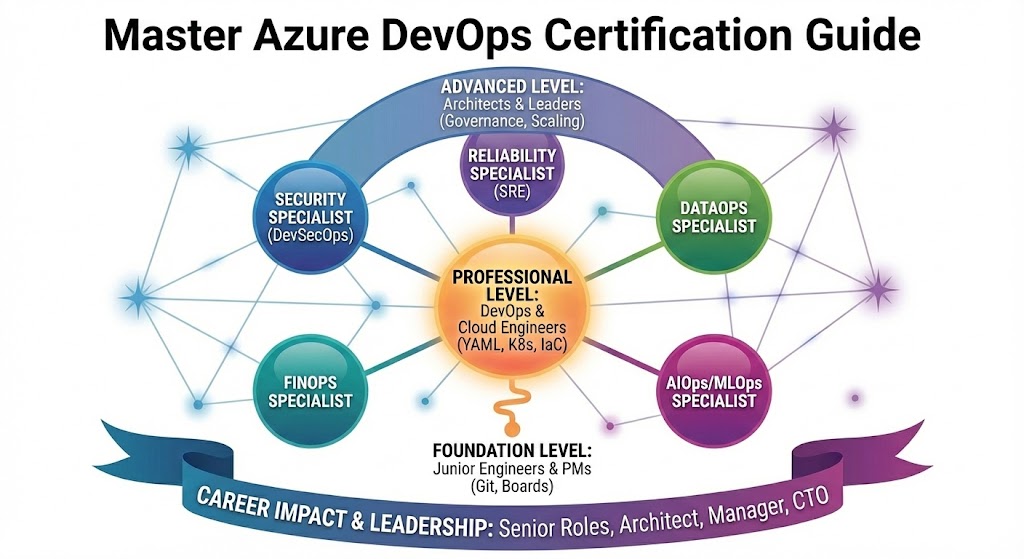
The certification framework divides expertise into foundation, professional, and advanced levels to ensure a logical progression of skills. Initially, the foundation level covers basic cloud concepts and the fundamental mechanics of version control. Subsequently, the professional level focuses on implementing complex CI/CD logic and managing infrastructure as code. Finally, the advanced level challenges candidates to design global-scale architectures and govern security across massive enterprise environments. Therefore, these levels allow you to map your learning journey to your specific career goals and experience level.
Complete Master in Azure DevOps Certification Table
| Track | Level | Who it’s for | Prerequisites | Skills Covered | Recommended Order |
| Core Admin | Foundation | Aspiring Admins | Basic IT Literacy | Azure Portal, CLI, Networking | 1st Step |
| Build & Release | Professional | Developers/DevOps | Foundation Skills | YAML Pipelines, CI/CD, Git | 2nd Step |
| Site Reliability | Professional | SRE / SysAdmins | Scripting Knowledge | Monitoring, Scale, Alerts | 3rd Step |
| Security/Compliance | Advanced | Security Pros | Professional Level | DevSecOps, Key Vault, Audits | 4th Step |
| Solutions Design | Advanced | Senior Architects | Full Stack Exp | HA, DR, Multi-Region Governance | 5th Step |
Detailed Guide for Each Master in Azure DevOps Certification
Master in Azure DevOps – Foundation Level
What it is
This certification validates that a candidate understands the core principles of cloud computing and the basic interface of the Azure DevOps platform. It establishes the technical baseline required for all advanced tracks.
Who should take it
Fresh graduates, project managers, and IT professionals transitioning from on-premises environments should start here to gain fundamental clarity.
Skills you’ll gain
- Create and manage Azure DevOps organizations and projects.
- Organize work items using boards and backlogs.
- Understand basic networking and cloud storage within Azure.
- Navigate the command-line interface for basic resource management.
Real-world projects you should be able to do
- Set up a basic project workspace for a small team with automated work tracking.
- Deploy a simple static website using the Azure portal interface.
Preparation plan
- 7-14 Days: Focus on the official documentation and familiarize yourself with the UI daily.
- 30 Days: Complete all introductory labs and practice basic CLI commands twice a week.
- 60 Days: Not required for this level unless you have no prior background in technology.
Common mistakes
- Skipping the study of cloud pricing models which leads to unexpected costs.
- Failing to understand the shared responsibility model between the provider and the user.
Best next certification after this
- Same-track: Master in Azure DevOps – Professional Level.
- Cross-track: Azure Fundamentals.
- Leadership: Agile Scrum Master certification.
Master in Azure DevOps – Professional Level
What it is
The professional level confirms that an engineer can build, test, and deploy software using sophisticated automation techniques. It proves that you can handle daily operations in a high-pressure development environment.
Who should take it
Mid-level developers and operations staff who want to specialize in pipeline automation and infrastructure management should pursue this level.
Skills you’ll gain
- Build complex multi-stage YAML pipelines for continuous delivery.
- Manage dependencies and artifacts across different development environments.
- Implement Infrastructure as Code (IaC) using Terraform scripts.
- Automate unit testing and code quality checks within the build phase.
Real-world projects you should be able to do
- Create a zero-downtime deployment pipeline for a microservices-based application.
- Automate the provisioning of a complete staging environment using ARM templates.
Preparation plan
- 7-14 Days: Review advanced YAML syntax and study environment gates.
- 30 Days: Build three unique pipelines for different programming languages.
- 60 Days: Master container orchestration and integrate Docker into your workflows.
Common mistakes
- Neglecting to use variable groups, which leads to insecure and hard-to-maintain pipelines.
- Forgetting to implement rollback strategies in the event of a failed deployment.
Best next certification after this
- Same-track: Master in Azure DevOps – Advanced Level.
- Cross-track: Azure Solutions Architect Associate.
- Leadership: Technical Project Lead certification.
Master in Azure DevOps – Advanced Level
What it is
This advanced certification validates your ability to design enterprise-scale solutions that meet strict security and compliance requirements. It represents the highest tier of technical leadership within the Azure ecosystem.
Who should take it
Senior engineers, cloud architects, and security specialists who lead large-scale digital transformations should take this exam.
Skills you’ll gain
- Design global architectures with high availability and disaster recovery.
- Implement automated security auditing and compliance as code.
- Optimize enterprise cloud costs through advanced monitoring and analytics.
- Lead the cultural transition toward a mature DevOps mindset across departments.
Real-world projects you should be able to do
- Architect a multi-region failover system for a mission-critical financial application.
- Design an automated governance framework that prevents non-compliant resource creation.
Preparation plan
- 7-14 Days: Analyze case studies involving large-scale cloud failures and their solutions.
- 30 Days: Practice designing complex system diagrams that prioritize security and scale.
- 60 Days: Conduct simulated security audits and implement advanced encryption policies.
Common mistakes
- Over-engineering a solution which makes it too difficult for junior staff to support.
- Ignoring the financial implications of architectural decisions on the corporate budget.
Best next certification after this
- Same-track: Azure Solutions Architect Expert.
- Cross-track: Certified Kubernetes Administrator.
- Leadership: CTO or Head of Infrastructure track.
Choose Your Learning Path
DevOps Path
The DevOps path focuses on breaking down the barriers between software developers and IT operations. Specifically, you learn to create a shared culture of accountability through automated workflows and clear communication tools. Furthermore, this path emphasizes the importance of continuous feedback to improve software quality constantly. Consequently, professionals on this path become experts at delivering value to customers at high speeds. Therefore, you should choose this track if you enjoy optimizing the entire software delivery lifecycle.
DevSecOps Path
The DevSecOps path integrates security protocols directly into the automated pipeline to ensure safety at every stage. Instead of waiting until the end of the process, you learn to “shift left” by scanning code for vulnerabilities during development. Moreover, this path covers the automation of compliance checks to meet legal and regulatory standards effortlessly. Consequently, you protect the organization from data breaches and security flaws before they reach production. Therefore, this track is ideal for engineers who prioritize security in high-stakes environments.
SRE Path
Site Reliability Engineering (SRE) utilizes software principles to manage and improve system stability and performance. On this path, you focus on defining service level objectives that balance the need for new features with system uptime. Furthermore, you learn to eliminate manual operational tasks by writing code that automates system recovery. Consequently, SREs ensure that large distributed systems remain reliable under heavy user traffic. Therefore, you should follow this track if you enjoy solving complex infrastructure puzzles and improving system resilience.
AIOps / MLOps Path
This path addresses the unique challenges of managing machine learning models and artificial intelligence within a production environment. You will learn to automate the training and deployment of models using specialized Azure tools. Moreover, this track covers the monitoring of model accuracy to detect data drift and maintain performance over time. Consequently, you bridge the gap between data science and operational engineering for modern applications. Therefore, choose this path if you want to work at the intersection of AI and cloud automation.
DataOps Path
DataOps focuses on the automated management of data pipelines to ensure high-quality analytics and reporting. You will learn to build resilient workflows that handle massive amounts of data with minimal manual intervention. Furthermore, this path emphasizes the use of version control for data schemas and the implementation of automated data quality tests. Consequently, you enable the organization to make faster decisions based on reliable and up-to-date information. Therefore, this track is perfect for professionals who want to optimize the flow of data within a company.
FinOps Path
The FinOps path brings financial accountability to the cloud by teaching you how to manage and optimize spending. You will learn to track cloud usage across different departments and implement automated cost-saving policies. Moreover, this track focuses on balancing performance requirements with budget constraints to maximize the value of cloud investments. Consequently, FinOps practitioners help organizations scale their infrastructure without incurring unnecessary or hidden costs. Therefore, you should pursue this path if you are interested in the intersection of cloud technology and business finance.
Role → Recommended Master in Azure DevOps Certifications
| Role | Recommended Certifications |
| DevOps Engineer | Master in Azure DevOps (Professional + Security) |
| SRE | Master in Azure DevOps (Operations + Advanced) |
| Platform Engineer | Master in Azure DevOps (Infrastructure + Architecture) |
| Cloud Engineer | Master in Azure DevOps (Foundation + Infrastructure) |
| Security Engineer | Master in Azure DevOps (Security + Governance) |
| Data Engineer | Master in Azure DevOps (DataOps + Professional) |
| FinOps Practitioner | Master in Azure DevOps (FinOps + Architecture) |
| Engineering Manager | Master in Azure DevOps (Foundation + Leadership) |
Next Certifications to Take After Master in Azure DevOps
Same Track Progression
Deep specialization allows an engineer to become the go-to expert for complex Azure problems within an organization. After finishing the master program, you should pursue the AZ-400 certification to further validate your skills in Microsoft’s eyes. This progression involves mastering the fine details of service meshes and advanced container management strategies. Furthermore, staying on this track ensures that you remain at the forefront of every new feature release from Azure. Consequently, you build a reputation as a highly specialized and irreplaceable technical asset.
Cross-Track Expansion
Broadening your skills across multiple cloud providers or specialized domains can make you much more versatile in the job market. For instance, learning AWS or Google Cloud allows you to support multi-cloud strategies for global enterprises. Alternatively, you might explore Kubernetes-specific certifications to master the container orchestration layer that runs on top of Azure. Moreover, expanding your knowledge into data engineering or cybersecurity provides a more holistic view of the technology landscape. Therefore, cross-track expansion is a strategic move for those aiming for high-level consulting roles.
Leadership & Management Track
Transitioning into leadership requires you to shift your focus from technical execution to strategic planning and team development. After you achieve technical mastery, you should look toward certifications in Agile leadership or IT service management. These programs teach you how to manage budgets, resolve team conflicts, and align technical projects with business goals. Furthermore, you will learn how to drive cultural change across an entire organization to improve overall efficiency. Consequently, you prepare yourself for executive roles such as Director of Engineering or CTO.
Training & Certification Support Providers for Master in Azure DevOps
DevOpsSchool
DevOpsSchool functions as a premier institution for technical education, offering an extensive range of courses that target the Azure ecosystem. Furthermore, they provide students with access to high-quality labs and mentorship from industry veterans who have decades of experience. The curriculum stays current with the latest industry trends, ensuring that learners gain relevant and marketable skills. Additionally, the platform encourages a collaborative learning environment where engineers can share their experiences and solve problems together. Consequently, graduates from this school often find themselves well-prepared for the challenges of enterprise-level cloud management. Therefore, it remains a top choice for those seeking a rigorous and supported learning journey.
Cotocus
Cotocus offers specialized training programs that focus on digital transformation and the practical application of DevOps tools in a business context. Moreover, their instructors emphasize the importance of speed and reliability in software delivery through hands-on workshops and real-world scenarios. The training modules cover everything from basic infrastructure setup to advanced automation strategies for global corporations. Furthermore, the organization provides flexible learning options that cater to the busy schedules of working professionals. Additionally, they offer personalized feedback to help students master complex concepts and improve their technical proficiency. Consequently, this provider helps engineers bridge the gap between theoretical knowledge and practical workplace success.
Scmgalaxy
Scmgalaxy serves as a massive community hub and training provider that focuses on configuration management and build automation. Furthermore, they offer a vast library of tutorials and forums where professionals can find answers to specific technical questions. Their training programs emphasize the mastery of command-line tools and scripting, which are essential for any serious DevOps engineer. Moreover, the platform keeps a close eye on the evolution of the industry, providing timely updates on new tools and methodologies. Additionally, the community-driven nature of the site allows for extensive networking opportunities with other experts in the field. Consequently, it is a highly respected resource for those who want to deepen their technical expertise.
BestDevOps
BestDevOps delivers comprehensive training solutions that prioritize high-impact learning through interactive lectures and intensive practical exercises. Furthermore, they design their curriculum to reflect the actual demands of the modern job market, focusing on the tools that companies use most. Their instructors bring a wealth of practical experience, providing students with insights that go beyond what is found in standard textbooks. Additionally, the organization offers career coaching and job placement assistance to help graduates secure lucrative positions. Moreover, the emphasis on end-to-end pipeline creation ensures that students can handle every aspect of the software delivery process. Consequently, this provider is excellent for those looking to make a significant career leap.
devsecopsschool.com
devsecopsschool.com focuses exclusively on the critical intersection of security and operations, providing specialized training for the next generation of security engineers. Moreover, they teach students how to integrate automated security checks into every phase of the development lifecycle. The curriculum covers advanced topics such as vulnerability management, compliance as code, and secure identity management in the cloud. Furthermore, the instructors emphasize a proactive approach to security that prevents breaches before they occur. Additionally, the practical labs allow students to test their skills in a safe environment using industry-standard security tools. Consequently, this institution is the leading choice for those who want to specialize in protecting cloud-native applications.
sreschool.com
sreschool.com provides a deep dive into the world of Site Reliability Engineering, teaching professionals how to maintain stable and scalable systems. Furthermore, their courses focus on essential concepts like error budgets, monitoring, and automated incident response. The instructors use real-world examples to show how large tech companies manage their infrastructure to achieve 99.9% uptime. Moreover, the training covers the use of observability tools to detect performance bottlenecks before they affect the end-user. Additionally, the program teaches engineers how to reduce operational toil through clever automation and better system design. Consequently, graduates are highly sought after by organizations that require high levels of system reliability.
aiopsschool.com
aiopsschool.com addresses the growing field of artificial intelligence in IT operations, offering cutting-edge training for forward-thinking engineers. Moreover, they teach you how to use machine learning algorithms to analyze massive amounts of system data and predict potential outages. The curriculum includes practical lessons on implementing AI-driven monitoring and automated incident correlation. Furthermore, the instructors provide guidance on the ethical use of AI and the challenges of integrating these tools into existing workflows. Additionally, students learn to automate repetitive tasks using intelligent agents, freeing up time for more strategic work. Consequently, this provider helps engineers stay ahead of the curve in an increasingly automated world.
dataopsschool.com
dataopsschool.com specializes in the automated management of data pipelines, providing essential training for modern data engineers and analysts. Furthermore, they show you how to apply DevOps principles to data workflows to improve accuracy and delivery speed. The courses cover topics such as data versioning, automated quality testing, and secure data orchestration in the cloud. Moreover, the instructors emphasize the importance of collaboration between data teams and operations to ensure a seamless flow of information. Additionally, the practical exercises use real-world data sets to simulate the challenges of managing large-scale data ecosystems. Consequently, this school is vital for any professional who wants to optimize data-driven decision-making.
finopsschool.com
finopsschool.com teaches the art and science of cloud financial management, helping professionals bring accountability to cloud spending. Moreover, their curriculum covers the three pillars of FinOps: inform, operate, and optimize. Students learn how to track costs, allocate budgets, and implement automated policies that reduce waste without sacrificing performance. Furthermore, the instructors emphasize the cultural shift needed to make every engineer aware of the financial impact of their technical choices. Additionally, the program provides practical tools and strategies that can be immediately applied to manage large enterprise cloud accounts. Consequently, graduates help their organizations scale their cloud presence in a financially sustainable way.
Frequently Asked Questions (General)
- How difficult is the Master in Azure DevOps program?
The difficulty varies based on your background, but the program structure ensures that you build skills progressively from basic to advanced levels. - How long does it take to finish the entire certification?
Most students finish the track in six to twelve months if they dedicate a few hours each week to study and labs. - Are there prerequisites for the starting level?
You only need a basic understanding of computer systems and a desire to learn about cloud automation to begin the foundation level. - What is the career impact of this certification?
Professionals often report higher salaries and more frequent job offers after validating their skills with this comprehensive mastery program. - In what order should I complete the modules?
You should follow the sequence from Foundation to Professional and then to Advanced to ensure you have a solid technical base. - Is this certification recognized by international employers?
Yes, the skills you gain are based on industry-standard practices that global companies use to manage their cloud infrastructure. - Do I need to be an expert coder to succeed?
You do not need to be a senior developer, but you must learn basic scripting and YAML syntax to automate pipelines effectively. - Can I take the training and exams remotely?
The platform offers a fully digital experience, allowing you to learn and complete assessments from any location with internet access. - Does the curriculum cover other clouds besides Azure?
While the primary focus remains on Azure, the DevOps principles you learn apply to any major cloud provider in the market. - How often does the provider update the course content?
The instructors update the materials regularly to include new Azure features and changing industry best practices. - Does the program include practical laboratory work?
Yes, the mastery path emphasizes hands-on proficiency through extensive lab environments and real-world project simulations. - Is there a community for networking with other students?
You gain access to a professional forum where you can collaborate with peers and receive guidance from experienced mentors.
FAQs on Master in Azure DevOps
- Which specific tools within the Azure suite does this program emphasize?
The curriculum focuses heavily on Azure Pipelines, Boards, and Repos to ensure you can manage the entire software lifecycle. Additionally, you will master Azure Artifacts for package management and Azure Test Plans to maintain high code quality. Furthermore, the program explores integrations with Azure Kubernetes Service and Azure Monitor for advanced orchestration and observability. Consequently, you gain a deep understanding of how these tools work together to create a seamless delivery ecosystem. Therefore, you become proficient in using the full power of Microsoft’s cloud automation platform. - How does the Master in Azure DevOps compare to other cloud certifications?
Unlike standard exams that focus on multiple-choice questions, this program requires you to demonstrate your skills through practical, project-based assessments. Moreover, it covers a broader range of third-party integrations like Terraform and Docker, which are essential for real-world DevOps roles. The mastery program emphasizes the “how-to” of daily engineering rather than just high-level architectural theory. Consequently, employers value this certification because it proves you can actually perform the work required in a production environment. Therefore, it provides a more comprehensive validation of your technical abilities. - Is this program suitable for companies using a hybrid cloud strategy?
Yes, the curriculum includes specific modules on managing hybrid environments where on-premises servers interact with the Azure cloud. You will learn how to set up self-hosted agents and secure connectivity between local data centers and cloud services. Furthermore, the program teaches you how to maintain consistent deployment and security policies across both environments. This expertise is critical for large organizations that cannot move all their data to the public cloud at once. Consequently, you become an expert in managing the complex transitions that define modern enterprise IT. - What support can I expect if I encounter technical issues during the labs?
The program provides access to a dedicated help desk and expert mentors who can guide you through any technical hurdles. Specifically, you can join live office hours or use the discussion forums to get answers to your specific questions. Moreover, the platform provides detailed walkthrough videos and documentation for every lab exercise to ensure you stay on track. This support system ensures that you can focus on learning without getting stuck on minor configuration errors. Therefore, you have a high probability of successfully completing the program with expert help. - Does the training include a focus on automated cost management?
Yes, the advanced levels of the program introduce you to the principles of FinOps and automated cost optimization within Azure. You will learn how to use monitoring tools to identify wasted resources and implement policies that scale infrastructure based on demand. Furthermore, the curriculum covers the use of reserved instances and spot pricing to significantly reduce cloud spending. This focus on financial efficiency ensures that your technical solutions are also economically sustainable for your company. Consequently, you help the organization maximize its return on investment in the cloud. - How does the program address the growing need for DevSecOps?
Security is a core component of the curriculum, with dedicated modules on integrating safety checks into the automated pipeline. You will learn to use Azure Key Vault for secret management and implement automated vulnerability scanning for your code and containers. Moreover, the program covers the creation of “Policy as Code” to ensure that every resource meets corporate compliance standards automatically. This proactive approach to security prevents vulnerabilities from reaching the production environment. Therefore, you gain the skills needed to protect your organization’s digital assets in an increasingly dangerous landscape. - Are the projects based on actual industry challenges?
Every project in the mastery path mirrors the real-world problems that engineering teams face in top-tier tech companies. Specifically, you will work on migrating legacy applications, orchestrating microservices, and setting up global disaster recovery plans. These projects require you to apply everything you have learned about automation, security, and scaling. Furthermore, industry experts review your work to ensure it meets professional standards for code quality and architecture. Consequently, you build a portfolio of work that demonstrates your readiness for high-level engineering roles. - What are the long-term career benefits of completing this mastery?
Achieving this mastery places you in the top bracket of cloud professionals globally, significantly increasing your earning potential and job security. Specifically, it qualifies you for senior positions such as Platform Architect or DevOps Lead in major corporations. Furthermore, the broad skill set you gain ensures that you remain adaptable even as the technology landscape continues to change. You will have the confidence to lead large-scale digital transformations and mentor other engineers. Therefore, this certification serves as a powerful catalyst for long-term professional success and leadership.
Final Thoughts: Is Master in Azure DevOps Worth It?
The modern technology landscape moves at a pace that requires constant learning and adaptation from every engineer. Consequently, investing in a structured program like the Master in Azure DevOps provides the quickest path to professional maturity. It offers a perfect balance between technical depth and strategic oversight, ensuring you can solve both immediate and long-term business problems. Furthermore, the hands-on nature of the training prepares you for the actual challenges you will face in a production environment. While the journey requires dedication, the career growth and stability it provides are unmatched in the current market. Therefore, you should take this step to secure your future as a leader in the cloud-native era.