Introduction
Modern DevOps roles no longer stop at pipelines and automation. Organizations expect leaders to manage delivery flow, system stability, security alignment, and financial awareness at the same time.
This guide speaks to engineers and managers who already work in DevOps-driven environments and now influence outcomes at a broader level. It explains how a management-focused DevOps certification supports leadership growth.
Rather than promoting credentials, the guide focuses on clarity, decision-making, and long-term career relevance in cloud-native and platform-oriented organizations.
What This Certification Represents
Leadership-focused DevOps certifications exist to address a clear gap between execution and ownership. Teams may automate deployments successfully, yet still struggle with reliability, coordination, and accountability.
This certification teaches professionals how to manage DevOps as a system rather than a collection of tools. It emphasizes workflows, cultural alignment, metrics, and governance over scripts and configurations.
The learning model reflects how enterprises operate in production, where leaders guide teams without interfering in daily technical tasks.
Roles That Benefit the Most
Professionals transitioning from senior engineering positions into people and delivery management gain immediate value from this certification. It also supports managers responsible for DevOps, platform, and reliability teams.
Senior SREs, cloud leads, and platform owners who coordinate multiple services benefit from the structured management perspective it provides.
For professionals working in India, it aligns with global delivery models and distributed teams. For international audiences, it supports DevOps Lead, Platform Manager, and Engineering Manager responsibilities.
Why This Certification Remains Relevant Long Term
Toolchains evolve every year, but leadership challenges remain stable. Teams still face release risks, unclear ownership, operational incidents, and cross-team dependency issues.
This certification focuses on those persistent problems rather than temporary technologies. It prepares leaders to interpret delivery metrics, reliability indicators, compliance pressure, and cloud cost signals.
By building durable management skills, professionals protect their careers against tool obsolescence and organizational change.
Certification Overview
The program runs through Certified DevOps Manager Certification and operates under DevOpsSchool.
Instead of relying on theory-heavy exams, the program evaluates how professionals think through real DevOps leadership scenarios. It prioritizes judgment, prioritization, and system-level reasoning.
This structure fits working professionals who already manage teams, services, and operational responsibility in live environments.
Levels and Career Alignment
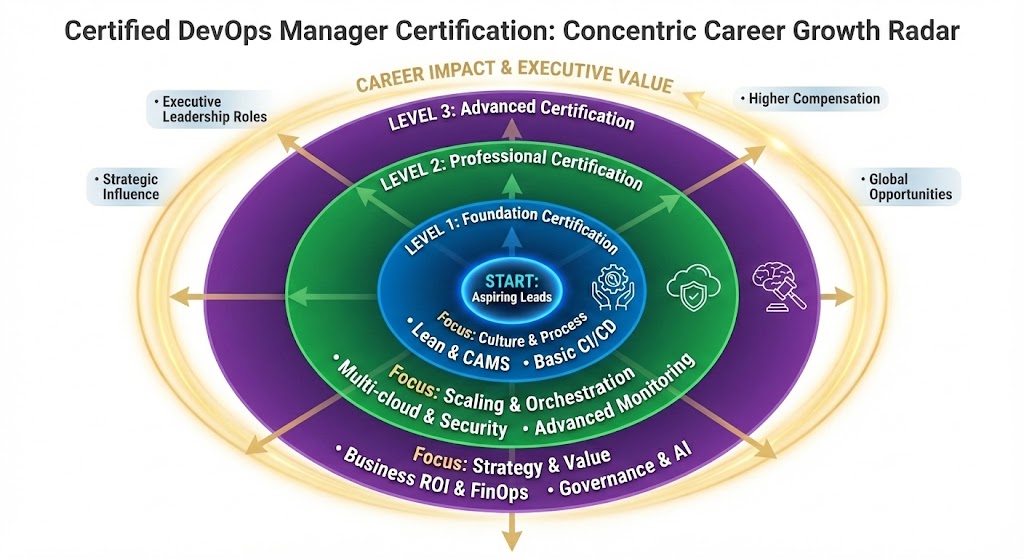
The certification follows a progression model aligned with leadership scope. Entry-level learning establishes shared language and core management principles.
Mid-level learning focuses on scaling DevOps across multiple teams and services while maintaining stability.
Advanced learning addresses enterprise transformation, compliance alignment, financial visibility, and value measurement. Each level expands responsibility rather than narrowing technical focus.
Certification Structure Overview
| Track | Level | Intended Audience | Entry Requirements | Core Focus | Order | Reference |
|---|---|---|---|---|---|---|
| DevOps Leadership | Foundation | New managers, senior engineers | DevOps awareness | Culture, metrics, flow | 1 | Certified DevOps Manager |
| DevOps Leadership | Professional | Delivery managers | Team ownership | Scaling, reliability | 2 | Certified DevOps Manager |
| DevOps Leadership | Advanced | Senior leaders | Multi-team scope | Strategy, governance | 3 | Certified DevOps Manager |
Foundation Level Details
Purpose
This level confirms that a professional understands how leadership decisions affect DevOps performance and team health.
Who should attend
Senior engineers preparing for management roles and recently appointed managers benefit the most.
Capabilities developed
- Collaboration models
- Delivery and reliability metrics
- Workflow transparency
Expected outcomes
- Define meaningful DevOps KPIs
- Review pipelines from a leadership perspective
- Improve feedback between teams
Preparation guidance
Spend two weeks reviewing DevOps principles. Use one month to study workflow patterns. Apply learnings directly to daily work over sixty days.
Common pitfalls
- Fixating on tools
- Ignoring team dynamics
Next steps
- Same track: Professional level
- Cross track: SRE leadership
- Leadership path: Management fundamentals
Professional Level Details
Purpose
This level validates the ability to manage delivery across teams, platforms, and services.
Who should attend
Engineering managers, platform leads, and senior SREs with operational accountability.
Capabilities developed
- Multi-team alignment
- Incident leadership
- Service reliability management
Expected outcomes
- Design DevOps operating models
- Run effective post-incident reviews
- Align delivery metrics with business objectives
Preparation guidance
Revisit leadership frameworks in the first two weeks. Study scaling models within a month. Analyze real incidents and data over two months.
Common pitfalls
- Treating DevOps as a separate department
- Overlooking organizational constraints
Next steps
- Same track: Advanced level
- Cross track: FinOps
- Leadership path: Program management
Advanced Level Details
Purpose
This level demonstrates the ability to lead DevOps initiatives at enterprise scale.
Who should attend
Senior managers, directors, and transformation leaders gain the most value.
Capabilities developed
- Strategic DevOps governance
- Compliance and risk alignment
- Organization-wide change leadership
Expected outcomes
- Drive enterprise DevOps adoption
- Integrate security and finance into delivery
- Measure business impact of DevOps initiatives
Preparation guidance
Align strategic concepts in two weeks. Review enterprise cases in one month. Map learning to organizational priorities over two months.
Common pitfalls
- Applying frameworks without context
- Underestimating cultural resistance
Next steps
- Same track: Continuous improvement programs
- Cross track: AIOps leadership
- Leadership path: Executive technology leadership
Choosing the Right Direction
DevOps Leadership
Focus on delivery efficiency, platform stability, and ownership clarity.
DevSecOps Leadership
Balance compliance requirements with release velocity.
SRE Leadership
Own availability targets, incident response, and error budgets.
AIOps and MLOps Leadership
Guide intelligent automation and data-driven operations.
DataOps Leadership
Manage reliability and speed across analytics pipelines.
FinOps Leadership
Control cloud spending and financial accountability.
Role-Based Guidance
| Role | Suggested Level |
|---|---|
| DevOps Engineer | Foundation |
| SRE | Professional |
| Platform Engineer | Professional |
| Cloud Engineer | Foundation |
| Security Engineer | Foundation |
| Data Engineer | Foundation |
| FinOps Practitioner | Professional |
| Engineering Manager | Professional to Advanced |
Progressing After Certification
Deep specialization
Advance further within DevOps leadership to manage broader programs.
Skill expansion
Add SRE, FinOps, or AIOps expertise for wider influence.
Leadership evolution
Move into senior technology leadership and organizational design roles.
Training and Support Landscape
DevOpsSchool delivers structured leadership-focused DevOps programs.
Cotocus supports enterprise-scale DevOps transformation initiatives.
Scmgalaxy combines process understanding with leadership education.
BestDevOps prepares engineers for practical management transitions.
devsecopsschool.com focuses on security-aware DevOps leadership.
sreschool.com strengthens reliability ownership capability.
aiopsschool.com develops AI-driven operations leadership.
dataopsschool.com addresses data delivery management skills.
finopsschool.com builds cloud financial governance expertise.
Frequently Asked Questions (General)
- Is Certified DevOps Manager difficult?
Difficulty depends on experience. Managers with delivery exposure find it practical rather than theoretical. - How long does preparation take?
Most professionals prepare in 30–60 days alongside work. - Is coding required?
Deep coding is not required, but system awareness helps. - Is it suitable for non-technical managers?
It suits managers with engineering exposure more than purely administrative roles. - Does it improve career growth?
It supports progression into higher-responsibility roles. - Is it globally relevant?
Yes, it aligns with global DevOps leadership expectations. - Can beginners pursue it?
It is not recommended without DevOps exposure. - Is it tool-specific?
No, it focuses on principles and operating models. - Does it include real scenarios?
Yes, the learning emphasizes practical decision-making. - Is it useful in service companies?
Yes, especially for managing multiple teams and clients. - Does it require renewal?
Renewal depends on certification policy. - Can it combine with cloud certifications?
Yes, it complements cloud and platform learning.
FAQs on Certified DevOps Manager
- How is this different from DevOps engineer certifications?
It focuses on leadership responsibilities rather than implementation skills. - Does it include cost management?
Higher levels integrate cost and value considerations. - Is it aligned with SRE practices?
Yes, it complements reliability leadership roles. - Can it support transformation roles?
It prepares professionals for organizational change efforts. - Is it useful for remote teams?
It supports distributed delivery models. - Does it address compliance?
Advanced levels cover governance and compliance topics. - Can it pair with cloud certifications?
Yes, cloud expertise strengthens its value. - Is it relevant outside IT services?
It applies to product companies and enterprises alike.
Final Assessment
This certification fits professionals who already influence delivery outcomes and now own people, systems, and decisions. It strengthens judgment rather than replacing technical skill.
For careers centered on accountability and long-term impact, it provides practical and durable value without relying on short-lived trends.