Introduction
Infrastructure management has evolved far beyond simple server maintenance, now requiring a sophisticated blend of software engineering and operational expertise. The Site Reliability Engineering Certified Professional (SRECP) functions as the definitive credential for those aiming to master system resilience at scale. This comprehensive roadmap assists developers and systems experts in navigating the complexities of high-availability cloud environments. By choosing this path, professionals learn to implement the automated safeguards that modern platform engineering demands. DevOpsSchool facilitates this journey by providing the high-level technical training necessary to excel in today’s competitive landscape.
What Defines the Site Reliability Engineering Certified Professional (SRECP)?
The Site Reliability Engineering Certified Professional (SRECP) validates your ability to apply rigorous engineering principles to IT operations. It moves practitioners away from reactive troubleshooting and toward a proactive, production-focused methodology. This certification emphasizes the practical application of Service Level Objectives (SLOs) and the strategic management of error budgets. By aligning with enterprise-grade workflows, the program ensures that every graduate can build and maintain distributed systems that remain stable under immense pressure.
Who Benefits Most from Site Reliability Engineering Certified Professional (SRECP)?
This program serves a diverse group of technical professionals responsible for digital product stability. Software developers seeking a transition into infrastructure find that this curriculum bridges the gap between writing code and managing its lifecycle. Experienced cloud engineers and DevOps practitioners use the Site Reliability Engineering Certified Professional (SRECP) to formalize their automation skills. Furthermore, engineering managers gain the necessary framework to lead reliability teams across global markets, including the rapidly growing tech sectors in India.
Why the Site Reliability Engineering Certified Professional (SRECP) Matters Now
Modern enterprises depend on distributed architectures that grow more complex every day. The Site Reliability Engineering Certified Professional (SRECP) provides long-term career security because it focuses on core principles rather than fleeting tool trends. Professionals who hold this credential demonstrate a mastery of observability and automation that directly reduces business risk. Investing your time in this certification positions you as a critical asset capable of steering organizations through the challenges of cloud-native scaling.
Core Overview of the Site Reliability Engineering Certified Professional (SRECP)
The official curriculum resides on the DevOpsSchool website, where students access the Site Reliability Engineering Certified Professional (SRECP) training modules. The program utilizes a practical, performance-based assessment model to verify that candidates can solve actual production bottlenecks. Topics include advanced monitoring, rapid incident response, and proactive capacity planning. This structure ensures that practitioners remain at the forefront of industry shifts, moving from basic theory to expert implementation seamlessly.
Certification Tracks: Site Reliability Engineering Certified Professional (SRECP)
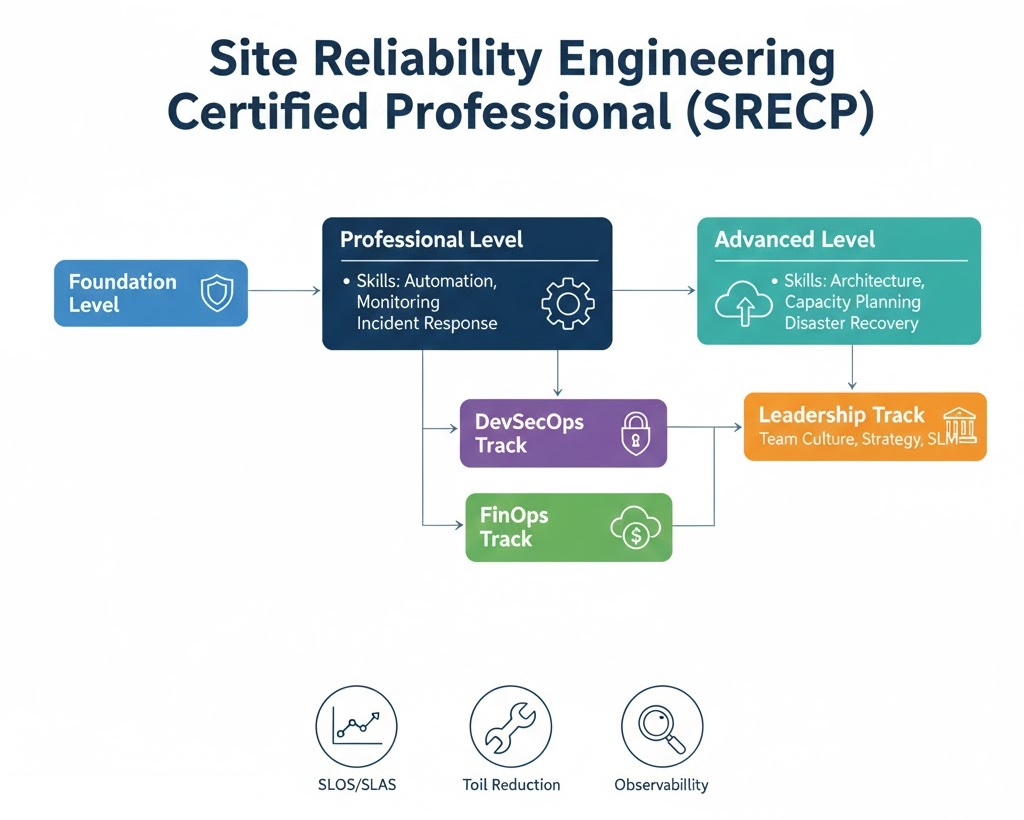
The program offers a clear progression through three distinct levels of expertise. The Foundation level introduces the core vocabulary and teaches you how to identify and eliminate operational toil. The Professional level expands into specialized tracks, integrating reliability with DevOps and FinOps practices. Finally, the Advanced level prepares you for strategic roles, focusing on architectural resilience and leading large-scale SRE transformations within major enterprises.
Comprehensive Site Reliability Engineering Certified Professional (SRECP) Table
| Track | Level | Target Audience | Prerequisites | Core Skills | Recommended Order |
| SRE Core | Foundation | Aspiring SREs | Basic Linux Knowledge | SLOs, SLIs, Error Budgets | 1st |
| Engineering | Professional | SREs/DevOps | Foundation Certificate | CI/CD, IaC, Automation | 2nd |
| Operations | Professional | Cloud Engineers | Foundation Certificate | Incident Management | 3rd |
| Strategic | Advanced | Architects/Leads | Professional Certificate | Resilience, Planning | 4th |
Detailed Track Breakdown: Site Reliability Engineering Certified Professional (SRECP)
Site Reliability Engineering Certified Professional (SRECP) – Foundation
What it is
This certification confirms your understanding of the cultural and technical shifts required to bridge the gap between development and operations. It ensures you can view reliability through the eyes of the end user.
Who should take it
Aspiring SREs and junior developers who want to see how their code performs in high-stakes production environments should start here.
Skills you’ll gain
- Crafting Service Level Indicators (SLIs).
- Managing and negotiating error budgets.
- Detecting and automating away manual toil.
- Mastering the basics of incident response.
Real-world projects you should be able to do
- Build a reliability dashboard for a live microservice.
- Establish an error budget policy for an engineering squad.
- Lead a blameless post-mortem after a system failure.
Preparation plan
- 7–14 days: Study the core SRE handbook and learn the essential terminology.
- 30 days: Complete hands-on labs focused on monitoring and basic automation.
- 60 days: Launch a pilot project that implements SLOs for a small web application.
Common mistakes
- Candidates often prioritize specific software over fundamental SRE principles.
- Many ignore the critical importance of a blameless culture in operational success.
Best next certification after this
- Same-track option: SRECP Professional.
- Cross-track option: DevOps Certified Professional.
- Leadership option: Certified SRE Manager.
Selecting Your Learning Path
DevOps Path
Engineers on this path integrate reliability directly into the delivery pipeline. You apply Site Reliability Engineering Certified Professional (SRECP) concepts to build automated guardrails that catch unstable code before it reaches the user. This approach utilizes canary releases and automated rollbacks to minimize risk during deployments. By merging agility with stability, you create a robust flow from the developer’s desk to the production server.
DevSecOps Path
This specialization weaves security directly into the reliability framework. You treat security threats as reliability risks, applying SLOs to vulnerability patching and threat response. The Site Reliability Engineering Certified Professional (SRECP) training teaches you to automate compliance checks within your daily SRE tasks. This ensure that your systems remain both highly available and fundamentally secure against external attacks.
SRE Path
This dedicated journey focuses on the craft of maintaining maximum uptime. You deep-dive into distributed systems, advanced observability, and complex disaster recovery. The path teaches you how to build self-healing architectures that survive regional cloud outages without manual intervention. You become a specialist who views every operational hurdle as a challenge that software automation can solve.
AIOps / MLOps Path
This path applies SRE principles to the world of machine learning and artificial intelligence. You learn to monitor model drift and data quality as part of your core service level objectives. The Site Reliability Engineering Certified Professional (SRECP) knowledge helps you manage the massive compute resources required for modern AI workloads. This ensures your machine learning pipelines remain performant even as data volumes grow.
DataOps Path
Data specialists use this path to ensure the integrity and availability of massive data pipelines. You apply error budgets to data latency and quality, ensuring that business leaders receive accurate information. The training helps you automate the recovery of failed data jobs and manage complex database dependencies. This creates a resilient data infrastructure that supports real-time analytics without constant manual oversight.
FinOps Path
This path combines system reliability with strict cost-efficiency. You learn to include cloud spending as a primary metric within your SRE dashboards and capacity planning. The Site Reliability Engineering Certified Professional (SRECP) framework provides the analytical tools needed to optimize resource usage based on actual demand. This ensures your organization maintains high performance while staying within its operational budget.
Role Mapping: Recommended Site Reliability Engineering Certified Professional (SRECP) Tracks
| Role | Recommended Certification Sequence |
| DevOps Engineer | SRECP Foundation followed by Professional Engineering |
| SRE | The full SRECP Suite (Foundation through Advanced) |
| Platform Engineer | SRECP Professional plus Infrastructure Automation |
| Cloud Engineer | SRECP Foundation plus Cloud Architecture tracks |
| Security Engineer | SRECP Foundation plus DevSecOps specialization |
| Data Engineer | SRECP Foundation plus DataOps Professional |
| FinOps Practitioner | SRECP Foundation plus Cloud Financial Management |
| Engineering Manager | SRECP Foundation plus Strategic Leadership track |
Advancing Beyond the Site Reliability Engineering Certified Professional (SRECP)
Same Track Progression
Deepening your expertise involves pursuing advanced architectural certifications that focus on chaos engineering and multi-cloud resilience. These programs challenge you to design anti-fragile systems that actually improve when placed under stress. You will focus on high-level strategies that define global reliability standards for the entire organization. This level of mastery prepares you for roles like Principal Reliability Architect.
Cross-Track Expansion
Broadening your skillset means exploring adjacent fields such as Cyber Security or Data Analytics. Understanding how security choices affect infrastructure makes you a more versatile and valuable engineer. Alternatively, mastering large-scale data systems allows you to apply SRE principles to the fastest-growing part of the tech industry. This variety of skills ensures you remain indispensable in any multi-disciplinary engineering environment.
Leadership & Management Track
Transitioning into leadership requires a shift toward people, process, and business alignment. Certifications in technical management help you translate complex SRE metrics into tangible business value for stakeholders. You learn how to build high-performing teams, manage large budgets, and drive cultural shifts across the enterprise. This path suits those who want to move from hands-on work to shaping the strategic direction of an engineering department.
Top Support Providers for Site Reliability Engineering Certified Professional (SRECP)
DevOpsSchool
DevOpsSchool offers a massive library of resources for aspiring reliability experts, including live sessions and self-paced modules. Their Site Reliability Engineering Certified Professional (SRECP) curriculum features hands-on labs that accurately mirror production environments. They focus on bridging the gap between theory and the actual technical skills the industry demands. Their community of mentors provides ongoing support to ensure every student reaches their career goals.
Cotocus
Cotocus delivers high-end technical training for corporate teams aiming to master cloud-native technologies. Their Site Reliability Engineering Certified Professional (SRECP) approach emphasizes enterprise automation and architectural best practices. They provide customized learning paths that align with specific company objectives, ensuring teams can implement new skills immediately. Their veteran trainers bring years of practical experience to every session they lead.
Scmgalaxy
Scmgalaxy serves as a comprehensive knowledge hub for the global SRE community, offering tutorials, blogs, and documentation. They support the Site Reliability Engineering Certified Professional (SRECP) by curating practice exams and the most relevant learning materials. Their content focuses on the specific “how-to” steps of SRE, providing the exact commands needed for success. It is the perfect resource for researchers and community-driven learners.
BestDevOps
BestDevOps focuses on career readiness and job transition for those pursuing the Site Reliability Engineering Certified Professional (SRECP). Their program includes intensive interview preparation and resume building alongside technical training. They maintain a high success rate by updating their curriculum monthly to reflect the latest software versions. This provider suits professionals who want a structured, results-oriented path to their next promotion.
devsecopsschool.com
This platform explores the intersection of security and operations within the SRE framework. They offer specialized modules for the Site Reliability Engineering Certified Professional (SRECP) that focus on automated compliance and vulnerability management. Their training ensures that reliability engineers maintain uptime without compromising the security of the application. It remains the top choice for those specializing in secure, resilient infrastructure.
sreschool.com
As a dedicated institution for reliability engineering, sreschool.com provides an exhaustive look at the SRE role. Their Site Reliability Engineering Certified Professional (SRECP) content focuses exclusively on performance tuning, incident response, and observability. They use advanced simulation environments to teach candidates how to handle massive traffic spikes. Their narrow focus ensures that students receive the most specialized education available today.
aiopsschool.com
Aiopsschool.com addresses the urgent need for artificial intelligence in infrastructure management. They integrate machine learning concepts into the Site Reliability Engineering Certified Professional (SRECP) curriculum, teaching students predictive maintenance. This provider helps engineers stay ahead by automating complex tasks with intelligent algorithms. Their training prepares you for the next generation of highly automated IT operations.
dataopsschool.com
Dataopsschool.com offers a unique perspective by focusing on data lifecycle reliability and pipeline integrity. Their Site Reliability Engineering Certified Professional (SRECP) support includes tracks for managing large-scale databases and streaming platforms. They teach you how to apply SRE principles to ensure data consistency across distributed networks. This is an essential resource for reliability engineers working in data-heavy organizations.
finopsschool.com
Finopsschool.com focuses on the financial accountability of cloud engineering. They supplement the Site Reliability Engineering Certified Professional (SRECP) training with modules on cost optimization and value engineering. Their curriculum helps engineers understand the business impact of their technical choices. This training proves vital for SREs who want to play a strategic role in their organization’s financial success.
Frequently Asked Questions (General)
- How difficult is the Site Reliability Engineering Certified Professional (SRECP)?The program presents a moderate to high challenge because it tests both coding and operational logic. You must demonstrate that you can apply reliability principles to complex, real-world infrastructure problems.
- What prerequisites should I meet for the professional level?You need a basic grasp of Linux, cloud platforms, and a scripting language like Python. Completing the Foundation level first provides the necessary conceptual base for advanced modules.
- How much study time does the program require?Most successful candidates spend 30 to 60 days preparing. Dedicating roughly 10 hours per week to labs and reading ensures you master the practical side of the curriculum.
- Do global employers recognize this certification?Yes, the program uses industry-standard SRE practices that major tech companies worldwide utilize. The skills you gain remain relevant across different regions and cloud providers.
- What kind of ROI can I expect?Certified engineers often secure higher salaries and faster promotions into leadership roles. The program validates skills that directly reduce operational risk, making you highly attractive to recruiters.
- Must I be a senior developer to pass?No, but you must feel comfortable writing scripts to automate manual tasks. SRE requires you to treat operations as a software problem, so functional coding is a requirement.
- How does this differ from DevOps training?DevOps focuses on the speed of the deployment pipeline. This program focuses on the stability and performance of systems after they reach the production environment.
- Are there any recertification rules?To keep your skills sharp, we recommend pursuing advanced levels or attending update workshops every few years. This ensures your knowledge keeps pace with the evolving tech landscape.
- Can I take the assessment online?Yes, the hosting site provides online proctored exams that you can take from anywhere. This allows busy professionals to validate their skills without traveling to a test center.
- Does the course provide hands-on experience?Practical application serves as the core of the program. You will complete numerous labs that simulate production-grade issues, ensuring you gain real experience during your study.
- How does this credential boost my career?It proves you can manage complex infrastructure at a massive scale. This certification often acts as a gatekeeper for senior SRE or infrastructure architect positions.
- Which tools will I master during the course?You will learn to use industry-standard tools for monitoring, containerization, and configuration management. The focus remains on how these tools support reliability goals like observability.
FAQs on Site Reliability Engineering Certified Professional (SRECP) Specifics
- How does the program define the SRE and DevOps relationship?The curriculum views SRE as a specific, highly technical implementation of the broader DevOps philosophy.
- What is the importance of Error Budgets in the exam?You must prove you can use error budgets to balance the speed of new feature releases with the need for system stability.
- Does the training cover incident response?Yes, it provides a structured framework for managing production outages, including blameless post-mortems and effective team communication.
- How deep does the observability training go?The program moves beyond simple monitoring to teach you how to gain deep insights into complex system behaviors and dependencies.
- Does the course address manual toil?You learn specific techniques to identify repetitive tasks and develop automation strategies that eliminate them for good.
- Is chaos engineering included in the path?Advanced tracks teach you chaos engineering principles so you can proactively test your system’s resilience by injecting controlled failures.
- What is the focus on Service Level Objectives (SLOs)?The course teaches you to define SLOs from the user’s perspective, ensuring your reliability targets match actual business requirements.
- How does the program handle capacity planning?You learn to use traffic trends and historical data to predict resource needs, preventing system crashes during sudden traffic spikes.
Final Thoughts: Is the Site Reliability Engineering Certified Professional (SRECP) Worth It?
In a world where system downtime costs millions and damages reputations, the ability to ensure reliability is a superpower. The Site Reliability Engineering Certified Professional (SRECP) offers more than just a credential; it provides a rigorous training ground that evolves your technical mindset. It forces you to stop fighting fires and start engineering resilience. If you want to move beyond manual operations and build intelligent, self-healing systems, this certification is an essential investment. The practical focus ensures that you can apply every lesson to your production environment immediately.