Introduction
The complexity of modern software delivery demands a high level of technical proficiency and cultural alignment. This guide explores the DevOps Certified Professional (DCP) program, which serves as a benchmark for engineers aiming to master the intersection of development and operations. We designed this resource for software engineers, systems administrators, and technical leads who want to formalize their expertise and advance their careers in a cloud-native world through DevOpsSchool.
Furthermore, the guide provides a clear roadmap for navigating the vast ecosystem of automation, orchestration, and continuous delivery. It clarifies the specific skills required to succeed and helps professionals make informed decisions about their learning investments. By reading this, you will understand how to transition from traditional roles into high-impact positions within platform engineering and site reliability teams.
Consequently, mastering these concepts allows you to contribute more effectively to enterprise-level digital transformations. This guide acts as your mentor, offering an unbiased perspective on the certification’s relevance in today’s competitive job market. We aim to help you build a sustainable career path that remains resilient despite the constant shifts in the technology landscape.
What is the DevOps Certified Professional (DCP)?
The DevOps Certified Professional (DCP) represents a rigorous validation of an engineer’s ability to design, implement, and manage automated software delivery pipelines. It exists to bridge the gap between theoretical knowledge and the practical demands of a production environment. Instead of focusing solely on specific tool syntax, the program emphasizes the underlying principles of flow, feedback, and continuous experimentation.
Moreover, the certification aligns with modern engineering workflows by incorporating practices like Infrastructure as Code (IaC), observability, and automated testing. It validates that a professional can handle the pressure of enterprise-scale deployments while maintaining stability and security. This focus on real-world application ensures that certified individuals can immediately contribute to their teams’ productivity.
In addition, the DCP framework reflects the needs of the modern enterprise, where speed and reliability must coexist. It encourages a shift-left mindset, where quality and security become everyone’s responsibility from the start of the development cycle. This holistic approach makes the certification a powerful asset for anyone looking to lead technical teams or manage complex infrastructure.
Who Should Pursue DevOps Certified Professional (DCP)?
Software engineers and systems administrators who wish to break out of siloed environments will find immense value in this program. It is particularly beneficial for professionals already working in cloud-native roles who need to formalize their knowledge of CI/CD and automation. Site Reliability Engineers (SREs) and platform engineers can also use this certification to sharpen their skills in building resilient, self-healing systems.
Furthermore, technical leaders and engineering managers should pursue the DCP to better understand the workflows their teams utilize daily. This knowledge enables them to make better architectural decisions and foster a culture of automation within their organizations. Beginners with a strong foundation in Linux and networking can use the certification as a springboard into a dedicated DevOps career.
In both the Indian and global markets, the demand for cross-functional talent continues to rise significantly. Organizations are looking for individuals who can navigate the entire software development lifecycle rather than specializing in just one narrow area. Consequently, this certification appeals to security professionals and data engineers who want to integrate DevOps practices into their specific domains.
Why DevOps Certified Professional (DCP) is Valuable and Beyond
The ongoing shift toward digital-first business models ensures a long-term demand for skilled DevOps practitioners. Companies across all sectors are adopting cloud-native technologies, which requires a workforce capable of managing distributed systems at scale. The DCP provides the foundational and advanced skills necessary to stay relevant even as individual tools evolve or disappear.
Moreover, obtaining this certification demonstrates a commitment to professional growth and technical excellence. It signals to employers that you possess a disciplined approach to software delivery and a deep understanding of operational stability. This credibility often leads to better project opportunities, higher salary brackets, and increased influence within technical organizations.
Finally, the return on time investment is high because the DCP focuses on universal principles that apply to any cloud provider or toolset. By mastering these core competencies, you future-proof your career against the volatility of the tech industry. The certification empowers you to lead automation initiatives that directly improve a company’s bottom line by reducing time-to-market and increasing deployment frequency.
DevOps Certified Professional (DCP) Certification Overview
The program is delivered via the DevOps Certified Professional (DCP) curriculum and hosted on DevOpsSchool. This certification uses a multi-layered assessment approach to ensure candidates possess both the theoretical understanding and the hands-on skills required for production environments. It focuses on the mastery of the entire DevOps lifecycle, from planning and coding to monitoring and optimization.
Furthermore, the ownership of the program lies with industry experts who update the content regularly to reflect current enterprise practices. The structure consists of several modules that cover version control, containerization, configuration management, and cloud orchestration. Each module concludes with practical labs that simulate real-world challenges, ensuring that the learning is grounded in reality.
Consequently, this practical focus distinguishes the DCP from other certifications that rely heavily on multiple-choice questions. It requires candidates to demonstrate their ability to troubleshoot failing pipelines and secure vulnerable configurations. By successfully completing this program, you earn a credential that carries weight with hiring managers and technical peers globally.
DevOps Certified Professional (DCP) Certification Tracks & Levels
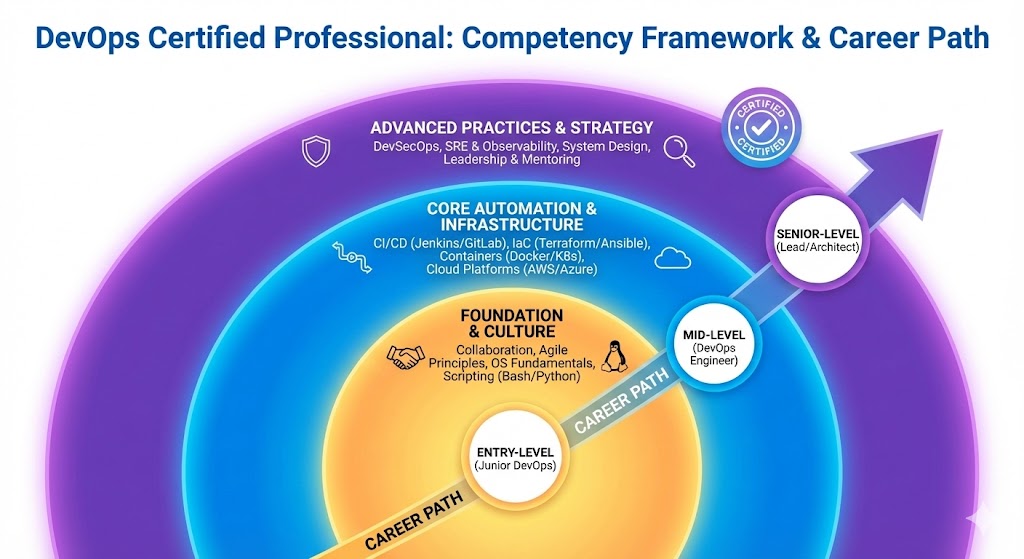
The certification structure follows a logical progression from foundational concepts to expert-level architectural skills. The Foundation level introduces the core philosophy of DevOps, basic Linux administration, and version control with Git. It provides the essential vocabulary and mindset required for anyone entering the field, regardless of their previous background.
Moving upward, the Professional level focuses on the deep integration of tools and processes. This track covers the construction of complex CI/CD pipelines, container orchestration with Kubernetes, and automated infrastructure provisioning. It targets engineers who are actively working in or transitioning into dedicated DevOps roles and need to handle day-to-day automation tasks.
Finally, the Advanced and Expert levels cater to those pursuing leadership or specialized roles like SRE, DevSecOps, or FinOps. These tracks delve into high-level strategy, advanced observability, security automation, and cost optimization. They align with career progression into senior engineering positions or architectural roles where systemic thinking is paramount.
Complete DevOps Certified Professional (DCP) Certification Table
| Track | Level | Who it’s for | Prerequisites | Skills Covered | Recommended Order | Official Link |
| Core DevOps | Foundation | Beginners, Admins | Basic Linux | Git, CI/CD Basics | 1st | Link |
| Core DevOps | Professional | Engineers, SREs | Foundation Level | Docker, K8s, IaC | 2nd | Link |
| Security | DevSecOps | Security Pros | Professional Level | SAST/DAST, Vault | 3rd (Optional) | Link |
| Operations | SRE | Platform Engineers | Professional Level | SLIs/SLOs, On-call | 3rd (Optional) | Link |
| Architecture | Master | Senior Leads | 5+ Years Exp | System Design, SCM | 4th | Link |
Detailed Guide for Each DevOps Certified Professional (DCP) Certification
DevOps Certified Professional (DCP) – Foundation Level
What it is
This certification validates a candidate’s understanding of the basic DevOps philosophy and the core tools required for version control and environment setup. It ensures you speak the language of modern software delivery.
Who should take it
Aspiring DevOps engineers, fresh graduates, and traditional IT administrators should take this to build a solid base for their career transition.
Skills you’ll gain
- Proficiency in Git and collaborative branching strategies.
- Basic understanding of Linux server administration.
- Fundamental concepts of Continuous Integration (CI).
- Knowledge of the DevOps cultural pillars (CAMS).
Real-world projects you should be able to do
- Set up a multi-user version control system for a small team.
- Automate a simple build process using a CI tool.
- Configure a basic web server environment using scripts.
Preparation plan
- 7-14 Days: Focus on Git commands and Linux fundamentals.
- 30 Days: Complete hands-on labs for build automation.
- 60 Days: Study the cultural aspects and take practice exams.
Common mistakes
- Ignoring the cultural aspects of DevOps in favor of tools.
- Failing to practice Linux command-line skills.
- Overcomplicating the initial CI pipeline setup.
Best next certification after this
- Same-track: DCP Professional Level.
- Cross-track: Cloud Practitioner (AWS/Azure).
- Leadership: Scrum Master.
DevOps Certified Professional (DCP) – Professional Level
What it is
This level confirms your ability to manage production-grade infrastructure and complex deployment pipelines. It focuses heavily on containerization and orchestration.
Who should take it
Experienced developers and systems engineers who are responsible for maintaining high-availability applications should pursue this certification.
Skills you’ll gain
- Expertise in Docker containerization and image management.
- Management of Kubernetes clusters and deployments.
- Implementation of Infrastructure as Code using Terraform.
- Advanced CI/CD pipeline orchestration using Jenkins or GitLab.
Real-world projects you should be able to do
- Migrate a monolithic application into a microservices architecture.
- Provision a multi-cloud environment using Terraform scripts.
- Deploy a zero-downtime update using blue-green deployment strategies.
Preparation plan
- 7-14 Days: Deep dive into Docker and Kubernetes architecture.
- 30 Days: Build and troubleshoot complex Jenkins files.
- 60 Days: Focus on IaC and cloud-specific integrations.
Common mistakes
- Neglecting security best practices in container images.
- Hardcoding values in Terraform instead of using variables.
- Focusing on a single tool rather than the end-to-end workflow.
Best next certification after this
- Same-track: DCP Master Level.
- Cross-track: Certified Kubernetes Administrator (CKA).
- Leadership: Engineering Manager track.
Choose Your Learning Path
DevOps Path
This path focuses on the core principles of streamlining the software development lifecycle through automation. You will learn to integrate various tools to create a seamless flow from code commit to production deployment. This track is ideal for those who enjoy building and optimizing pipelines for speed and quality. Furthermore, it prepares you to handle the day-to-day challenges of modern application delivery in an agile environment.
DevSecOps Path
The DevSecOps path emphasizes the integration of security at every stage of the DevOps pipeline. You will explore automated security scanning, vulnerability management, and secret handling. This track is essential for professionals who want to ensure that speed does not come at the cost of safety. Moreover, it teaches you how to implement a “security as code” approach that scales with the organization’s growth.
SRE Path
The Site Reliability Engineering (SRE) path focuses on applying engineering practices to operations tasks to build highly scalable and reliable systems. You will master observability, incident response, and error budget management. This track is perfect for those who enjoy solving complex distributed systems problems and improving system uptime. Consequently, it aligns you with the operational standards used by top-tier tech companies globally.
AIOps / MLOps Path
This specialized path addresses the unique challenges of deploying and managing machine learning models in production. You will learn how to automate ML workflows, manage data versioning, and monitor model performance over time. This track bridges the gap between data science and DevOps, ensuring that AI initiatives provide real business value. Furthermore, it is a rapidly growing field with significant demand for cross-functional experts.
DataOps Path
The DataOps path applies DevOps principles to data management and analytics pipelines. You will focus on improving data quality, reducing cycle times for data analytics, and automating data integration processes. This track is vital for organizations that rely on data-driven decision-making and need reliable data delivery. Moreover, it helps data engineers and architects build more robust and scalable data infrastructures.
FinOps Path
The FinOps path focuses on the cultural and technical shift required to manage cloud spending effectively. You will learn how to bring financial accountability to the variable spend model of the cloud. This track is crucial for organizations looking to optimize their cloud ROI and ensure that engineering teams understand the cost impact of their architectural choices. Consequently, it combines technical expertise with business acumen.
Role → Recommended (Topic name) Certifications
| Role | Recommended Certifications |
| DevOps Engineer | DCP Foundation, DCP Professional |
| SRE | DCP Professional, DCP SRE Specialist |
| Platform Engineer | DCP Professional, DCP Master |
| Cloud Engineer | DCP Foundation, Cloud Provider Certs |
| Security Engineer | DCP DevSecOps Specialist |
| Data Engineer | DCP DataOps Specialist |
| FinOps Practitioner | DCP FinOps Specialist |
| Engineering Manager | DCP Foundation, DCP Leadership Track |
Next Certifications to Take After DevOps Certified Professional (DCP)
Same Track Progression
After completing the Professional level, you should aim for the DCP Master or Expert certification. This progression allows you to transition from being a tool implementer to a system architect. You will learn how to design organizational-wide DevOps strategies and lead large-scale transformations. Deepening your expertise in this track ensures you remain a subject matter expert in core automation and delivery practices.
Cross-Track Expansion
Broadening your skills into areas like SRE or DevSecOps provides a more comprehensive understanding of the modern stack. By earning a cross-track certification, you become a “T-shaped” professional with deep expertise in one area and broad knowledge in others. This makes you more versatile and valuable to teams that require cross-functional collaboration. It also opens up new career opportunities in specialized domains that pay higher premiums.
Leadership & Management Track
If your goal is to lead teams, you should consider certifications in technical leadership or project management. These programs help you develop the soft skills and strategic thinking required to manage people and budgets. Transitioning into leadership allows you to influence the culture and direction of an entire engineering department. It combines your technical foundation from the DCP with the ability to drive organizational change.
Training & Certification Support Providers for DevOps Certified Professional (DCP)
DevOpsSchool
DevOpsSchool provides a comprehensive ecosystem for learners aiming to master the DCP curriculum through instructor-led training and real-world projects. They focus on delivering hands-on experience by using industry-standard tools and environments that mirror actual production settings. The trainers bring years of practical experience, ensuring that students learn how to solve real problems rather than just passing an exam. Furthermore, they offer extensive support through community forums and dedicated lab assistants. This commitment to practical education makes them a preferred choice for many corporate training programs in India and abroad. Their structured approach helps students build confidence and technical depth simultaneously.
Cotocus
Cotocus specializes in high-end technical consulting and training, particularly for advanced DevOps and SRE certifications. They offer tailored programs that cater to the specific needs of enterprises and experienced professionals who want to level up their skills quickly. Their methodology emphasizes deep-dive technical sessions and architectural discussions that go beyond the basics of tool usage. Moreover, they provide excellent post-training support to help candidates implement what they have learned in their respective workplaces. This focus on long-term skill retention and application distinguishes them as a premium training provider. Many senior engineers choose Cotocus for their career advancement due to the high caliber of their instructors.
Scmgalaxy
Scmgalaxy serves as a massive knowledge hub and training provider for the global DevOps community. They offer an extensive library of resources, including tutorials, videos, and practice labs that support the DCP learning path. Their training programs are known for being accessible and highly detailed, covering everything from basic configuration management to complex cloud orchestration. Furthermore, they foster a vibrant community where professionals can share insights and troubleshoot common issues together. This community-driven approach ensures that the learning material remains updated with the latest industry trends. They provide a cost-effective way for individual learners to gain deep technical knowledge and industry recognition.
BestDevOps
BestDevOps focuses on delivering high-quality, streamlined training for busy professionals who need to gain certifications without disrupting their work schedules. They offer flexible learning options, including weekend batches and self-paced modules, all aligned with the DCP requirements. Their curriculum is designed to be concise yet thorough, focusing on the most critical skills required for the job market. Moreover, they provide mock exams and interview preparation sessions to help candidates succeed in their career transitions. This results-oriented approach makes them a popular choice for engineers looking for a direct path to certification. They consistently produce high success rates among their graduates.
devsecopsschool.com
DevSecOpsSchool is a dedicated platform for engineers who want to specialize in the intersection of security and DevOps. They provide the specific training required for the DCP DevSecOps track, focusing on automated security testing and compliance. Their labs include hands-on exercises with tools like SonarQube, Vault, and various container security scanners. Furthermore, they emphasize the cultural shift needed to integrate security into the development process seamlessly. This specialization makes them the go-to resource for security professionals looking to modernize their skill sets. Their curriculum ensures that security becomes an enabler of speed rather than a bottleneck in the delivery pipeline.
sreschool.com
SRESchool focuses exclusively on the principles and practices of Site Reliability Engineering. They provide the necessary training for the DCP SRE track, covering topics like error budgets, toil reduction, and advanced monitoring. Their programs are designed to teach engineers how to build systems that can withstand production pressures and scale efficiently. Moreover, they use real-world incident scenarios to help students develop strong troubleshooting and system design skills. This specialized focus is invaluable for those looking to work in high-scale environments like those found in major tech firms. They bridge the gap between traditional operations and modern software engineering.
aiopsschool.com
AIOpsSchool addresses the emerging need for artificial intelligence in IT operations. They provide specialized training for the DCP AIOps track, teaching students how to use machine learning to improve monitoring and incident management. Their curriculum covers data science fundamentals tailored for operations professionals, including anomaly detection and predictive maintenance. Furthermore, they help engineers understand how to manage the lifecycle of AI models within a DevOps framework. This unique training path prepares professionals for the future of automated operations. It is an excellent choice for those looking to stay at the cutting edge of technological innovation.
dataopsschool.com
DataOpsSchool provides targeted training for managing data pipelines using DevOps methodologies. They support the DCP DataOps track by focusing on data quality automation, versioning, and continuous integration for data workflows. Their programs are essential for data engineers who want to bring more agility and reliability to their data platforms. Moreover, they provide hands-on experience with modern data tools and orchestration frameworks. This specialized training helps organizations treat their data as a product with a defined delivery lifecycle. It ensures that data teams can meet the high demands of modern analytics and business intelligence.
finopsschool.com
FinOpsSchool focuses on the financial management side of cloud computing and DevOps. They provide the training required for the DCP FinOps track, teaching professionals how to optimize cloud costs through technical and cultural changes. Their curriculum covers cloud billing architectures, cost allocation strategies, and waste reduction techniques. Furthermore, they help bridge the communication gap between engineering and finance teams. This specialized knowledge is becoming increasingly important as companies look to control their growing cloud expenditures. By completing this training, professionals can demonstrate their ability to deliver high-performance systems that are also economically efficient.
Frequently Asked Questions (General)
- What is the main benefit of getting a DCP certification?The primary benefit is gaining a structured and recognized validation of your skills in modern software delivery and automation.
- How difficult is the DCP exam compared to other certifications?The DCP is considered moderately difficult because it requires both theoretical knowledge and practical hands-on experience in a lab environment.
- Do I need a computer science degree to pursue this?No, a degree is not mandatory, but a strong foundation in Linux, networking, and basic programming is highly recommended for success.
- How long does it typically take to prepare for the Professional level?Most professionals with some prior experience take between 30 and 60 days of consistent study and practice to feel fully prepared.
- Is the certification recognized globally?Yes, the DCP program is recognized by major technology firms and enterprises across the globe as a standard for DevOps proficiency.
- Does the certification require regular renewal?Yes, you generally need to renew the certification or advance to a higher level every few years to ensure your skills remain current.
- Can I take the exam online?Most providers offer a proctored online exam option, allowing you to take the test from the comfort of your home or office.
- What is the passing score for the DCP exams?While it varies by level, most exams require a score of at least 70% to 75% to pass and earn the credential.
- Are there any prerequisites for the Foundation level?There are no formal prerequisites, though basic familiarity with the Linux command line and general IT concepts will help significantly.
- How much does the certification cost?The cost depends on the provider and the level of certification, but it typically ranges from a few hundred to several hundred dollars.
- Does the DCP cover specific cloud providers like AWS or Azure?The DCP focuses on cloud-agnostic principles and tools, although practical labs may use specific cloud platforms for implementation.
- How does this certification impact salary potential?Certified professionals often see a significant increase in their market value, sometimes resulting in 20% to 30% higher salary offers.
FAQs on DevOps Certified Professional (DCP)
- How does DCP help with career progression in India?In the Indian market, the DCP helps you stand out in a crowded pool of candidates by proving you possess high-demand technical skills. Companies in major hubs like Bengaluru and Hyderabad actively seek certified professionals to lead their digital transformation projects. Consequently, it opens doors to senior roles in multinational corporations and high-growth startups alike.
- What tools are emphasized in the DCP curriculum?The curriculum focuses on a balanced toolset including Git for version control, Docker for containerization, and Kubernetes for orchestration. Furthermore, it covers configuration management with Ansible and Infrastructure as Code with Terraform. This broad tool coverage ensures you can work in diverse technical environments regardless of the specific stack a company uses.
- Is the DCP certification focused on a specific industry?No, the DCP is designed to be applicable across all industries that rely on software, including finance, healthcare, and retail. The principles of automation and reliability are universal and provide value wherever software delivery is a critical business function. This versatility makes the certification a long-term asset for your entire professional journey.
- How does the DCP handle the human element of DevOps?The DCP emphasizes that DevOps is as much about culture as it is about tools. It teaches you how to foster collaboration between development and operations teams and how to implement feedback loops. Consequently, you learn to reduce friction in the organization and build a culture of shared responsibility and continuous improvement.
- Can I transition from a manual testing role to DevOps using this?Yes, the DCP provides a clear path for testers to move into automated testing and eventually full DevOps roles. By mastering the CI/CD modules, you learn how to integrate automated quality checks directly into the delivery pipeline. This shift is highly valued as companies move toward continuous testing models.
- What kind of support is available during the learning process?Learners have access to extensive documentation, community forums, and hands-on lab environments provided by the training partners. Furthermore, instructor-led sessions provide the opportunity to ask specific questions and receive personalized feedback on your progress. This multi-channel support ensures that you never feel stuck or overwhelmed by the technical complexity.
- Does the DCP cover site reliability engineering (SRE) concepts?Yes, the DCP includes significant modules on monitoring, observability, and incident management, which are core components of SRE. It teaches you how to define service level objectives and how to manage system health proactively. Consequently, it prepares you for roles that require a high degree of operational excellence and system stability.
- How relevant is the DCP for engineering managers?For managers, the DCP provides the technical context needed to lead modern engineering teams effectively. It helps you understand the bottlenecks in your delivery process and gives you the vocabulary to discuss architectural trade-offs. Moreover, it empowers you to champion automation initiatives that improve your team’s overall productivity and morale.
Final Thoughts: Is DevOps Certified Professional (DCP) Worth It?
When you look at the trajectory of the software industry, it is clear that automation and operational excellence are no longer optional. The DevOps Certified Professional (DCP) offers a structured way to gain these essential skills while earning a credential that the industry respects. From my perspective as a mentor, the true value lies not in the digital badge itself, but in the disciplined mindset you develop during the preparation process.
Furthermore, the DCP forces you to move beyond your comfort zone and explore the entire lifecycle of an application. It challenges you to think about security, cost, and reliability as integral parts of the development process rather than afterthoughts. This holistic understanding is what separates a senior engineer from a junior one. Consequently, if you are looking to increase your impact and future-proof your career, this certification is a solid investment.
Ultimately, your success depends on how you apply these principles in your daily work. A certification can get you the interview, but your ability to solve real problems will get you the job. Use the DCP as a foundation to build your expertise, stay curious, and never stop experimenting with new ways to improve how we build and ship software.