Introduction
Modern software engineering requires a radical shift in how teams handle security, which makes the DevSecOps Certified Professional (DSOCP) a vital credential for current professionals. This guide explores how you can bridge the gap between rapid development and robust safety protocols. Furthermore, DevOpsSchool provides the necessary training to master these advanced automation techniques. By following this roadmap, you gain the clarity needed to make better career decisions while staying ahead of industry trends. Therefore, this overview helps you understand the technical requirements and strategic advantages of mastering security as code.
Why DevSecOps Certified Professional (DSOCP) is Valuable Today
Organizations globally face a rising tide of sophisticated cyber threats, which increases the demand for engineers who prioritize security. DevSecOps principles ensure that you remain highly relevant even as specific cloud platforms or tools change over time. Furthermore, the tech industry currently favors “Shift Left” strategies where every team member shares the responsibility for digital safety. Consequently, earning this certification provides a massive return on investment by placing you at the center of modern infrastructure design. Enterprise leaders actively seek professionals who can reduce risk without sacrificing the speed of innovation.
Who Should Pursue DevSecOps Certified Professional (DSOCP)?
Software developers and site reliability engineers find this program essential because it transforms their understanding of the delivery pipeline. Cloud architects and security analysts who want to move into automated environments will also see immediate benefits in their daily workflows. Additionally, engineering managers should pursue this path to lead their teams toward more secure and compliant release cycles. The curriculum supports both early-career engineers and seasoned veterans who need to formalize their expertise in automated governance. Its influence stretches across the tech hubs of India and into the largest enterprise environments worldwide.
What is the DevSecOps Certified Professional (DSOCP)?
The DevSecOps Certified Professional (DSOCP) represents an evolution in engineering where security functions as an integrated, automated process. It exists because traditional, manual security checks cannot keep pace with high-frequency CI/CD release cycles. Furthermore, this program emphasizes hands-on, production-focused learning rather than just memorizing theoretical concepts. It aligns with the “Security as Code” philosophy, allowing your team to identify and fix vulnerabilities before they ever reach production. Consequently, you learn to build a resilient platform that protects user data while maintaining operational agility.
DevSecOps Certified Professional (DSOCP) Certification Tracks & Levels
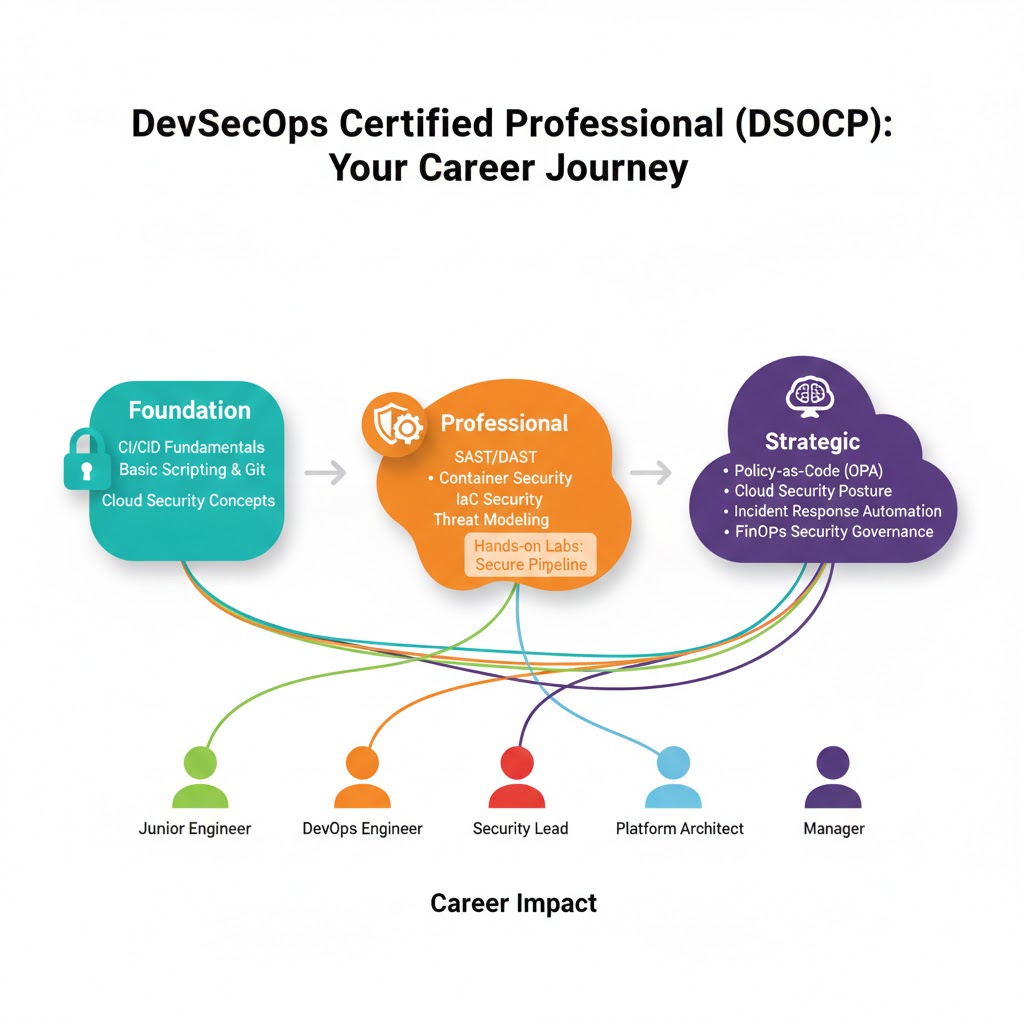
The DSOCP program utilizes a structured hierarchy including foundation, professional, and advanced levels to foster long-term skill development. The foundation level focuses on the basics of scanning and testing within a standard automated pipeline. Moving to the professional level allows you to tackle more complex topics like container hardening and secrets orchestration. Furthermore, the advanced track prepares you for high-level architectural governance and compliance automation across entire organizations. This logical progression ensures that you build a solid technical base before moving into enterprise-wide security leadership.
Complete DevSecOps Certified Professional (DSOCP) Certification Table
| Track | Level | Who it’s for | Prerequisites | Skills Covered | Recommended Order | Official Link |
| Security Ops | Foundation | Junior Engineers | Linux/Git | SAST, DAST, SCA | First | DSOCP Official |
| Infrastructure | Professional | SREs/DevOps | Foundation | Vault, Docker, K8s | Second | DSOCP Official |
| Governance | Advanced | Senior Leads | Professional | Compliance as Code | Third | DSOCP Official |
| Strategic | Expert | Tech Directors | Advanced | Risk Management | Fourth | DSOCP Official |
DevSecOps Certified Professional (DSOCP) Certification Overview
This program delivers high-quality technical instruction through specialized training modules hosted on the DevSecOps School platform. It uses a practical, lab-based assessment method to ensure you can implement these security strategies in a live setting. Moreover, the program structure maintains a vendor-neutral stance while teaching you the industry’s most popular open-source tools. This methodology ensures that your skills remain applicable regardless of the specific cloud environment your company uses. Consequently, the certification serves as a powerful validation of your ability to secure the entire software lifecycle.
Detailed Guide for Each DevSecOps Certified Professional (DSOCP) Certification
DevSecOps Certified Professional (DSOCP) – Foundation
What it is
The Foundation level establishes your knowledge of basic security integration within the development process. It serves as your entry point into the world of “Shift Left” security and automated code analysis.
Who should take it
Junior developers, QA testers, and entry-level sysadmins find this level particularly helpful for their career growth. It also suits anyone who wants to transition from traditional IT support into a modern DevOps role.
Skills you’ll gain
- You will learn to integrate Static Application Security Testing (SAST) into your build process.
- You will master Software Composition Analysis to find vulnerabilities in third-party libraries.
- You will understand the cultural shifts required to align security with development teams.
- You will generate automated security reports that help teams prioritize remediation.
Real-world projects you should be able to do
- You should be able to create a GitLab pipeline that automatically scans for vulnerabilities on every push.
- You should be able to implement a tool that blocks any build containing critical security flaws.
Preparation plan
- 7–14 days: Study the core concepts of the DevSecOps Manifesto and modern pipeline architecture.
- 30 days: Set up local labs to practice integrating basic scanners with Jenkins or GitHub Actions.
- 60 days: Complete a full security-integrated project and take practice exams to verify your knowledge.
Common mistakes
- Many candidates focus only on tool configuration while ignoring the communication between teams.
- Beginners often fail to distinguish between critical security risks and minor false positives.
Best next certification after this
- Same-track option: DSOCP Professional.
- Cross-track option: SRE Certified Professional.
- Leadership option: Engineering Management Foundation.
DevSecOps Certified Professional (DSOCP) – Professional
What it is
The Professional level expands your focus into infrastructure security and runtime protection for modern applications. It validates your ability to secure the platform and the data residing within it.
Who should take it
Experienced DevOps engineers and SREs who manage production environments should pursue this certification. It targets those who lead technical security initiatives within their respective engineering squads.
Skills you’ll gain
- You will harden container images and secure Kubernetes cluster configurations.
- You will implement HashiCorp Vault to manage application secrets and sensitive data.
- You will run Dynamic Application Security Testing (DAST) against live staging environments.
- You will build monitoring dashboards that track security events in real-time.
Real-world projects you should be able to do
- You should be able to design a system that manages and rotates database credentials automatically.
- You should be able to secure a Kubernetes deployment using network policies and RBAC.
Preparation plan
- 7–14 days: Research CIS Benchmarks and container security best practices in depth.
- 30 days: Spend significant time configuring and testing enterprise secrets management tools.
- 60 days: Build a complete monitoring and alerting stack that responds to security threats in production.
Common mistakes
- Some engineers create overly restrictive security gates that slow down legitimate development work.
- Professionals occasionally forget to secure the build server itself, leaving the automation pipeline vulnerable.
Best next certification after this
- Same-track option: DSOCP Advanced.
- Cross-track option: Cloud Security Architect.
- Leadership option: Technical Lead Certification.
DevSecOps Certified Professional (DSOCP) – Advanced
What it is
The Advanced level covers large-scale governance and the implementation of automated compliance frameworks. It validates your expertise in designing security systems that span multiple teams and cloud providers.
Who should take it
Principal engineers, enterprise architects, and senior security leads should focus on this advanced track. It prepares you for high-impact roles where you define the security standards for an entire company.
Skills you’ll gain
- You will write and enforce Policy as Code to govern cloud infrastructure automatically.
- You will automate compliance audits for global standards like SOC2 or GDPR.
- You will design multi-cloud security architectures that protect distributed systems.
- You will lead complex threat modeling sessions to identify architectural weaknesses early.
Real-world projects you should be able to do
- You should be able to implement a global policy that prevents the creation of insecure cloud resources.
- You should be able to build a centralized dashboard that tracks compliance across 100+ cloud accounts.
Preparation plan
- 7–14 days: Review global regulatory requirements and how they map to specific technical controls.
- 30 days: Master policy languages like Rego to write custom enforcement rules for your infrastructure.
- 60 days: Create a comprehensive security and compliance framework for a large-scale enterprise simulation.
Common mistakes
- Architects sometimes design policies without understanding the operational needs of the development teams.
- Candidates often focus too much on compliance documentation instead of technical resilience.
Best next certification after this
- Same-track option: Expert Governance track.
- Cross-track option: FinOps Professional.
- Leadership option: CISO Training and Certification.
Choose Your Learning Path
DevOps Path
A DevOps professional should focus on adding security into the existing CI/CD flow without reducing deployment speed. Start with the DSOCP Foundation to learn how to add automated scanners to your daily builds. Furthermore, you should move toward the Professional level to master container and infrastructure security. This path ensures that security becomes a core feature of your automation strategy. Consequently, you become a more versatile engineer capable of delivering safe, reliable software at high velocity.
DevSecOps Path
The specialized DevSecOps path is for those who want to make security automation their primary career goal. You should follow the DSOCP levels in order to build a deep, end-to-end understanding of the entire security stack. This path requires you to understand both offensive security tactics and defensive automation techniques. Moreover, you will learn to build systems that automatically detect and fix vulnerabilities. This expertise is highly valued in regulated industries such as banking, insurance, and healthcare.
SRE Path
Site Reliability Engineers should view security through the lens of system availability and operational health. Since security breaches cause significant downtime, your goal is to prevent these incidents before they happen. Focus on the DSOCP Professional level to master monitoring, secrets management, and production security. Furthermore, use Advanced concepts to implement automated recovery for security failures. This path makes you a comprehensive reliability expert who handles both operational bugs and security threats with ease.
AIOps / MLOps Path
As companies adopt artificial intelligence, securing the underlying data and models becomes a top priority. Professionals in this path should use DSOCP to learn how to protect the infrastructure that hosts ML workloads. You will focus on securing data pipelines and ensuring that models remain free from tampering. Consequently, you build a “Secure ML” lifecycle that protects your company’s intellectual property. This path bridges the gap between high-level data science and low-level infrastructure security.
DataOps Path
DataOps professionals must ensure that data flows securely across the organization without exposure. Use the DSOCP Foundation to learn how to implement automated data masking and encryption in your pipelines. Furthermore, the Advanced modules help you automate the audits required for handling sensitive user data. This ensures that your organization meets privacy standards while maintaining a high speed of data delivery. Consequently, you become the primary advocate for data integrity and safety within your engineering group.
FinOps Path
FinOps practitioners benefit from DSOCP by identifying the financial risks associated with insecure resources. Unsecured or misconfigured cloud assets can lead to massive cost spikes due to unauthorized usage or breaches. By learning the Foundation and Professional levels, you identify expensive security gaps that impact the bottom line. Furthermore, you will advocate for security tools that offer the best financial and operational efficiency. This path allows you to manage the cloud budget and security posture as a single, unified goal.
Role → Recommended DevSecOps Certified Professional (DSOCP) Certifications
| Role | Recommended Certifications |
| DevOps Engineer | DSOCP Foundation, DSOCP Professional |
| SRE | DSOCP Professional, DSOCP Advanced |
| Platform Engineer | DSOCP Professional, DSOCP Advanced |
| Cloud Engineer | DSOCP Foundation, DSOCP Professional |
| Security Engineer | DSOCP Professional, DSOCP Advanced |
| Data Engineer | DSOCP Foundation, Data Security Track |
| FinOps Practitioner | DSOCP Foundation, FinOps Certified |
| Engineering Manager | DSOCP Foundation, Governance Track |
Next Certifications to Take After DevSecOps Certified Professional (DSOCP)
Same Track Progression
After you master the DSOCP Advanced level, you should pursue deep specialization in specific cloud platforms or security domains. This might include earning security-specific credentials from AWS, Azure, or Google Cloud to solidify your platform expertise. Furthermore, exploring advanced penetration testing or digital forensics helps you understand the mindset of modern attackers. This deep technical knowledge makes you the go-to expert for solving the most complex enterprise security issues. Consequently, you prepare yourself for elite roles like Principal Security Architect.
Cross-Track Expansion
Broadening your skills into related fields like SRE or FinOps creates a much more versatile professional profile. Understanding how security impacts system reliability or cloud costs allows you to provide holistic advice to your leadership. Moreover, earning certifications in Kubernetes administration or cloud architecture can strengthen your technical base. This cross-pollination of skills is highly valued in high-growth companies where engineers wear multiple hats. Therefore, expanding your knowledge ensures you stay competitive as the tech landscape continues to change.
Leadership & Management Track
For those who want to transition into strategy, the leadership track is the natural next step after finishing DSOCP. This path involves moving from managing tools to managing teams, budgets, and overall corporate risk. Certifications in engineering management or executive leadership will help you move into roles like Engineering Director or CISO. You will use your deep technical background to make strategic decisions that protect the company’s long-term health. Consequently, this path focuses on communication, vision, and building a strong security culture across the organization.
Training & Certification Support Providers for DevSecOps Certified Professional (DSOCP)
DevOpsSchool remains a leader in technical training, specifically focusing on the intersection of security and modern operations. They provide an immersive learning environment that blends theoretical depth with intense practical labs. Furthermore, their instructors bring years of real-world industry experience, ensuring you learn production-ready techniques. Consequently, you gain the confidence to implement complex security pipelines in any enterprise environment. Their commitment to student success makes them a top choice for professionals globally.
Cotocus offers specialized training and consulting services that focus on the deep technical mastery of DevSecOps. Their approach is highly practical, using real-world scenarios to ensure you can apply your skills immediately. Moreover, they tailor their programs to meet the needs of modern engineering squads, making them a preferred choice for corporate upskilling. Consequently, professionals who train with Cotocus find themselves better prepared for the challenges of high-scale cloud security. They bridge the gap between classroom learning and actual operational requirements.
Scmgalaxy provides a massive library of resources, tutorials, and community support for those pursuing the DSOCP certification. They offer a unique perspective on security by focusing on its roots in software configuration management and release engineering. Furthermore, their platform serves as a hub where engineers share knowledge and solve complex automation problems together. Scmgalaxy helps you understand the evolution of DevSecOps, giving you a deeper context for modern practices. Their community-driven approach makes them an excellent resource for continuous learning.
BestDevOps specializes in high-impact training sessions designed for busy, working professionals who need to master DevSecOps quickly. Their flexible programs emphasize the use of open-source tools, ensuring your skills remain portable across different employers. Furthermore, they focus on building a strong foundation of core principles before moving into advanced automation topics. Consequently, they produce well-rounded engineers who can lead security initiatives in any technical environment. They prioritize practical outcomes over theoretical fluff in every session.
devsecopsschool.com acts as a centralized portal for everyone interested in the DevSecOps movement and formal certification. They offer structured learning paths, tool comparisons, and the latest industry news to keep you informed. Furthermore, their training modules take you from a complete beginner to an expert-level practitioner through a series of logical steps. The platform also provides various free resources to help you get started on your security journey. It is a vital resource for staying current in the rapidly changing world of security automation.
sreschool.com focuses on the critical link between site reliability and security, making it a perfect partner for SREs. They teach you how to build systems that are both highly available and inherently secure against modern threats. Furthermore, their curriculum highlights the importance of monitoring and automated response in maintaining system health. Consequently, you gain a unique operational perspective that is often missing from traditional security courses. They ensure that uptime and safety remain equally important priorities in your daily work.
aiopsschool.com provides cutting-edge training for engineers who want to incorporate artificial intelligence into their security workflows. They offer modules that explore how machine learning can detect threats and automate remediation at a massive scale. Furthermore, they help you understand the specific security requirements of AI and ML models in production. Consequently, you prepare yourself for the next generation of technical roles where AI and security merge. This provider is ideal for those who want to stay on the bleeding edge of technology.
dataopsschool.com addresses the urgent need for security within high-speed data engineering and analytics pipelines. They teach you how to apply DSOCP principles to protect data at every stage of its lifecycle. Furthermore, they focus on the automated implementation of data masking and encryption to ensure compliance with global laws. Consequently, you learn to deliver fast insights without compromising user privacy or data integrity. They bridge the gap between data science and corporate security standards effectively.
finopsschool.com offers a unique perspective on how security decisions impact the financial performance of a cloud-based organization. They help you identify misconfigured resources that pose both a security risk and a financial burden. Furthermore, their training helps you build a business case for security by demonstrating long-term cost savings. Consequently, you learn to optimize the cloud infrastructure for both safety and financial efficiency. This dual expertise makes you a highly valued asset to any leadership team.
Frequently Asked Questions (General)
- How difficult is it to pass the DSOCP certification exam?
The exam is moderately difficult because it tests your practical ability to implement security tools rather than just your memory of facts. You must demonstrate that you can solve real-world automation challenges.
- What is the typical timeframe for completing the entire track?
Most professionals spend three to six months to complete all levels from foundation to advanced. This allows for enough hands-on practice in the labs to master the technical topics.
- Are there any mandatory requirements before I start the Foundation level?
You should have a basic understanding of the Linux command line and Git version control. Knowing at least one programming language will significantly help you with the automation modules.
- What kind of salary increase can I expect after earning this certification?
DevSecOps specialists often command higher salaries than standard DevOps engineers due to the specialized nature of security automation. It also opens doors to more senior, high-impact roles.
- Is the DSOCP certification recognized by employers outside of India?
Yes, the tools and principles taught in the program are global industry standards used by major tech firms worldwide. This makes your certification valuable in any international market.
- Do I need to be a security expert before I join the program?
No, the program teaches you security from an engineering perspective, starting with the very basics. You only need a strong technical foundation and a desire to learn automation.
- Which tools will I learn to use during the DSOCP training?
You will master a variety of tools including SonarQube, Snyk, Jenkins, Docker, Kubernetes, HashiCorp Vault, and various monitoring frameworks.
- How are the certification exams delivered?
The exams are typically delivered online and include a mix of conceptual questions and practical lab tasks. You must successfully complete the technical exercises to pass.
- Is it possible to take the Professional exam before the Foundation exam?
We strongly recommend taking the levels in order because the Professional curriculum assumes you already understand the concepts introduced in the Foundation level.
- When does the DSOCP certification expire?
The certification usually requires renewal or continuing education every two to three years. This ensures that you stay up to date with the latest security threats and tools.
- How does DSOCP differ from other security certifications like CISSP?
CISSP focuses on high-level management and security theory, while DSOCP is a technical, hands-on certification focused on automation and engineering.
- Can my company get a discount for certifying our whole engineering team?
Many providers like DevOpsSchool offer enterprise packages and group discounts for organizations looking to upskill their entire technical staff.
FAQs on DevSecOps Certified Professional (DSOCP)
- What is the “Shift Left” philosophy mentioned in the course?
Shift Left means moving security checks to the beginning of the development cycle. This allows you to catch and fix issues much faster and cheaper than in production.
- How does the program handle compliance requirements?
The program teaches you to turn compliance rules into automated tests. This ensures your infrastructure always meets regulatory standards without manual intervention.
- Does the course focus on a specific cloud provider like AWS?
The program remains vendor-neutral, teaching you concepts that apply to AWS, Azure, and Google Cloud equally. You will use various tools that work across all major platforms.
- What is the primary goal of the Professional level track?
The Professional level focuses on securing the infrastructure and the application environment. You will learn to harden containers and manage secrets at scale.
- How does Policy as Code help an organization?
Policy as Code allows you to define security rules in your configuration files. This ensures that every resource you deploy automatically follows your company’s security standards.
- Can this certification help me move into a management role?
Yes, the Advanced level focuses on governance and strategy, which are critical skills for engineering managers and technical directors.
- How do the labs help me prepare for the real world?
The labs simulate production environments where you must integrate security tools and respond to threats. This gives you the actual experience needed to succeed in a job.
- Why is container security a major focus in the program?
Since most modern applications run in containers, securing the images and the orchestration layer is vital for protecting the entire application stack.
Final Thoughts: Is DevSecOps Certified Professional (DSOCP) Worth It?
When you analyze the future of the technology industry, it is clear that security has become a fundamental part of the engineering process. Earning the DevSecOps Certified Professional (DSOCP) is a strategic move that transforms you into a highly valuable specialist in a high-demand field. This journey requires hard work and a dedication to continuous technical growth, but the career rewards are exceptional. You will no longer just be building software; you will be building resilient, secure platforms that protect the future of your organization. My advice as a mentor is to embrace this challenge, master the automated tools, and lead the way toward a safer digital world.