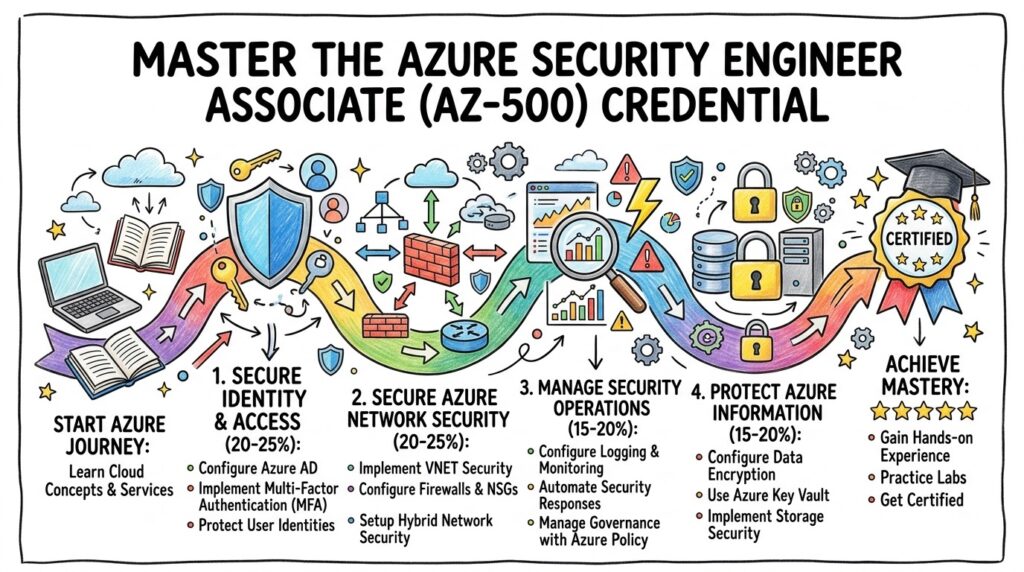
Modern enterprise environments demand robust protection, making the Azure Security Engineer Associate (AZ-500) certification a cornerstone for technical career growth. Transitioning into a high-level role requires more than just basic cloud knowledge; it requires a deep understanding of how to defend identity, infrastructure, and applications. Engineers who train through DevOpsSchool gain the technical edge needed to implement sophisticated security controls across the Microsoft ecosystem. This comprehensive guide breaks down the AZ-500 curriculum to help SREs, developers, and platform architects navigate their professional journey with clarity and purpose.
Defining the Azure Security Engineer Associate (AZ-500)
The Azure Security Engineer Associate (AZ-500) validates an engineer’s capacity to build and manage secure cloud-native architectures. Unlike entry-level certifications, this program emphasizes production-ready skills like threat modeling, platform protection, and rigorous identity management. Enterprises seek professionals who can automate security protocols within a CI/CD pipeline rather than performing manual audits. This certification bridges the gap between theoretical security and modern engineering workflows by focusing on “security as code” and granular access control.
Ideal Candidates for the AZ-500 Path
Cloud security specialists represent the primary audience, but the curriculum offers immense value to a wider range of technical roles. Systems engineers and SREs use these skills to harden infrastructure against evolving digital threats. Beginners with basic cloud familiarity can leverage this credential to pivot into lucrative security operations roles. Furthermore, technical leaders and engineering managers in India and across the global market prioritize this certification to ensure their teams meet strict compliance and data protection standards.
Why the AZ-500 Remains Essential Beyond This Year
The explosion of automated cyberattacks has made verified security expertise a non-negotiable asset for IT professionals. Because Microsoft Azure holds a massive share of the enterprise market, these skills remain relevant even as individual software tools change. The AZ-500 provides an excellent return on time because it reinforces core security logic—like Zero Trust and defense-in-depth—that translates across any cloud provider. Holding this certificate proves that an engineer can move beyond simple operations to become a strategic defender of corporate assets.
Core Structure of the Certification Program
Students access the formal curriculum through the Azure Security Technologies AZ-500 course hosted on the DevOpsSchool platform. The exam utilizes a practical assessment model, requiring candidates to solve complex case studies and perform real-time security configurations. Microsoft maintains ownership of the credential, ensuring the content aligns with the latest portal updates and API security features. The program organizes its objectives into four pillars: identity management, platform protection, data security, and security operations management.
Career Progression and Certification Tracks
This professional-level milestone anchors the Azure security portfolio by connecting foundational knowledge to expert-level architecture. It provides a specialized track for DevOps and SRE practitioners who focus on automated incident response and identity governance. Most engineers view this as the mid-tier achievement that qualifies them for daily security operations before they pursue lead architectural positions. This progression mirrors a standard career ladder, moving from general cloud engineering into specialized security leadership or FinOps roles.
Comprehensive AZ-500 Certification Matrix
| Track | Level | Who it’s for | Prerequisites | Skills Covered | Recommended Order |
| Cloud Defense | Associate | SREs & Cloud Engineers | Azure Basics | RBAC, Firewalls, Key Vault | Second after AZ-900 |
| Identity Focus | Specialist | IAM Professionals | Active Directory Knowledge | Entra ID, PIM, Governance | Parallel with AZ-500 |
| SecOps | Professional | SOC Analysts | Incident Management | Sentinel, Defender, Monitoring | Following AZ-500 |
| App Shielding | Developer | DevSecOps Engineers | Scripting & Web Apps | Container Security, API Defense | After AZ-204 |
Deep Dive: Azure Security Engineer Associate (AZ-500) Details
The Scope of the Role
This associate-level credential confirms that a professional can implement threat protection and manage security controls across a full cloud tenant. It proves mastery over identity access and the ability to safeguard networks, databases, and hosted applications.
Targeted Audience
Engineers with at least one year of hands-on Azure experience benefit most from this certification. It also serves SREs and DevOps professionals who want to lead security initiatives within their production environments.
Core Competencies Acquired
- Managing Microsoft Entra ID for identity protection and governance.
- Hardening network perimeters using Azure Firewall and NSGs.
- Utilizing Microsoft Sentinel and Defender for Cloud to monitor security posture.
- Protecting sensitive data in SQL databases and storage accounts via encryption.
Practical Project Milestones
- Deploying a secure Hub-and-Spoke network with centralized traffic inspection.
- Establishing a Zero Trust identity framework using Multi-Factor Authentication and PIM.
- Managing environmental secrets and certificates through Azure Key Vault automation.
Strategy for Preparation
- Initial 14 Days: Focus on high-level architecture and take practice tests to find knowledge gaps.
- 30-Day Mark: Execute hands-on labs daily, specifically focusing on Entra ID and network isolation.
- 60-Day Mark: Master the PowerShell and CLI commands required for security automation and finalize exam readiness.
Frequent Candidate Pitfalls
- Ignoring the command-line interface (CLI) and PowerShell syntax used in security tasks.
- Underestimating the complexity of Identity Governance and Privileged Identity Management.
- Relying too heavily on the GUI while ignoring JSON policies and ARM templates.
Future Certification Pathways
- Direct Progression: Microsoft Cybersecurity Architect Expert (SC-100).
- Lateral Growth: Azure Solutions Architect Expert (AZ-305).
- Leadership Transition: Certified Information Systems Security Professional (CISSP).
Specialized Learning Paths
DevOps Strategy
The DevOps path centers on automating security checks within the software delivery lifecycle. Engineers integrate AZ-500 controls into CI/CD pipelines to achieve “secure by design” deployments. This involves managing secrets via Key Vault and enforcing policy-as-code across all environments.
DevSecOps Focus
This route emphasizes shift-left security and continuous vulnerability monitoring. Professionals specialize in container security and automated threat response within the Azure ecosystem. The AZ-500 provides the necessary foundation for implementing these advanced security tools in regulated industries.
SRE Methodology
Site Reliability Engineers use security knowledge to maintain system uptime during active attacks. By mastering AZ-500, SREs build resilient platforms using Azure’s native DDoS protection. They focus on balancing encryption requirements with system performance to ensure a safe user experience.
AIOps / MLOps Direction
As AI dominates the industry, securing data pipelines and model endpoints becomes a top priority. Engineers use AZ-500 skills to protect training data and inference compute instances. They implement strict identity controls to prevent unauthorized access to proprietary machine learning models.
DataOps Specialty
DataOps professionals prioritize the safety of data at rest and in motion. This path uses AZ-500 to master SQL encryption and private link configurations. It ensures that engineering pipelines remain compliant with global privacy laws while supporting business analytics.
FinOps Perspective
FinOps practitioners analyze the cost-to-risk ratio of security resources. AZ-500 helps them understand which logging levels in Microsoft Sentinel provide value versus which ones waste budget. They optimize cloud spend by choosing the right security tier for each resource.
Mapping Roles to Recommended Certifications
| Role | Recommended Certifications |
| DevOps Engineer | AZ-500, AZ-400 |
| SRE | AZ-500, AZ-104 |
| Platform Architect | AZ-500, AZ-305 |
| Cloud Engineer | AZ-104, AZ-500 |
| Security Analyst | SC-300, AZ-500, SC-100 |
| Data Engineer | DP-203, AZ-500 |
| FinOps Manager | FinOps Practitioner, AZ-500 |
| Technical Lead | AZ-900, AZ-500 |
Scaling Your Expertise After AZ-500
Deep Vertical Specialization
Professionals who complete the AZ-500 often move toward the Microsoft Cybersecurity Architect Expert (SC-100). This role shifts the focus from daily implementation to designing high-level defense strategies. You will learn to harmonize various Microsoft security products into a unified enterprise shield.
Broad Horizontal Expansion
Broadening your influence requires pursuing the Azure Solutions Architect Expert (AZ-305). Security knowledge makes you a superior architect because you can design safety into the blueprint. Alternatively, the AZ-400 allows you to master the “how” of security automation for DevOps teams.
Transitioning to Leadership
Combining technical AZ-500 skills with a CISM or CISSP credential creates a powerful leadership profile. This path proves you possess both hands-on technical ability and the management perspective needed for a CISO role. You will focus on risk assessment and team management rather than just portal configurations.
Leading Training Providers for AZ-500
DevOpsSchool
DevOpsSchool delivers highly practical training sessions designed for the AZ-500 exam. Their instructor-led modules prioritize real-world experience over simple memorization. Students utilize a safe lab environment to configure firewalls and manage identities without affecting live systems. The platform’s strong community and expert trainers make it a premier choice for global professionals.
Cotocus
Cotocus offers elite training on high-end technology stacks, including cloud security. They create tailored programs for corporate teams looking to align their internal security with AZ-500 standards. Their curriculum adjusts to the specific infrastructure needs of each organization.
Scmgalaxy
Scmgalaxy serves as a major community hub for DevOps and SCM professionals. They provide a vast library of tutorials and guides that support the AZ-500 journey. Their material focuses on integrating security within the software configuration management lifecycle.
BestDevOps
BestDevOps creates efficient, streamlined paths for busy professionals seeking certification. Their practice exams and curated content mirror the real AZ-500 environment to build candidate confidence. They focus on the core competencies required for immediate success.
devsecopsschool.com
This platform focuses exclusively on the intersection of development, security, and operations. Their AZ-500 training uses a DevSecOps lens to emphasize automation and security-as-code. It is the perfect choice for engineers building secure CI/CD pipelines.
sreschool.com
Sreschool.com teaches security from the viewpoint of system reliability and health. They analyze how security settings impact performance and uptime. Their modules help SREs view security as a core component of overall platform stability.
aiopsschool.com
Aiopsschool.com merges artificial intelligence with modern security operations. Their AZ-500 content highlights the use of AI-driven tools like Microsoft Sentinel for intelligent threat detection. This provider prepares engineers for the future of automated cloud security.
dataopsschool.com
Dataopsschool.com prioritizes the protection of data platforms and engineering pipelines. Their AZ-500 training focuses heavily on encryption, masking, and secure data access. This serves as a vital resource for data engineers and DBAs.
finopsschool.com
Finopsschool.com explains the financial impact of various security configurations. They provide insights into the pricing of services like Azure Firewall to help professionals justify security budgets. This training bridges the gap between technical safety and financial optimization.
General Frequently Asked Questions
- How hard is the AZ-500 exam?Candidates usually find the exam moderately difficult because it combines theoretical knowledge with live lab tasks.
- Must I know how to code to pass AZ-500?You do not need to be a developer, but you must understand JSON and basic scripting with PowerShell or CLI.
- What is the recommended study duration?Most engineers prepare for 30 to 60 days, depending on their existing familiarity with the Azure portal.
- Does the exam have specific prerequisites?Microsoft sets no formal requirements, but having AZ-104 knowledge significantly aids your success.
- What kind of career ROI can I expect?Certified security engineers typically command higher salaries and qualify for more senior technical roles.
- Is taking the AZ-900 first necessary?Cloud beginners should start with AZ-900, but experienced pros can jump directly into the AZ-500.
- When does the AZ-500 credential expire?The certification remains valid for one year, but you can renew it annually through a free online assessment.
- Will I encounter live labs in the exam?Microsoft frequently includes performance-based questions where you configure security settings in a live portal.
- Do global employers recognize the AZ-500?Yes, it is one of the most respected cloud security credentials in the international job market.
- Can I land a Cyber Security job with just this?It serves as a primary qualification for Cloud Security Analyst roles within Microsoft-centric companies.
- What is the typical question count?The exam usually features 40 to 60 questions, including case studies and drag-and-drop tasks.
- How does it compare to AWS security certifications?Both provide high value; you should choose the one that aligns with the cloud provider your company uses.
Focused FAQs on Azure Security Concepts
- What is the core objective of the AZ-500?It focuses on the practical implementation of security controls across identity, network, and data layers.
- How much of the exam covers Microsoft Entra ID?Identity management is a major pillar, so expect a significant portion of the test to focus on Entra ID.
- Does the test include hybrid cloud scenarios?Yes, it covers secure connections between on-premises data centers and Azure via VPN or ExpressRoute.
- What is the role of Microsoft Sentinel in the curriculum?Sentinel is the primary tool covered for security operations and centralized incident response.
- Is container security a requirement?Yes, candidates must know how to secure Azure Kubernetes Service (AKS) and containerized apps.
- Will the exam test me on compliance?You will use Microsoft Defender for Cloud to track security scores and regulatory compliance.
- Is automation knowledge essential?Success requires an understanding of how to automate security via ARM templates and scripts.
- How is AZ-500 different from the SC-300 exam?SC-300 focuses only on identity, whereas AZ-500 covers the entire security spectrum of the Azure platform.
Final Mentor Perspective: Is the AZ-500 Worth the Effort?
Investing in the Azure Security Engineer Associate (AZ-500) fundamentally changes your technical perspective. It shifts your focus from merely building systems to building them with a “security-first” mindset. Today’s industry requires every engineer to act as a security advocate, and this credential provides the verified proof of that capability. Beyond the digital badge, you gain the confidence to implement Zero Trust architectures and defend complex production environments. If you dedicate the time to master the labs and understand identity frameworks, this certification will serve as a powerful engine for your career longevity.