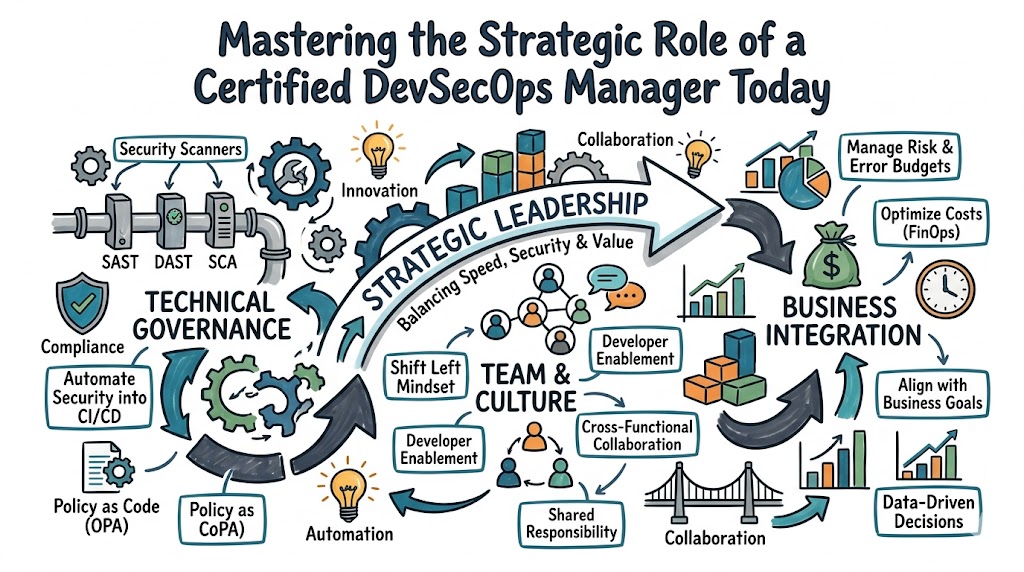
Modern software delivery requires more than just rapid deployment; it demands a sophisticated leadership approach that weaves security into every phase of the lifecycle. This guide explores the Certified DevSecOps Manager program, a specialized track for professionals who want to lead high-performing, secure engineering teams. By following the standards set by DevSecOpsSchool, you can bridge the gap between technical execution and executive governance. Choosing this path empowers you to make informed career decisions while protecting your organization against the complex cyber threats that define the current digital landscape.
What is the Certified DevSecOps Manager?
The Certified DevSecOps Manager designation serves as a high-level credential for those who orchestrate security protocols within a DevOps framework. It exists because organizations now realize that tools alone cannot create a secure culture; they require leaders who integrate security without sacrificing development speed.
This program prioritizes practical, production-ready knowledge over abstract concepts by teaching managers how to navigate risk, compliance, and team collaboration. It aligns perfectly with cloud-native workflows and enterprise environments that demand both agility and rigorous safety standards.
Who Should Pursue Certified DevSecOps Manager?
Senior software engineers, SREs, and cloud architects ready for leadership roles will find this certification indispensable. It also benefits security professionals and data engineers who must understand operational pipelines to enforce policies across decentralized engineering departments.
Whether you are a rising lead in India or a seasoned manager in a global tech hub, the curriculum offers value by covering everything from “shift-left” basics to advanced corporate strategy. Companies worldwide actively seek leaders who can translate complex security needs into actionable business objectives.
Why Certified DevSecOps Manager is Valuable and Beyond
Enterprise adoption of cloud-native stacks has made specialized security management a permanent requirement for modern business. This certification ensures long-term career relevance because it focuses on strategic implementation rather than individual, short-lived software tools.
Mastering the management of security debt and automated compliance allows you to thrive in an industry that increasingly relies on speed and precision. The career investment pays off quickly, as organizations offer premium compensation to leaders who can minimize data breach risks while maintaining high-frequency release schedules.
Certified DevSecOps Manager Certification Overview
Candidates access the program through the official training portal, and the primary provider website hosts the entire learning journey. The certification uses a hands-on assessment style that challenges you with scenario-based problems instead of simple rote memorization.
The program owners keep the curriculum updated with the latest industry shifts, such as supply chain security and software bill of materials. The structure helps working professionals move systematically from basic security concepts to mastering the complexities of enterprise-wide security governance.
Certified DevSecOps Manager Certification Tracks & Levels
The certification features foundation, professional, and advanced levels to support various stages of a technical career. Beginners focus on core philosophies, while professional-level students dive into the technicalities of automated scanning and security gates.
The advanced level specifically targets the Manager role, emphasizing budgeting, policy creation, and leading cross-functional departments. These tiers create a clear professional ladder, allowing an engineer to climb toward roles like Head of DevSecOps or Chief Information Security Officer.
Complete Certified DevSecOps Manager Certification Table
| Track | Level | Who it’s for | Prerequisites | Skills Covered | Recommended Order |
| Security Leadership | Advanced | Engineering Managers | DevOps Experience | Governance, Risk, Compliance | 3 |
| Security Engineering | Professional | SREs / Developers | Scripting Basics | Tool Integration, CI/CD | 2 |
| Security Essentials | Foundation | Entry-level Tech | Basic IT Knowledge | Shift-left, Vulnerabilities | 1 |
Export to Sheets
Detailed Guide for Each Certified DevSecOps Manager Certification
Certified DevSecOps Manager – Foundation Level
What it is
This level confirms your understanding of the core philosophy required to blend security into a DevOps culture. It verifies that you grasp the “Shift Left” movement and the basic vocabulary of modern security.
Who should take it
Junior developers, system admins, or recent graduates who want to start a career in secure operations should take this. It requires no deep security background, making it an ideal entry point.
Skills you’ll gain
- Mastering the DevSecOps lifecycle.
- Spotting security bottlenecks in CI/CD.
- Learning SAST and DAST fundamentals.
Real-world projects you should be able to do
- Launching a basic automated security scan in a pipeline.
- Writing security requirement docs for a small app.
Preparation plan
- 7–14 days: Study DevOps culture and basic terminology.
- 30 days: Experiment with open-source security tools.
- 60 days: Use hands-on labs to fix security vulnerabilities in code.
Common mistakes
- Forgetting the cultural side of DevOps.
- Failing to see how security impacts delivery speed.
Best next certification after this
- Same-track option: Professional DevSecOps Engineer.
- Cross-track option: Certified SRE Foundation.
- Leadership option: Technical Team Lead.
Certified DevSecOps Manager – Professional Level
What it is
This certification proves your technical skill in implementing security tools within a production pipeline. It focuses on automating non-intrusive security checks that don’t stall the workflow.
Who should take it
Mid-level engineers, SREs, and Cloud Architects responsible for delivery pipelines will benefit most. You should already know how to use Docker, Kubernetes, and CI tools.
Skills you’ll gain
- Running automated container scans.
- Handling secrets management platforms.
- Organizing vulnerability remediation workflows.
Real-world projects you should be able to do
- Constructing a full DevSecOps pipeline with automated gates.
- Building compliance-as-code into cloud environments.
Preparation plan
- 7–14 days: Review CI/CD scripts and advanced automation.
- 30 days: Deploy various security tools in a test environment.
- 60 days: Fine-tune pipeline performance and security accuracy.
Common mistakes
- Creating too many false positives through over-automation.
- Ignoring the feedback loop between developers and security alerts.
Best next certification after this
- Same-track option: Advanced DevSecOps Manager.
- Cross-track option: Certified Cloud Security Professional.
- Leadership option: Certified Engineering Manager.
Certified DevSecOps Manager – Advanced (Manager) Level
What it is
This validates your ability to steer a department-wide security transformation. It centers on strategy, legal compliance, and building long-term roadmaps for the organization.
Who should take it
Engineering Managers and aspiring CISOs who must justify budgets and manage teams should enroll. You need several years of leadership experience and a strong grasp of business risk.
Skills you’ll gain
- Crafting security governance frameworks.
- Controlling budgets for security software.
- Driving organizational change and security awareness.
Real-world projects you should be able to do
- Developing a multi-year DevSecOps strategy for a corporation.
- Analyzing the maturity of existing security models.
Preparation plan
- 7–14 days: Learn compliance frameworks like SOC2.
- 30 days: Study successful security implementations.
- 60 days: Build a full security strategy for a mock company.
Common mistakes
- Losing the business goal while chasing technical details.
- Failing to give team members ownership of security tasks.
Best next certification after this
- Same-track option: Executive Security Leadership.
- Cross-track option: FinOps Practitioner.
- Leadership option: CISO track.
Choose Your Learning Path
DevOps Path
You focus on speed and efficiency here, making security a natural extension of the developer’s work. You learn to eliminate friction between teams by ensuring all code undergoes automated testing before reaching production.
DevSecOps Path
This core path offers a deep dive into security strategy across the entire software development lifecycle. It suits those who want to defend the application stack while maintaining a fast release rhythm.
SRE Path
Site Reliability Engineering ensures system uptime, and this path adds a critical security layer to that goal. You learn to manage security incidents like reliability issues, preventing breaches from causing total system failure.
AIOps Path
This path uses artificial intelligence to predict security threats before they happen. You focus on machine learning algorithms that analyze massive data sets to catch anomalies that humans might miss.
MLOps Path
Machine Learning Operations requires unique security for data pipelines and model safety. You study how to protect training data and ensure no one tampers with your models during deployment.
DataOps Path
Data operations require the orchestration of information across multiple platforms, making privacy vital. You learn to use encryption, data masking, and access controls to keep sensitive info safe.
FinOps Path
Security tools can become expensive, so this path focuses on the financial side of operations. You learn to balance security costs against risk levels, protecting the company without wasting money.
Role → Recommended Certified DevSecOps Manager Certifications
| Role | Recommended Certifications |
| DevOps Engineer | Professional DevSecOps Engineer |
| SRE | DevSecOps Professional + SRE Foundation |
| Platform Engineer | Advanced DevSecOps Manager |
| Cloud Engineer | DevSecOps Cloud Specialist |
| Security Engineer | Certified DevSecOps Manager |
| Data Engineer | DataOps Security Specialist |
| FinOps Practitioner | DevSecOps Manager + FinOps |
| Engineering Manager | Advanced Certified DevSecOps Manager |
Export to Sheets
Next Certifications to Take After Certified DevSecOps Manager
Same Track Progression
Deep specialization involves exploring niche areas like threat modeling or penetration testing within a pipeline. You should look for advanced cloud-native security courses or zero-trust workshops to keep your skills sharp.
Cross-Track Expansion
Broadening your skills means studying fields like Platform Engineering or FinOps. This wider perspective helps you make better architectural decisions that impact the entire organization’s infrastructure and budget.
Leadership & Management Track
Moving into higher leadership roles requires a focus on people and communication. Certifications in executive leadership or project management complement your technical skills and prepare you for C-level roles.
Training & Certification Support Providers for Certified DevSecOps Manager
DevOpsSchool This provider delivers high-quality training programs that use hands-on labs to simulate real-world engineering challenges. They focus on blending tools and culture to help students master the DevOps ecosystem through expert guidance.
Cotocus A leading firm that helps large enterprises navigate cloud-native transformations and infrastructure automation. They offer specialized support for teams that need to implement DevSecOps at scale without losing performance.
Scmgalaxy This community platform acts as a massive knowledge hub for configuration management and DevOps. It provides a wide range of tutorials and forums to help professionals track the latest trends in automation.
BestDevOps Focusing on quality, this provider creates lean learning paths for those who want to excel in reliability and security. Their curriculum targets the essential skills that modern tech companies demand from their leads.
devsecopsschool.com This site remains the top choice for anyone specializing in the overlap of development and security. It offers clear roadmaps for every certification level, ensuring you gain the skills that top employers look for.
sreschool.com Dedicated to Site Reliability Engineering, this school teaches you how to build systems that stay up and stay secure. Their courses show that reliability and security must work together in the cloud.
aiopsschool.com As AI changes IT, this school provides training on using machine learning for better operations. You learn to automate complex decisions that improve both the speed and safety of your enterprise.
dataopsschool.com This provider focuses on securing the data pipelines that fuel modern business. They give you the tools to manage large-scale data while following all global privacy and security regulations.
finopsschool.com Managing the cost of security is a vital skill, and this school provides the necessary training. They help you optimize your cloud spending so you stay protected without breaking the bank.
Frequently Asked Questions (General)
- How hard is the Certified DevSecOps Manager exam?
The exam presents a significant challenge because it tests both technical logic and management strategy.
- How much time do I need to study?
Plan for 30 to 60 days of consistent effort depending on your current DevOps experience.
- What are the requirements for the manager track?
You generally need a few years of leadership experience and a strong grasp of DevOps.
- Does this certification offer a good return on investment?
Yes, companies pay a premium for certified leaders who can reduce security risks.
- Which certification should I take first?
Start with the Foundation level, then move to Professional before attempting the Manager level.
- Do the courses include hands-on labs?
Yes, top providers include virtual labs where you practice integrating real security tools.
- Does this cover AWS and Azure security?
The principles apply to all clouds, but most labs use AWS, Azure, or Google Cloud examples.
- When does the certification expire?
Most certifications require a renewal every two to three years to keep your skills current.
- Can this help me get a promotion?
It provides the management framework and technical authority needed to move into leadership.
- Is the test available online?
Most providers offer proctored online exams that you can take from any location.
- Are there groups for student networking?
Many schools offer Slack channels or forums for students to discuss the curriculum.
- What tools will I learn to manage?
You will work with tools for container scanning, SAST, DAST, and automated compliance.
FAQs on Certified DevSecOps Manager
- Does the course explain compliance-as-code?
The training shows you how to automate audits so your infrastructure always stays compliant.
- Do I need to be a programmer?
You don’t need to be an expert coder, but you must understand basic scripting and logic.
- How much of the course covers culture?
A large section of the manager track focuses on breaking down silos and building team trust.
- Is this credential recognized in India?
Yes, both Indian and global tech firms highly value this specialized security leadership training.
- How is this different from a CISSP?
This focuses specifically on the automated pipelines of DevOps rather than general IT security.
- Does it cover the software supply chain?
Yes, you learn to secure third-party libraries and the tools that build your code.
- Are there real-world case studies?
The manager level uses real breach examples to teach you how to identify and stop risks.
- Do you learn about security budgeting?
The curriculum includes lessons on how to choose cost-effective tools that provide maximum protection.
Final Thoughts: Is Certified DevSecOps Manager Worth It?
Selecting the Certified DevSecOps Manager path is a powerful way to secure your professional future as tech continues to change. Having watched the industry move from manual checks to automated pipelines, I see that the real challenge lies in leading people through these transitions. This certification gives you the authority and the strategy to treat security as a business advantage rather than a simple checklist. If you want to prove your ability to lead modern engineering teams, this roadmap provides exactly what you need. Avoid short-term hype and focus on these enduring leadership principles to ensure you stay in high demand for years to come.