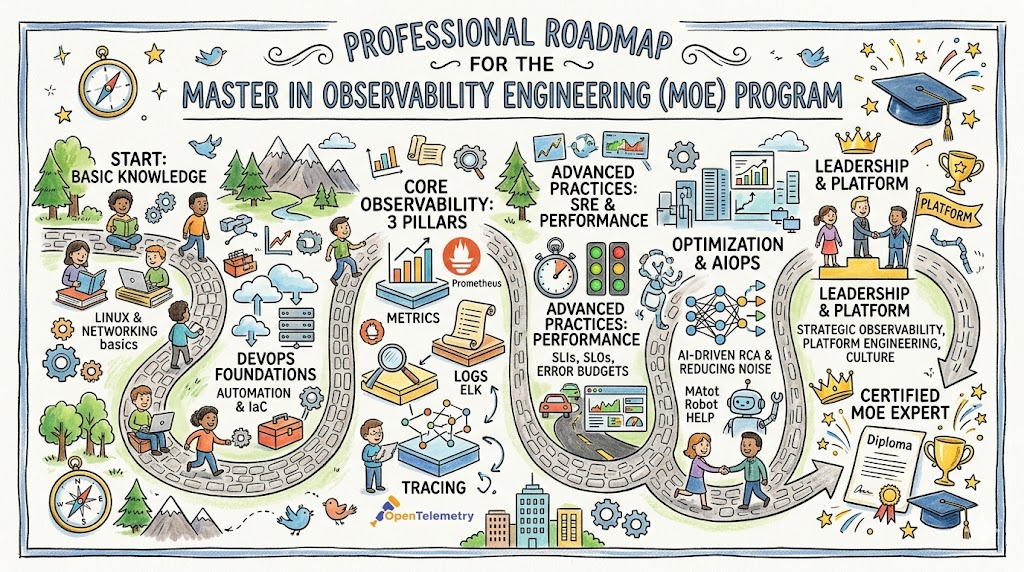
In the current landscape of cloud-native architecture, engineers must look beyond traditional monitoring to maintain high-performing systems. Obtaining a Master in Observability Engineering (MOE) empowers DevOpsschool professionals to dissect complex distributed environments with precision and speed. This guide clarifies how this specific certification path enables Site Reliability Engineers and Platform leads to transform raw telemetry into actionable business intelligence. By mastering these advanced diagnostic skills, you position yourself at the forefront of the next evolution in infrastructure management and automated system recovery.
What is the Master in Observability Engineering (MOE)?
The Master in Observability Engineering (MOE) serves as a specialized framework designed to bridge the gap between simple status checks and deep system forensic analysis. It exists because modern microservices generate a volume of data that standard dashboards cannot effectively interpret without a structured approach. This program focuses heavily on production-ready skills, teaching engineers how to instrument code for traces, metrics, and logs simultaneously. Enterprises prioritize this certification because it aligns directly with the need for rapid troubleshooting and high-availability targets in massive, scaling environments.
Who Should Pursue Master in Observability Engineering (MOE)?
System administrators, cloud architects, and backend developers find the most immediate value in the MOE designation. It specifically targets those who manage Kubernetes clusters or serverless functions where traditional visibility often fails. Managers also pursue this track to understand how to build data-driven cultures that prioritize reliability and performance over reactive firefighting. Whether you operate within the Indian tech sector or a global conglomerate, these skills apply to any team running mission-critical software at scale.
Why Master in Observability Engineering (MOE) is Valuable and Beyond
The tech industry currently faces a massive shortage of engineers who can actually interpret high-cardinality data. The MOE certification provides long-term career security by focusing on the underlying telemetry protocols that outlast any single software vendor. As companies adopt AIOps and automated scaling, they require experts who can validate the data feeding these intelligent systems. Your investment in this learning path yields a significant return by making you indispensable during complex architectural migrations and high-pressure incident responses.
Master in Observability Engineering (MOE) Certification Overview
The official program resides on the course URL provided in the introduction and runs through the primary hosting website. It breaks down the vast subject of observability into manageable modules that cover everything from agent installation to advanced data correlation. Candidates undergo rigorous assessments that mirror real-world outages, ensuring they can perform under pressure in a live production environment. The structure emphasizes the “how” and “why” of system behavior, moving far beyond the “what” of basic monitoring tools.
Master in Observability Engineering (MOE) Certification Tracks & Levels
Professionals can advance through three distinct tiers: Foundation, Professional, and Advanced. The Foundation level introduces the core telemetry types, while the Professional tier explores distributed tracing and service mesh integration. The Advanced level focuses on organization-wide strategy, cost optimization, and the integration of machine learning for anomaly detection. This tiered approach allows you to build a specialized resume that reflects your actual depth of expertise in modern system reliability.
Complete Master in Observability Engineering (MOE) Certification Table
| Track | Level | Who it’s for | Prerequisites | Skills Covered | Recommended Order |
| Operational Core | Foundation | DevOps Newcomers | Basic CLI Skills | Dashboarding, Basic Logs | 1 |
| Distributed Specialist | Professional | Mid-level SREs | Foundation Level | OpenTelemetry, Tracing | 2 |
| Strategic Lead | Advanced | Principal Architects | Professional Level | Governance, Scaling Data | 3 |
| Intelligence Expert | Expert | AIOps Leads | Advanced Level | ML Modeling, Predictive Ops | 4 |
Detailed Guide for Each Master in Observability Engineering (MOE) Certification
Master in Observability Engineering (MOE) – Foundation
What it is
This certification confirms that an engineer understands the fundamental mechanics of metrics collection and log centralization. It marks the first step toward becoming a reliability expert.
Who should take it
Junior developers and operations staff who need to build their first meaningful dashboards and alerts.
Skills you’ll gain
- Installing and configuring Prometheus exporters.
- Writing basic queries to visualize system health.
- Organizing log data for easy searching.
- Creating alerts that minimize noise.
Real-world projects you should be able to do
- Monitor a fleet of Linux servers using node-exporters.
- Build a centralized logging pipeline for a small API.
Preparation plan
- 7-14 Days: Study the basics of time-series databases and log structures.
- 30 Days: Set up a local lab environment with Docker and Grafana.
- 60 Days: Practice troubleshooting common infrastructure bottlenecks in your lab.
Common mistakes
- Tracking too many metrics without a clear purpose.
- Ignoring the context provided by log metadata.
Best next certification after this
- Same-track option: MOE Professional.
- Cross-track option: Cloud Security Associate.
- Leadership option: Project Management Basics.
Master in Observability Engineering (MOE) – Professional
What it is
This professional-level credential focuses on the challenges of microservices and the implementation of distributed tracing. It validates your ability to see the “whole picture” across multiple services.
Who should take it
Intermediate SREs who handle complex request flows and high-traffic cloud environments.
Skills you’ll gain
- Implementing spans and traces across different languages.
- Calculating Service Level Objectives (SLOs) effectively.
- Optimizing data storage for high-volume telemetry.
- Utilizing service meshes for observability.
Real-world projects you should be able to do
- Map a request journey across five different microservices.
- Reduce Mean Time to Resolution (MTTR) using trace analysis.
Preparation plan
- 7-14 Days: Master the OpenTelemetry API and SDK basics.
- 30 Days: Instrument a complex application using Jaeger or Honeycomb.
- 60 Days: Develop cost-effective data sampling strategies for a production cluster.
Common mistakes
- Implementing tracing without a clear correlation ID strategy.
- Failing to align SLOs with actual customer experiences.
Best next certification after this
- Same-track option: MOE Advanced.
- Cross-track option: Certified Kubernetes Administrator.
- Leadership option: SRE Team Lead Certification.
Choose Your Learning Path
DevOps Path
This path integrates observability directly into the software development lifecycle. You learn to treat “observability as code,” ensuring every new feature includes its own telemetry. This proactive approach allows teams to identify bugs during canary deployments before they affect the entire user base. It fundamentally changes how developers interact with production environments.
DevSecOps Path
Security-minded engineers use this path to turn telemetry data into a defensive shield. You learn to identify unusual traffic patterns and unauthorized system changes through specialized logs. This path teaches you how to automate security responses based on real-time observability signals. It bridges the gap between traditional operations and modern threat hunting.
SRE Path
The Site Reliability Engineering path focuses on maintaining the “Golden Signals” of latency, traffic, errors, and saturation. You master the technical skills needed to build resilient systems that handle failures gracefully. This track emphasizes automation and the reduction of manual toil through intelligent data analysis. It remains the gold standard for those running high-scale web platforms.
AIOps Path
Engineers on the AIOps path apply mathematical models to operations data to find patterns humans might miss. You learn to automate the identification of root causes and suppress redundant alerts. This path focuses on building “self-aware” systems that can predict outages. It represents the cutting edge of modern enterprise infrastructure management.
MLOps Path
This track addresses the unique observability needs of machine learning models. You monitor data pipelines to ensure the accuracy of predictions and the health of the underlying compute resources. This path ensures that AI applications remain reliable and performant over time. It is essential for data-driven companies moving ML models into production.
DataOps Path
DataOps professionals focus on the health of data movement and processing. You learn to observe data quality, latency in ETL jobs, and the performance of large-scale databases. This path ensures that the entire data pipeline remains transparent and functional. It serves as the foundation for reliable business intelligence and reporting.
FinOps Path
The FinOps path connects technical performance to cloud costs. You learn how to use observability metrics to identify wasteful spending and optimize resource allocation. This specialization allows you to prove the financial value of engineering decisions. It is becoming a vital skill for companies looking to scale efficiently in the cloud.
Role → Recommended Master in Observability Engineering (MOE) Certifications
| Role | Recommended Certifications |
| DevOps Engineer | MOE Foundation & Professional |
| SRE | MOE Professional & Advanced |
| Platform Engineer | MOE Advanced & Infrastructure Specialist |
| Cloud Engineer | MOE Professional & FinOps |
| Security Engineer | MOE DevSecOps Specialist |
| Data Engineer | MOE DataOps Track |
| FinOps Practitioner | MOE FinOps Specialist |
| Engineering Manager | MOE Advanced Strategy |
Next Certifications to Take After Master in Observability Engineering (MOE)
Same Track Progression
After completing the MOE Advanced level, you should look for niche certifications in specific open-source tools or high-level architecture. Deepening your knowledge in Prometheus, Grafana, or specialized eBPF monitoring will solidify your status as a top-tier expert. This keeps your skills sharp and ensures you remain a leader in the observability space.
Cross-Track Expansion
Observability experts often find success by branching into Cloud Security or Advanced Kubernetes Management. These skills complement MOE perfectly, as they allow you to understand the systems you are observing from the ground up. Broadening your expertise makes you a more versatile asset for any organization using complex cloud stacks.
Leadership & Management Track
If you aim for the C-suite or Director roles, consider certifications in IT Management or Strategic Leadership. These programs teach you how to align technical reliability metrics with business growth and customer satisfaction. Moving into leadership allows you to influence the observability culture of an entire company.
Training & Certification Support Providers for Master in Observability Engineering (MOE)
DevOpsSchool
This organization provides high-quality, mentor-led training sessions that focus on real-world observability scenarios. They offer a deep dive into the MOE curriculum with hands-on labs that simulate enterprise environments. Many professionals choose this provider for their comprehensive approach and industry-recognized certifications.
Cotocus
This provider excels at technical consulting and advanced training for high-growth tech teams. They help engineers master the nuances of distributed systems and telemetry collection through specialized workshops. Their training style focuses on immediate practical application within your current work environment.
Scmgalaxy
As a robust community platform, this provider offers a wide array of tutorials, blogs, and training modules for DevOps enthusiasts. They specialize in helping engineers stay current with the latest open-source observability tools. It is a great resource for both foundational learning and advanced troubleshooting tips.
BestDevOps
This training center focuses on career transformation, providing students with the skills needed to land senior SRE and DevOps roles. Their MOE-aligned courses emphasize the development of a professional portfolio through practical projects. They provide excellent mentorship for those looking to advance their technical standing.
devsecopsschool.com
This platform focuses specifically on the intersection of security and modern operations. They provide specialized tracks that teach how to use observability data for compliance and threat detection. Their training is essential for anyone working in highly regulated industries.
sreschool.com
Dedicated specifically to Site Reliability Engineering, this provider places observability at the center of their curriculum. They teach the math and logic behind SLOs and error budgets. Their courses prepare engineers to manage the most demanding global infrastructures.
aiopsschool.com
This provider leads the way in teaching artificial intelligence for IT operations. They show you how to apply machine learning to your observability data to automate incident response. Their courses are ideal for engineers looking to future-proof their careers.
dataopsschool.com
This platform focuses on the unique observability challenges within data engineering and analytics pipelines. They teach you how to monitor data flows and ensure high-quality outputs for business users. It is the go-to provider for data professionals.
finopsschool.com
Focusing on the financial side of the cloud, this provider teaches you how to link observability to the bottom line. You learn to monitor and manage cloud spend through technical metrics. Their training is vital for modern cost-conscious engineering teams.
Frequently Asked Questions (General)
- How much time should I dedicate to the MOE program?
You should plan for at least five to ten hours per week over a period of three to six months to truly master the material and labs.
- Does the MOE certification require a strong math background?
While you don’t need advanced calculus, you should understand basic statistics and logic to create meaningful SLOs and error budgets.
- Can I pass the exam using only open-source tools?
The MOE curriculum focuses on open standards like OpenTelemetry, so you can definitely use open-source tools to prepare for and pass the assessments.
- Will this certification help me transition from sysadmin to DevOps?
Absolutely, as observability is one of the most critical skills needed in modern DevOps and SRE roles today.
- Are there any group discounts for corporate teams?
Most training providers offer customized packages for engineering teams looking to standardize their observability practices across the company.
- What makes MOE different from other DevOps certifications?
While general DevOps courses cover a bit of everything, MOE goes deep into the specific science of system visibility and data analysis.
- Do I need to be an expert in Kubernetes first?
You should have a basic understanding of containers, but the MOE program will teach you the specifics of observing them effectively.
- Is the exam project-based or multiple-choice?
The MOE assessment typically includes a mix of theoretical questions and hands-on lab challenges to test your practical skills.
- Does the certification expire?
Most providers recommend a refresh every two to three years to ensure you remain current with the fast-moving observability tool landscape.
- Can I take the classes in a self-paced format?
Yes, many authorized providers offer self-paced video modules alongside their live instructor-led sessions.
- What salary increase can I expect after getting MOE certified?
While it varies by region, engineers with specialized observability skills often see a significant bump in compensation due to the high demand for SREs.
- Is there a prerequisite for the Professional level?
Generally, you must either pass the Foundation exam or demonstrate equivalent industry experience to enroll in the Professional track.
FAQs on Master in Observability Engineering (MOE)
- Which specific tools does the MOE program cover?
The program focuses primarily on industry standards like Prometheus, Grafana, OpenTelemetry, and ELK/EFK stacks to ensure your skills remain vendor-neutral.
- How does MOE address the problem of data silos?
It teaches you how to unify logs, metrics, and traces into a single source of truth, allowing different teams to collaborate during an incident.
- Does the certification cover eBPF technology?
The Advanced levels of MOE typically introduce eBPF as a modern way to achieve deep infrastructure observability without modifying application code.
- Will I learn how to build custom exporters?
Yes, the Professional level includes training on how to write custom exporters for legacy applications that do not natively support modern telemetry.
- Does MOE include training on incident management?
Observability is a tool for incident management, so the curriculum teaches you how to use your data to lead efficient war rooms and post-mortems.
- How does the program handle cloud-native vs. on-premise observability?
The core principles apply to both, but the labs often focus on cloud-native environments like AWS, Azure, or Google Cloud.
- Can MOE help with application performance monitoring (APM)?
Distributed tracing, a key part of the MOE curriculum, is the modern standard for APM in microservices architectures.
- Is the MOE program suitable for security professionals?
Security engineers find great value in the log analysis and anomaly detection modules, which are essential for modern threat hunting.
Final Thoughts: Is Master in Observability Engineering (MOE) Worth It?
Technical excellence in the modern era requires a deep understanding of how systems communicate and fail. By completing the MOE certification, you gain more than just a title; you acquire the ability to see through the noise of complex cloud environments. I have seen many engineers struggle with “hidden” bugs for days, whereas an observability expert finds the root cause in minutes. This program saves you time, reduces stress during on-call shifts, and makes you a leader in your organization. If you want to move beyond basic monitoring and truly master your infrastructure, the MOE path offers the most direct and practical route.