Introduction
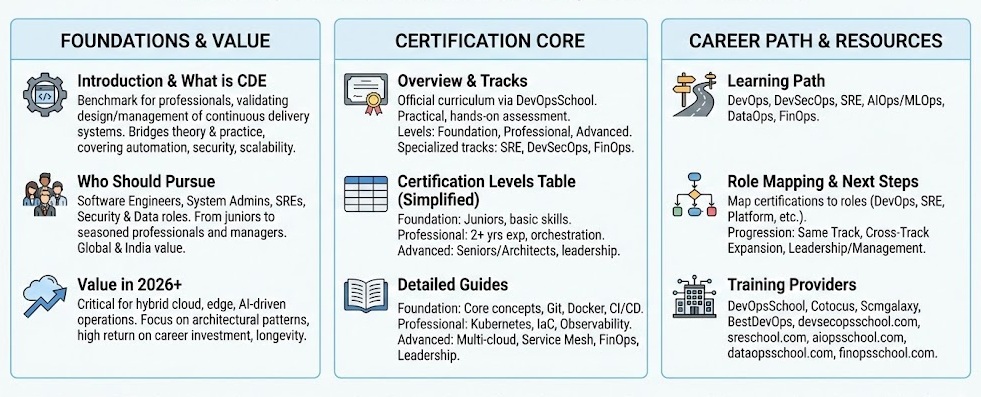
Software delivery has undergone a fundamental shift. Modern engineering teams are expected to deliver faster, operate reliably, and scale systems without increasing operational risk. In this environment, the Certified DevOps Engineer (CDE) has emerged as a meaningful benchmark for professionals responsible for turning code into stable, production-ready systems.
This guide is written for software engineers, system administrators, DevOps and SRE professionals, platform and cloud engineers, as well as managers accountable for delivery outcomes. It is intended for those who want more than surface-level tooling knowledge and are looking to understand the engineering discipline that supports high-performing teams.
Today’s cloud-native and platform-driven ecosystems demand a structured approach to automation, security, observability, and scale. This guide explains what the Certified DevOps Engineer (CDE) represents, how it fits into real-world engineering careers, and how it can help professionals make informed, long-term career decisions rather than short-term tooling choices.
What is the Certified DevOps Engineer (CDE)?
The Certified DevOps Engineer (CDE) is a professional certification designed to validate an engineer’s ability to design, implement, and operate continuous delivery systems in real production environments. It focuses on applied engineering skills rather than theoretical concepts or tool memorization.
Unlike certifications that revolve around a single cloud provider’s ecosystem, CDE emphasizes DevOps fundamentals that remain consistent across platforms. These include automation, system reliability, collaboration, and operational feedback loops that support rapid yet safe delivery.
At its foundation, the CDE program is intended to close the gap between knowing DevOps concepts and applying them effectively in production. The curriculum covers version control, CI/CD pipelines, container orchestration, infrastructure as code, and observability—core pillars required to manage distributed, microservices-based systems at scale.
Who Should Pursue Certified DevOps Engineer (CDE)?
Certified DevOps Engineer (CDE) is suitable for professionals at different career stages. Entry-level engineers and system administrators can use it to transition into DevOps roles with a clear, structured learning path. It helps avoid the confusion caused by jumping between tools without understanding underlying principles.
Mid-level and senior engineers working in development, operations, or cloud roles benefit by formalizing their experience. SREs can strengthen their automation and reliability practices, while security professionals can build a foundation for integrating security directly into delivery pipelines.
The certification also provides value to data engineers and MLOps practitioners who manage infrastructure-heavy workloads. Its relevance spans global markets and is particularly strong in India, where demand for DevOps talent continues to grow faster than supply.
Why Certified DevOps Engineer (CDE) is Valuable in 2026 and Beyond
Enterprise systems are becoming more complex with the widespread adoption of hybrid cloud, edge computing, and AI-driven platforms. These environments require engineers who can maintain consistency, reliability, and automation across diverse technologies. Certified DevOps Engineer (CDE) addresses this need by focusing on durable engineering practices.
Rather than anchoring learning to rapidly changing tools, the certification concentrates on architectural patterns and operational principles. CI/CD design, infrastructure automation, testing strategies, and observability remain essential regardless of platform evolution.
Organizations increasingly prefer engineers who combine depth in one area with a broad understanding of the full delivery pipeline. CDE supports this skill profile, making it a strong long-term investment for career stability, adaptability, and compensation growth.
Certified DevOps Engineer (CDE) Certification Overview
The Certified DevOps Engineer (CDE) program is delivered through the official curriculum available on
the Certified DevOps Engineer course page
and is hosted on
the DevOpsSchool platform.
The program follows a progressive structure that guides learners from foundational concepts to advanced architectural practices. It is maintained by industry practitioners to reflect real production challenges rather than academic exercises.
Assessments emphasize hands-on and scenario-based evaluation. This approach ensures that certified professionals can perform critical DevOps tasks in production environments. Community and enterprise feedback influence updates, keeping the certification aligned with industry needs.
Certified DevOps Engineer (CDE) Certification Tracks & Levels
The CDE program is organized into three primary levels aligned with career progression. The Foundation level focuses on DevOps culture, automation basics, and core tools. The Professional level deepens expertise in orchestration, infrastructure automation, and CI/CD design. The Advanced level targets large-scale architecture, optimization, and organizational transformation.
In addition to these core levels, the certification offers specialization tracks. Engineers can focus on SRE practices, security integration through DevSecOps, or financial governance using FinOps. This modular approach allows professionals to customize learning paths based on real job responsibilities.
Complete Certified DevOps Engineer (CDE) Certification Table
| Track | Level | Who it’s for | Prerequisites | Skills Covered | Recommended Order | Official Link |
|---|---|---|---|---|---|---|
| Core DevOps | Foundation | Junior Engineers, Students | Basic Linux & Coding | Git, Docker, CI/CD basics | 1 | View Course |
| Core DevOps | Professional | Engineers with 2+ years experience | CDE Foundation or equivalent | Kubernetes, Terraform, Jenkins | 2 | View Course |
| Core DevOps | Advanced | Senior Engineers, Architects | CDE Professional | Service Mesh, Scalability, IaC | 3 | View Course |
| SRE Track | Professional | Ops & Reliability Engineers | System administration experience | SLOs, SLIs, Error Budgets | Parallel | View Course |
| Security Track | Professional | Security Engineers | Security fundamentals | Secrets, SAST/DAST, Compliance | Parallel | View Course |
Detailed Guide for Each Certified DevOps Engineer (CDE) Certification
Certified DevOps Engineer (CDE) – Foundation
What it is
Validates understanding of DevOps fundamentals, automation basics, and cultural principles that support modern delivery workflows.
Who should take it
Students, junior engineers, system administrators, and professionals beginning their DevOps journey.
Skills you’ll gain
- Version control with Git
- Docker container fundamentals
- Basic CI/CD automation
- DevOps lifecycle awareness
Real-world projects you should be able to do
- Containerize a multi-tier application
- Build a simple CI pipeline
- Manage structured Git workflows
Preparation plan
7–14 days: Core concepts and tooling basics
30 days: Hands-on CI/CD and container labs
60 days: End-to-end deployment project
Common mistakes
Focusing on tools without understanding DevOps principles.
Best next certification after this
Same-track: CDE Professional
Cross-track: Certified SRE Professional
Leadership: DevOps Team Lead Certification
Certified DevOps Engineer (CDE) – Professional
What it is
Validates the ability to design and manage production-scale DevOps systems using orchestration and infrastructure automation.
Who should take it
Engineers responsible for production pipelines and operational stability.
Skills you’ll gain
- Kubernetes operations
- Infrastructure as Code
- Monitoring and observability
- Secure configuration management
Real-world projects you should be able to do
- Operate a Kubernetes cluster
- Automate cloud infrastructure
- Deploy using blue-green or canary models
Preparation plan
7–14 days: Advanced Kubernetes and IaC concepts
30 days: Multi-project hands-on practice
60 days: Production troubleshooting scenarios
Common mistakes
Ignoring state and real incident handling.
Best next certification after this
Same-track: CDE Advanced
Cross-track: Certified DevSecOps Professional
Leadership: Engineering Manager Track
Certified DevOps Engineer (CDE) – Advanced
What it is
Validates architectural design skills and leadership capability in large-scale DevOps environments.
Who should take it
Senior engineers, architects, and platform leaders.
Skills you’ll gain
- Multi-cloud and multi-region design
- Service Mesh implementation
- Cost optimization strategies
- Large-scale modernization planning
Real-world projects you should be able to do
- Disaster recovery architecture
- Multi-cluster service mesh deployment
- Cloud cost and performance optimization
Preparation plan
7–14 days: Architecture and systems design review
30 days: Enterprise architecture documentation
60 days: Advanced experimentation and peer review
Common mistakes
Designing overly complex solutions without operational clarity.
Best next certification after this
Same-track: Cloud Architect certifications
Cross-track: Certified MLOps Engineer
Leadership: CTO / VP Engineering programs
Choose Your Learning Path
DevOps Path
Focuses on automation, CI/CD, and developer productivity.
DevSecOps Path
Integrates security into pipelines and infrastructure from the start.
SRE Path
Emphasizes reliability, observability, and incident management.
AIOps / MLOps Path
Addresses infrastructure automation for AI and ML platforms.
DataOps Path
Applies DevOps principles to data pipelines and analytics systems.
FinOps Path
Centers on cloud cost control and financial accountability.
Role → Recommended Certified DevOps Engineer (CDE) Certifications
| Role | Recommended Certifications |
|---|---|
| DevOps Engineer | CDE Foundation, CDE Professional |
| SRE | CDE Professional, Certified SRE Professional |
| Platform Engineer | CDE Professional, CDE Advanced |
| Cloud Engineer | CDE Foundation, Cloud Associate Certifications |
| Security Engineer | CDE Foundation, Certified DevSecOps Professional |
| Data Engineer | CDE Foundation, Certified DataOps Professional |
| FinOps Practitioner | CDE Foundation, Certified FinOps Professional |
| Engineering Manager | CDE Foundation, DevOps Leadership Track |
Final Thoughts: Is Certified DevOps Engineer (CDE) Worth It?
Certified DevOps Engineer (CDE) is valuable not because of the credential itself, but because of the discipline it builds. DevOps has become core engineering work, not a side function. This certification offers a structured path to develop that responsibility.
It is not a shortcut to instant career growth. However, for professionals seeking long-term relevance and the ability to operate complex systems confidently, Certified DevOps Engineer (CDE) provides a strong, practical foundation. Apply the principles consistently, and career growth follows naturally.
📞 Call to Action & Contact Details
End the article with the following contact information:
📞 USA: +1 (469) 756-6329
📞 India: +91 99057 40781
✉️ Email: Contact@DevOpsSchool.com