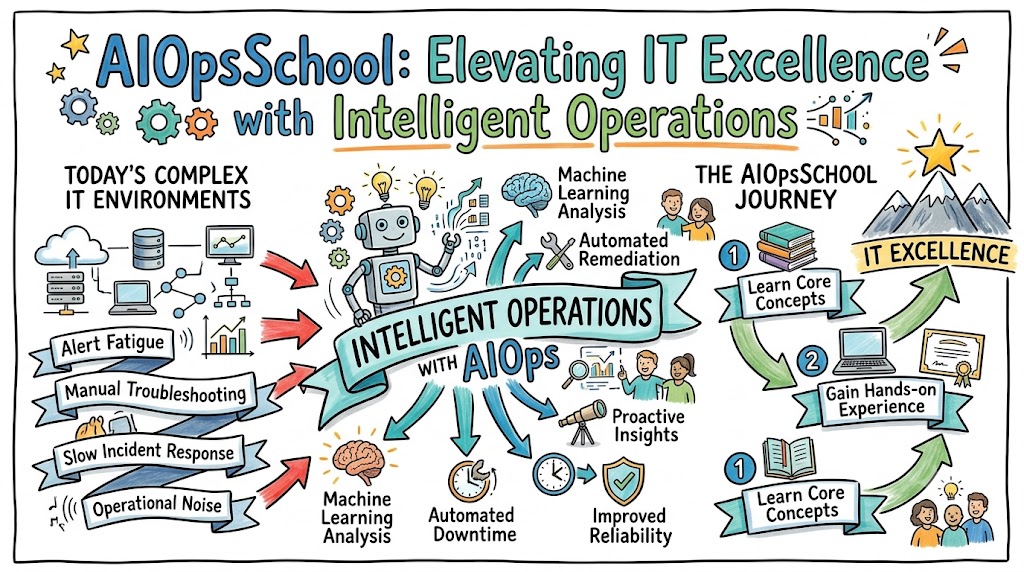
The modern enterprise infrastructure resembles a sprawling digital metropolis. Microservices, hybrid cloud environments, serverless architectures, and Kubernetes clusters create billions of data points every single second. For engineering teams, managing this scale manually has become humanly impossible. Systems administrators, Site Reliability Engineers, and DevOps professionals find themselves buried under an avalanche of alerts. Critical warning signs vanish in thousands of redundant notifications, leading to catastrophic alert fatigue. When a production system crashes, engineers scramble across siloed dashboards, wasting precious hours trying to isolate the problem. This operational bottleneck hinders innovation and threatens business stability.
To bridge this massive gap, modern technology professionals are rapidly turning toward advanced educational ecosystems like AiOpsSchool. Navigating complex, distributed cloud architectures requires moving away from reactive monitoring and adopting intelligent, proactive automation. Pursuing structured AIOps Training empowers technology professionals to integrate artificial intelligence, machine learning, and advanced pattern recognition directly into their telemetry pipelines. By converting chaotic streams of raw data into clear, actionable intelligence, engineering teams can predict system failures before they impact end users. The shift toward intelligent operations is no longer a luxury; it has become a fundamental operational requirement.
What Is AIOps?
To navigate the future of enterprise infrastructure, engineers must first answer a foundational question: what is AIOps? At its core, Artificial Intelligence for IT Operations represents the strategic integration of big data, machine learning, and advanced analytics into the software monitoring ecosystem. Instead of relying on rigid, human-defined rules that trigger simple alerts, this methodology leverages continuous machine learning algorithms to understand baseline system behavior. It ingests massive volumes of operational data from diverse sources, automatically identifying complex patterns that escape human observation.
Ultimately, the primary purpose of this approach is to transform raw infrastructure data into autonomous decision-making power. It shifts IT management away from manual dashboards and moving toward automated, self-healing systems. By centralizing operations data, the system identifies anomalies, isolates structural root causes, and triggers automated workflows. This shift allows technology teams to stop fighting daily operational fires and focus on building scalable features.
Key Operational Concepts You Must Know
Before implementing advanced automation architectures, engineering teams must master the foundational building blocks of modern AIOps in IT operations. Without a solid grasp of these core telemetry concepts, implementing machine learning models will only lead to confusing metrics and false positives.
- Observability and Telemetry: The bedrock of intelligent operations relies on collecting high-fidelity logs, metrics, and distributed traces. Telemetry data provides the raw visibility needed to understand internal system states based on external outputs.
- Event Correlation: Modern systems generate thousands of fragmented alerts during an outage. Correlation engines ingest these disparate events, group them by temporal or topological relationships, and compress them into a single, comprehensive incident dossier.
- Baseline vs. Anomaly Detection: Traditional systems use static thresholds, like sending an alert if CPU usage exceeds 80%. Intelligent systems establish dynamic baselines that adapt to seasonal usage patterns, automatically flagging statistical anomalies without human intervention.
- Automation and Remediation: The final stage of operational maturity moves from detection to resolution. Automated runbooks and self-healing scripts intercept correlated incidents, executing immediate fixes to restore services without manual engineering effort.
AIOps for Beginners
Starting a new technical journey can feel overwhelming, but entering this field now provides an unprecedented competitive edge. Transitioning into AIOps for beginners offers an accessible, high-impact career pivot for anyone looking to master modern infrastructure management.
- The Death of Static Alerting: Traditional monitoring systems are breaking under the weight of cloud-native architectures, making expertise in intelligent noise reduction highly valuable across tech companies.
- Unprecedented Career Leverage: Organizations worldwide face a massive shortage of engineering talent capable of building machine learning telemetry pipelines.
- The Shift to Autonomous Operations: Enterprises are aggressively moving away from manual system triage, meaning future leadership roles will belong to professionals who know how to automate system recovery.
AIOps vs DevOps vs MLOps
Understanding the modern engineering landscape requires drawing clear boundaries between overlapping technical methodologies. While these frameworks complement one another, their core objectives, target environments, and operational focus areas differ significantly.
| Concept | Primary Focus | Core Question It Answers | Primary Data Inputs |
|---|---|---|---|
| DevOps | Continuous software delivery pipelines, collaborative development, and automated infrastructure deployment. | How can we safely deploy high-quality software features to our users faster? | Source code, CI/CD pipeline metrics, deployment success rates. |
| AIOps | Intelligent infrastructure management, automated incident mitigation, and noise reduction. | How do we use machine learning to keep complex distributed systems highly available? | Distributed traces, infrastructure logs, system metrics, and incident tickets. |
| MLOps | Managing machine learning model lifecycles, versioning training datasets, and tracking deployment pipelines. | How do we reliably deploy, monitor, and update machine learning models in production? | Model hyper-parameters, training datasets, and inference latency metrics. |
Platform Implementation vs. Culture — What’s the Real Difference?
A common pitfall for many enterprise organizations is treating advanced telemetry as a simple software package that can be purchased and installed overnight. Technology executives often buy expensive software suites, connect them to their infrastructure, and wonder why their teams still suffer from long resolution times. True operational transformation requires combining comprehensive AIOps Training with deep cultural adjustments. Technology teams must learn to transition from traditional tribal knowledge to transparent, data-driven automation pipelines.
Building a resilient architecture requires shifting how engineering teams interact with machine learning outputs. Engineers must learn to trust automated recommendations, share operational telemetry across fragmented departments, and rewrite traditional post-mortem processes. Buying software provides the underlying engine, but investing in continuous education gives teams the skills to drive it safely. Without this cultural foundation, platforms become complex, underutilized dashboards that add to operational confusion.
Core AIOps Use Cases
Deploying intelligent systems across enterprise cloud environments unlocks powerful operational capabilities. Organizations can move beyond reactive fire-fighting by using specific AIOps use cases to protect infrastructure stability and enhance user experiences.
- Automated Anomaly Detection: By tracking multi-variate telemetry streams, machine learning engines catch subtle, slow-burning performance degradations before they trigger catastrophic customer outages.
- Intelligent Event Correlation: Systems compress thousands of noisy, redundant alerts across network layers into a single, organized incident, reducing operational noise by up to 90%.
- Advanced AIOps Root Cause Analysis: When multi-tier microservices fail, automated systems trace dependencies back to the source, pinpointing the exact code deployment or infrastructure failure causing the crash.
- Predictive Capacity Planning: Algorithms analyze long-term infrastructure trends to accurately forecast future disk, memory, and compute consumption, preventing resource exhaustion before it occurs.
- Automated Remediation Workflows: When well-understood system incidents surface, the environment triggers automated webhooks and runbooks, resolving infrastructure bugs without requiring late-night engineering pages.
Real-World Use Cases of Modern Operations
Global enterprises use these automated workflows to solve complex real-world scaling challenges. For instance, an enterprise e-commerce platform facing a sudden latency spike during a high-traffic holiday event can leverage intelligent systems to instantly correlate database resource constraints with a recent microservice update. This automated discovery allows engineers to roll back the specific problematic code deployment within minutes, protecting millions of dollars in transaction revenue.
Similarly, a retail banking institution processing millions of real-time transactions can utilize machine learning algorithms to isolate subtle security anomalies across its distributed payment gateways. By identifying hidden patterns that mimic normal user behavior but point to data exfiltration, the system flags threats that traditional firewalls miss.
Finally, a fast-growing global SaaS provider can implement predictive analytics to forecast database storage exhaustion weeks in advance. This proactive insight allows their infrastructure team to scale cloud resources comfortably during regular business hours, entirely avoiding emergency midnight database migrations.
AIOps Tools You Should Know
Building a modern telemetry stack requires an intimate knowledge of the industry’s leading enterprise and open-source software platforms. Aspiring engineers should view this AIOps tools list as a blueprint for practical hands-on study.
Monitoring & Observability Platforms
- Dynatrace: Uses a powerful causal AI engine to deliver precise answers about application performance and cloud infrastructure dependencies.
- Datadog: Offers comprehensive watchdogs that use machine learning to surface anomalies and outliers across distributed cloud resources automatically.
- New Relic: Provides centralized applied intelligence capabilities to reduce alert noise, correlate incidents, and accelerate root cause discoveries.
Event Correlation & ITSM Tools
- BigPanda: Specializes in ingesting massive volumes of IT noise and clustering alerts into clear, actionable incident timelines.
- PagerDuty Process Automation: Combines incident response orchestration with intelligent event clustering and automated runbook executions.
- Moogsoft: Uses advanced algorithmic noise reduction to filter out background telemetry static and expose critical infrastructure incidents early.
Open-Source Stacks & Cloud-Native Services
- OpenTelemetry: The industry-standard framework for collecting vendor-agnostic traces, metrics, and logs across cloud systems.
- Prometheus & Grafana Mimir: Combines flexible metric collection with long-term, scalable storage systems designed for enterprise environments.
- Amazon DevOps Guru: A cloud-native machine learning service that analyzes AWS resource telemetry to identify operational anomalies.
Studying a detailed, hands-on AIOps Tutorial helps engineers learn how to connect these separate platforms into a unified, self-healing production environment.
Common Mistakes in Operations Engineering
Implementing intelligent machine learning systems into complex infrastructure pipelines comes with distinct engineering risks. Teams often encounter predictable pitfalls that can stall enterprise deployment plans and alienate engineering staff.
- Over-Alerting and Ignoring Noise Reduction: Configuring systems to trigger heavy alerts for minor anomalies creates widespread team fatigue. Engineers quickly learn to mute notifications, causing them to miss genuine system failures.
- The Fix: Set wide initial anomaly tolerances and prioritize event correlation rules over raw alerts.
- Treating Platform Ingestion as Set-and-Forget: Assuming machine learning models stay accurate forever without maintenance leads to drift. As application code changes, baseline profiles must evolve alongside it.
- The Fix: Review model performance weekly and re-train baseline metrics after major architectural updates.
- Skipping Data Quality and Normalization: Ingesting messy, unstructured, or unindexed logs into analytical pipelines breaks correlation engines. Machine learning requires clean, consistently structured data to accurately group events.
- The Fix: Enforce strict OpenTelemetry logging standards across all software development squads.
- Automating Remediation Too Early Without Trust: Deploying destructive self-healing scripts before testing correlation accuracy can lead to accidental system outages. An unverified script might reboot a healthy core database during a minor network hiccup.
- The Fix: Run automated runbooks in “dry-run” advisory mode until the models prove consistent accuracy.
- Lack of Cross-Team Buy-In: Forcing automated operations tools onto SRE squads without their input creates internal resistance. Engineers will bypass the platform and return to traditional debugging methods.
- The Fix: Involve engineering teams early by letting them build the initial correlation policies.
AIOps for SRE
Site Reliability Engineers focus on maintaining system availability, scalability, and performance. Integrating AIOps for SRE transforms how these specialists track operational health, shifting the focus from constantly monitoring dashboards to driving systemic automation.
Instead of hunting through disjointed system logs, reliability engineers use machine learning to protect critical Service Level Objectives (SLOs). Automated tools calculate the Mean Time to Detection (MTTD) by instantly identifying multi-system anomalies that escape traditional checks. By grouping separate infrastructure alerts into a single incident, the platform drastically cuts the Mean Time to Resolution (MTTR). This allows engineering teams to fix production issues before consuming their system’s error budget.
Seeing AIOps in Action
Consider a global fintech company whose primary payment portal suddenly experiences a severe transaction slowdown during peak trading hours.
The Problem
Traditional monitoring dashboards show a massive spike in user checkout latency, triggering hundreds of separate alerts across network, database, and application teams. Engineers join emergency calls, but every department claims their specific dashboard looks green.
The Automated Solution
- Ingestion: The centralized data pipeline ingests distributed trace telemetry, application performance logs, and infrastructure metrics in real time.
- Correlation: The platform identifies that the hundreds of separate alerts are actually triggered by a single shared infrastructure event, combining them into one incident file.
- Root Cause Analysis: The platform runs an automated root cause analysis, tracing dependencies to find that a minor database connection pool leak followed a microservice update.
- Remediation: The system automatically executes a pre-approved runbook script that safely recycles the leaking connection pool and redirects user traffic to a stable backup container.
The Measurable Result
The entire incident is detected, analyzed, and resolved within four minutes. The organization prevents an extended outage, protects transaction revenue, and reduces MTTR by over 85% compared to manual troubleshooting.
How to Become an Operations Expert — Career Roadmap
Transitioning into a senior operations engineering role requires a structured approach to building practical skills. Professionals must combine core software delivery experience with deep expertise in machine learning telemetry.
- Master Core IT Systems and Monitoring Foundations: Build a strong foundational knowledge of Linux environments, networking protocols, cloud providers, and basic Python coding.
- Learn Modern Observability Frameworks: Master the mechanics of open-source monitoring systems, focusing on distributed tracking and standard log formats.
- Get Hands-On Practice with Analytical Platforms: Set up sandbox environments to connect modern correlation tools with active application pipelines.
- Earn Professional Validation: Validate your technical expertise by obtaining an industry-recognized certification to prove your architecture design skills.
- Specialize in Advanced Automation Engineering: Focus on designing self-healing production workflows and managing large-scale SRE data pipelines.
Taking a comprehensive AIOps Course provides the structured labs, mentorship, and practical validation needed to move through this career path smoothly.
Frequently Asked Questions
- What is the primary benefit of earning an AIOps Certification?Earning an AIOps Certification provides formal proof of your ability to manage data-driven, automated enterprise cloud environments. It helps your resume stand out to top-tier technology employers and confirms your mastery of automated incident management.
- Who should enroll in an AIOps Foundation Certification course?An AIOps Foundation Certification is ideal for systems administrators, application developers, IT managers, and traditional helpdesk engineers. It provides the core data literacy and machine learning vocabulary needed to participate in modern enterprise operations.
- How does an AIOps Course differ from a standard DevOps training program?A standard DevOps program focuses on CI/CD software delivery pipelines, version control, and infrastructure deployments. In contrast, an specialized AIOps Course concentrates on using machine learning, anomaly detection, and automated remediation to manage running systems.
- Do I need a strong background in data science to learn these tools?No, you do not need an advanced data science background to begin learning. Modern platforms provide built-in machine learning models, allowing engineers to focus on configuring data pipelines rather than writing raw mathematical algorithms.
- How do these intelligent tools help reduce enterprise cloud infrastructure costs?These platforms analyze historical cloud resource usage to identify idle testing servers, over-provisioned databases, and inefficient containers. This allows teams to scale down resources safely without risking application performance.
- Can these automated platforms help prevent internal corporate security threats?Yes, by continuously analyzing system access logs and user configurations, the platform flags anomalous behavior patterns. This allows security operations teams to isolate compromised user accounts before a data breach occurs.
Why Get an AIOps Certification?
Enrolling in an AIOps Foundation Certification program offers professionals far more than just another line item on a resume. As organizations retire legacy monitoring tools, holding a validated credential demonstrates your readiness to lead complex, modern infrastructure transformations.
- Global Industry Recognition: Prove to enterprise employers that you possess the advanced technical knowledge required to design self-healing cloud architectures.
- Structured Technical Learning: Avoid fragmented web tutorials by following a clear, expert-led learning path covering data ingestion, correlation, and automated remediation.
- Career and Salary Growth: Position yourself for premium engineering roles, such as automated systems architect and cloud reliability leader, which command higher market compensation.
Where to Learn AIOps
Building the skills required to manage automated IT environments demands access to top-tier, industry-aligned training programs. Professionals looking to lead this technical shift need structured instruction, practical lab environments, and recognized career credentials.
- AIOps Training: Take part in deep-dive educational tracks covering real-time log parsing, machine learning model tuning, and enterprise event orchestration.
- AIOps Course: Learn by building with step-by-step labs focused on connecting open-source telemetry tools to active cloud clusters.
- AIOps Certification: Validate your operational expertise by passing comprehensive exams designed to prove your real-world architecture skills.
- AIOps Tutorial: Access targeted, practical guides focused on solving specific daily engineering challenges, such as writing custom alert correlation rules.
Advanced Growth and Industry Specialization
As systems expand, the demand for certified expertise will only intensify. Professionals who invest time in specialized educational tracks—such as AIOps Engineer Certification and comprehensive AIOps Engineer Training—position themselves at the absolute forefront of modern infrastructure engineering. These advanced programs teach engineers how to manage complex multi-cloud deployments, build resilient data pipelines, and design custom machine learning models tailored to unique enterprise application needs.
Furthermore, mastering modern topics through structured AI Observability Training ensures you can maintain clear visibility into the health of live machine learning models and large language model infrastructures. Building these advanced capabilities allows you to deliver massive value as an expert in AIOps for SRE and DevOps Engineers. For large enterprises, this technical shift is driven by strategic AIOps Consulting and targeted AIOps Implementation Services, which help legacy teams modernize their workflows, select the right tools, and deploy scalable automation safely.