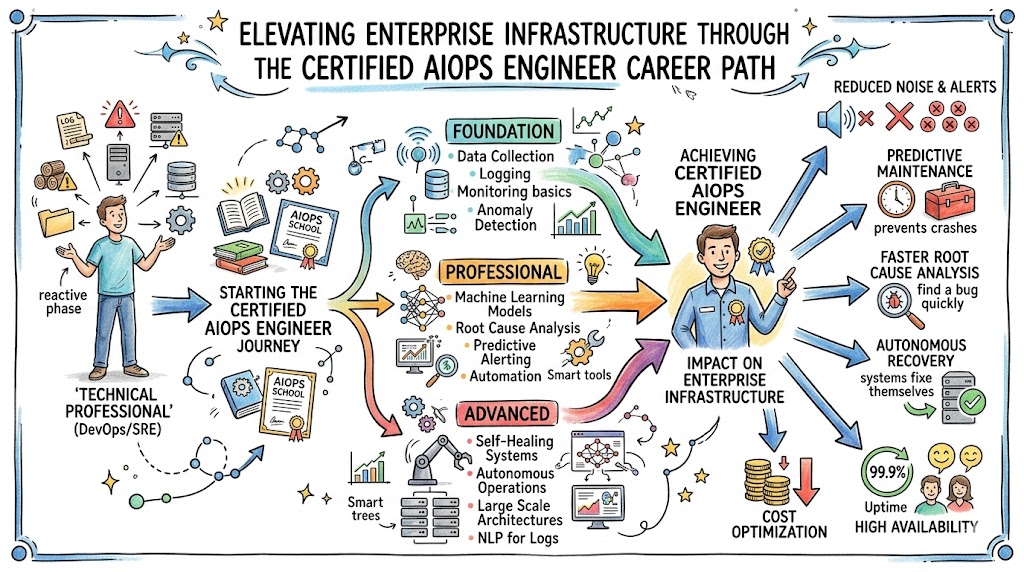
The Certified AIOps Engineer credential empowers technical experts to master the critical fusion of artificial intelligence and operational excellence. This guide offers a robust roadmap for DevOps specialists, site reliability engineers, and platform architects who want to automate intricate infrastructure via machine learning. Since modern enterprises demand autonomous systems, gaining expertise in algorithmic operations secures your position as a high-value asset in the tech industry. You can leverage this analysis to steer your professional journey toward success at AIOpsSchool and beyond.
Defining the Certified AIOps Engineer
The Certified AIOps Engineer program delivers a specialized curriculum that connects standard monitoring with advanced intelligent automation. It prioritizes the practical use of big data and analytics to boost system visibility and slash response times. This certification rejects purely theoretical models in favor of production-ready implementation within contemporary engineering workflows. It establishes the rigorous standards necessary to manage event noise, detect anomalies, and automate root cause discovery in massive enterprise environments.
Ideal Candidates for this Certification
SREs and systems engineers who oversee distributed architectures find immediate utility in this program as they replace manual toil with smart automation. Cloud architects and security analysts who process vast log streams also gain vital pattern recognition skills through this training. While beginners with Python and Linux basics can use this as a career bridge, engineering leaders gain the technical depth to drive AI transformations. This designation carries immense weight across global markets and India’s thriving technology sectors.
Unlocking Value in Modern Engineering
Demand for intelligent operations grows daily because manual monitoring fails to keep pace with microservices and multi-cloud complexity. This certification grants you professional longevity by shifting your focus from reactive firefighting to proactive architectural design. You remain competitive even as specific tools change because you master the core data science principles of operations. Professionals see a clear return on investment through superior operational efficiency and faster career progression.
Program Structure and Delivery
AIOpsSchool hosts and delivers this program via Certified AIOps Engineer. The curriculum guides students from core concepts to elite engineering by focusing on actual telemetry data. You face a mix of knowledge tests and performance-based labs that verify your ability to handle real-world datasets. This tiered structure ensures you maintain full ownership of a flexible yet demanding learning path.
Career Tracks and Progression Levels
The program organizes learning into foundation, professional, and advanced tiers to support various career stages. The foundation level teaches data ingestion and basic alerting, serving junior engineers and cross-skilling managers perfectly. Professional modules tackle model training for operational telemetry, while advanced courses focus on building entire autonomous recovery layers. These levels mirror your natural progression from an Associate to a Principal Architect.
Complete Certified AIOps Engineer Certification Table
| Track | Level | Who it’s for | Prerequisites | Skills Covered | Recommended Order |
| Operations | Foundation | Junior DevOps/SRE | Linux Basics | Data collection, Basic Python | 1 |
| Engineering | Professional | SRE/Platform Engineers | Foundation Cert | Anomaly detection, ML models | 2 |
| Architecture | Advanced | Principal Engineers | Professional Cert | Autonomous systems, NLP | 3 |
| Management | Leadership | CTO/VPs | General Ops Exp | AIOps Strategy, ROI Analysis | 1 |
Technical Deep Dive: Certification Levels
Certified AIOps Engineer – Foundation
What it is
This certification confirms your fundamental grasp of how artificial intelligence optimizes traditional IT monitoring and operations. It provides the essential entry point for building data pipelines.
Who should take it
Recent graduates, system admins, and aspiring DevOps engineers should start here to specialize in automated infrastructure.
Skills you’ll gain
- Mastery of the AIOps conceptual framework
- Execution of operational data ingestion
- Descriptive analytics for system logs
- Proficiency with core AIOps toolsets
Real-world projects you should be able to do
- Set up a centralized logging platform with smart filters
- Build dashboards that separate critical alerts from noise
Preparation plan
A 14-day sprint works for those reviewing core modules and incident case studies. A 30-day plan adds hands-on lab time, while a 60-day schedule helps those new to Linux and Python.
Common mistakes
- Skipping basic statistical concepts
- Ignoring data quality before starting AI modeling
Best next certification after this
- Same-track option: Certified AIOps Engineer – Professional
- Cross-track option: Certified SRE Professional
- Leadership option: AIOps Strategy for Managers
Certified AIOps Engineer – Professional
What it is
This tier validates your ability to build machine learning models for operational telemetry. You learn to convert raw logs into actionable intelligence through predictive math.
Who should take it
Experienced SREs and DevOps engineers with two-plus years of experience who want to minimize Mean Time to Repair (MTTR).
Skills you’ll gain
- Deployment of unsupervised learning for log data
- Creation of predictive maintenance models
- Automated Root Cause Analysis (RCA)
- Advanced event correlation strategies
Real-world projects you should be able to do
- Construct a predictive scaling engine for Kubernetes
- Launch an automated incident classifier for a NOC
Preparation plan
The 14-day path suits experts already using ML. Most professionals need 30 days for model tuning practice or 60 days to integrate ML libraries into DevOps pipelines.
Common mistakes
- Using overly complex deep learning for simple problems
- Forgetting to integrate AI models with legacy infrastructure
Best next certification after this
- Same-track option: Certified AIOps Engineer – Advanced
- Cross-track option: MLOps Engineering Professional
- Leadership option: Technical Lead – AI Operations
Certified AIOps Engineer – Advanced
What it is
This elite credential proves you can build self-healing systems and fully autonomous infrastructure layers. It marks the peak of AIOps technical mastery.
Who should take it
Principal Engineers and Architects who design resilient, global-scale systems that require zero human intervention.
Skills you’ll gain
- Architecture of closed-loop remediation
- Natural Language Processing (NLP) for logs
- Scaling data lakes for AIOps
- Reinforcement learning for system tuning
Real-world projects you should be able to do
- Engineer an autonomous, self-healing cloud architecture
- Deploy an AI-driven disaster recovery system across regions
Preparation plan
Experts can use a 14-day window to document their skills. A 30-day plan includes a major capstone project, while 60 days ensures mastery of complex architectural patterns.
Common mistakes
- Overlooking model drift in live environments
- Building systems too complex for team maintenance
Best next certification after this
- Same-track option: AIOps Post-Doctorate Professional
- Cross-track option: Advanced Cloud Security Architect
- Leadership option: Director of Platform Engineering
Specialized Learning Paths
DevOps Path
Engineers in this track integrate AI directly into CI/CD pipelines to forecast deployment risks. They use AIOps to trigger automated rollbacks before failures impact customers. This path prioritizes speed and stability through intelligent deployment gates. You learn to build feedback loops that provide instant insights to development teams.
DevSecOps Path
This track combines security monitoring with AI to catch threats that bypass traditional firewalls. You focus on detecting anomalies in network traffic to block attacks preemptively. Professionals automate vulnerability patching during the active operational phase. This remains vital for anyone securing data in highly regulated industries.
SRE Path
Site Reliability Engineers master alert suppression and automated incident response in this track. You maintain strict Service Level Objectives by building predictive alerting systems. SREs learn to create error budget trackers that use AI to forecast potential breaches. This path forms the core of high-availability service management.
AIOps Path
This dedicated specialty focuses on the data science behind operational excellence. You build the platforms and data lakes that provide telemetry insights to the entire organization. Specialists here ensure AI models scale effectively while maintaining extreme accuracy. It provides a deep dive into the engineering required for large-scale AI infrastructure.
MLOps Path
This path manages the lifecycle of the machine learning models themselves. You bridge the gap between data science and operations to deploy and monitor models efficiently. This becomes critical for organizations that rely on AI as a core infrastructure component. You emphasize version control for both your models and your operational data.
DataOps Path
DataOps experts manage the quality and flow of telemetry feeding the AIOps engines. You ensure that logs from different sources arrive clean and normalized in real-time. Without your work, AIOps models fail due to inconsistent data inputs. This path suits those who enjoy engineering robust pipelines and ensuring data integrity.
FinOps Path
This specialty applies AI to cloud cost management and resource optimization. You learn to predict cloud spending and automate the rightsizing of infrastructure to prevent waste. It sits at the intersection of technical excellence and financial logic. This track helps companies maximize their cloud ROI while maintaining top performance.
Role → Recommended Certified AIOps Engineer Certifications
| Role | Recommended Certifications |
| DevOps Engineer | Certified AIOps Foundation, Professional |
| SRE | Certified AIOps Professional, Advanced |
| Platform Engineer | Certified AIOps Advanced, MLOps Foundation |
| Cloud Engineer | Certified AIOps Foundation, FinOps Track |
| Security Engineer | Certified AIOps Professional, DevSecOps Track |
| Data Engineer | Certified AIOps Foundation, DataOps Track |
| FinOps Practitioner | Certified AIOps Foundation, FinOps Track |
| Engineering Manager | Certified AIOps Foundation, Management Track |
Future Growth and Expansion
Same Track Progression
After reaching the advanced level, look toward niche specializations within the AI ecosystem. You should explore specific frameworks for time-series forecasting or advanced log analysis. Constant learning keeps you at the edge of algorithmic operations. You transition from a practitioner to a recognized authority in automation.
Cross-Track Expansion
Broadening your expertise into DevSecOps or MLOps provides a comprehensive view of the modern tech stack. An AIOps master who understands security becomes a massive asset for any firm. This expansion facilitates better team collaboration and opens doors to full-stack leadership roles. You gain a better understanding of the failures that cause massive downtime.
Leadership & Management Track
If you prefer strategy over coding, the leadership track highlights the ROI of AI implementation. You learn to manage specialized teams and explain technical risks to executive stakeholders. These credentials help you move into Director or CTO positions. This track emphasizes culture, budgeting, and long-term technical vision.
Training & Certification Support Providers
DevOpsSchool
This organization provides deep instructor-led sessions for mastering the DevOps lifecycle through AI. They emphasize real-world scenarios and labs that prepare you for the pressure of live production environments.
Cotocus
Specializing in cloud-native consulting, they offer technical insights into implementing AIOps effectively. Their courses help you move from manual operations to fully automated, AI-driven workflows.
Scmgalaxy
This community platform shares tutorials and training focused on intelligent automation and configuration. It serves as an excellent resource for staying current with the latest AIOps toolsets.
BestDevOps
They offer training programs that highlight industry best practices for leveraging AI in operations. The curriculum meets the needs of both individual engineers and large corporate teams.
devsecopsschool.com
This provider focuses on the intersection of security and operations, teaching you to build secure AI-driven pipelines. Their content shows you how to automate security responses within CI/CD flows.
sreschool.com
Dedicated to SRE principles, this school offers courses on maintaining stability through machine learning. Their training helps you reduce manual toil via intelligent analytics and predictive modeling.
aiopsschool.com
As the primary home for this program, they offer the most comprehensive path to achieving this credential. Their resources align perfectly with exam objectives and provide necessary technical depth.
dataopsschool.com
This site teaches you to build the data pipelines that fuel AIOps engines. Their training ensures your AI models receive high-quality, real-time telemetry for accurate decision-making.
finopsschool.com
They specialize in cloud finance, teaching you how to use AI to optimize spending. Their training bridges the gap between engineering choices and their financial impact.
Frequently Asked Questions (General)
- Does the Certified AIOps Engineer exam present a high difficulty for beginners?Candidates find the exam challenging because it blends operations experience with data science, requiring a broad skill set.
- What time commitment does the foundation level require?Most engineers dedicate 30 to 40 hours of study and lab work to master the foundation concepts.
- Must I learn specific coding languages for this path?While the foundation level stays high-level, you should learn Python to succeed in professional and advanced tiers.
- Will I see a strong return on investment from this cert?Engineers often secure higher salaries and lead high-impact automation projects immediately after earning this credential.
- Do these certifications expire?Technical leaders recommend renewing or advancing your certification every two to three years to stay relevant.
- Can I skip directly to the professional level?While the sequence helps most, experts with years of AIOps experience can challenge the professional exam directly.
- Do certified professionals gain access to a community?Yes, you join an exclusive network of experts to share job leads and technical insights.
- Are the practical labs included in the training cost?Most comprehensive training packages include full access to the necessary sandbox lab environments.
- How does this differ from standard DevOps certifications?DevOps focuses on the delivery process, while AIOps focuses on using AI to manage the live operational environment.
- Does the exam involve a proctored setting?You typically complete a proctored knowledge exam and a practical project to prove your hands-on skills.
- Do I need a strong background in statistics?Basic statistical knowledge helps immensely, as AIOps relies on identifying patterns and anomalies in data.
- Do major cloud providers recognize this credential?Vendor-neutral skills remain highly valuable to all major cloud platforms and their enterprise partners.
FAQs on Certified AIOps Engineer
- Which AIOps tools does the curriculum cover?The program explores several open-source and enterprise tools for logging, ML, and monitoring to ensure versatility.
- How does the training handle data privacy concerns?Modules teach you to handle telemetry responsibly, ensuring AI models don’t expose sensitive system data.
- Can this help me transition into a Data Science role?The applied machine learning foundation provides an excellent springboard into MLOps or specialized data science roles.
- Does the focus stay on cloud or on-premise setups?The curriculum covers hybrid strategies, addressing both modern cloud-native designs and legacy on-premise data centers.
- Does the program include NLP for log analysis?Advanced levels teach you to use NLP to extract insights from unstructured logs and support tickets.
- How do the exam labs work?You solve specific problems in a sandbox, such as suppressing alert noise or pinpointing a performance bottleneck.
- Is AI-driven cost optimization a part of the course?The FinOps track specifically addresses how AI models predict and minimize cloud infrastructure waste.
- Are group discounts available for corporate teams?Most associated providers offer enterprise packages for teams looking to upskill in AIOps together.
Final Thoughts: Is Certified AIOps Engineer Worth It?
Choosing this certification signifies a strategic commitment to the future of algorithmic operations. Human teams can no longer manually analyze the massive data streams of modern systems, making AIOps an essential skill for every engineer. This program moves you beyond the mystery of AI and teaches you to build transparent, self-healing infrastructure. If you dedicate the effort to master both telemetry and automation, you will enjoy significant career growth and technical influence. Focus on the underlying logic and real-world projects to ensure this certification drives your professional success for years to come.