Introduction
Certified DevOps Professional (CDP) is designed for engineers and technical leaders who want to move beyond tools and understand DevOps as a production-grade engineering discipline. This guide is written for working professionals who design, build, deploy, and operate real systems at scale. In today’s cloud-native and platform-driven world, DevOps is no longer optional—it is foundational to speed, reliability, and business outcomes.
This guide helps you evaluate whether Certified DevOps Professional (CDP) fits your career stage, role, and long-term growth plans. You will learn how the certification maps to real-world responsibilities, not just exams.
What is the Certified DevOps Professional (CDP)?
Certified DevOps Professional (CDP) represents applied DevOps competence focused on real production systems rather than academic theory. The certification exists to close the gap between knowing tools and operating resilient, scalable platforms in live environments.
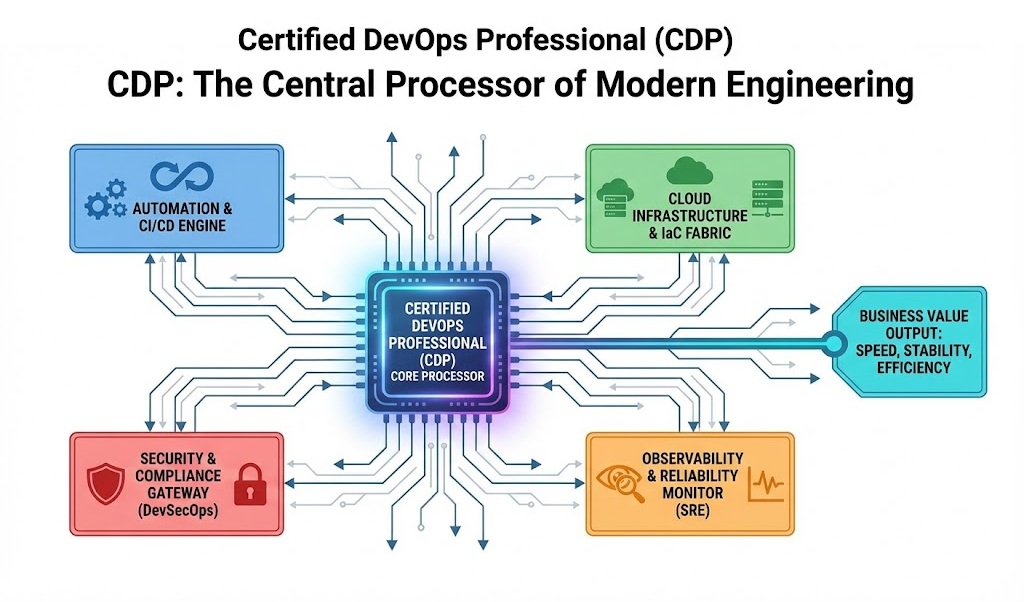
It emphasizes CI/CD, infrastructure automation, cloud platforms, monitoring, security integration, and operational excellence as practiced in modern enterprises. Certified DevOps Professional (CDP) aligns with how engineering teams actually work—cross-functional, automated, measurable, and continuously improving.
The goal is to validate skills that survive tool changes and remain relevant across organizations.
Who Should Pursue Certified DevOps Professional (CDP)?
Certified DevOps Professional (CDP) is well-suited for DevOps engineers, SREs, platform engineers, and cloud professionals working in delivery-focused teams. It also benefits security engineers, data engineers, and FinOps practitioners who collaborate closely with DevOps workflows.
Early-career engineers gain structured understanding of production practices, while experienced professionals validate and formalize their expertise. Engineering managers and tech leads use Certified DevOps Professional (CDP) to better guide teams and architectural decisions.
The certification is equally relevant for professionals in India and global markets, where DevOps maturity varies but demand remains strong.
Why Certified DevOps Professional (CDP) is Valuable in 2026 and Beyond
Tools change every year, but DevOps principles remain stable. Certified DevOps Professional (CDP) focuses on those enduring practices—automation, observability, resilience, and feedback loops. Enterprises continue adopting cloud-native platforms, internal developer platforms, and SRE models, all of which depend on strong DevOps foundations.
This certification helps professionals stay employable despite rapid ecosystem changes. The return on investment comes from improved system reliability, faster delivery, and better cross-team collaboration. Certified DevOps Professional (CDP) rewards time spent learning concepts that scale with your career.
Certified DevOps Professional (CDP) Certification Overview
The Certified DevOps Professional (CDP) program is delivered via Certified DevOps Professional and hosted on devopsschool. The certification follows a structured, role-oriented approach rather than a single, tool-heavy exam.
It includes progressive levels and assessments that test real-world understanding, not rote memorization. Ownership and governance focus on industry relevance and continuous updates based on enterprise feedback.
The structure supports professionals who want measurable skill validation aligned with job performance.
Certified DevOps Professional (CDP) Certification Tracks & Levels
Certified DevOps Professional (CDP) is organized into foundation, professional, and advanced levels to match career stages. Foundation levels establish core DevOps concepts and workflows used across teams. Professional levels deepen hands-on capability in automation, cloud, and operations.
Advanced levels introduce specialization tracks such as SRE, FinOps, DevSecOps, and platform engineering. Each level maps clearly to increasing responsibility and system ownership.
This progression supports long-term career growth rather than one-time certification goals.
Complete Certified DevOps Professional (CDP) Certification Table
| Track | Level | Who it’s for | Prerequisites | Skills Covered | Recommended Order | Official Link |
|---|---|---|---|---|---|---|
| DevOps Core | Foundation | Entry to mid-level engineers | Basic Linux & Git | CI/CD basics, automation concepts | 1 | https://www.devopsschool.com/certification/certified-devops-professional.html |
| DevOps Core | Professional | Working DevOps engineers | Foundation level | Pipelines, IaC, monitoring | 2 | https://www.devopsschool.com/certification/certified-devops-professional.html |
| DevOps Core | Advanced | Senior engineers | Professional level | Architecture, reliability, scale | 3 | https://www.devopsschool.com/certification/certified-devops-professional.html |
| SRE | Professional | Reliability engineers | DevOps professional | SLOs, incident mgmt | 4 | https://www.devopsschool.com/certification/certified-devops-professional.html |
| FinOps | Professional | Cloud cost owners | DevOps basics | Cost control, metrics | 5 | https://www.devopsschool.com/certification/certified-devops-professional.html |
Detailed Guide for Each Certified DevOps Professional (CDP) Certification
Certified DevOps Professional (CDP) – Foundation
What it is
This certification validates core DevOps concepts and workflows used in modern delivery teams. It focuses on understanding how automation and collaboration improve delivery outcomes.
Who should take it
Junior to mid-level engineers transitioning into DevOps-oriented roles benefit most.
Skills you’ll gain
- CI/CD fundamentals
- Infrastructure automation basics
- Monitoring awareness
Real-world projects you should be able to do
- Build a basic CI pipeline
- Automate environment provisioning
Preparation plan
7–14 days for revision, 30 days for labs, 60 days for hands-on practice.
Common mistakes
Ignoring fundamentals, focusing only on tools.
Best next certification after this
Same-track: CDP Professional
Cross-track: SRE fundamentals
Leadership: DevOps team basics
Certified DevOps Professional (CDP) – Professional
What it is
This level validates applied DevOps skills in production-like environments.
Who should take it
Working DevOps and cloud engineers with hands-on responsibilities.
Skills you’ll gain
- Pipeline design
- IaC implementation
- Observability practices
Real-world projects you should be able to do
- Design CI/CD for microservices
- Implement monitoring and alerts
Preparation plan
7–14 days review, 30 days labs, 60 days real projects.
Common mistakes
Memorizing tools without understanding workflows.
Best next certification after this
Same-track: CDP Advanced
Cross-track: FinOps Professional
Leadership: Platform strategy
Choose Your Learning Path
DevOps Path
Focuses on automation, CI/CD, and cloud operations for delivery speed.
DevSecOps Path
Adds security integration into pipelines and infrastructure workflows.
SRE Path
Emphasizes reliability, incident management, and service health.
AIOps / MLOps Path
Integrates analytics and automation into operations and ML systems.
DataOps Path
Applies DevOps principles to data pipelines and analytics platforms.
FinOps Path
Balances cloud cost optimization with engineering performance.
Role → Recommended Certified DevOps Professional (CDP) Certifications
| Role | Recommended Certifications |
|---|---|
| DevOps Engineer | CDP Foundation, Professional |
| SRE | CDP Professional, SRE Track |
| Platform Engineer | CDP Advanced |
| Cloud Engineer | CDP Professional |
| Security Engineer | CDP + DevSecOps |
| Data Engineer | CDP + DataOps |
| FinOps Practitioner | CDP + FinOps |
| Engineering Manager | CDP Professional |
Next Certifications to Take After Certified DevOps Professional (CDP)
Same Track Progression
Deepen specialization within DevOps and platform engineering.
Cross-Track Expansion
Broaden skills into security, data, or financial operations.
Leadership & Management Track
Transition into architectural and people leadership roles.
Training & Certification Support Providers for Certified DevOps Professional (CDP)
DevOpsSchool
Provides structured DevOps training with enterprise-focused curricula and labs.
Cotocus
Offers consulting-driven learning aligned with real client use cases.
Scmgalaxy
Focuses on automation and continuous delivery skill development.
BestDevOps
Delivers curated DevOps content and certification preparation.
devsecopsschool.com
Specializes in DevSecOps integration and security automation.
sreschool.com
Covers reliability engineering and operational excellence.
aiopsschool.com
Focuses on analytics-driven operations and automation.
dataopsschool.com
Applies DevOps practices to data engineering workflows.
finopsschool.com
Addresses cloud cost control and financial accountability.
Frequently Asked Questions (General – Minimum 12 with answer in 100 words)
Is Certified DevOps Professional (CDP) difficult?
The difficulty depends on experience. It is practical, not theoretical, and rewards real understanding.
How long does it take to prepare?
Most professionals take 30–60 days with hands-on practice.
Do I need coding experience?
Basic scripting and automation familiarity is recommended.
Is it suitable for managers?
Yes, it helps managers understand delivery and operations realities.
Does it focus on one tool?
No, it emphasizes concepts over specific tools.
Is it recognized globally?
It aligns well with global DevOps role expectations.
Can freshers take it?
Foundation level is suitable with basic IT knowledge.
Does it help salary growth?
It supports roles associated with higher responsibility and pay.
Is cloud knowledge required?
Basic cloud understanding is highly beneficial.
How often is it updated?
The curriculum evolves with industry practices.
Is it exam-only?
Assessments focus on applied understanding.
Can I switch domains after CDP?
Yes, it enables movement into SRE, DevSecOps, and FinOps.
FAQs on Certified DevOps Professional (CDP)
How does CDP differ from tool-based certifications?
CDP focuses on workflows and outcomes, not vendor tools.
Is CDP relevant without Kubernetes expertise?
Yes, but Kubernetes knowledge enhances value.
Does CDP cover monitoring and observability?
Yes, as core production skills.
Is CDP aligned with Agile practices?
It complements Agile delivery models.
Can CDP help in platform engineering roles?
Yes, it provides strong foundational concepts.
Is there a renewal requirement?
Updates are encouraged to stay current.
Does CDP support career switching?
It helps engineers transition into DevOps roles.
Is CDP worth it for experienced engineers?
Yes, it validates and structures existing knowledge.
Final Thoughts: Is Certified DevOps Professional (CDP) Worth It?
Certified DevOps Professional (CDP) is worth pursuing if you care about building and running systems that work reliably in the real world. It does not promise shortcuts or instant promotions, but it strengthens how you think and operate as an engineer or leader.
For professionals who want long-term relevance rather than short-term tool expertise, Certified DevOps Professional (CDP) provides solid value. Treated as a learning journey, not just a credential, it becomes a meaningful career investment.