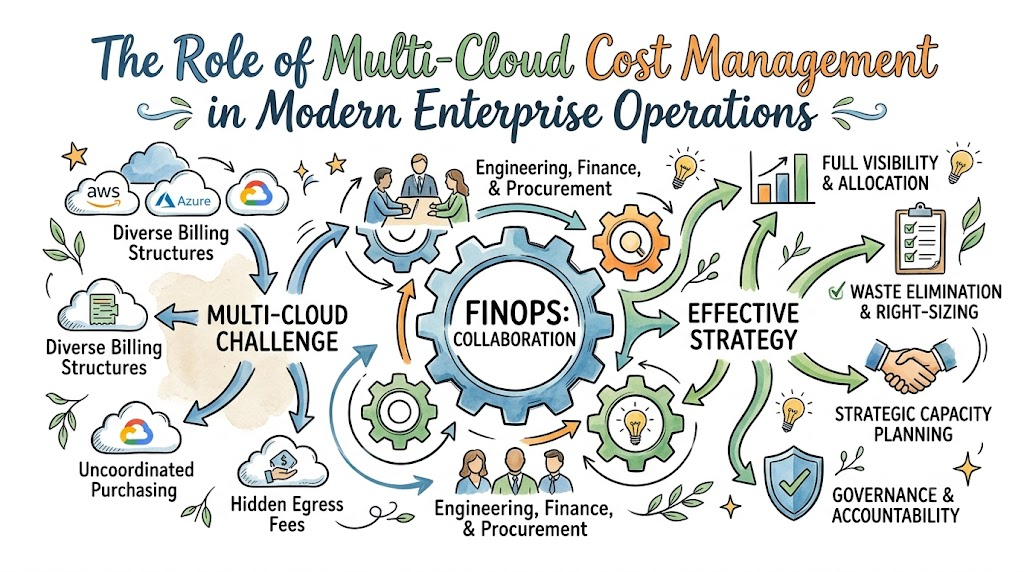
Managing infrastructure spending across multi-cloud environments requires a deliberate, disciplined operational framework. Organizations frequently face budget overruns because development teams deploy assets across diverse cloud platforms without centralized governance. Consequently, adopting consistent cross-cloud financial management becomes a business imperative for modern technology enterprises. By uniting engineering choices with corporate financial targets, companies regain clear predictability over their digital investments. Building these core competencies through an established training resource like Finopsschool equips technical leaders with the exact skills needed to streamline hybrid cloud operations. This cooperative alignment ensures every provisioned resource delivers measurable business value.
Furthermore, teams stop viewing cross-cloud bills as confusing, unpredictable invoices and begin treating them as strategic growth drivers. Engineers receive direct insight into the financial consequences of their platform choices, which promotes ownership across development cycles. Finance departments can forecast future infrastructure expenditures with greater reliability because normalized usage data bridges the gap between disparate provider metrics. Ultimately, this structural alignment reduces expensive redundancies without compromising agility, reliability, or product speed.
Understanding Cloud Financial Operations
Operating across multiple cloud platforms introduces significant complexity into traditional corporate accounting and procurement. Providers utilize completely different billing formats, resource taxonomies, and metric units for compute, memory, and networking assets. Engineers often provision multi-cloud systems rapidly using automated deployment scripts, unintentionally bypassing enterprise budget checks. Without standardized visibility and shared guardrails, multi-cloud spending quickly exceeds approved limits within weeks.
To solve this continuous challenge, enterprises must adopt a structured financial framework tailored specifically for heterogeneous computing environments. Multi-cloud financial management provides this operational model, combining cultural accountability with systematic analytics to drive maximum return on investment. It creates a collaborative forum where software developers, system architects, and finance controllers interact consistently. Consequently, organizations learn to regard resource governance as an essential operational standard rather than a reactive audit exercise.
Additionally, this operating methodology relies on three continuous phases to ensure long-term budget discipline. The inform phase normalizes varied cloud provider billing data to deliver unified visibility across departments. Next, the optimize phase identifies cross-platform efficiency gains, such as right-sizing compute nodes and eliminating stranded networking routes. Finally, the operate phase integrates automated financial policies into continuous delivery pipelines, maintaining lean operations indefinitely.
Key Operational Concepts You Must Know
Unified Tagging and Cross-Platform Data Normalization
Effective multi-cloud cost governance starts with unified tagging standards across every vendor account. Since each cloud provider uses proprietary naming conventions and resource categorizations, normalizing data into a unified schema is vital. Establishing mandatory labels for environment, application owner, cost center, and business purpose enables seamless expense aggregation. When operational telemetry is translated into a single unified taxonomy, teams gain clear accountability across systems.
Moreover, rigorous data normalization eliminates the problem of unassigned or fragmented infrastructure running undetected across secondary providers. Financial controllers can accurately correlate expenses to distinct customer-facing applications regardless of the underlying cloud host. As a result, engineering groups actively take ownership of their respective service footprints. Shared financial clarity turns cross-cloud cost stewardship into an everyday engineering habit.
Cross-Cloud Workload Placement and Right-Sizing
Strategic workload placement involves deploying specific applications to the cloud environment that offers the optimal performance-to-cost ratio. Rather than treating all clouds identically, teams analyze proprietary pricing structures, data transfer rates, and hardware configurations for each service. Concurrently, regular right-sizing ensures active instances closely match dynamic workload needs instead of running at theoretical peak allocations. This continuous calibration stops idle capacity from consuming capital around the clock.
By monitoring performance analytics across platforms, system administrators can safely downscale oversized resources and retire abandoned volumes. Eliminating unattached block storage, unused IP reservations, and idle load balancers produces immediate financial gains. This ongoing operational hygiene guarantees that enterprises pay only for active, efficient infrastructure rather than speculative overhead.
Portfolio Commitment Management and Discount Optimization
Major cloud providers feature substantial discounts through reserved capacity agreements, flexible commitment terms, and enterprise savings programs. However, managing these discounts across multiple cloud providers requires continuous usage tracking and predictive capacity planning. FinOps practitioners evaluate aggregate baseline utilization across platforms to secure optimal discount rates without over-committing. Balancing discounted commitments with flexible spot or on-demand instances protects budgets against unexpected architectural changes.
Furthermore, over-committing to a single provider can reduce operational flexibility and inadvertently complicate multi-cloud workload mobility. Therefore, commitment portfolios must be reviewed collaboratively between technical architects and financial analysts on an ongoing schedule. A balanced, multi-cloud reservation strategy extracts maximum pricing benefits while preserving architectural flexibility.
| Operational Discipline | Primary Focus Area | Business Value |
|---|---|---|
| Data Normalization | Unified Resource Tagging | Comprehensive visibility across diverse platforms |
| Workload Placement | Performance-Cost Matching | Elimination of expensive platform mismatches |
| Commitment Management | Cross-Cloud Discount Terms | Maximized savings on baseline infrastructure |
Platform Implementation vs. Culture — What’s the Real Difference?
The Mechanics of Tool Deployment
Platform implementation centers on deploying multi-cloud cost platforms, configuring API connections, and generating aggregated management dashboards. Companies often invest heavily in specialized software platforms expecting automated dashboards to fix cross-cloud overspending immediately. These platforms perform well at aggregating disparate billing data, discovering anomalies, and visualizing cost distributions across regions. However, deploying a management tool represents only the technical foundation of a comprehensive financial strategy.
+-----------------------------------+       +-----------------------------------+
|      Platform Implementation      |  -->  |         Cultural Adoption         |
|  (Tools, APIs & Aggregated Data)  |       | (Shared Ownership & Daily Habits) |
+-----------------------------------+       +-----------------------------------+
Without proactive human participation, multi-cloud platforms simply document financial waste without solving the root architectural problems. Development teams must review incoming recommendations, evaluate technical feasibility, and execute necessary adjustments in their deployment scripts. Relying exclusively on tooling fosters passive reporting instead of active, continuous cost management. Software platforms provide valuable data, but they cannot replace knowledgeable engineering decisions.
Driving Genuine Behavioral Transformation
Cultural adoption focuses on reforming day-to-day organizational behaviors so cost awareness becomes an essential design criterion. Within a mature FinOps culture, engineers weigh running costs alongside scalability, reliability, and security during architecture discussions. Achieving this mindset requires removing historical barriers that separated corporate finance departments from technical teams. Education and transparent communications serve as the primary drivers for achieving this operational balance.
When financial analysts understand technical constraints, they produce adaptable budgets that support necessary infrastructure evolution. Simultaneously, when developers comprehend budget guardrails, they build clean, cost-efficient systems from the initial design phase. This mutual respect creates an environment where cross-functional alignment happens naturally every day. Culture elevates cost management from an administrative check into a point of technical pride.
Real-World Use Cases of Modern Operations
Optimizing Data Egress and Multi-Cloud Interconnects
A global logistics enterprise distributed its microservices across two separate cloud providers to improve operational resiliency. However, high data transfer fees between the platforms quickly inflated monthly network expenditures beyond original estimates. The engineering team had deployed services without considering the financial penalties associated with cross-cloud data movement. To address the issue, architects restructured application communications to minimize high-volume data egress across boundaries.
By implementing local caching layers and routing traffic through dedicated private network connections, egress charges decreased significantly. Finance teams partnered with infrastructure leads to track data movement metrics on a weekly basis. Consequently, the organization preserved its multi-cloud availability benefits while reducing networking costs substantially.
Workload Migration and Flexible Compute Sourcing
A fast-growing analytics provider ran large-scale batch processing workloads that required substantial compute capacity. Rather than anchoring all compute operations to a single provider, they developed containerized jobs capable of executing on any platform. The team monitored cross-cloud spot market pricing and shifted batch workloads to the provider offering the lowest real-time compute rates. This dynamic workload strategy allowed them to capture deep market discounts without sacrificing turnaround times.
+------------------------------------+
| Dynamic Multi-Cloud Spot Monitor   |
+------------------------------------+
                  |
                  v
+------------------------------------+
| Route Workloads to Lowest-Cost VM  |
+------------------------------------+
                  |
                  v
+------------------------------------+
| Significant Compute Cost Reduction |
+------------------------------------+
This dynamic approach enabled the company to run demanding batch pipelines at a fraction of standard on-demand costs. Engineering and finance established shared performance baselines to ensure execution times remained within acceptable service thresholds. As a result, the enterprise achieved superior operational efficiency and improved profitability across their product suite.
Common Mistakes in Operations Engineering
Miscalculating Multi-Cloud Network Egress Charges
A frequent mistake in multi-cloud architecture is neglecting network egress charges during the system design phase. Inbound data movement is generally free across cloud providers, but transferring data outbound or between providers incurs ongoing fees. Organizations often distribute interconnected microservices across different clouds without factoring in the continuous cost of inter-service data transmission. Over time, these communication paths create substantial, unexpected monthly expenses that erode the economic benefits of a multi-cloud approach.
To avoid this financial pitfall, engineering teams must evaluate network communication topologies prior to multi-cloud deployment. Designing services to process data locally within the host cloud prevents unnecessary cross-provider data transfers. Regular architectural audits ensure data movement patterns stay within planned limits.
- Audit network traffic patterns to discover hidden cross-provider data transfers.
- Establish local caching systems to reduce redundant external requests.
- Consolidate interdependent microservices within the same platform boundary when feasible.
Fragmented Tooling and Uncoordinated Purchases
Another widespread mistake is allowing different engineering teams to procure standalone cost management tools for each individual cloud. Operating multiple single-cloud platforms prevents cross-platform visibility and generates conflicting utilization data. Additionally, fragmented procurement obscures overall infrastructure volume, weakening the enterprise’s ability to negotiate enterprise discount agreements. Uncoordinated tooling also increases administrative overhead and introduces inconsistencies in financial reporting.
+------------------------------------+
| Fragmented Provider-Specific Tools |
+------------------------------------+
                  |
                  v
+------------------------------------+
| Centralized Multi-Cloud Strategy   |
+------------------------------------+
                  |
                  v
+------------------------------------+
| Unified Visibility & Better Terms  |
+------------------------------------+
Organizations should deploy a unified, multi-cloud cost management strategy that delivers a single source of financial truth. Centralizing billing ingestion across all platforms gives management total visibility into the aggregate infrastructure footprint. This coordinated view enhances forecasting precision and strengthens leverage during vendor contract negotiations.
How to Become an Operations Expert — Career Roadmap
Mastering Multi-Cloud Architecture and Data Standards
Developing expertise in multi-cloud cost management requires a firm grasp of underlying cloud infrastructure across major platforms. Aspiring professionals must understand how compute, managed storage, networking, and serverless architectures are metered by each provider. Earning multi-cloud certifications builds technical authority and demonstrates practical understanding of varied cloud environments. Additionally, learning open-source data schemas and billing specifications is invaluable for integrating disparate cost telemetry into unified platforms.
- Attain cross-platform architecture credentials to understand varied vendor services.
- Master open billing standards to parse multi-cloud expenditure datasets effectively.
- Build proficiency in data tools to analyze raw cloud usage records at enterprise scale.
Developing Financial Fluency and Cross-Functional Leadership
Technical knowledge alone is incomplete without strong financial literacy and clear executive communication capabilities. Specialists must understand corporate budgeting processes, capital allocation, depreciation schedules, and operational forecasting principles. This financial knowledge allows practitioners to translate technical metrics into clear business value proposals that resonate with leadership. Bridging the gap between software development teams and corporate finance elevates practitioners into indispensable operational leaders.
- Study financial fundamentals to understand operational spending models and forecasting methods.
- Frame infrastructure recommendations around unit economics and business growth metrics.
- Facilitate cross-departmental reviews to align engineering velocity with fiscal discipline.
FAQ Section
- What makes multi-cloud cost management more challenging than single-cloud operations?
Multi-cloud operations require reconciling disparate billing structures, varied resource nomenclatures, and fluctuating data transfer costs across independent platforms. Furthermore, the absence of native, consolidated dashboards demands unified normalization layers to track spending accurately.
- How should organizations approach commitment discounts across multiple cloud providers?
Enterprises should evaluate steady-state baseline utilization separately for each cloud vendor while factoring in future architectural plans. Committing to flexible savings plans for stable baseline usage ensures substantial discounts without restricting cross-platform flexibility.
- Can engineering teams use native cloud provider tools for a multi-cloud FinOps practice?
Native cloud tools excel at providing granular data for their own environments, but they cannot evaluate external cloud platforms. Consequently, enterprises generally pair native tools with unified data pipelines or multi-cloud platforms to maintain comprehensive oversight.
- Who should be responsible for managing multi-cloud infrastructure budgets?
Budget management should be a shared responsibility shared between application owners and dedicated FinOps practitioners. Application engineers manage usage efficiency, while FinOps leaders coordinate commitment purchases, billing normalization, and financial governance policies.
- How does standardizing resource tagging improve multi-cloud financial governance?
Standardized tagging establishes consistent cost attribution across varied cloud environments regardless of native provider differences. This uniform tracking enables automated cost assignment to specific teams, preventing untracked expenses from accumulating unnoticed.
Final Summary
Managing multi-cloud spending effectively is essential for organizations seeking to scale digital operations efficiently. By embedding financial accountability directly into technical planning, businesses protect their operating margins while modernizing infrastructure. This operational alignment grants developers the freedom to innovate while giving financial executives predictable, transparent cloud investments. Ultimately, establishing mature multi-cloud FinOps practices turns complex multi-cloud deployments into a sustainable, competitive business advantage.