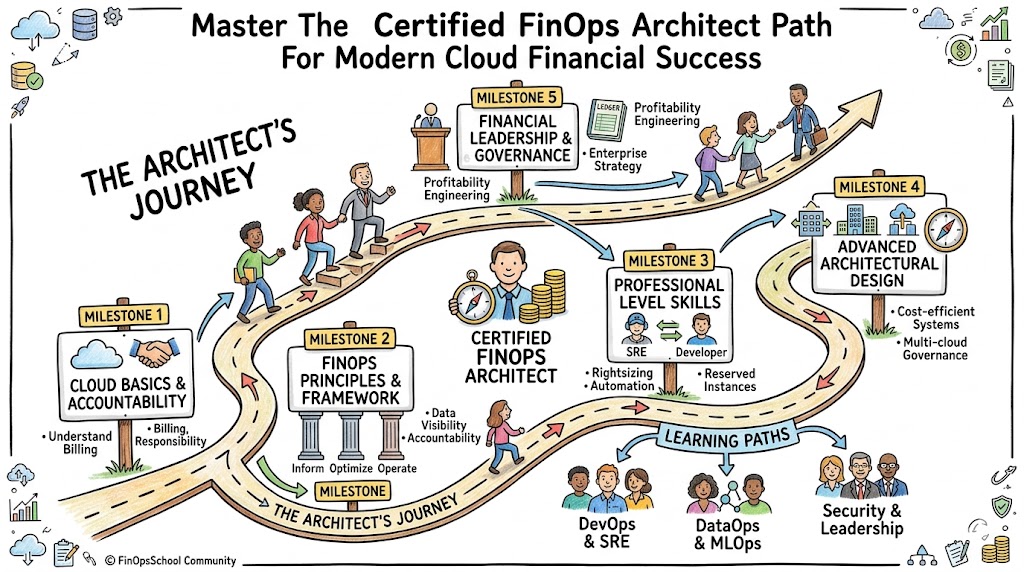
Navigating the intersection of cloud finance and engineering requires specialized expertise to manage modern infrastructure costs effectively. This Certified FinOps Architect guide serves as a comprehensive roadmap for cloud professionals looking to bridge the gap between technical operations and financial accountability. As organizations scale their cloud presence, the need for architects who understand unit economics becomes critical for long-term sustainability. This manual helps engineers, architects, and managers evaluate the strategic impact of this certification on their professional trajectory. By understanding the rigorous requirements and learning outcomes, you can make an informed decision about integrating FinOpsSchool resources into your career development plan.
What is the Certified FinOps Architect?
The Certified FinOps Architect represents a peak level of mastery in cloud financial management and architectural optimization. It exists to validate an engineer’s ability to design cloud systems that are not just high-performing, but also economically efficient. Unlike theoretical frameworks, this program focuses on production-grade scenarios where architectural choices directly influence the corporate bottom line. It aligns perfectly with modern engineering workflows by treating cost as a primary architectural metric alongside performance, security, and reliability. Enterprises today prioritize architects who can build scalable systems while maintaining strict fiscal discipline across multi-cloud environments.
Who Should Pursue Certified FinOps Architect?
This certification target engineers, SREs, and cloud architects who handle large-scale cloud deployments and complex billing structures. Cloud security professionals and data engineers also benefit significantly, as they often oversee resource-heavy workloads that require cost governance. Beginners with a strong interest in cloud economics find a structured path, while experienced leads use it to validate their strategic oversight capabilities. In both global and Indian markets, the shift toward “Profitability Engineering” makes this credential highly relevant for anyone managing enterprise cloud budgets. Managers looking to foster a culture of financial accountability within their technical teams will find the curriculum indispensable.
Why Certified FinOps Architect is Valuable and Beyond
The demand for FinOps expertise continues to surge as cloud waste becomes a major concern for global enterprises. This certification ensures longevity in your career because it focuses on universal economic principles rather than temporary tool-specific features. As companies move past basic cloud migration and into the optimization phase, architects who can prove ROI become the most valuable assets. It helps professionals remain relevant even as cloud providers change their pricing models or service offerings. Ultimately, the return on time investment is high, as it positions you for leadership roles that require a blend of technical depth and business acumen.
Certified FinOps Architect Certification Overview
The program is delivered via the official curriculum and hosted on the specialized platform. This certification employs a rigorous assessment approach that evaluates both theoretical knowledge and practical application of FinOps principles. It is structured to guide learners through the lifecycle of cloud financial management, from initial visibility to continuous optimization. The ownership of the learning process remains with the professional, allowing for a self-paced yet disciplined approach to mastering complex cloud billings. Practitioners gain a deep understanding of how to implement governance at scale without slowing down engineering velocity.
Certified FinOps Architect Certification Tracks & Levels
The certification journey begins with foundational tracks designed to establish a common language between finance and engineering teams. As candidates progress to the professional level, the focus shifts toward advanced data analysis, forecasting, and automated remediation strategies. Specialized tracks allow professionals in DevOps, SRE, or DataOps to tailor the FinOps principles to their specific technical domains. These levels align with career progression, moving from individual contributor roles to high-level architectural oversight. By following this tiered approach, learners ensure they build a solid base before tackling the complexities of advanced enterprise financial modeling.
Complete Certified FinOps Architect Certification Table
| Track | Level | Who it’s for | Prerequisites | Skills Covered | Recommended Order |
| Foundations | Associate | Junior Engineers | Cloud Basics | Cost Visibility | First |
| Engineering | Professional | SRE / DevOps | 2 Years Experience | Automation | Second |
| Architecture | Advanced | Solutions Architects | 5 Years Cloud Exp | System Design | Third |
| Leadership | Expert | IT Managers | Financial Literacy | Governance | Fourth |
| Specialized | Specialist | Data Engineers | Domain Knowledge | Workload Tuning | Optional |
Detailed Guide for Each Certified FinOps Architect Certification
Certified FinOps Architect – Foundation Level
What it is
This level validates a basic understanding of cloud financial management and the core terminology used in the industry. It ensures that all stakeholders can communicate effectively about cloud spending and resource allocation.
Who should take it
Junior cloud engineers, finance associates, and project managers should take this to build a shared understanding of cloud billing. It is ideal for those new to the FinOps framework.
Skills you’ll gain
- Understanding cloud pricing models
- Navigating billing dashboards
- Identifying cost drivers
- Basic tagging and labeling strategies
Real-world projects you should be able to do
- Generate a monthly cloud spend report
- Identify unallocated cloud resources
- Implement a basic resource tagging policy
Preparation plan
- 7-14 Days: Focus on memorizing core FinOps terminology and cloud pricing structures.
- 30 Days: Practice navigating various cloud billing consoles and running basic reports.
- 60 Days: Not typically required for this level unless the candidate is entirely new to cloud.
Common mistakes
- Ignoring the difference between Capex and Opex
- Failing to understand the shared responsibility model in cloud costs
Best next certification after this
- Same-track option: Professional FinOps Practitioner
- Cross-track option: DevOps Foundation
- Leadership option: IT Business Management
Certified FinOps Architect – Professional Level
What it is
This certification validates the ability to implement automated cost-saving measures and complex forecasting models. It focuses on the “Act” and “Operate” phases of the FinOps lifecycle.
Who should take it
Senior DevOps engineers and SREs who are responsible for maintaining infrastructure efficiency should pursue this level. It requires a solid grasp of automation tools.
Skills you’ll gain
- Implementing automated rightsizing
- Advanced cloud usage forecasting
- Managing Reserved Instances and Savings Plans
- Creating custom cost dashboards
Real-world projects you should be able to do
- Build an automated “cleanup” script for unused snapshots
- Design a dashboard that tracks unit cost per microservice
- Negotiate and implement a multi-year savings plan strategy
Preparation plan
- 7-14 Days: Review advanced cloud discounting mechanisms and API-based billing data.
- 30 Days: Build scripts to pull billing data into external visualization tools.
- 60 Days: Conduct a full cost audit of a production-like environment.
Common mistakes
- Focusing only on cost cutting instead of value optimization
- Neglecting the cultural shift required for engineering buy-in
Best next certification after this
- Same-track option: Advanced FinOps Architect
- Cross-track option: Certified SRE Professional
- Leadership option: Engineering Manager Track
Choose Your Learning Path
DevOps Path
In this path, the focus remains on integrating cost checks directly into the CI/CD pipeline. Engineers learn to treat cloud budget as a “soft limit” that triggers alerts during the deployment phase. This ensures that expensive architectural mistakes are caught before they reach production. It bridges the gap between rapid delivery and fiscal responsibility.
DevSecOps Path
The security-focused path emphasizes how governance and compliance intersect with cost management. Professionals learn to audit environments for both security vulnerabilities and financial leaks simultaneously. By implementing policy-as-code, they ensure that every resource is both secure and cost-optimized. This creates a robust framework for enterprise-grade cloud operations.
SRE Path
Site Reliability Engineers focus on the relationship between performance metrics and cost efficiency. This path teaches how to balance high availability with the most economical resource utilization. SREs learn to use FinOps data to justify infrastructure upgrades or optimizations based on actual user demand. It transforms reliability from a cost center into a value driver.
AIOps Path
This track explores how artificial intelligence can be used to predict cloud spending patterns and detect anomalies automatically. Professionals learn to deploy machine learning models that analyze historical billing data to prevent budget overruns. It focuses on the proactive management of dynamic cloud environments using intelligent automation. This reduces manual oversight while increasing accuracy.
MLOps Path
Machine Learning Operations require massive compute power, making cost management a top priority. This path covers the optimization of training jobs, GPU utilization, and model deployment costs. Engineers learn to select the most cost-effective instances for different stages of the ML lifecycle. It ensures that innovation in AI remains financially viable for the organization.
DataOps Path
Data-intensive applications often incur high storage and egress costs that need careful monitoring. This path focuses on optimizing data pipelines, storage tiers, and query performance to reduce overhead. Data professionals learn to architect systems that provide high throughput without unnecessary financial waste. It is essential for managing modern big data ecosystems.
FinOps Path
The dedicated FinOps path is for those who want to specialize entirely in cloud financial operations. It covers the full spectrum of visibility, optimization, and operation within a dedicated FinOps team. Practitioners learn to facilitate communication between finance, procurement, and engineering departments. This path is the backbone of a successful cloud financial management strategy.
Role → Recommended Certified FinOps Architect Certifications
| Role | Recommended Certifications |
| DevOps Engineer | FinOps Associate, Professional Cloud Developer |
| SRE | FinOps Professional, Site Reliability Associate |
| Platform Engineer | FinOps Architect, Infrastructure Specialist |
| Cloud Engineer | FinOps Associate, Cloud Solutions Architect |
| Security Engineer | FinOps Specialist, Cloud Security Professional |
| Data Engineer | DataOps FinOps, Big Data Architect |
| FinOps Practitioner | Professional FinOps, Advanced FinOps Architect |
| Engineering Manager | FinOps Leadership, IT Financial Management |
Next Certifications to Take After Certified FinOps Architect
Same Track Progression
Deepening your specialization within the FinOps domain involves pursuing advanced architectural certifications. These credentials focus on multi-cloud orchestration and global-scale financial governance. You will learn to handle complex organizational structures and billion-dollar cloud budgets. This path solidifies your status as a top-tier expert in cloud economics.
Cross-Track Expansion
Broadening your skills into SRE or DevSecOps provides a more holistic view of cloud health. By understanding how performance and security impact cost, you become a more versatile architect. This cross-pollination of skills allows you to solve complex problems that span multiple departments. It makes you a more effective collaborator in diverse technical environments.
Leadership & Management Track
Transitioning to leadership requires a focus on people, processes, and high-level strategy. Certifications in IT business management or engineering leadership help you move from technical execution to organizational oversight. You will learn how to build and lead FinOps teams that deliver measurable business value. This path is ideal for those looking to reach executive levels.
Training & Certification Support Providers for Certified FinOps Architect
DevOpsSchool
This provider offers extensive resources for professionals looking to master the intersection of automation and financial management. Their curriculum emphasizes hands-on labs where students can practice real-world cost optimization strategies. By focusing on the practical application of tools, they prepare engineers for the complexities of modern cloud environments. Students gain access to a wealth of case studies from diverse industries.
Cotocus
Known for its specialized focus on cloud-native technologies, this platform provides deep-dive sessions on architectural efficiency. Their training modules are designed to help professionals understand the nuances of various cloud provider billing engines. They offer customized learning paths that cater to both individual contributors and enterprise teams. The focus remains on achieving maximum performance for every dollar spent.
Scmgalaxy
This community-driven platform offers a wide range of tutorials and articles on FinOps and DevOps integration. It serves as a valuable knowledge base for practitioners who need to stay updated on the latest industry trends. Their resources cover everything from basic tagging strategies to advanced automated remediation. It is an excellent starting point for self-motivated learners.
BestDevOps
Providing comprehensive certification prep, this group focuses on the core competencies required for modern SRE and FinOps roles. Their training approach involves interactive workshops that simulate enterprise-scale cloud challenges. They emphasize the importance of data-driven decision-making in technical operations. Graduates are well-equipped to handle the financial demands of high-growth tech companies.
devsecopsschool.com
This institution focuses on the vital link between security, compliance, and financial governance. Their courses teach how to implement security policies that also serve as cost-saving measures. By integrating these domains, they help organizations build resilient and efficient cloud infrastructures. Their curriculum is highly regarded for its emphasis on policy-as-code.
sreschool.com
Dedicated to the principles of site reliability, this school explores how infrastructure stability impacts the bottom line. Their training covers how to optimize resource utilization while maintaining strict service level agreements. Students learn to use financial metrics as a signal for system health. It is a premier destination for engineers who want to master efficient scaling.
aiopsschool.com
This provider focuses on the future of operations through the lens of artificial intelligence and machine learning. Their curriculum includes modules on using AI to automate cloud financial management and anomaly detection. They prepare professionals to manage the next generation of self-healing and self-optimizing infrastructures. The training bridges the gap between data science and operations.
dataopsschool.com
Specializing in the data lifecycle, this school provides specific guidance on managing the costs of large-scale data processing. Their courses cover database optimization, storage tiering, and efficient data egress strategies. They help data professionals ensure that their pipelines are both fast and cost-effective. This is crucial for organizations dealing with massive datasets.
finopsschool.com
As a primary source for FinOps education, this platform offers the most direct path to mastering cloud economics. Their certifications are recognized globally for their rigor and practical relevance. They provide a comprehensive framework that aligns engineering, finance, and business teams. It remains the gold standard for anyone serious about a career in FinOps.
Frequently Asked Questions
1. How difficult is the Certified FinOps Architect exam?
The exam is considered moderately difficult as it requires both technical cloud knowledge and financial literacy. It tests your ability to apply concepts to real-world scenarios rather than just memorizing definitions.
2. What is the recommended study time for a working professional?
Most professionals spend between 30 and 60 days preparing, depending on their existing cloud experience. Consistency is key, with a few hours of study per week usually being sufficient.
3. Are there any mandatory prerequisites before taking the advanced level?
While not always mandatory, having a foundational cloud certification or two years of hands-on experience is highly recommended. This ensures you understand the infrastructure you are trying to optimize.
4. How does this certification impact my salary potential?
Professionals with FinOps certifications often see a significant increase in their market value. Organizations are willing to pay a premium for architects who can demonstrably reduce cloud waste.
5. Is the certification recognized globally?
Yes, the principles of cloud financial management are universal, and this credential is respected by major enterprises worldwide. It is particularly valuable for companies operating in multiple cloud regions.
6. Do I need to be an expert in finance to pass?
No, you do not need a finance degree. The program teaches you the specific financial concepts necessary for cloud management, such as amortization and forecasting.
7. How often does the certification need to be renewed?
Most professional certifications require renewal every two to three years to ensure you are up-to-date with the latest cloud features. This keeps your skills sharp in a rapidly evolving field.
8. Can I take the exam online?
Yes, most certification providers offer proctored online exams for convenience. This allows you to take the test from your home or office.
9. Does the curriculum cover multi-cloud environments?
Yes, a major focus of the advanced levels is managing costs across different providers like AWS, Azure, and Google Cloud. This is essential for modern enterprise architects.
10. What kind of tools will I learn to use?
You will learn to use native cloud billing tools, third-party optimization platforms, and custom scripting for automation. The focus is on the strategy behind the tools.
11. Is this certification suitable for managers?
Absolutely, as it provides the framework necessary to oversee technical teams and communicate cloud value to executive leadership. It helps managers justify infrastructure spend.
12. Will this help me in a small startup environment?
Yes, even in startups, managing “burn rate” is critical. The efficiency principles you learn will help you scale the business without spiraling costs.
FAQs on Certified FinOps Architect
1. What specific architectural patterns are covered in this program?
The program focuses on patterns like serverless computing, auto-scaling groups, and spot instance integration. You learn to design systems that automatically adjust their cost based on real-time demand signals.
2. How does the certification handle the concept of “Unit Economics”?
It teaches you how to calculate the cost of cloud resources per business transaction. This allows you to prove the direct relationship between cloud spend and company revenue.
3. Does the exam include practical lab components?
Advanced levels often include simulation-based questions where you must identify the most cost-effective architecture for a given scenario. This ensures you can apply theory to practice.
4. How does FinOps differ from traditional IT procurement?
FinOps is a continuous, real-time process involving engineers, whereas procurement is often a centralized, periodic event. This certification bridges the gap between these two approaches.
5. Are there specific modules for Kubernetes cost management?
Yes, managing container costs is a significant part of the curriculum. You learn how to allocate shared cluster costs to different teams or projects accurately.
6. How is “Cloud Waste” defined in the context of the exam?
Waste is defined as any resource that is provisioned but not utilized, or utilized inefficiently. The program teaches you how to identify and eliminate these leaks.
7. Can this certification help with cloud migration planning?
Yes, it provides the tools to forecast future costs and build a business case for moving workloads to the cloud. This reduces the risk of “bill shock” after migration.
8. What role does “Policy as Code” play in the curriculum?
It is a central theme, teaching you how to automate financial governance using tools that enforce budget limits and tagging requirements automatically. This ensures continuous compliance.
Final Thoughts: Is Certified FinOps Architect Worth It?
Any cloud professional hoping to advance their career would be wise to invest in the Certified FinOps Architect accreditation. The ability to strike a balance between technical quality and financial accountability is becoming essential as enterprises shift toward more disciplined cloud utilization. The structured knowledge and industry recognition required to spearhead these projects are provided by this credential.
It is not just about passing an exam; it is about adopting a mindset that views cost as a vital sign of architectural health. By mastering these principles, you position yourself as a key player in your organization’s long-term cloud success. For those ready to move beyond basic engineering and into the realm of strategic technical leadership, this path is highly recommended.