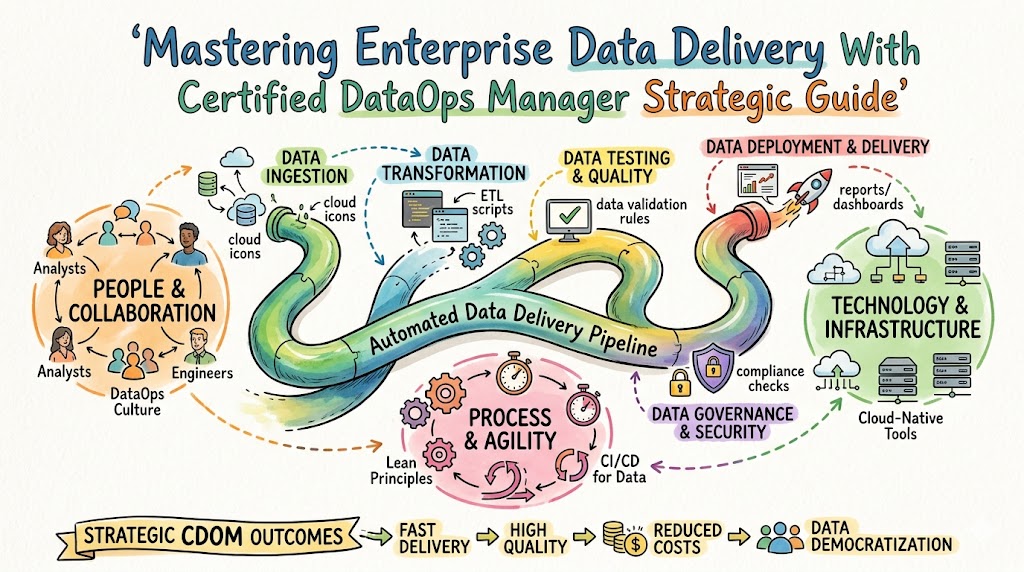
Mastering data pipelines requires more than just technical skills; it demands a strategic approach to management and delivery. This comprehensive guide helps professionals understand the CDOM – Certified DataOps Manager program offered by DataOpsSchool to enhance their career trajectory. As the industry shifts toward automated and collaborative data environments, staying ahead in the cloud-native and platform engineering landscape is essential. This document provides the clarity needed for engineers and managers to make informed career decisions regarding specialized data management.
What is the CDOM – Certified DataOps Manager?
The CDOM – Certified DataOps Manager is a professional designation that signifies expertise in streamlining data delivery through automated workflows and collaborative culture. It exists to bridge the gap between traditional data management and modern, agile engineering practices by emphasizing production-focused efficiency over theory. This program aligns with enterprise needs by ensuring that data life cycles are predictable, scalable, and secure within modern cloud infrastructures. It provides a blueprint for implementing continuous integration and continuous delivery for data, allowing teams to treat data as a high-quality product.
Who Should Pursue CDOM – Certified DataOps Manager?
This path is ideal for data engineers, SREs, and cloud professionals who aim to oversee complex data ecosystems and improve operational reliability. Beginners can gain a structured entry point into the data lifecycle, while experienced engineers and technical leaders can validate their ability to scale enterprise data operations. In both the Indian market and the global tech landscape, roles such as Data Architects and Platform Managers find significant value in this credential. It specifically targets those responsible for reducing the cycle time of data analytics while maintaining high governance standards across distributed teams.
Why CDOM – Certified DataOps Manager is Valuable and Beyond
The demand for DataOps continues to grow as enterprises move away from siloed data structures toward integrated, automated platforms. This certification ensures longevity in a career because it focuses on the fundamental principles of lean manufacturing applied to data, rather than just shifting toolsets. As organizations adopt more complex AI and machine learning models, the ability to manage the underlying data flow becomes a critical competitive advantage. Investing time in this certification provides a high return by making professionals indispensable in high-scale cloud environments where data reliability is non-negotiable.
CDOM – Certified DataOps Manager Certification Overview
The program is delivered via the official portal and is hosted on the primary platform. It features a tiered assessment approach that evaluates both conceptual understanding and the practical application of DataOps frameworks in enterprise settings. The certification structure is designed to be practical, focusing on ownership of the data pipeline and the governance required to manage it. Candidates are tested on their ability to integrate various automation tools while ensuring compliance and performance across the entire data lifecycle.
CDOM – Certified DataOps Manager Certification Tracks & Levels
The certification is categorized into foundation, professional, and advanced levels to cater to different stages of a professional’s career. Foundation tracks focus on the core principles of data agility, while professional and advanced tracks dive deep into architecture, leadership, and specialized automation. These levels allow for clear career progression, enabling an engineer to move from technical execution to strategic management roles. By following these tracks, professionals can align their learning with specialized areas like FinOps or SRE to become well-rounded experts in modern data infrastructure.
Complete CDOM – Certified DataOps Manager Certification Table
| Track | Level | Who it’s for | Prerequisites | Skills Covered | Recommended Order |
| Core DataOps | Foundation | Aspiring Data Managers | Basic Data Knowledge | Agile Data, Automation | First |
| Engineering | Professional | Data & DevOps Engineers | 2+ Years Experience | CI/CD for Data, Testing | Second |
| Leadership | Advanced | Engineering Managers | 5+ Years Experience | Governance, Strategy | Third |
| Specialized | Expert | Principal Architects | Advanced Engineering | AI Integration, Scaling | Optional |
Detailed Guide for Each CDOM – Certified DataOps Manager Certification
CDOM – Certified DataOps Manager – Foundation Level
What it is
This entry-level certification validates a professional’s grasp of the core DataOps philosophy and its role in modern software delivery. It ensures the candidate understands how to reduce data defects and improve collaboration between data producers and consumers.
Who should take it
It is suitable for junior data engineers, project managers, or DevOps practitioners who are new to specialized data workflows. No deep coding experience is required, but a general understanding of IT systems is beneficial.
Skills you’ll gain
- Understanding the DataOps Manifesto and core principles.
- Knowledge of automated data testing and quality assurance.
- Ability to map data value streams within an organization.
Real-world projects you should be able to do
- Design a basic automated data pipeline for a small team.
- Implement a version control system for data schemas.
Preparation plan
- 7-14 Days: Focus on the core definitions and the primary DataOps lifecycle stages.
- 30 Days: Complete all modular assessments and review case studies on data agility.
- 60 Days: Conduct a mock implementation of a DataOps framework in a lab environment.
Common mistakes
- Treating DataOps only as a set of tools rather than a cultural shift.
- Ignoring the importance of data governance during the automation process.
Best next certification after this
- Same-track option: CDOM Professional Level.
- Cross-track option: Cloud Practitioner Certification.
- Leadership option: Certified Agile Leader.
CDOM – Certified DataOps Manager – Professional Level
What it is
This certification confirms the ability to implement and manage complex data pipelines using advanced automation and orchestration techniques. It focuses on the technical execution of the DataOps strategy in multi-cloud environments.
Who should take it
Middle-level engineers and SREs who handle data infrastructure daily should pursue this level. It requires a solid technical background and experience with containerization or cloud services.
Skills you’ll gain
- Mastering orchestration tools for complex data workflows.
- Implementing security and compliance as code within data pipelines.
- Optimizing data environments for cost and performance.
Real-world projects you should be able to do
- Build a self-service data platform for internal analytics teams.
- Automate the deployment of data warehouses across different cloud providers.
Preparation plan
- 7-14 Days: Review advanced orchestration and containerization concepts.
- 30 Days: Work through practical labs involving real-time data streaming.
- 60 Days: Deep dive into security integration and enterprise-scale monitoring.
Common mistakes
- Over-complicating the pipeline with too many third-party integrations.
- Failing to establish clear metrics for measuring pipeline success.
Best next certification after this
- Same-track option: CDOM Advanced Level.
- Cross-track option: Certified SRE Professional.
- Leadership option: Technical Program Manager Certification.
Choose Your Learning Path
DevOps Path
Professionals on this path focus on integrating data pipelines into the broader software delivery lifecycle. They learn to treat data scripts and infrastructure as code, ensuring that data changes follow the same rigorous testing as application code. This path emphasizes the reduction of technical debt and the improvement of deployment frequency for data-heavy applications.
DevSecOps Path
This path prioritizes the security of data at rest and in transit throughout the pipeline. Learners focus on automating security checks, managing encryption keys, and ensuring that sensitive data is masked during testing phases. It is designed for those who want to ensure that agility does not come at the cost of vulnerability or regulatory non-compliance.
SRE Path
The SRE path for DataOps focuses on the reliability, availability, and performance of data platforms. Professionals learn how to set Service Level Objectives for data delivery and manage incident responses for pipeline failures. This path is essential for maintaining large-scale data environments where downtime leads to significant business impact.
AIOps Path
In this specialized track, the focus is on using artificial intelligence to monitor and optimize IT operations. Professionals learn how to handle the massive amounts of data generated by system logs and metrics to predict failures. This path bridges the gap between infrastructure management and intelligent automation.
MLOps Path
This path is tailored for those managing the lifecycle of machine learning models. It covers the automation of model training, deployment, and monitoring to ensure that models remain accurate over time. It addresses the unique challenges of versioning data alongside model code in production environments.
DataOps Path
The pure DataOps path focuses on the end-to-end orchestration of data from source to consumption. It emphasizes building a culture of collaboration between data scientists, engineers, and analysts. The goal is to create a seamless, automated flow that delivers high-quality insights to the business rapidly.
FinOps Path
This path addresses the financial management of data and cloud resources. Professionals learn how to track data storage costs, optimize cloud spending, and allocate budgets effectively across data projects. It is a critical path for ensuring that data operations remain sustainable and cost-effective as they scale.
Role → Recommended CDOM – Certified DataOps Manager Certifications
| Role | Recommended Certifications |
| DevOps Engineer | CDOM Foundation + Professional |
| SRE | CDOM Professional + SRE Specialized |
| Platform Engineer | CDOM Professional + Advanced |
| Cloud Engineer | CDOM Foundation + Specialized |
| Security Engineer | CDOM Professional + DevSecOps Track |
| Data Engineer | CDOM Foundation + Professional + DataOps Track |
| FinOps Practitioner | CDOM Foundation + FinOps Track |
| Engineering Manager | CDOM Foundation + Advanced Leadership |
Next Certifications to Take After CDOM – Certified DataOps Manager
Same Track Progression
After completing the core manager certifications, professionals should look into deep specialization within specific cloud providers or data tools. This involves mastering niche technologies that sit at the top of the DataOps stack. Continued learning in this area ensures you remain at the forefront of technical innovation and architectural design.
Cross-Track Expansion
Broadening your skills into areas like Site Reliability Engineering or Cybersecurity provides a more holistic view of the enterprise. This expansion allows a manager to communicate effectively across different departments and understand the impact of data on the entire infrastructure. It makes a professional more versatile and capable of handling complex, multi-disciplinary projects.
Leadership & Management Track
For those looking to move into executive roles, the next step involves certifications in strategic management and organizational change. This transition focuses less on individual tools and more on building high-performing teams and driving business value through technology. Understanding the financial and human aspects of engineering is key to succeeding at this level.
Training & Certification Support Providers for CDOM – Certified DataOps Manager
DevOpsSchool
This provider offers extensive training programs that focus on the practical application of DevOps and DataOps methodologies. Their curriculum is designed by industry experts to ensure that students gain hands-on experience with the latest tools and frameworks used in the enterprise.
Cotocus
This organization specializes in cloud-native training and consulting, helping professionals master the complexities of modern infrastructure. They provide tailored learning paths that align with specific career goals, ensuring that learners can apply their skills immediately in real-world scenarios.
Scmgalaxy
As a community-driven platform, this provider offers a wealth of resources, including tutorials, blogs, and forums for collaboration. They focus on the technical aspects of software configuration management and automation, making them a great resource for hands-on learners.
BestDevOps
This provider delivers high-quality training sessions focused on the best practices of site reliability and continuous delivery. Their courses are structured to help professionals pass certification exams while building a strong foundation in engineering excellence.
devsecopsschool.com
This platform focuses exclusively on the intersection of development, security, and operations. They provide specialized courses that teach engineers how to integrate security into every stage of the software development lifecycle, ensuring safe and rapid delivery.
sreschool.com
Dedicated to the discipline of Site Reliability Engineering, this school offers deep dives into monitoring, incident management, and system scalability. Their training is essential for those looking to manage mission-critical systems with high availability and performance.
aiopsschool.com
This provider helps professionals understand the role of artificial intelligence in IT operations. Their curriculum covers the use of machine learning to automate root cause analysis and improve the efficiency of large-scale infrastructure management.
dataopsschool.com
As the primary host for the CDOM program, this site provides comprehensive modules on data agility and pipeline orchestration. They focus on bridging the gap between data engineering and operational excellence for modern businesses.
finopsschool.com
This organization teaches the principles of cloud financial management, helping teams optimize their spending. Their courses are vital for managers who need to balance technical performance with budgetary constraints in a cloud-first world.
Frequently Asked Questions (General)
- What is the difficulty level of the CDOM exam?
The exam is moderately challenging as it tests both theoretical concepts and practical scenarios related to data management.
- How much time is required to prepare for this certification?
Most professionals spend between 30 to 60 days preparing, depending on their existing experience with data systems.
- Are there any specific prerequisites for the foundation level?
There are no formal prerequisites, but a basic understanding of IT operations and data concepts is highly recommended.
- What is the return on investment for this certification?
Candidates often see improved job prospects and salary increases as they move into high-demand roles like DataOps Manager.
- Can I take the exam online?
Yes, the certification exams are typically offered through an online proctored platform for global accessibility.
- How long does the certification remain valid?
The certification is usually valid for two to three years, after which recertification or continuing education is required.
- Does this certification focus on specific tools?
While it covers popular tools, the primary focus is on the underlying methodologies and frameworks that apply to any toolset.
- Is this program recognized globally?
Yes, it is designed to meet international standards and is recognized by major technology firms around the world.
- What is the difference between DevOps and DataOps?
DevOps focuses on software delivery, while DataOps specifically addresses the agility and quality of data pipelines and analytics.
- Are there lab exercises included in the training?
Most training modules include hands-on labs to ensure candidates can apply what they learn in a simulated environment.
- Who manages the curriculum for the CDOM?
The curriculum is managed by industry experts at DataOpsSchool to ensure it reflects current enterprise needs and trends.
- Can this help me move into a leadership role?
Yes, the advanced levels specifically focus on strategy and management, making it an excellent path for aspiring leaders.
FAQs on CDOM – Certified DataOps Manager
- How does CDOM address data governance?
It integrates governance as an automated part of the pipeline rather than a manual, after-the-fact check.
- Is coding required for the CDOM certification?
While deep coding isn’t always required for foundation levels, professional levels require knowledge of scripting and automation tools.
- Does it cover multi-cloud data strategies?
Yes, the program prepares you to manage data across various environments like AWS, Azure, and Google Cloud.
- What is the main goal of a DataOps Manager?
The goal is to provide high-quality data to users at a high velocity while maintaining system stability.
- How does it handle big data technologies?
The framework is designed to be scalable, addressing the unique challenges posed by large-scale data processing and storage.
- Can I jump directly to the Professional level?
It is recommended to follow the order, but those with significant industry experience may qualify for higher levels directly.
- Are there group discounts for corporate teams?
Many providers offer corporate training packages for teams looking to standardize their DataOps practices across the department.
- What is the passing score for the certification exam?
The passing score varies by level but generally requires demonstrating a high degree of proficiency in the core domains.
Final Thoughts: Is CDOM – Certified DataOps Manager Worth It?
Navigating the modern data landscape requires a balance of technical agility and strategic oversight. The CDOM – Certified DataOps Manager provides a structured and practical path for professionals to validate their expertise in this growing field. Instead of chasing every new tool, this program focuses on the core principles of automation, collaboration, and quality that remain constant. If your goal is to lead high-performing teams and ensure the reliable delivery of data in a complex environment, this certification is a solid investment. It offers the credentials needed to stand out in a competitive market while providing the skills to solve real production challenges.