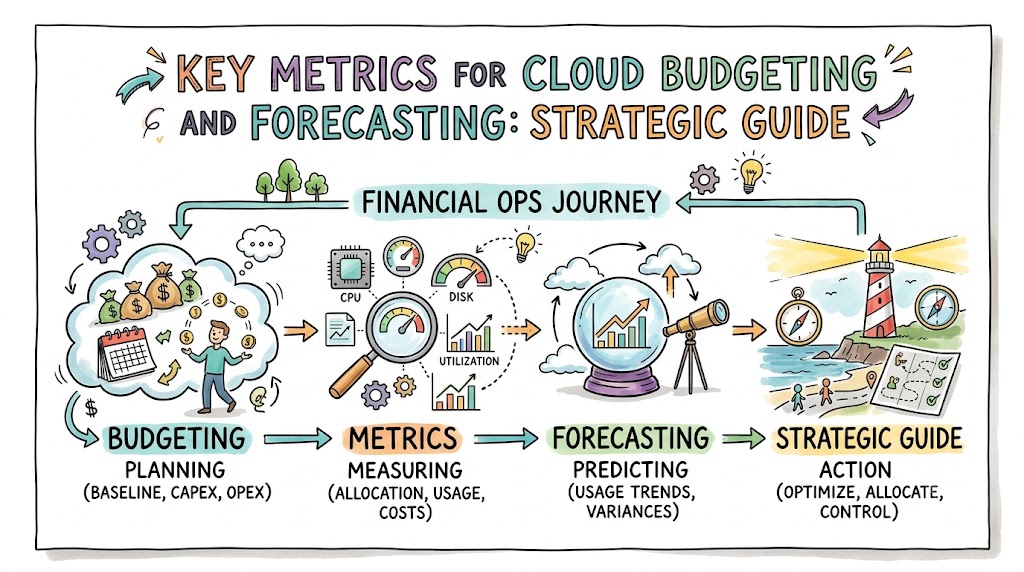
Predicting and controlling modern infrastructure expenses requires moving beyond basic invoice totals. Because variable cloud consumption can shift instantly with engineering deployments or business traffic, tracking dedicated performance metrics becomes vital for maintaining financial health. Establishing precise measurement practices with insights from a premier learning platform like Finopsschool equips engineering and finance teams with actionable visibility. This structured approach replaces manual estimation with reliable, data-backed operational discipline.
Consequently, organizations gain continuous oversight of their variable operational expenditures. Engineering leads can instantly connect deployment decisions to financial forecasts, while finance managers achieve predictable quarterly planning. By monitoring the right metrics, businesses shift from reactive budget reviews to proactive financial control.
Understanding Cloud Financial Operations
Transitioning from static capital purchases to variable cloud usage fundamental changes how organizations handle financial operations. Engineers now hold the operational ability to provision infrastructure with code, which directly impacts monthly bills in real time. Without clear monitoring indicators, cloud spending can easily exceed original projections before management notices the trend.
Implementing dedicated metrics provides complete visibility into resource utilization across all cloud environments. FinOps brings technology, finance, and product teams together to evaluate costs through standardized measurement practices. This continuous oversight ensures that infrastructure expenditures directly support business objectives without unnecessary financial waste.
Furthermore, evaluating these operational metrics follows a continuous cycle across three distinct operational phases. The inform phase establishes baseline metrics like cost allocation coverage and tagging hygiene. Next, the optimize phase uses variance analysis and utilization rates to eliminate idle compute footprint. Finally, the operate phase embeds these tracking mechanisms directly into continuous deployment pipelines.
Key Operational Concepts You Must Know
Total Cost Allocation Coverage
Allocation coverage tracks the exact percentage of cloud spend mapped back to specific business units, products, or engineering owners. Achieving high coverage requires strict tagging policies and automated resource labeling across all accounts. When unallocated spending is minimized, financial controllers can accurately attribute operational costs to specific revenue-generating projects.
Without proper allocation, organizations struggle with unassigned infrastructure expenses that cloud monthly financial reviews. High allocation rates empower team leaders to own their infrastructure footprints responsibly. Consequently, shared accountability becomes standard across the entire enterprise.
Forecast Accuracy Rate and Variance Score
Forecast accuracy measures how closely actual spending aligns with projected financial budgets over a specific timeframe. Maintaining a low variance score indicates that technical teams possess deep visibility into upcoming capacity needs and product launches. Consistently high variances signal flawed estimation models or unmonitored infrastructure changes.
Regularly evaluating forecast variance enables finance teams to refine future budget projections with greater confidence. It also helps identify unexpected spending trends before they cause major quarterly budget overruns. Stable variance score trends build strong trust between engineering managers and corporate executives.
Cloud Unit Economics and Efficiency Ratios
Unit economics measures cloud expenses relative to key business drivers, such as cost per active user, transaction, or API call. Standard invoice totals often increase as business activity scales, which can mislead teams into seeing efficiency as waste. Unit metrics provide true context by determining if cloud cost growth is outpacing overall business growth.
By monitoring these ratios, organizations verify whether their underlying cloud architecture scales efficiently as revenue expands. A declining cost per unit during traffic expansion indicates a highly optimized, scalable infrastructure footprint. This insight allows executives to make informed pricing and product strategies.
| Metric Name | Focus Area | Core Formula / Primary Goal |
|---|---|---|
| Cost Allocation Coverage | Tagging & Attribution | (Allocated Spend / Total Spend) × 100 |
| Forecast Accuracy Rate | Budget Adherence | 100 – |(Actual Spend – Budgeted Spend) / Budgeted Spend| × 100 |
| Unit Economics | Business Efficiency | Total Cloud Spend / Business Volume Metric (e.g., Users) |
Platform Implementation vs. Culture — What’s the Real Difference?
The Mechanics of Tool Deployment
Deploying management dashboards and automated metric tools provides the technical foundation for financial visibility. These platforms automatically pull billing data, calculate variance metrics, and generate real-time usage graphs. However, tracking metrics through automated tooling represents only the first step toward effective cloud cost management.
+---------------------------------+       +---------------------------------+
|     Platform Metric Tooling     |  -->  |        Cultural Adoption        |
|   (Data Gathering & Graphs)     |       | (Engineering Metric Ownership)  |
+---------------------------------+       +---------------------------------+
Software tools highlight operational anomalies, but they cannot automatically fix poor architectural patterns. Engineers must actively review metric telemetry and take action on recommendations. Without continuous human involvement, automated monitoring simply records overspending without preventing it.
Driving Genuine Behavioral Transformation
Cultural adoption occurs when engineering and product teams natively use financial metrics to guide daily architectural decisions. Developers start evaluating unit costs and idle compute percentages during regular technical design reviews. This mental transformation turns cost optimization into a core quality metric alongside security and system performance.
Cross-functional collaboration builds shared trust across finance and technology leadership. Engineers gain a clearer understanding of margin constraints, while finance managers learn to interpret cloud usage telemetry accurately. Culture transforms metric tracking from an external auditing exercise into an internal team habit.
Real-World Use Cases of Modern Operations
Detecting Cost Anomalies in Dynamic Microservices
An enterprise software company running microservices struggled with sudden, unexpected spikes in monthly infrastructure expenses. Their monthly invoice review consistently discovered overspend weeks after the events actually occurred. To fix this issue, they implemented daily cost anomaly metrics with automated alerting triggers.
By analyzing real-time usage telemetry against baseline historical trends, the system flagged misconfigured container instances within hours. The engineering team resolved the underlying deployment issue before it impacted the quarterly budget. Automated tracking prevented major budget overruns while protecting service performance.
Optimizing Non-Production Spend with Usage Metrics
A financial technology firm realized that non-production environments accounted for an excessive percentage of their total monthly cloud spend. Development and testing servers were left running continuously over weekends and holidays, generating unnecessary costs. They established an environment cost breakdown metric to isolate development expenses from production costs.
+-----------------------------------+
| Isolate Dev/Test Cost Breakdown   |
+-----------------------------------+
                 |
                 v
+-----------------------------------+
| Enforce Off-Hours Shutdown Rules  |
+-----------------------------------+
                 |
                 v
+-----------------------------------+
| Substantial Non-Prod Cost Drop    |
+-----------------------------------+
Armed with clear data, platform engineers configured automated off-hours shutdown schedules for all non-production resources. They monitored the non-production cost ratio weekly to ensure developer compliance with new environment policies. Consequently, non-production cloud expenses dropped significantly without slowing feature release velocity.
Common Mistakes in Operations Engineering
Ignoring Idle Compute Metrics and Storage Growth
Focusing solely on top-line cloud spend often leads teams to overlook underutilized compute nodes and orphan storage volumes. Engineers frequently provision extra instance capacity to handle hypothetical demand, leaving servers idle for days. Additionally, unattached storage volumes continue generating monthly charges long after their associated instances are deleted.
To address these hidden costs, operations teams must continuously track idle compute percentages and storage growth rates. Implementing automated rightsizing policies and cleanup scripts ensures resources match actual workloads. Tracking resource utilization metrics systematically eliminates unnecessary infrastructure waste.
- Audit idle compute resources weekly to rightsized overprovisioned nodes.
- Implement automated cleanup routines for unattached storage volumes.
- Review non-production environments to enforce off-hours power policies.
Relying on Total Spend Instead of Unit Metrics
Judging cloud budget health strictly by total spend can lead to incorrect decisions during periods of rapid business growth. A rising cloud bill might simply reflect a massive increase in active customer transactions. Cutting costs blindly without understanding unit efficiency can harm application performance and user experience.
+--------------------------------------+
| Evaluated Raw Total Cloud Spend      |
+--------------------------------------+
                   |
                   v
+--------------------------------------+
| Analyze Cost Per Customer / Unit     |
+--------------------------------------+
                   |
                   v
+--------------------------------------+
| Make Data-Backed Architecture Decisions|
+--------------------------------------+
Teams should evaluate spend in context by pairing top-line costs with unit economic KPIs. Analyzing cost per user or cost per transaction reveals true infrastructure efficiency regardless of scale. This balanced perspective protects critical system capacity while identifying real optimization opportunities.
How to Become an Operations Expert — Career Roadmap
Mastering Cloud Telemetry and Cost Data Analytics
Building a career in cloud financial operations requires a strong foundation in cloud architectures and data analytics. Aspiring professionals must learn how public cloud billing files record granular usage details across compute, storage, and networking. Mastering SQL and data visualization tools enables specialists to convert millions of raw billing line items into clear dashboards.
- Learn raw billing exports across major cloud infrastructure providers.
- Master query languages to analyze complex utilization datasets efficiently.
- Build real-time dashboards that connect usage telemetry to business units.
Developing Financial Literacy and Executive Reporting
Technical data skills must be paired with solid corporate finance fundamentals to drive real organizational change. Operations experts need to understand budgeting cycles, capital allocation, variance reporting, and margin calculations. This financial knowledge allows specialists to communicate technical recommendations effectively to executive stakeholders.
- Study corporate finance basics including variance analysis and budgeting.
- Translate technical metrics into executive-level business impacts.
- Establish regular reporting habits to keep cross-functional teams aligned.
FAQ Section
- What is the most important cloud budgeting metric for engineering teams to track initially?
Total cost allocation coverage is the essential baseline metric because it ties raw cloud spending directly to specific teams and applications. Without clear allocation data, teams cannot take targeted responsibility for their infrastructure costs.
- How does tracking cloud unit metrics improve long-term financial forecasting accuracy?
Unit metrics connect infrastructure expenses directly to business growth drivers like active users or transaction volume. Forecasting based on business growth units yields far more accurate projections than simply projecting historical spend trends.
- What is a healthy target for cloud forecast accuracy in mature FinOps organizations?
Mature organizations typically target a monthly forecast accuracy rate of 90% or higher. Maintaining low variance demonstrates strong operational control and predictable technical planning.
- Why should companies track idle compute percentages alongside total monthly spending?
Total spend shows how much money was charged, but idle compute metrics reveal how much of that spend was entirely wasted. Tracking idle resources highlights direct opportunities to downsize capacity without impacting performance.
- How often should teams review cost allocation tags and tag hygiene metrics?
Teams should review allocation tags and hygiene metrics monthly to catch untagged or improperly labeled resources early. Regular audits prevent unallocated spend from distorting chargeback reports and budget forecasts.
Final Summary
Tracking the right metrics transforms cloud budgeting and forecasting from educated guesswork into an accurate operational science. By monitoring allocation coverage, forecast variance, and unit economics, organizations gain total control over variable infrastructure expenses. Embedding these indicators into daily engineering workflows creates a strong culture of continuous financial stewardship. Ultimately, mastering these core metrics enables enterprises to scale efficiently while maximizing the business value of their cloud investments.