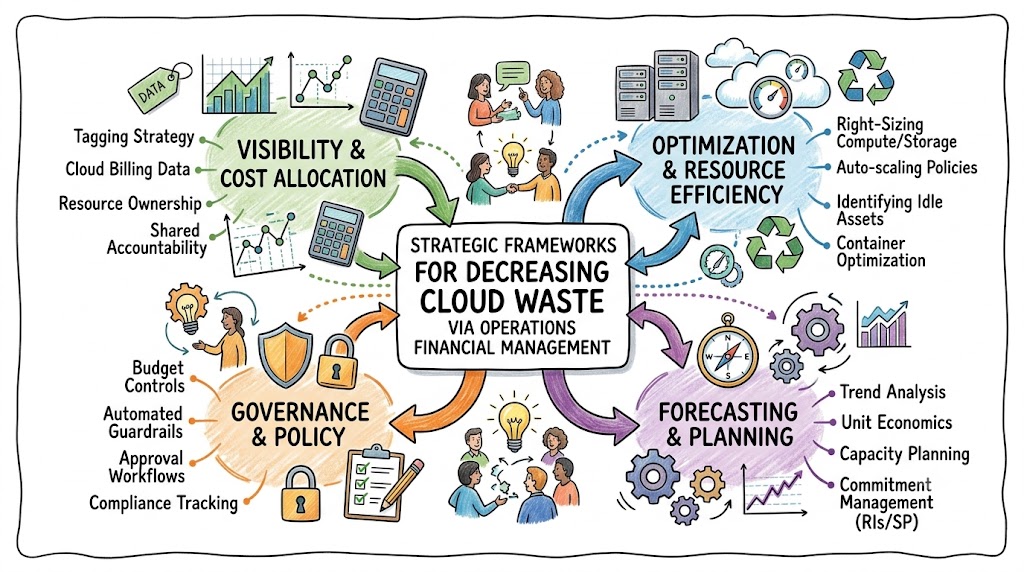
Modern digital transformation initiatives often run into unexpected budget obstacles due to sprawling cloud architecture deployments. Engineering teams frequently provision excess server compute capacity to guarantee high availability during unpredictable operational traffic spikes. However, this defensive infrastructure design pattern leads to underutilized server resources that quietly bleed corporate operating capital. By adopting cost-aware architectural frameworks taught by platforms like Finopsschool, organizations can bridge financial strategy with engineering execution seamlessly. This systematic collaboration transforms variable cloud infrastructure expenditures into visible, controlled, and business-value-driven growth drivers.
Furthermore, reducing cloud waste requires a complete cultural shift away from legacy annual IT capital expenditure paradigms. Development teams must receive continuous feedback regarding the direct financial impact of their automated code deployments. Transparency across operational metrics allows teams to identify idle storage blocks and unattached resources in real time. Ultimately, continuous cloud financial governance ensures that companies only pay for necessary infrastructure resources without hindering application delivery velocity.
Key Operational Concepts You Must Know
Granular Cost Allocation and Tagging Metrics
Accurate cost allocation acts as the critical foundation for identifying and eliminating unnecessary cloud spending across enterprise environments. Organizations must enforce strict resource labeling policies so every running server instance or container maps back to specific business units. When operational telemetry directly connects resource usage to responsible teams, dynamic engineering accountability naturally replaces unmanaged infrastructure sprawl.
Furthermore, detailed tagging frameworks enable finance professionals to analyze unit economics alongside application workload fluctuations. This granular visibility prevents unallocated operational expenses from hiding within massive consolidated multi-cloud provider invoices. Consequently, engineering teams can proactively identify and terminate abandoned infrastructure components before billing cycles finalize.
Intelligent Auto-Scaling and Dynamic Sizing
Matching computing capacity directly with real-time application demand prevents expensive over-provisioning across dynamic cloud ecosystems. Traditional static infrastructure designs keep server capacity running at maximum levels regardless of actual user activity, wasting valuable compute budget during off-peak hours. Implementing automated scaling policies allows environments to shrink dynamically when traffic decreases naturally.
In addition, continuous right-sizing requires analyzing historical CPU, memory, and network throughput data across active application clusters. Downsizing underutilized database nodes and compute instances reduces monthly recurring infrastructure spending significantly without impacting user experience. This systematic approach guarantees that operational environments remain fully lean and highly responsive around the clock.
Commitment Discounts and Capacity Rightsizing
Cloud vendors offer substantial rate reductions for companies willing to commit to predictable long-term compute capacity footprints. Utilizing reserved instances and flexible savings plans allows financial management teams to secure massive discounts over standard on-demand pricing models. However, committing to excess capacity without analyzing historical usage patterns can lock an organization into unwanted financial liabilities.
Therefore, engineering and finance teams must continuously collaborate to determine the true baseline capacity required for ongoing operations. Balancing on-demand resources for variable workloads alongside discounted committed instances for predictable baseline compute optimizes total infrastructure expenditure efficiently.
| Operational Concept | Primary Focus | Financial & Technical Impact |
|---|---|---|
| Granular Tagging | Resource Ownership Tracking | Total cost visibility and departmental accountability |
| Dynamic Scaling | Automated Capacity Matching | Instant elimination of idle compute server waste |
| Commitment Discounts | Long-Term Capacity Planning | Significant reduction in standard vendor hourly rates |
Platform Implementation vs. Culture — What’s the Real Difference?
Technical Tooling and Infrastructure Configuration
Platform implementation focuses on installing analytical monitoring tools, configuring API connectors, and building consolidated financial dashboards. These software management platforms collect raw billing data across multi-cloud environments and display clear operational metrics. However, simply deploying technical software solutions does not automatically decrease cloud waste or enforce disciplined resource management.
+------------------------------------+       +------------------------------------+
|       Platform Implementation      |  -->  |         Cultural Execution         |
|  (Dashboards, APIs & Telemetry)    |       |  (Accountability & Daily Habits)   |
+------------------------------------+       +------------------------------------+
Dashboards merely highlight financial anomalies; they do not possess the architectural context required to refactor wasteful code paths. Without dedicated engineering teams inspecting telemetry and acting on recommendations, optimization reports remain completely unaddressed. Consequently, software tools provide essential operational visibility, but human intervention remains strictly necessary for real waste reduction.
Behavioral Accountability and Mindset Shift
Cultural adoption transforms cost management from a periodic accounting audit into an active, everyday engineering responsibility. In a cost-aware corporate culture, developers consider resource efficiency alongside security, availability, and software performance during initial system design. This behavioral evolution requires breaking down historical operational silos that separated corporate finance units from technical software teams completely.
When software architects understand budget constraints and finance leaders comprehend architectural trade-offs, collaborative decision-making becomes the standard operational habit. Cross-functional alignment ensures that cost optimization happens continuously throughout the software development lifecycle rather than during emergency budget cuts. Cultural transformation ultimately drives sustainable, long-term efficiency across all modern cloud deployments.
Real-World Use Cases of Modern Operations
Automated Waste Reduction in E-Commerce Computing
A global online retail enterprise faced surging cloud bills caused by unmanaged developer sandbox environments remaining active permanently. The company implemented automated governance scripts that automatically inspect environment activity tags every evening across all non-production accounts. Any non-production database or virtual server detected running without active developer connections automatically shuts down until the next business morning.
+-------------------------------------+
| Daily Non-Production Usage Scan     |
+-------------------------------------+
                   |
                   v
+-------------------------------------+
| Identify Idle Developer Sandboxes   |
+-------------------------------------+
                   |
                   v
+-------------------------------------+
| Automated Off-Hours Server Shutdown |
+-------------------------------------+
This automated policy eliminated thousands of hours of unnecessary overnight compute charges across hundreds of isolated development accounts globally. The finance department reported immediate monthly cost savings without impacting software engineering output or project delivery schedules. Furthermore, developers gained easy self-service portals to override shutdown schedules whenever legitimate evening testing cycles were required.
Multi-Tenant Container Resource Optimization
A software-as-a-service provider operating large Kubernetes clusters noticed significant billing spikes despite maintaining steady customer user growth. Detailed container telemetry revealed that software engineering teams requested excessively large memory and CPU reservations to avoid manual pod scaling configuration. Consequently, massive amounts of physical host cluster capacity sat completely idle while blocking other container workloads from deploying efficiently.
By establishing automated container right-sizing metrics, the operations team adjusted deployment manifests to match actual memory usage patterns. This targeted optimization doubled the container density per physical host node while maintaining strict application performance service level agreements. The firm cut its underlying compute infrastructure footprint by nearly forty percent within three billing cycles.
Common Mistakes in Operations Engineering
Retaining Orphaned Storage Volumes and Unused IP Addresses
A frequent operational error involves terminating compute instances without removing associated persistent storage disks or static network addresses. Engineers regularly delete virtual servers during rapid testing iterations, assuming that attached block storage devices automatically decommission alongside them. Over time, hundreds of orphaned storage volumes remain active, continuously incurring premium storage fees despite storing zero active application data.
To halt this continuous drain on operational budgets, platform engineers must configure automated garbage collection workflows. Automated tools regularly scan cloud infrastructure for unattached storage volumes and unallocated elastic network addresses, notifying administrators or deleting them automatically. Building clean environment decommissioning routines into automated CI/CD pipelines keeps the underlying cloud footprint lean perpetually.
- Configure automated scripts to clean up unattached persistent volumes weekly.
- Audit static public IP allocations regularly to release unassigned network endpoints.
- Delete abandoned snapshot backups that exceed company compliance retention limits.
Over-Reliance on Generic Vendor Advisory Tools
Relying exclusively on automated recommendations generated by public cloud vendor management consoles often leads to flawed architectural decisions. Vendor algorithms analyze generalized metrics without understanding unique business context, upcoming sales events, or critical application architecture requirements. For instance, an automated system might advise downsizing a database instance that appears idle, unaware that it powers critical end-of-month financial reconciliation processing.
+-------------------------------------+
| Native Cloud Vendor Recommendation   |
+-------------------------------------+
                   |
                   v
+-------------------------------------+
| Engineering Architectural Review    |
+-------------------------------------+
                   |
                   v
+-------------------------------------+
| Safe, Value-Driven Optimization     |
+-------------------------------------+
Engineering teams must treat native vendor advisories as helpful preliminary suggestions rather than mandatory architectural commands. Cross-functional operational boards should evaluate each proposal against application roadmaps and operational traffic patterns prior to executing production changes. This balanced validation protects system stability while capturing genuine, risk-free cost optimizations.
How to Become an Operations Expert — Career Roadmap
Technical Architecture Mastery and Infrastructure Analysis
Building a successful career in cloud financial operations requires a fundamental understanding of cloud-native system design patterns. Aspiring specialists must learn how serverless architectures, container orchestrators, relational databases, and object stores incur charges under variable usage models. Earning technical credentials across major public cloud platforms validates architectural competency and establishes deep engineering credibility.
- Master cloud network pricing models to optimize cross-region data transfer costs.
- Learn container orchestration mechanisms to design high-density microservice clusters.
- Develop proficiency in SQL and data query tools to analyze complex billing datasets.
Strategic Financial Communication and Business Alignment
Technical knowledge alone is insufficient for driving enterprise-wide operational change; specialists must also communicate effectively with finance executives. Developing financial literacy around corporate budgeting cycles, capital allocation, and operational variance analysis enables specialists to articulate technical decisions in business terms. Translating technical metrics into clear business value positioning helps secure executive sponsorship for broader optimization initiatives.
- Study core business accounting concepts to align engineering spend with corporate financial goals.
- Build clear executive reporting dashboards highlighting cost savings alongside performance metrics.
- Facilitate joint cross-functional workshops between software engineers and corporate procurement teams.
FAQ Section
- What is cloud waste, and how does financial management help eliminate it?
Cloud waste refers to unutilized or over-provisioned cloud resources that generate expenses without delivering business value. Financial management establishes cross-functional visibility, automated optimization rules, and shared accountability to identify and eliminate these operational inefficiencies continuously.
- How do automated tagging policies prevent budget overruns in cloud operations?
Automated tagging policies enforce metadata labeling on every deployed resource, preventing unallocated or untracked infrastructure from running. This granular tracking attributes costs directly to specific product teams, encouraging responsible usage and enabling instant identification of wasteful deployments.
- Should organizations rely solely on native cloud provider tools for cost optimization?
Native vendor tools provide excellent baseline metrics, but they lack deep context regarding specific application workloads and business cycles. Organizations should combine native tools with internal engineering reviews to ensure optimization decisions do not compromise application reliability or performance.
- What role does rightsizing play in reducing overall infrastructure expenses?
Rightsizing matches compute and storage resource specifications directly with actual historical usage telemetry. Sizing down over-provisioned database nodes and virtual instances ensures that companies pay strictly for necessary capacity rather than idle headroom.
- How does continuous container monitoring reduce microservice operational costs?
Container monitoring tools track resource requests against actual memory and CPU consumption across Kubernetes clusters. This detailed visibility allows engineers to adjust deployment manifests, increase pod density per host node, and dramatically reduce underlying compute host requirements.
Final Summary
Eliminating cloud waste requires combining modern technical automation with a strong cultural commitment to operational efficiency. By establishing granular allocation metrics, rightsizing workloads continuously, and fostering cross-functional collaboration, organizations turn infrastructure spend into a strategic advantage. Engineers gain clear visibility into the financial impact of their code, while finance leaders receive accurate forecasting data. Adopting these disciplined operational practices guarantees that digital scaling remains sustainable, cost-effective, and fully aligned with core business objectives.