Introduction
Engineering teams across growing software companies face massive pressure to push product updates while maintaining uninterrupted platform performance. Developers routinely spend valuable hours troubleshooting broken build scripts, server outages, and manual release steps instead of building customer-facing features. Contracting specialized cloud talent resolves these operational friction points instantly and gives businesses an agile competitive edge. When technology organizations collaborate with dedicated cloud engineers through DevOpsFreelancer, they streamline release workflows, reduce overhead, and fortify infrastructure stability. Sourcing project-based specialists transforms complex operational demands into repeatable automated systems, giving companies maximum elasticity and continuous software delivery capabilities.
What Is a DevOps Freelancer?
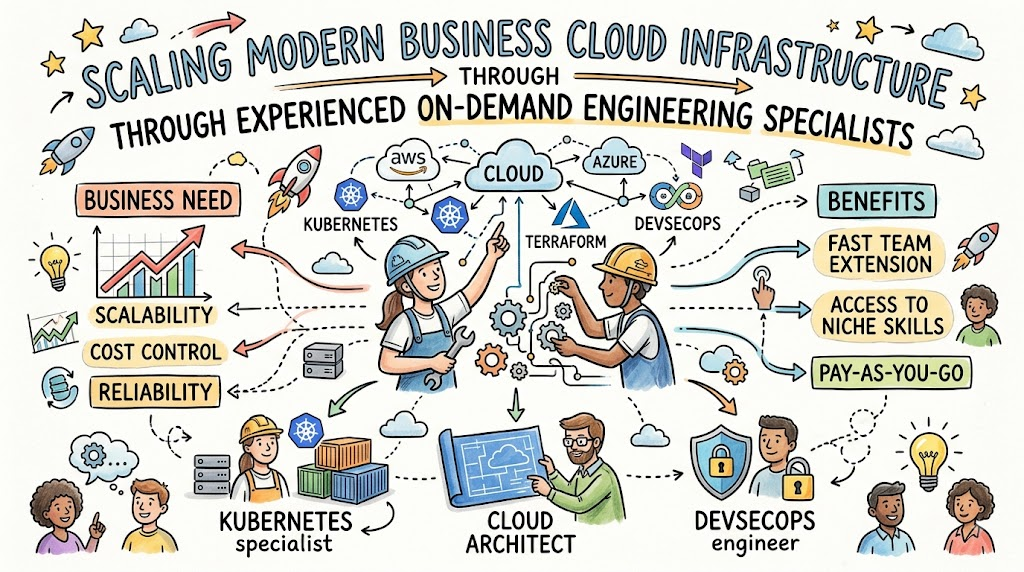
A DevOps Freelancer is an independent cloud architect who merges software delivery processes with modern system administration on a flexible contract basis. These professionals go beyond writing basic scripts; they overhaul how engineering teams build, test, secure, and monitor digital applications. Contracting an independent specialist provides immediate technical leadership, allowing internal developers to accelerate product roadmaps without managing server configuration burdens.
Furthermore, independent consultants offer extensive knowledge gathered from solving complex architectural challenges across diverse industries. They assess active release workflows, patch hidden security gaps, and build automated cloud environments tailored to company milestones. Partnering with dedicated contractors gives organizations total operational flexibility, enabling them to scale technical resources up or down as business priorities change.
+-------------------------------------------------------------------+
|                  Modern Elastic Engineering Model                 |
+-------------------------------------------------------------------+
                                  |
         +------------------------+------------------------+
         |                                                 |
         v                                                 v
+------------------+                              +------------------+
| Automated Cloud  |                              | Business Growth  |
| Systems          |                              | Results          |
+------------------+                              +------------------+
         |                                                 |
         +--> Declarative Infrastructure Code             +--> Rapid Feature Releases
         +--> Automated Build Pipelines                   +--> High Platform Uptime
         +--> Continuous Security Controls                +--> Optimized Infrastructure Costs
         +--> Full System Observability                   +--> Elastic Team Capacity
Why Companies Hire DevOps Freelancers
Fast-growing technology firms frequently run into complex infrastructure bottlenecks that demand specialized capabilities outside their current team’s bandwidth. Sourcing and hiring permanent senior cloud architects requires several months while significantly increasing recurring payroll expenses. Consequently, engineering directors choose to Hire DevOps Freelancer talent to secure targeted, expert-level execution for pressing cloud projects.
Additionally, engaging project-based contractors eliminates slow recruitment cycles and removes long-term employment commitments. Independent advisors bring fresh technical insights, quickly identifying hidden operational risks that internal engineers frequently overlook. As a direct result, companies complete major server migrations, pipeline automation projects, and platform upgrades faster and well within budget targets.
| Feature / Criteria | Permanent In-House Engineer | Independent Cloud Contractor |
|---|---|---|
| Onboarding Speed | 30 to 60 Days | 1 to 3 Days |
| Cost Model | Fixed Annual Payroll + Benefits | Elastic Hourly or Milestone Rates |
| Technical Versatility | Internal Stack Focus | Multi-Cloud & Cross-Industry Mastery |
| Primary Focus | Feature Maintenance & Support | Targeted Problem Solving & Automation |
| Capacity Elasticity | Fixed Capacity | Flexible On-Demand Scaling |
What Does a Freelance DevOps Engineer Do?
A Freelance DevOps Engineer serves as the primary builder of an organization’s automated software release pipeline and cloud server architecture. These experts analyze existing systems, design resilient cloud environments, and establish continuous integration and continuous deployment workflows. Converting manual setup procedures into clean, automated code allows software updates to transition seamlessly from developer machines to production systems.
Moreover, these engineers actively manage operational hazards through automated performance monitoring, stress testing, and disaster recovery planning. Installing modern observability tools allows them to track application health and fix potential bugs before downtime affects customers. Consequently, corporate platforms maintain high performance, excellent availability, and cost-efficient cloud utilization during traffic surges.
DevOps Freelancer India: Why Organizations Consider Remote Specialists
International technology companies frequently partner with a DevOps Freelancer India to access world-class engineering capabilities while optimizing operational spending. Indian engineering professionals hold recognized multi-cloud certifications, possess deep software expertise, and demonstrate strong analytical problem-solving skills. Contracting remote Indian specialists enables companies to maintain continuous operational coverage and keep release pipelines moving around the clock.
In addition, collaborating with Indian cloud contractors provides remarkable budget flexibility without compromising code quality or security posture. These professionals adapt smoothly to global work standards, modern communication channels, and agile team workflows. Consequently, international enterprises build resilient cloud platforms while maintaining exceptionally lean operational expenses.
- 24/7 Productivity: Time-zone differences support round-the-clock maintenance and continuous release pipelines.
- Cost Advantage: Elite engineering knowledge delivered at a fraction of Western corporate hiring overhead.
- Abundant Expertise: Direct access to thousands of certified professionals skilled across AWS, GCP, Azure, and Kubernetes.
- Rapid Deployment: Immediate availability that allows specialists to join active development sprints without delay.
AWS DevOps Freelancer: When AWS Expertise Matters
Deploying enterprise workloads on Amazon Web Services requires deep cloud expertise to avoid security misconfigurations and rising monthly bills. An AWS DevOps Freelancer designs resilient cloud architectures using core services such as EC2, EKS, ECS, Lambda, and CloudFront. They structure identity policies, isolated virtual networks, and automated backup schedules according to AWS Well-Architected Framework principles.
Furthermore, an AWS contractor continuously tracks resource usage to eliminate wasted compute power and trim cloud bills. Converting manual dashboard steps into declarative Infrastructure as Code scripts prevents configuration drift across development, testing, and live production environments. Consequently, businesses achieve maximum system performance, ironclad security boundaries, and completely predictable cloud costs.
Kubernetes Freelancer: Managing Containerized Environments
Operating microservices at scale requires deep expertise in container orchestration and cluster administration. Engaging a Kubernetes Freelancer guarantees your containerized applications run smoothly, scale dynamically under heavy traffic, and maintain strong security controls. These specialists manage cluster installations, ingress routing, service mesh configurations, and zero-downtime application updates.
In addition, container consultants eliminate performance bottlenecks, adjust pod compute limits, and establish automated cluster monitoring. They simplify application deployments across hybrid or multi-cloud infrastructure, ensuring complete application mobility. Consequently, engineering teams ship container updates rapidly without risking system outages or application downtime.
- Cluster Tuning: Fine-tuning CPU and memory allocations to prevent container crashes and eliminate cluster waste.
- Dynamic Autoscaling: Setting up Pod Autoscalers to handle traffic surges automatically without human intervention.
- Cluster Security: Enforcing RBAC access controls, network isolation policies, and encryption at rest across all nodes.
- Persistent Storage: Provisioning stateful volume drivers for database workloads and storage requirements.
Terraform Freelancer: Building Repeatable Infrastructure
Building cloud environments manually leads to dangerous configuration drift, security oversights, and inconsistent server setups across deployment environments. Partnering with a Terraform Freelancer helps organizations adopt declarative Infrastructure as Code standards across all major cloud providers. These automation architects build modular, reusable code templates that provision virtual networks, database clusters, and cloud storage in minutes.
Moreover, Terraform consultants implement central state locking systems, automated drift detection routines, and peer code review workflows. Treating infrastructure configurations with the exact same rigor as application source code guarantees quick rollbacks and reliable disaster recovery capabilities. As a result, businesses eliminate deployment chaos and establish audited, repeatable cloud setups.
Azure DevOps Freelancer: Supporting Microsoft Cloud Environments
Organizations heavily reliant on Microsoft technical stacks require experienced cloud professionals to streamline deployment workflows and cloud administration. An Azure DevOps Freelancer builds Azure Pipelines, configures Enterprise Active Directory permissions, and provisions Azure Kubernetes Service clusters efficiently. They unify software delivery workflows by connecting source code repositories directly with automated cloud deployment stages.
Additionally, Microsoft cloud consultants optimize resource allocation, apply governance policies, and maintain strict regulatory compliance across all subscription tiers. They facilitate smooth migrations moving legacy data center servers into secure, fully managed Azure environments. Therefore, enterprise leaders modernize their technical operations while preserving full administrative control and data security.
DevSecOps Freelancer: Integrating Security Into Delivery
Postponing application security evaluations until final deployment creates severe operational risks and delays releases. A DevSecOps Freelancer embeds automated vulnerability scanning, code analysis, and compliance checks directly into daily development workflows. Shifting security practices left enables teams to identify and remediate code vulnerabilities during pull requests rather than in live production.
Furthermore, DevSecOps consultants implement secret management vaults, scan container images, and set up static security analysis tools. They assist organizations in meeting strict compliance mandates like SOC2, ISO27001, and HIPAA without slowing down production pipelines. Consequently, technology teams maintain robust security controls while keeping delivery schedules on track.
+-------------------------------------------------------------------+
|               Shift-Left DevSecOps Delivery Pipeline              |
+-------------------------------------------------------------------+
                                  |
   +-------------------+-------------------+-------------------+
   |                   |                   |                   |
   v                   v                   v                   v
+------------+   +------------+   +------------+   +------------+
| Code & Git |   | CI Build & |   | Container  |   | Deploy &   |
| Pre-Commit |   | SAST Check |   | Image Scan |   | Live DAST  |
+------------+   +------------+   +------------+   +------------+
   |                   |                   |                   |
   +----> Secrets      +----> Static       +----> CVE          +----> Runtime
          Detection           Analysis            Scanning            Audit
SRE Freelancer: Improving Reliability
Unplanned server outages and slow loading times frustrate users and hurt company revenues. An SRE Freelancer applies software engineering solutions directly to operational and infrastructure problems. They establish concrete Service Level Indicators (SLIs) and Service Level Objectives (SLOs) to strike an optimal balance between feature delivery speed and overall system reliability.
Furthermore, site reliability experts build self-healing infrastructure, intelligent alert routing systems, and automated incident recovery workflows. They run blameless post-mortem investigations after system incidents to eliminate root causes permanently. As a result, digital platforms deliver uninterrupted availability, fast load times, and superior fault tolerance.
MLOps Freelancer: Operating Machine Learning Systems
Deploying artificial intelligence models into live production setups introduces operational obstacles that standard delivery pipelines cannot solve. An MLOps Freelancer connects data science teams with scalable cloud infrastructure engineering. They build automated data ingestion pipelines, continuous model training workflows, hyperparameter tuning routines, and production API serving endpoints.
Additionally, MLOps consultants install continuous monitoring systems to track model accuracy decay, data drift, and request latencies. They monitor expensive GPU processing clusters carefully to keep machine learning infrastructure expenses completely under control. Consequently, companies turn experimental machine learning algorithms into scalable, reliable enterprise software solutions.
Skills to Check Before Hiring a DevOps Freelancer
Selecting an independent cloud engineer requires reviewing both their practical engineering capabilities and overall communication skills. A competent specialist demonstrates mastery across leading cloud platforms, container technologies, and Infrastructure as Code frameworks. In addition, they need strong Linux and networking fundamentals to troubleshoot complex server glitches quickly.
Evaluating how clearly an engineer explains technical concepts to non-technical team members is equally important. During technical interviews, test candidate capabilities using real-world operational scenarios rather than theoretical questions. Selecting an engineer with balanced technical and communication skills guarantees smooth integration into your development team.
- Cloud Proficiency: Deep experience building and managing AWS, Azure, or GCP cloud environments.
- Tooling Mastery: Expertise in using Terraform, Ansible, Docker, and Kubernetes for automation.
- CI/CD Expertise: Hands-on experience building automated build pipelines using GitHub Actions or GitLab CI.
- Observability Skills: Practical experience deploying Datadog, Prometheus, Grafana, and ELK monitoring stacks.
Questions to Ask During a Technical Interview
Asking practical, scenario-based technical questions helps interviewers gauge an engineer’s real-world experience and problem-solving skills. Skip simple definition questions that candidates easily memorize beforehand. Instead, present actual infrastructure challenges and ask the candidate to explain their troubleshooting step-by-step.
Direct your questions toward how they mitigate live outages, protect sensitive credentials, and fix configuration drift across multi-tier setups. Evaluate how carefully they weigh choices between performance, system complexity, and cloud costs. This practical engineering perspective separates seasoned contractors from inexperienced coders.
- “How do you manage database credentials and API keys safely inside CI/CD pipelines?”
- “How do you configure state file locking and state security when sharing Terraform across team members?”
- “Which architecture strategies do you deploy to ensure zero-downtime updates for microservice applications?”
- “How did you fix the last unexpected production outage that occurred on a system under your care?”
- “Which specific adjustments do you make to cut monthly cloud hosting costs on AWS or Azure platforms?”
Common Mistakes When Hiring Freelance DevOps Specialists
Companies frequently encounter project delays because they fail to specify exact project outcomes before hiring external talent. Expecting a single consultant to fix application code, manage cloud security, and maintain internal office networks leads to frustration and delays. Setting defined project boundaries and concrete goals ensures engagement success.
Another common mistake involves restricting a contractor’s access to code repositories and project documentation during initial onboarding. Treating independent experts like distant vendors instead of active team members stalls technical progress. Granting direct access to tools and clear documentation enables contractors to deliver valuable engineering results quickly.
- Undefined Scope: Hiring specialists without establishing clear goals, project timelines, or success metrics.
- Unrealistic Goals: Expecting an external consultant to repair deep-seated application architectural flaws instantly.
- Slow Onboarding: Delaying access to cloud environments, codebases, and team communication tools.
- Focusing on Price: Selecting candidates based solely on low hourly rates instead of proven technical capabilities.
How to Structure a DevOps Freelance Project
Running a successful contract engineering project requires organizing technical goals into clear, structured execution phases. Start with a detailed discovery phase where the consultant reviews your active cloud infrastructure, security policies, and release workflows. This preliminary review establishes baseline metrics and highlights urgent technical priorities.
Next, establish explicit deliverables, acceptance standards, and milestone targets for each phase of project execution. Maintain transparent project visibility through daily asynchronous updates and centralized tracking tools. Conducting structured milestone assessments keeps engineering work on schedule, within budget, and aligned with core business priorities.
+-------------------------------------------------------------------+
|               Structured Freelance Project Execution              |
+-------------------------------------------------------------------+
                                  |
   +-------------------+-------------------+-------------------+
   |                   |                   |                   |
   v                   v                   v                   v
+------------+   +------------+   +------------+   +------------+
| Phase 1:   |   | Phase 2:   |   | Phase 3:   |   | Phase 4:   |
| Assessment |   | Automation |   | Production |   | Knowledge  |
| & Audit    |   | Buildout   |   | Migration  |   | Transfer   |
+------------+   +------------+   +------------+   +------------+
   |                   |                   |                   |
   +----> System       +----> IaC & CI/CD  +----> Staging &    +----> Docs &
          Review              Pipelines           Production          Training
How DevOpsFreelancer Can Help
Locating reliable, pre-vetted cloud engineering specialists no longer requires filtering through crowded freelance job sites. DevOpsFreelancer connects growing businesses with certified cloud engineers, automation architects, and site reliability specialists tailored to your stack. Whether you need short-term migration support or long-term operational maintenance, the platform simplifies candidate discovery.
Additionally, the platform provides flexible hiring models that match your project timeline and financial constraints. You gain immediate access to international talent skilled in AWS, Azure, GCP, Kubernetes, DevSecOps, and MLOps. Partnering with dedicated platform specialists allows your team to expand infrastructure safely while staying focused on building exceptional customer products.
Frequently Asked Questions About DevOpsFreelancer
- What responsibilities fall under an independent cloud engineer’s scope?
Independent cloud engineers build, automate, and maintain deployment pipelines, hosting infrastructure, and cloud environments to help businesses ship reliable software faster.
- How fast can our company hire talent through the platform?
Businesses review pre-vetted engineer profiles and start onboarding qualified talent within two to three business days, bypassing lengthy recruitment delays.
- Why do businesses choose contract specialists over full-time hires?
Contract engineers provide flexible, project-focused technical expertise without permanent payroll commitments, letting companies scale technical capabilities up or down as business priorities change.
- Do remote contractors collaborate smoothly with internal engineering teams?
Yes, professional contractors adopt your communication tools, project workflows, and development methodologies to function as natural extensions of your team.
- Which safety measures protect our sensitive cloud credentials?
Senior experts use enterprise identity providers, temporary IAM roles, secret management systems, and zero-trust policies to ensure total credential security.
- Do early-stage startups benefit from hiring contract cloud experts?
Yes, early-stage startups use contract experts to build robust cloud infrastructure and automated pipelines quickly without taking on senior full-time salaries.
- How do contract professionals manage multi-cloud deployments?
Experienced contractors use cross-platform tools like Terraform and Kubernetes to manage AWS, Google Cloud, and Azure environments through standardized automation workflows.
- What contract payment structures does the platform support?
The platform supports flexible contract arrangements, including hourly rates, fixed-cost project milestones, and recurring monthly retainers based on your technical scope.
- How do security experts maintain compliance inside build pipelines?
DevSecOps contractors insert static code analyzers, image scanners, secret detectors, and policy verification tools directly into continuous integration workflows.
- What handover steps occur when a contractor completes an automation project?
After completing the project, contractors deliver full system documentation, architecture diagrams, and team training sessions to guarantee smooth internal handoffs.
Final Thoughts
Modernizing cloud platforms and streamlining software release pipelines remain critical objectives for modern digital enterprises. Engaging specialized contract talent provides a flexible, cost-effective method to upgrade technical capabilities without increasing corporate overhead. Contracting experts across cloud infrastructure, container orchestration, automation, and security removes expensive operational barriers. Embracing an agile contract engineering model allows your organization to innovate rapidly, maintain exceptional service availability, and outperform competitors in a changing digital market.