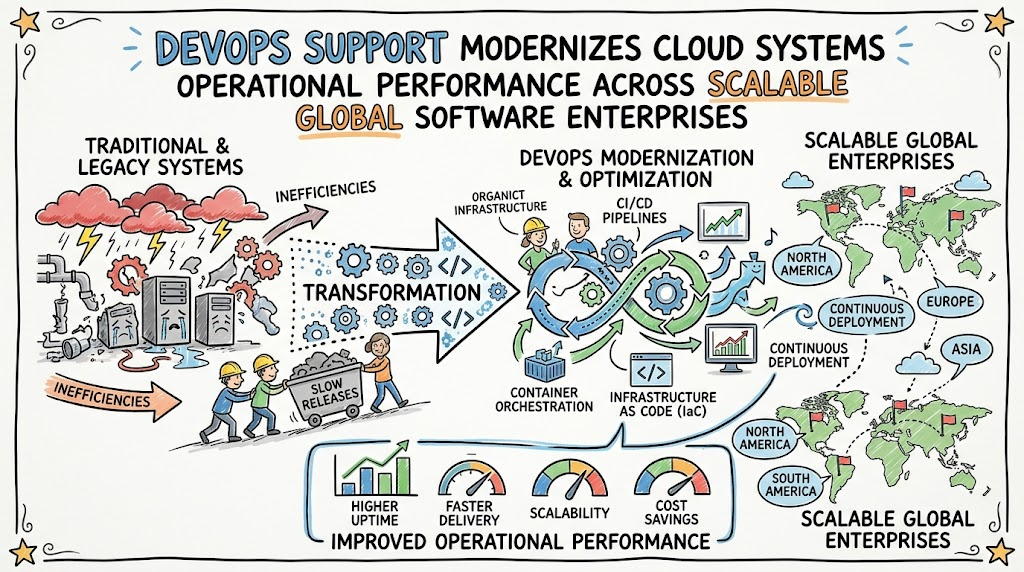
Introduction
Technology executives constantly strive to accelerate feature deployment speed while guaranteeing total system resilience. However, scaling complex distributed architectures frequently overwhelms software developers with routine server management, deployment errors, and sudden system outages. Consequently, application development slows down as internal engineering teams spend excessive hours firefighting technical debt instead of writing core product code.
Integrating specialized platform management resolves this friction by establishing an automated, robust delivery ecosystem. When organizations assign routine cloud administration, automated pipeline maintenance, and real-time incident triage to dedicated infrastructure specialists, internal engineers reclaim their time for strategic product innovation.
Therefore, this comprehensive guide evaluates how modern operational frameworks drive reliable software delivery. We explore core service offerings, cloud deployment models, security integrations, and actionable roadmaps that empower digital businesses to scale without operational bottlenecks.
What Are DevOps Support Services?
DevOps Support Services deliver continuous cloud infrastructure maintenance, proactive system monitoring, automated release pipeline tuning, and rapid incident resolution. In practice, expert platform engineers oversee your cloud instances, deployment automation, container clusters, and software delivery pipelines continuously.
Instead of stretching internal developers thin with routine operational tasks, forward-thinking organizations utilize these specialized services to maintain continuous platform stability. The day-to-day scope includes writing declarative infrastructure as code, refining automated CI/CD workflows, applying security patches, optimizing database queries, and resolving server alerts immediately.
Consequently, establishing this operational backbone ensures that your software delivery remains fast, secure, and predictable. Furthermore, offloading maintenance tasks shields application developers from constant context-switching, allowing them to focus entirely on feature development.
Why DevOps Support Matters
Continuous system performance powers every growing digital enterprise platform. When production software experiences unexpected outages or performance degradation, companies lose immediate revenue, damage customer trust, and derail developer productivity.
Proactive operational care identifies infrastructure anomalies before they disrupt user workflows. Industry research indicates that unmonitored configuration drift and manual deployment errors cause over 70% of production outages, proving that automated governance remains vital for modern tech companies.
Additionally, dedicated platform care speeds up delivery pipelines, enabling developers to release software updates with total confidence. By eliminating operational bottlenecks, organizations transform fragile build systems into reliable, automated engines that consistently deliver software value.
24/7 DevOps Support Services: When Do They Make Sense?
Adopting 24/7 DevOps Support Services becomes essential when digital platforms serve global user bases that require uninterrupted software availability. Modern financial applications, e-commerce stores, and enterprise SaaS platforms cannot tolerate unexpected downtime, regardless of time zones or holiday schedules.
Forcing local developers to manage middle-of-the-night server alarms leads directly to severe fatigue and high employee turnover. Continuous 24/7 monitoring ensures that dedicated engineers investigate system alerts instantly, maintaining strict Service Level Agreements (SLAs) without exhausting your internal workforce.
Moreover, round-the-clock operational coverage supports non-stop deployment capabilities and real-time security threat mitigation. Companies handling high transaction volumes or managing sensitive customer data gain complete confidence, knowing that experienced specialists guard their infrastructure continuously.
Managed DevOps Services vs Internal DevOps Operations
Choosing between managed operational partnerships and building in-house platform teams represents a critical strategic decision. The operational comparison matrix below highlights key differences across essential performance metrics:
| Operational Dimension | Managed DevOps Services | Internal DevOps Operations |
|---|---|---|
| Talent Availability | Immediate access to certified multi-cloud specialists | Requires prolonged recruitment and onboarding cycles |
| Cost Efficiency | Predictable monthly fees without hiring overhead | High fixed payroll expenses, benefits, and retention costs |
| Coverage Scope | Native 24/7 continuous monitoring and rapid response | Limited to local working hours without paid on-call shifts |
| Tooling & Best Practices | Enterprise automation frameworks ready on day one | Built slowly through trial, error, and internal research |
| Scalability | Adjusts team capacity up or down on demand | Rigid team structures requiring slow headcount additions |
Leveraging Managed DevOps Services grants growing companies enterprise-grade system resilience while avoiding the massive financial burden of recruiting and retaining a large internal platform staff.
What Should a Good DevOps Support Model Include?
A robust operational framework supports every phase of the software development lifecycle through specialized engineering disciplines. The key roles listed below deliver complete platform coverage:
- Infrastructure Automation Engineer: Authors Infrastructure as Code (IaC) templates, provisions cloud servers, monitors configuration drift, and enforces architecture standards.
- Release Pipeline Specialist: Optimizes build pipelines, integrates automated test suites, and executes zero-downtime application deployments effortlessly.
- Observability & SRE Engineer: Builds real-time monitoring dashboards, distributed tracing mechanisms, alerting triggers, and structured incident response runbooks.
- Cloud Security Specialist: Automates security vulnerability scans, manages access controls, enforces compliance rules, and patches system flaws regularly.
Combining these technical roles guarantees complete operational protection, eliminating single points of failure across your entire digital ecosystem.
DevOps Support Company India: What Should Businesses Evaluate?
Partnering with a specialized DevOps Support Company India grants global businesses access to elite technical talent, rapid response times, and exceptional cost efficiency. However, selecting the right partner requires thorough evaluation of technical competencies.
Organizations must assess prospective partners based on certified cloud credentials, verified SLA compliance, clear escalation pathways, and robust security policies. A mature provider delivers detailed root-cause analysis reports, transparent communication, and dedicated account leadership.
In addition, verify the partner’s practical experience with modern cloud-native systems and enterprise automation frameworks. Choosing a battle-tested service provider guarantees smooth team onboarding, continuous platform enhancement, and alignment with your strategic business goals.
Kubernetes Support Services
Running containerized workloads in production demands advanced technical mastery to maintain high availability, elasticity, and cluster safety. Enterprise Kubernetes Support Services deliver non-stop cluster administration, handling control plane tuning, worker node auto-scaling, ingress routing, and seamless version upgrades.
Production container platforms frequently encounter storage volume failures, pod crash loops, memory bottlenecks, and complex networking issues. Specialized container engineers rapidly diagnose and resolve these microservices anomalies using advanced observational tools.
Furthermore, continuous cluster hardening, container image scanning, and service mesh management defend your containerized applications against malicious threats. Expert cluster management guarantees continuous high performance across hybrid and multi-cloud environments.
AWS DevOps Support Services
Amazon Web Services provides an expansive collection of cloud resources that require expert configuration and continuous oversight. Specialized AWS DevOps Support Services streamline cloud operations across EKS, ECS, EC2, Lambda, and CloudFront.
Using Terraform and CloudFormation templates, support engineers maintain uniform infrastructure across development, testing, and production environments. Continuous resource right-sizing and architecture tuning dramatically lower your monthly AWS cloud spend.
Additionally, robust automated backup routines, disaster recovery execution, and strict AWS IAM security policies maintain enterprise compliance. Expert cloud management ensures high operational efficiency while your core developers focus on building new application features.
Azure DevOps Support Services
Enterprise organizations running workloads on Microsoft Cloud gain immense value from specialized Azure DevOps Support Services. Skilled engineers manage Azure Pipelines, AKS clusters, Azure Resource Manager templates, and cloud governance policies.
Support specialists construct automated deployment pipelines that incorporate security checks, static code analysis, and automated integration tests into Azure workflows. Direct integration between Azure resources and enterprise identity management frameworks guarantees airtight security controls.
Furthermore, continuous performance monitoring across Azure SQL, app services, and storage instances prevents performance degradation during traffic spikes. Proactive cloud management keeps your Microsoft cloud environment operating at peak capacity.
DevSecOps Support Services
Integrating security controls directly into automated deployment pipelines is essential for protecting modern application environments. Dedicated DevSecOps Support Services embed automated security checks across every phase of software development and deployment.
Engineers incorporate Static Application Security Testing (SAST), Dynamic Application Security Testing (DAST), container image scanning, and secret detection tools inside your build pipelines. This early security integration catches code vulnerabilities during development, preventing expensive security fixes in production.
Moreover, continuous compliance tracking against frameworks like SOC2, HIPAA, and ISO27001 keeps your cloud infrastructure audit-ready at all times. Automated patch cycles and credential rotation shield your organization against evolving security risks continuously.
SRE Support Services
Site Reliability Engineering applies software engineering principles directly to infrastructure operations. Dedicated SRE Support Services establish precise Service Level Indicators (SLIs) and Service Level Objectives (SLOs) to monitor application availability and performance systematically.
By implementing error budget management, SRE specialists help product managers balance rapid feature releases with system stability goals. If error budgets deplete due to instability, automated policy gates temporarily pause risky deployments until platform reliability recovers.
Additionally, thorough post-incident reviews turn unexpected system outages into valuable long-term platform improvements. Chaos engineering exercises and continuous capacity planning ensure your infrastructure handles sudden traffic spikes easily.
MLOps Support Services
Deploying, tracking, and maintaining machine learning models in production environments requires specialized automation pipelines. Comprehensive MLOps Support Services manage machine learning infrastructure, model versioning, feature repositories, and automated training workflows.
Support engineers construct automated pipelines using Kubeflow and MLflow to streamline model deployment, tracking, and validation. Real-time data monitoring flags model drift, feature decay, and data corruption early, preserving model prediction accuracy.
Furthermore, optimizing GPU usage and implementing smart scaling policies reduces the heavy compute costs tied to artificial intelligence workloads. Dependable operational oversight ensures your machine learning applications generate fast, accurate, and consistent business insights.
A Practical Example of DevOps Support
A rapidly growing financial service business struggled with frequent database slowdowns and failed software deployments during heavy trading hours. Their internal developers spent over 40% of their work week resolving infrastructure bugs and executing manual deployment steps.
After bringing in a dedicated operational support team, the company fully automated its release pipelines using infrastructure as code and zero-downtime deployment patterns. The team introduced real-time tracing tools to monitor database latency and query health proactively.
+-------------------+     +---------------------+     +-----------------------+
|  Developer Push   | --> | Automated CI/CD     | --> | Security & Vulnerability|
|  (Git Commit)     |     | Pipeline & Tests    |     | Automated Scanning    |
+-------------------+     +---------------------+     +-----------------------+
                                                                  |
                                                                  v
+-------------------+     +---------------------+     +-----------------------+
| Continuous 24/7   | <-- | Blue-Green / Canary | <-- | Staging & Production  |
| SRE Observability |     | Zero-Downtime Deploy|     | Kubernetes Clusters   |
+-------------------+     +---------------------+     +-----------------------+
As a direct result of this transformation, deployment failure rates fell by 85%, and mean recovery time during outages dropped from two hours to under seven minutes. Most importantly, software developers reclaimed their schedules to focus entirely on feature creation.
How to Build a DevOps Support Strategy
Constructing an effective operational strategy requires a structured, step-by-step roadmap that aligns technical tasks with core corporate goals. The actionable steps below outline how to establish a resilient operational strategy:
- Audit Current Infrastructure: Review existing cloud setups, deployment pipelines, monitoring systems, and team pain points thoroughly.
- Define Operational Targets: Establish clear performance metrics, including Mean Time to Detect (MTTD), Mean Time to Recovery (MTTR), and release success rates.
- Automate Infrastructure Delivery: Convert manual processes into declarative Infrastructure as Code scripts, standard container builds, and automated pipeline tests.
- Deploy Complete Observability: Set up centralized logging, distributed tracing, metric dashboards, and intelligent alert rules across all applications.
- Establish Escalation Protocols: Build clear incident runbooks, team schedules, escalation pathways, and communication channels for rapid emergency response.
- Refine Operations Continuously: Conduct routine post-incident reviews, audit cloud spending, review error budget data, and optimize deployment scripts continuously.
Following this structured methodology eliminates workflow bottlenecks and creates a reliable platform for sustained business growth.
How DevOps Support Can Reduce Operational Overhead
External support teams lower operational expenses by automating repetitive platform management tasks. Automated server provisioning, self-healing software architectures, and standardized release pipelines drastically reduce the human labor required to maintain online services.
Additionally, support engineers continuously monitor cloud spending to eliminate waste. By identifying unattached storage drives, right-sizing server instances, and applying automated auto-scaling rules, support teams routinely trim cloud hosting bills by 20% to 35%.
Finally, eliminating developer context-switching protects engineering teams from costly exhaustion and employee turnover. When software developers dedicate their full energy to writing feature code, overall corporate productivity increases significantly.
When Should You Consider External DevOps Support?
Recognizing the exact right moment to hire external operational support depends on specific operational warning signs within your engineering team. Key indicators signaling an urgent need include:
- Frequent System Outages: Experiencing repeated application downtime, slow incident recovery times, or unmonitored infrastructure failures.
- Developer Fatigue: Software developers spending excessive hours handling overnight system alerts and performing routine maintenance tasks.
- Stalled Release Velocity: Release cycles dragging due to fragile deployment scripts, manual testing steps, or server configuration bugs.
- Accelerated Cloud Expansion: Scaling complex multi-cloud or containerized systems beyond the current skill set of your internal developers.
- Strict Regulatory Demands: Facing rigorous compliance standards like SOC2 or HIPAA that require audited deployment controls and non-stop monitoring.
Addressing these operational red flags early through external partnerships prevents software downtime and keeps your engineering goals on track.
Why a Specialized Support Partner Can Help
Specialized support partners bring battle-tested technical expertise gained from managing hundreds of complex cloud environments. This deep exposure allows them to identify architectural weaknesses, apply proven industry standards, and fix technical bugs far faster than internal teams.
Furthermore, specialized engineering partners offer flexible resource scaling, allowing your business to expand operational capacity during major product launches or rapid expansion phases. Access to expert platform engineers delivers top-tier infrastructure management without the financial burden of building a huge internal team.
By teaming up with a trusted service partner, you convert software infrastructure from an operational headache into a powerful business asset. Continuous system stability, advanced security, and high release velocity become standard organizational capabilities.
Frequently Asked Questions About DevOpsSupport
- Within what timeframe can dedicated platform engineers onboard our infrastructure?Onboarding generally takes between three days and two weeks depending on system complexity. During this initial period, support engineers audit your cloud environment, document platform architecture, establish secure access protocols, deploy monitoring tools, and build customized incident runbooks to ensure a seamless transition.
- What specific SLA response times do you guarantee for critical production outages?Standard SLA frameworks guarantee response times under 15 minutes for critical production outages (Severity 1). Dedicated engineers launch emergency runbooks immediately, establish live war rooms, isolate root causes, and work non-stop until your application restores full functionality.
- In what ways do external specialists collaborate with internal development teams?External platform engineers integrate directly into your existing communication channels, such as Slack or Microsoft Teams, and ticketing systems like Jira or ServiceNow. Support engineers attend regular operational meetings, submit detailed incident summaries, and function as an extended platform engineering unit.
- Can external specialists manage multi-cloud infrastructure environments simultaneously?Yes, experienced engineers maintain certified proficiency across major cloud platforms, including AWS, Azure, Google Cloud Platform, and hybrid environments. They utilize unified automation tools like Terraform to maintain consistent configuration management and security practices across all clouds.
- Which security protocols protect sensitive corporate data and credentials?Security measures rely on zero-trust access policies, temporary role-based access permissions, encrypted secrets vaults, and mandatory multi-factor authentication. Support engineers never store unencrypted credentials on local machines, and administrative actions undergo strict audit logging.
- What differentiates standard cloud provider support from managed operational support?Standard cloud provider support focuses purely on underlying cloud hardware and native service uptime. Managed operational support assumes full ownership of your custom application stack, build pipelines, container setups, database health, security policies, and daily deployment automation.
- How do support teams assist companies in optimizing cloud expenses?Support specialists analyze resource utilization constantly, remove unattached storage drives, recommend optimal server instances, implement automated schedules for development environments, and configure auto-scaling rules to cut unnecessary cloud costs.
- Do engineers support legacy systems during ongoing cloud migration projects?Yes, platform engineers manage legacy monolithic applications while building modern containerized microservices environments in parallel. This dual approach ensures uninterrupted business operations throughout complex legacy modernization efforts.
- Which observability platforms and monitoring frameworks do engineers implement?Support teams implement leading open-source and commercial observability solutions, including Prometheus, Grafana, Datadog, New Relic, and the Elastic Stack. These platforms deliver complete system visibility, log aggregation, distributed tracing, and real-time alert generation.
- How do support teams manage security patches and software updates?Patch management follows structured, automated workflows across testing environments prior to staging and production deployment. Support teams execute security scans, validate patches in staging environments, and perform zero-downtime rolling updates during scheduled maintenance windows.
Final Thoughts
Sustaining continuous platform resilience requires unrelenting operational focus, specialized cloud skills, and proactive infrastructure governance. As software environments expand, forcing internal development teams to maintain round-the-clock server operations routinely leads to developer burnout, operational drag, and costly system downtime.
Engaging dedicated operational support empowers your enterprise to achieve continuous uptime, rapid release velocity, and optimized cloud expenditures. By combining automated pipeline delivery, robust security frameworks, comprehensive observability, and expert engineering assistance, businesses establish a solid foundation for sustainable growth.
Investing in specialized operational management converts technical infrastructure into a powerful growth accelerator. Prioritizing platform stability today ensures your software remains secure, high-performing, and ready to scale effortlessly into the future.