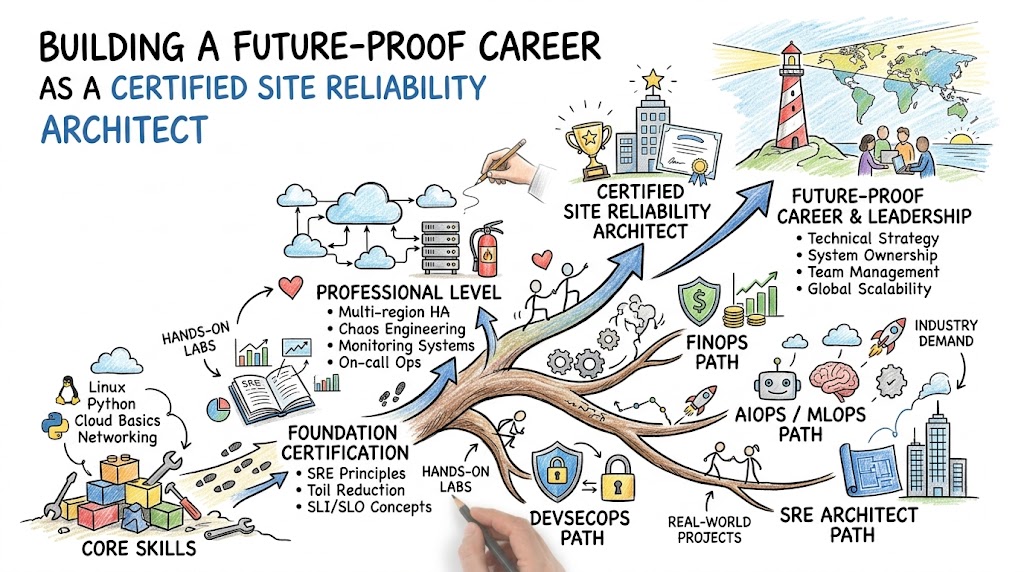
Modern software delivery demands a perfect balance between rapid innovation and rock-solid stability. This guide explores the Certified Site Reliability Architect program, a rigorous certification path designed for those who want to master high-scale system design. Whether you are an engineer or a manager, understanding how to architect for failure is now a non-negotiable skill in the cloud-native era. By utilizing the training resources at Sreschool, professionals can gain the technical depth required to manage complex production environments with confidence. This overview serves as a strategic roadmap to help you evaluate the curriculum, assess market demand, and select the right learning path for your unique career goals.
What is the Certified Site Reliability Architect?
The Certified Site Reliability Architect stands as a definitive credential for engineers committed to operational excellence. This program prioritizes practical, production-focused learning over abstract theory, ensuring that architects can handle real-world system stress. It bridges the gap between development speed and infrastructure resilience, providing a standardized framework for modern engineering workflows.
By focusing on architectural patterns that promote high availability, the program aligns with the needs of large-scale enterprise environments. Candidates learn to implement core SRE principles like Error Budgets and SLOs to manage technical debt and deployment risks effectively. Ultimately, this certification validates an engineer’s ability to design systems that are resilient by default.
Who Should Pursue Certified Site Reliability Architect?
Experienced DevOps engineers, platform specialists, and cloud architects gain the most from this certification journey. It provides the structured methodology needed to move into senior or principal engineering roles. Beyond pure operations, security and data professionals use these principles to ensure their specific infrastructure components remain stable under heavy load.
The program carries immense value in both the Indian tech sector and the global market, appealing to those who work in distributed team environments. Engineering managers and technical leaders also find the curriculum useful for establishing high-performance reliability cultures within their organizations. Whether you are starting your SRE journey or looking to codify years of experience, this certification offers a clear path forward.
Why Certified Site Reliability Architect is Valuable and Beyond
Enterprise adoption of SRE principles continues to grow as companies realize that downtime directly impacts the bottom line. This certification ensures that your skills remain relevant despite the constant rotation of popular tools and platforms. By mastering the fundamental laws of distributed systems, you build a career that remains resilient to industry shifts.
The program offers a high return on investment by preparing professionals for mission-critical roles that command premium salaries. As organizations move toward multi-cloud and hybrid environments, the need for architects who can ensure cross-platform stability is higher than ever. Choosing this path demonstrates a commitment to long-term technical leadership and operational maturity.
Certified Site Reliability Architect Certification Overview
The program delivery happens through the official curriculum at Sreschool and is hosted on a professional learning platform. Unlike traditional exams, the assessment approach focuses on practical application and the ability to solve complex architectural puzzles. This ensures that every certified professional can actually perform the tasks required in a production setting.
The ownership of the certification lies with industry veterans who ensure the content stays aligned with current enterprise practices. Candidates move through a structured journey that starts with core concepts and culminates in advanced disaster recovery and scalability designs. This practical focus makes the certification highly respected by hiring managers and technical peers alike.
Certified Site Reliability Architect Certification Tracks & Levels
The certification hierarchy follows three distinct levels: Foundation, Professional, and Advanced. The Foundation level focuses on the essential vocabulary and metrics of reliability. The Professional level introduces advanced automation and monitoring strategies, while the Advanced level challenges candidates with complex, cross-organizational architectural decisions.
Specialization tracks allow professionals to tailor their learning toward specific domains like FinOps, DataOps, or DevSecOps. This flexibility ensures that the certification remains highly relevant to a wide variety of engineering roles. By progressing through these levels, candidates build a comprehensive portfolio of skills that support long-term career growth.
Complete Certified Site Reliability Architect Certification Table
| Track | Level | Who it’s for | Prerequisites | Skills Covered | Recommended Order |
| SRE Core | Foundation | Aspiring SREs | Basic IT Knowledge | SLIs, SLOs, Toil | 1 |
| Architecture | Professional | Senior DevOps | SRE Foundation | Scalability, Design | 2 |
| Enterprise | Advanced | Principal Leads | Professional SRE | Governance, DR | 3 |
| Security | Professional | Sec Engineers | SRE Foundation | Resilience, Security | 2 |
| Data Focus | Professional | Data Engineers | SRE Foundation | Pipeline Reliability | 2 |
Detailed Guide for Each Certified Site Reliability Architect Certification
Certified Site Reliability Architect – Foundation Level
What it is This foundational certification validates your core understanding of Site Reliability Engineering principles. It confirms that you understand the cultural and technical shifts required to maintain high-availability systems.
Who should take it This level is perfect for junior engineers, developers, and project managers who need to understand the basics of SRE. It serves as the essential first step for anyone entering the operations space.
Skills you’ll gain
- Defining and monitoring SLIs and SLOs.
- Techniques for identifying and reducing manual toil.
- Managing release cycles using Error Budgets.
- Basic automation and monitoring setup.
Real-world projects you should be able to do
- Create a basic observability dashboard for a microservice.
- Write a standardized post-mortem for a simulated outage.
- Automate a recurring maintenance task using Python.
Preparation plan
- 7–14 days: Review the core SRE workbook and memorize key metrics.
- 30 days: Set up a basic monitoring stack in a local lab environment.
- 60 days: Complete all practice exams and review industry case studies.
Common mistakes
- Treating SRE as just another name for a traditional “Ops” role.
- Ignoring the cultural aspects of shared responsibility.
Best next certification after this
- Same-track option: Professional Certified Site Reliability Architect.
- Cross-track option: DevSecOps Foundation.
- Leadership option: SRE Team Lead Certification.
Certified Site Reliability Architect – Professional Level
What it is The Professional level validates your ability to implement advanced reliability patterns in production. It moves beyond theory to test your skill in building self-healing, scalable infrastructure.
Who should take it Current SREs and DevOps professionals with at least two years of experience should pursue this. It targets those responsible for the uptime and performance of enterprise applications.
Skills you’ll gain
- Advanced chaos engineering and resilience testing.
- Designing and managing multi-region architectures.
- Implementing automated incident response systems.
- Performance tuning and capacity management.
Real-world projects you should be able to do
- Design a zero-downtime deployment strategy for a global app.
- Implement a self-healing mechanism for a Kubernetes cluster.
- Build a cross-region disaster recovery plan with automated failover.
Preparation plan
- 7–14 days: Study advanced networking and cloud-native design patterns.
- 30 days: Perform deep-dive labs involving service meshes and observability.
- 60 days: Simulate and resolve complex distributed system failures.
Common mistakes
- Overlooking the cost implications of high-availability designs.
- Failing to test disaster recovery plans in a realistic environment.
Best next certification after this
- Same-track option: Advanced Certified Site Reliability Architect.
- Cross-track option: Cloud Security Professional.
- Leadership option: Technical Program Manager Path.
Choose Your Learning Path
DevOps Path
Engineers on this path focus on merging development speed with operational stability. They build automated pipelines that verify the reliability of every code change before it hits production. This route is ideal for those who want to master the entire software delivery lifecycle. It emphasizes a “shift-left” approach to reliability and performance.
DevSecOps Path
This track integrates security as a core component of system reliability. Candidates learn to treat security vulnerabilities as critical system failures, automating the response to threats. It is perfect for professionals who want to build infrastructure that is both resilient and secure by design. Professionals here focus on building “defense-in-depth” within an SRE framework.
SRE Path
The core SRE path is dedicated to the technical mastery of distributed systems at scale. It focuses on the metrics, monitoring, and automation required to keep massive platforms running smoothly. This is the definitive route for those wanting to become lead architects of highly available services. It teaches you to manage complex incidents and drive long-term system hardening.
AIOps Path
This path explores the use of machine learning to manage the massive amount of data generated by modern systems. Candidates learn to build intelligent systems that can predict outages and automate complex decision-making. It is ideal for engineers who want to stay at the cutting edge of automated operations. AIOps focuses on reducing the noise in monitoring and identifying root causes faster.
MLOps Path
Focusing on the reliability of machine learning models, this path ensures that AI systems are as stable as traditional software. It addresses the unique operational challenges of data drift, model retraining, and specialized hardware. Professionals learn to apply SRE rigor to the lifecycle of machine learning production. This is an essential track for companies heavily invested in artificial intelligence.
DataOps Path
Data reliability is the primary focus of this specialized engineering path. Professionals learn to apply SRE principles to data pipelines, ensuring that information remains accurate and available. It covers the orchestration of big data workflows and the monitoring of data quality at scale. This route is vital for organizations that rely on real-time data for business intelligence.
FinOps Path
Modern architects must understand the financial impact of their technical decisions in the cloud. This path teaches how to optimize infrastructure costs without compromising on performance or reliability. It focuses on transparency, accountability, and the architectural patterns that drive cost-efficiency. This skill set is increasingly required for senior leaders managing enterprise cloud budgets.
Role → Recommended Certified Site Reliability Architect Certifications
| Role | Recommended Certifications |
| DevOps Engineer | Certified SRE Architect (Professional) |
| SRE | Advanced Certified Site Reliability Architect |
| Platform Engineer | Certified SRE Architect (Professional) |
| Cloud Engineer | Certified Site Reliability Architect (Foundation) |
| Security Engineer | DevSecOps + SRE Foundation |
| Data Engineer | DataOps + SRE Foundation |
| FinOps Practitioner | FinOps + SRE Foundation |
| Engineering Manager | Certified Site Reliability Architect (Foundation) |
Next Certifications to Take After Certified Site Reliability Architect
Same Track Progression
Once you master the architectural level, the logical next step is cloud-specific expert certifications. Earning a Google Professional Cloud DevOps Engineer or AWS Certified DevOps Engineer – Professional provides platform-specific depth to your SRE skills. These credentials prove you can implement high-level architectural patterns on the world’s leading cloud platforms.
Cross-Track Expansion
Broadening your expertise into security or AI infrastructure offers a significant competitive advantage. Pursuing a Certified Kubernetes Security Specialist (CKS) allows you to apply reliability principles to the security domain. Likewise, moving into MLOps certifications helps you manage the specialized infrastructure required for modern artificial intelligence workloads.
Leadership & Management Track
Transitioning into leadership requires a shift from technical execution to long-term strategic planning. Certifications in Engineering Management or Technical Program Management help you manage the human and financial aspects of SRE. This path is ideal for those who want to lead entire departments and drive organizational reliability standards.
Training & Certification Support Providers for Certified Site Reliability Architect
DevOpsSchool This organization offers comprehensive training that covers the full spectrum of SRE tools and philosophies. Their curriculum emphasizes hands-on projects to ensure students can apply their knowledge in real-world scenarios.
Cotocus Cotocus provides specialized consulting and training for high-level infrastructure roles. They focus on delivering industry-relevant content that reflects the latest architectural standards used by major enterprises.
Scmgalaxy As a leading community platform, Scmgalaxy provides a wealth of free and paid resources for SRE practitioners. They offer deep-dive tutorials and study materials for various levels of technical certification.
BestDevOps BestDevOps focuses on providing fast-paced, high-impact training for professionals looking to upskill quickly. Their courses are designed to help engineers master the automation skills required for senior roles.
devsecopsschool.com This provider focuses specifically on the intersection of security and site reliability. They offer unique training modules that help SREs build secure, resilient infrastructure for the modern cloud.
sreschool.com This is the primary destination for the Certified Site Reliability Architect program, offering the most direct path to certification. They provide expert-led instruction and highly realistic lab environments.
aiopsschool.com Aiopsschool is a leader in teaching the future of operations through machine learning. Their curriculum helps architects understand how to use AI to predict failures and automate recovery.
dataopsschool.com This organization addresses the critical need for reliability in big data ecosystems. They provide specialized training on maintaining the performance and accuracy of complex data pipelines.
finopsschool.com Finopsschool teaches engineers how to manage the financial side of cloud architecture. Their courses are essential for anyone looking to balance high availability with fiscal responsibility.
Frequently Asked Questions
- How difficult is the Certified Site Reliability Architect exam?
The exam is moderately challenging because it focuses on your ability to solve practical architectural problems rather than just memorizing definitions.
- How long should I study before taking the test?
Most candidates require between 30 and 60 days of consistent study, depending on their existing hands-on experience with cloud systems.
- Are there any prerequisites for the foundation level?
No strict prerequisites exist, but a basic understanding of Linux and at least one cloud platform will make the learning process much smoother.
- What is the return on investment for this certification?
Certified architects often see immediate career benefits, including access to higher-paying roles and increased recognition within the engineering community.
- Should I take the levels in a specific order?
Yes, starting with the Foundation level is highly recommended to ensure you have a solid grasp of the core SRE terminology and culture.
- Does this certification require renewal?
Yes, to stay current with rapidly evolving technology, the certification typically requires renewal every two to three years.
- Does the exam focus on a specific cloud provider?
No, the principles taught are cloud-agnostic, though labs often use industry-standard tools like Kubernetes and Prometheus to illustrate concepts.
- Is this certification valuable for software developers?
Absolutely, as it helps developers understand how their code behaves in production and how to build more resilient applications from the start.
- Can I take the exam from my home?
Yes, the certification providers offer proctored online exams that you can take from any location with a stable internet connection.
- How does SRE differ from traditional DevOps?
SRE is a specific way of implementing DevOps that focuses heavily on using software engineering to solve operational and reliability problems.
- Are there any lab-based components in the exam?
Yes, the higher levels often include lab environments where you must demonstrate your ability to fix or design infrastructure in real-time.
- Is this certification recognized globally?
Yes, the curriculum is based on the SRE standards pioneered by companies like Google and used by top-tier tech firms worldwide.
FAQs on Certified Site Reliability Architect
- What is the primary focus of the architect-level certification?
The architect level focuses on high-level system design, multi-region scalability, and disaster recovery strategies for global-scale enterprise applications.
- How does this certification improve my day-to-day work?
It provides a framework for reducing manual tasks and improving system stability, leading to fewer incidents and a better work-life balance.
- Do I need to know how to code to pass?
Yes, basic to intermediate coding skills in languages like Python or Go are necessary for the automation and scripting portions of the exam.
- Does the curriculum cover multi-cloud design?
Yes, the architectural patterns you learn are designed to be implemented across AWS, Azure, and Google Cloud Platform without major changes.
- How does the program handle incident response?
You will learn to design automated response systems and conduct deep-root cause analysis to prevent the same failure from happening twice.
- Are soft skills like communication part of the certification?
Yes, especially at the Advanced level, where incident leadership and cross-team communication are vital for successful SRE implementation.
- How often is the exam content updated?
The providers review the content annually to ensure it includes the latest trends in cloud-native architecture, AIOps, and serverless technology.
- Can I skip directly to the Professional level?
Some providers allow you to skip the Foundation level if you can demonstrate significant hands-on experience in a dedicated SRE role.
Final Thoughts: Is Certified Site Reliability Architect Worth It?
Deciding to pursue this certification means you are serious about taking your engineering career to the next level of maturity. As modern systems grow more complex, the industry desperately needs professionals who can design for stability from the first line of code. This path offers a clear, structured way to gain those skills and prove your expertise to the world.
Choosing to follow the SRE path is a commitment to the long-term health of both your systems and your career. The program at Sreschool provides the tools, labs, and instruction needed to master these high-demand architectural skills. For any engineer looking to move into a senior or principal role, becoming a Certified Site Reliability Architect is a truly valuable and rewarding achievement.