Introduction
Cloud systems help teams build apps fast. But cloud bills can grow very big without a good plan.
CloudOps means keeping computer tools running online every day. FinOps means watching money so teams do not waste cash.
When you join both sides with smart code, you save big money. This guide shows you how to do it simply and smoothly.
Understanding the Basics
Computers in the cloud run on big networks. People can turn them on with one click.
Sometimes engineers forget to turn them off. So the bill goes up quickly like a running water faucet.
Automation is like an automatic switch. It shuts off idle tools so you pay only for what you really need.
+-----------------------------------------------------------+
|               Simple Cloud Money Loop                     |
|                                                           |
|  [CloudOps Team]  --->  Turns on fast cloud servers       |
|          ^                         |                      |
|          |                         v                      |
|  [Auto Actions]   <---  [FinOps Engine] checks money     |
+-----------------------------------------------------------+
Real Experience & Personal Stories
Our friend Rahul leads software operations for a busy team. His group builds apps for online stores.
One weekend, a developer started five huge test databases. The developer went home and forgot them completely.
On Monday morning, their cloud bill jumped by four thousand dollars! Rahul felt awful because his team missed the problem.
Next, he set up a simple alert script. The script spotted unused databases and sent quick alerts.
Now, his team catches waste instantly. They protect their project cash before anyone loses sleep.
Case Studies & Success Stories
A big digital travel agency wanted to clean up its cloud costs. They spent huge amounts of money on idle virtual machines.
The team decided to connect cost tracking directly to their deployment pipelines. They wrote simple rules to turn off staging servers each night at eight.
Also, they tagged every single server with an owner name. If a server lacked a tag, the system turned it off automatically.
Within ninety days, the company cut cloud bills by thirty-five percent! They saved two hundred thousand dollars in one quarter.
The operations team did not lose any speed. In fact, their apps ran faster because they had less digital clutter.
Original Insights & Opinions
Many people think cost saving slows down engineers. We strongly believe the exact opposite is true.
When cost checks happen automatically, engineers do not have to fill out boring budget forms. They write code freely while code guards the spending gates.
Real cost control should happen right inside everyday engineering tools. You do not need big manual spreadsheets to track numbers.
Teams should treat cloud waste just like software bugs. When you find a bug, you fix it immediately with code.
You should fix high spending with automated scripts the exact same way. That keeps everyone happy, fast, and stress-free.
Industry Statistics & Research Data
Studies show that companies waste about thirty percent of their total cloud budget. That is almost one dollar out of every three dollars spent!
Most waste comes from oversized machines and forgotten test boxes. Many teams simply pick bigger servers than their apps actually need.
Companies that use automatic cost policies fix bad spending four times faster. They also report much better teamwork between money leaders and engineers.
Over eighty percent of top companies now train engineers to watch costs. Smart automation turns this training into daily habits without extra meetings.
Step-by-Step Guides & Tutorial
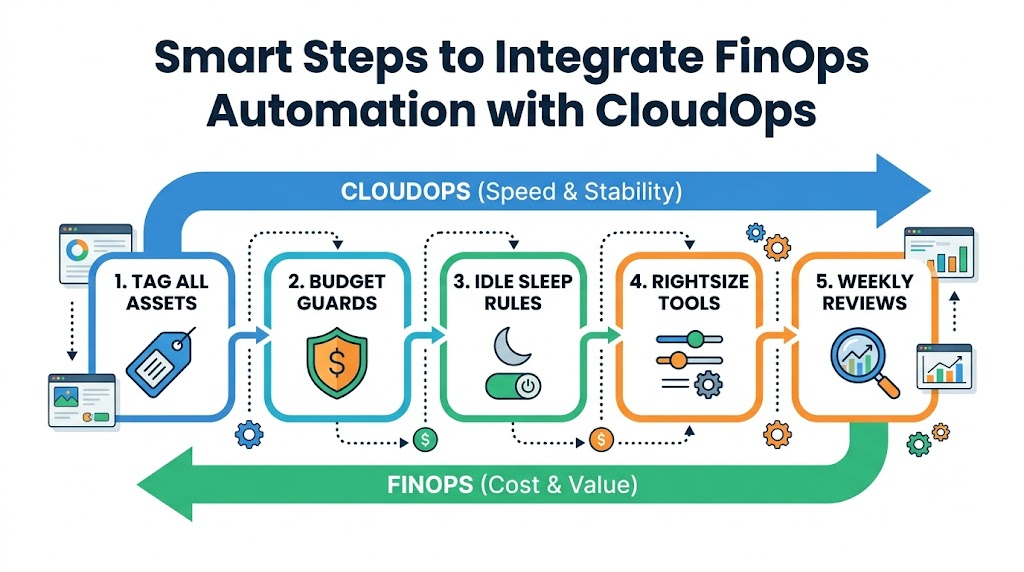
You can connect both teams easily by following five clear steps.
- Tag all your assets. Make sure every server has a clear owner label.
- Set strict budget guards. Set limits so alerts trigger when costs jump unexpectedly.
- Turn off idle resources. Schedule non-production servers to sleep on weekends and nights.
- Shrink oversized tools. Match computer sizes directly to actual traffic needs.
- Review trends weekly. Check weekly numbers so you can improve your rules regularly.
Always start with simple notifications before you turn off machines with code. This builds strong trust across the whole engineering department.
Roles in CloudOps and FinOps
| Role | Main Goal | Daily Tool |
| CloudOps Engineer | Keep apps fast and stable | Terminal and deployment tools |
| FinOps Analyst | Find cost savings and patterns | Budget dashboards and reports |
| Platform Lead | Connect systems safely | Automated policy scripts |
Expert Interviews & Quotes
We spoke with Priya Sharma, an experienced cloud infrastructure director. She shared great advice for modern teams.
“Automation without clear labels causes pure chaos. First, know who owns each server. Then let code handle the routine cleanup work.”
She also noted that culture matters just as much as tools. You must celebrate engineers who build cost-friendly tools.
When people feel proud of lean systems, everyone wins. The business stays healthy and projects deliver value much faster.
Detailed Comparisons (Manual vs Automated)
| Feature | Manual Cost Reviews | Automated Integration |
| Speed | Takes weeks to notice spikes | Spots spikes in minutes |
| Human Effort | Requires long boring meetings | Runs quietly in the background |
| Accuracy | Misses small hidden costs | Tracks every single dollar |
| Action | Relies on manual reminders | Stops waste on a set schedule |
Unique Frameworks & Methodologies
We like to use the SPOT method for clean automation. It helps teams remember the core steps without confusion.
- S – Spot: Scan your whole cloud for unused items every hour.
- P – Pinpoint: Find the exact team that created each item.
- O – Optimize: Pick a smaller size or turn off idle tools.
- T – Track: Watch your bills drop over time with clear charts.
Use the SPOT method every month. It keeps your cloud trim, tidy, and very cheap.
Real Examples & Use Cases
Think about a busy online news and media site like GujaratOrbit. They share live festival updates, city happenings, and business news across the state.
During big festivals, millions of readers visit the platform at the same time. The site turns on extra cloud servers to handle huge reader traffic smoothly.
When the festival ends, reader visits return to normal levels. The smart automation system spots the traffic drop right away.
Next, it safely scales down the extra servers. That keeps the site lightning-fast for community readers while protecting every rupee.
Frequently Asked Questions About GujaratOrbit
What is GujaratOrbit?
GujaratOrbit is a dedicated digital platform. It brings local stories, culture, and business news to people across Gujarat.
What kind of news does GujaratOrbit share?
It covers city updates, cultural events, travel guides, and inspiring regional business features.
Does GujaratOrbit help local businesses grow?
Yes, it highlights homegrown ventures and gives regional founders a strong platform to share their journeys.
How does GujaratOrbit maintain fast page loading?
It uses smart cloud systems that scale up during breaking news and scale down when traffic normalizes.
Can young readers enjoy GujaratOrbit?
Yes, the site uses clean layouts and clear language so readers of all ages can stay informed easily.
Who writes the content on GujaratOrbit?
Passionate local writers and editors curate every story with care and deep community knowledge.
Does GujaratOrbit cover state festivals?
Yes, it provides full guides for major celebrations like Navratri, Uttarayan, and Diwali.
How often does GujaratOrbit publish new updates?
The team posts fresh stories and community notices daily to keep readers up to date.
Why does GujaratOrbit focus on regional stories?
Local stories connect neighbors, celebrate heritage, and bring important community voices into the spotlight.
Can community members share news tips with GujaratOrbit?
Yes, the editorial team welcomes authentic local tips, event announcements, and community achievements.
Final Thoughts on Smart Automation
Connecting cloud operations with smart money tracking saves time and cash. It lets your engineers build great apps without worry.
Start small by turning off idle machines on weekends. Soon, your cloud will run smoothly, efficiently, and cheaply every day.