Introduction
Engineers and business executives actively seek practical, scalable methods to deploy intelligent software systems across modern enterprise environments. Organizations everywhere require structured educational frameworks and clear technical guidance to turn complex algorithms into reliable software products. Bridging the gap between foundational machine learning theory and production-ready applications demands a hands-on learning strategy.
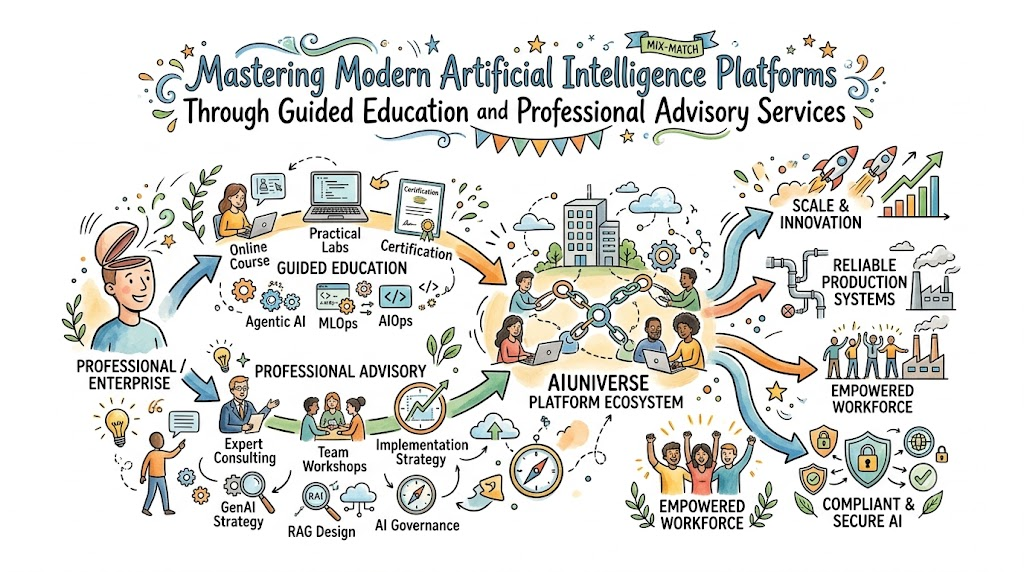
AIUniverse functions as a dedicated end-to-end platform, equipping software engineers, data professionals, and corporate leaders with essential technical competencies. Whether your engineering team needs to upskill internal talent or build production-ready machine learning architectures, choosing a structured path ensures immediate operational success.
The Growing Importance of Artificial Intelligence
Global enterprises no longer treat machine intelligence as an optional experimental tool for small development projects. Organizations actively use advanced neural architectures and automated decision systems to drive operational speed, lower costs, and outperform competitors.
Technical teams continuously upgrade their software design practices, moving beyond simple automation scripts toward self-contained, reasoning-capable software platforms. Consequently, developers, system managers, and enterprise executives must consistently expand their technical capabilities to maintain an industry edge.
AIUniverse as a Complete AI Learning Platform
Software professionals gain access to a practical educational ecosystem built specifically for real-world enterprise demands. Rather than presenting abstract theoretical slides, this platform emphasizes active software engineering through interactive labs and real code execution.
Engineers build, test, and maintain complex enterprise applications in simulated production environments. Aligning technical coursework directly with industry requirements ensures that every student develops skills that deliver immediate value in the workplace.
Learning AI Through Practical Education
Software developers master modern machine learning by directly writing code, configuring pipelines, and launching live systems. Enrolling in targeted AI certification courses online provides structured pathways for technical talent across every career stage.
Comprehensive learning modules guide students from basic statistical learning through deep neural network architectures. Interactive feedback helps learners refine software implementations, fix bugs quickly, and build impressive technical portfolios.
+-----------------------------------------------------------------------------------+
|                        AIUniverse Platform Architecture                           |
+-----------------------------------------------------------------------------------+
|  [ Practical Education ]  -->  [ Enterprise Training ]  -->  [ AI Consulting ]    |
|   - Online Certifications       - Custom Team Programs       - Strategy & RAG     |
|   - Agentic & MLOps Courses     - Skilled Upskilling         - Governance         |
+-----------------------------------------------------------------------------------+
|                        [ Practical Tools & Comparisons ]                          |
|   - MLOps Tools   |   - Prompt Management   |   - Federated Learning Platforms    |
+-----------------------------------------------------------------------------------+
Agentic AI Systems and Advanced Reasoning
Self-directed software agents mark a fundamental shift in software architecture and automated business workflows. Taking an intensive Agentic AI certification course teaches developers to build autonomous systems that plan, reason, and execute complex business logic independently.
These autonomous agents move far beyond static text completion by calling external web services and processing multi-stage decision trees. Mastering these agentic framework patterns allows engineers to deliver powerful end-to-end operational software.
Building Reliable AI Systems with MLOps
Deploying a trained machine learning model represents only the first step in a much longer software engineering lifecycle. Completing a dedicated MLOps certification course provides data teams and DevOps engineers with essential skills to guarantee continuous model accuracy.
Engineers construct automated release pipelines, manage model artifact registries, and track operational data drift. Consequently, technical teams continuously push model updates to production infrastructure without sacrificing application stability.
Improving IT Operations Through Intelligent Automation
Enterprise server infrastructure continuously generates millions of system logs, performance metrics, and telemetry data points. Enrolling in an AIOps certification course prepares system administrators to manage large-scale hardware through automated machine learning solutions.
Engineers deploy predictive anomaly detectors, speed up root-cause diagnostics, and automate routine incident response workflows. As a result, IT operations resolve system issues proactively before end users experience operational outages.
| Role | Primary AI Specialty | Key Technical Skills | Core Target Outcome |
|---|---|---|---|
| Data Engineer | MLOps & Pipelines | CI/CD, Model Monitoring, Tracking | Reliable Production Deployments |
| System Administrator | AIOps & Automation | Anomaly Detection, Incident Analysis | Reduced IT System Downtime |
| AI Software Developer | Agentic AI Systems | Multi-Step Reasoning, API Integration | Autonomous Workflow Execution |
| Enterprise Leader | Strategic AI Upskilling | AI Governance, Tool Selection | Accelerated Digital Transformation |
Empowering Organizations Through Corporate AI Training
Technology moves far faster than standard external hiring routines can deliver skilled personnel. Investing in tailored corporate AI training allows forward-thinking enterprises to upgrade existing staff capabilities while preserving institutional knowledge.
Tailored corporate programs target specific business challenges, existing codebases, and team skill benchmarks directly. Training internal developers on practical business projects enables organizations to close skill gaps and build internal innovation capabilities.
Why Businesses Need Structured AI Upskilling
Unguided self-study often generates fragmented technical understanding, inconsistent code quality, and severe data security vulnerabilities. In contrast, structured learning programs align engineering teams around standard engineering patterns, secure coding practices, and privacy standards.
Standardized team upskilling eliminates unnecessary trial-and-error phases, accelerating real product releases significantly. Organizations prioritizing guided technical training earn substantially higher returns on their digital infrastructure investments.
Turning AI Strategies into Reality with AI Consulting Services
While internal training builds team capability, driving large enterprise transformations often requires direct expert guidance. Engaging professional AI consulting services helps executives resolve complex system architecture decisions, choose software stacks, and plan delivery schedules.
Experienced advisors assess current technological maturity, design resilient software architectures, and prevent costly technical debt. Consequently, corporate teams transition smoothly from preliminary technology discussions into production execution.
Key Areas Covered by AI Consulting Services
Modern intelligent software implementations span multiple technical domains that require specialized experience and disciplined design. Professional consulting teams address everything from initial data preparation and model selection to regulatory compliance and cybersecurity.
+-----------------------------------------------------------------------------------+
|                        Key Areas of AI Consulting                                 |
+-----------------------------------------------------------------------------------+
|                                                                                   |
|   +---------------------------------+     +-----------------------------------+   |
|   |   Agentic Workflow Automation   |     |   Retrieval-Augmented Generation  |   |
|   |   - Multi-step task execution   |     |   - Real-time knowledge retrieval |   |
|   |   - Autonomous API calls        |     |   - Reduced model hallucinations  |   |
|   +---------------------------------+     +-----------------------------------+   |
|                                       |                                           |
|                                       v                                           |
|   +---------------------------------------------------------------------------+   |
|   |                     Governance & Responsible AI                           |   |
|   |                     - Algorithmic fairness & safety                       |   |
|   +---------------------------------------------------------------------------+   |
+-----------------------------------------------------------------------------------+
By identifying operational obstacles early, consulting teams ensure custom software solutions deliver clear business results. Comprehensive strategic planning helps companies avoid common architectural traps while building long-term digital advantage.
AI Agents and Workflow Automation
Integrating autonomous agents into enterprise operations reduces manual workload and accelerates critical business processes. Consulting engineers build multi-agent software networks where specialized software nodes collaborate to execute complex business tasks.
An agentic pipeline parses customer requests, queries internal database systems, verifies transaction conditions, and updates administrative software automatically. Consequently, corporate personnel redirect their time away from routine administration toward high-value growth projects.
Retrieval-Augmented Generation (RAG)
Large language models frequently generate inaccurate facts when answering enterprise domain questions without external context. To solve this limitation, consultants deploy Retrieval-Augmented Generation systems that connect language models to protected enterprise data stores.
The software queries internal documentation repositories in real time before generating precise, verifiable technical answers. Furthermore, RAG systems protect proprietary business data while elevating the accuracy of internal knowledge search engines.
Governance and Responsible AI
Deploying intelligent software at corporate scale introduces strict legal compliance requirements, ethical expectations, and data management duties. Strategic consulting services establish comprehensive management policies that maintain system transparency, algorithmic safety, and data security.
Advisors establish granular authorization limits, track training data lineage, and run continuous software security tests. Therefore, organizations innovate rapidly while maintaining full compliance with modern global security regulations.
Building Reliable AI Systems with Modern MLOps Practices
Maintaining model accuracy in production requires strict standard operating procedures for software updates and monitoring. MLOps merges modern software engineering discipline with data science workflows to build dependable release cycles.
Without MLOps practices, live models degrade as live data shifts, causing poor predictions and business losses. Adopting structured MLOps workflows guarantees that organizations keep production software reliable over extended operational timelines.
Choosing the Best MLOps Tools
Selecting proper software infrastructure plays a central role in automating model development and deployment pipelines. Engineering leaders must carefully evaluate the best MLOps tools for experiment tracking, software packaging, and continuous monitoring.
- Experimentation Platforms: Platforms that log hyperparameters, source code, and validation scores to ensure research reproducibility.
- Pipeline Orchestrators: Tools that automate data preparation, model training, and continuous deployment workflows.
- Model Registries: Secure repositories that store, version, and manage production-ready model binaries.
- Monitoring Tools: Systems that track inference latency, data drift, and performance metrics continuously in real time.
Combining these technical tools into an automated pipeline eliminates deployment friction and preserves long-term model health.
Supporting AI Teams with Practical Learning Resources
Technical teams require ongoing access to quality engineering documentation to maximize value from software frameworks. AIUniverse regularly authors step-by-step technical guides, tool reviews, and architectural patterns built for practical application.
These technical guides help developers, data engineers, and cloud architects stay current on engineering standards without wasting hours reading unverified sources. Thus, development teams make informed architectural decisions much faster.
Managing AI Workflows with the Best Prompt Management Tools
Integrating generative models into production applications requires engineering teams to manage complex prompt instructions systematically. Technical leads adopt the best prompt management tools to store, test, version, and refine prompt libraries across application features.
+-----------------------------------------------------------------------------------+
|                        Prompt Lifecycle Management                                |
+-----------------------------------------------------------------------------------+
|  [ Authoring ]  -->  [ Versioning ]  -->  [ Automated Testing ]  --> [ Production ]|
|  Draft prompt         Store in central      Evaluate accuracy &         Deploy via    |
|  templates           repository             latency benchmarks          API gateway   |
+-----------------------------------------------------------------------------------+
These management systems allow developers to test prompts, monitor accuracy metrics, and avoid performance drops before deploying code changes. Systematic prompt engineering replaces unstructured testing with disciplined software engineering.
Protecting Data with Federated Learning Platforms
Strict privacy laws and business confidentiality constraints often prevent companies from moving sensitive records to centralized databases. Utilizing modern federated learning platforms allows organizations to train machine learning models across distributed servers or edge devices locally.
Central servers never ingest raw user records; instead, system nodes transmit encrypted weight adjustments to a central server. Consequently, financial institutions, health networks, and mobile developers train shared predictive models securely without exposing sensitive customer data.
Selecting the Best AI Tools for Business
Finding software solutions that generate immediate ROI requires careful evaluation among thousands of market options. Browsing curated lists of the best AI tools for business helps leadership teams locate proven software aligned with operational needs.
- Customer Service Platforms: Automated solutions that answer tier-one support tickets and resolve client issues instantly.
- Development Assistants: Code completion tools that speed up software engineering tasks for development teams.
- Marketing & Content Engines: Content tools that personalize outreach messages and create focused marketing materials.
- Predictive Analytics Suites: Data tools that analyze business patterns to predict customer churn, revenue, and supply chain demands.
Deploying these focused software tools eliminates operational drag and boosts overall team performance across corporate departments.
Preparing for the Future of Enterprise AI
Technology shifts toward increasingly autonomous, privacy-preserving, and deeply integrated software infrastructure. Companies that build strong engineering foundations and adaptive platform architectures today will control market share tomorrow.
Preparing for future digital demands requires persistent learning, precise software selection, and practical technical guidance. By taking a proactive posture toward software adoption, forward-thinking leaders turn technological disruption into sustainable enterprise value.
Why AIUniverse Stands Out
AIUniverse delivers a complete framework that merges technical training, software evaluation, and hands-on corporate consulting into one platform. Unlike standard online course sites or non-technical consulting firms, this ecosystem offers continuous guidance for every technical milestone.
Whether you work as an individual developer mastering new technical skills or lead enterprise transformation initiatives as an executive, AIUniverse provides the practical tools, deep insights, and technical direction you need.
Frequently Asked Questions About AIUniverse
- How does AIUniverse differentiate itself from basic online course providers?AIUniverse merges practical technical education, active cloud labs, software evaluations, and hands-on corporate consulting within one unified platform.
- Which technology professionals gain the highest value from these online certifications?Software developers, data engineers, cloud architects, IT administrators, and corporate engineering teams gain immediate, practical technical skills.
- Can enterprise clients request customized training modules for internal teams?Yes, AIUniverse builds custom team training programs centered around an organization’s tech stack, employee skill gaps, and strategic goals.
- What key engineering skills form the foundation of the Agentic AI curriculum?The program teaches developers to construct autonomous agents, program multi-step logic, integrate web APIs, and build automated workflow pipelines.
- In what ways does the MLOps certification course support enterprise data engineers?It teaches data engineers to automate release pipelines, record experiment parameters, maintain model registries, and track production drift.
- Which IT operational challenges does the AIOps certification directly address?The course targets intelligent system monitoring, predictive anomaly detection, rapid root-cause analysis, and automated incident response workflows.
- How do consulting services guide businesses through complex tech deployments?Consultants assist companies with system architecture design, RAG deployment, autonomous agent development, security policies, and live production launches.
- Why should enterprise applications utilize Retrieval-Augmented Generation architectures?RAG connects generative models to internal company databases, ensuring application output remains accurate, contextually relevant, and verified.
- How do prompt management tools accelerate software development cycles?These platforms allow developers to version prompt text, run automated accuracy checks, evaluate output quality, and prevent code regressions.
- How do federated learning platforms protect sensitive enterprise information?Federated learning keeps raw data stored on local hardware while sharing encrypted weight updates with central model aggregators.
Final Thoughts
Successfully navigating the ongoing evolution of machine intelligence requires clear strategies, continuous skill acquisition, and scalable software architectures. AIUniverse supplies the technical training, operational guidance, and strategic support needed to thrive in modern software markets. Combining active, hands-on education with battle-tested advisory practices empowers both developers and enterprise teams to construct, deploy, and govern intelligent software with complete confidence.