Introduction
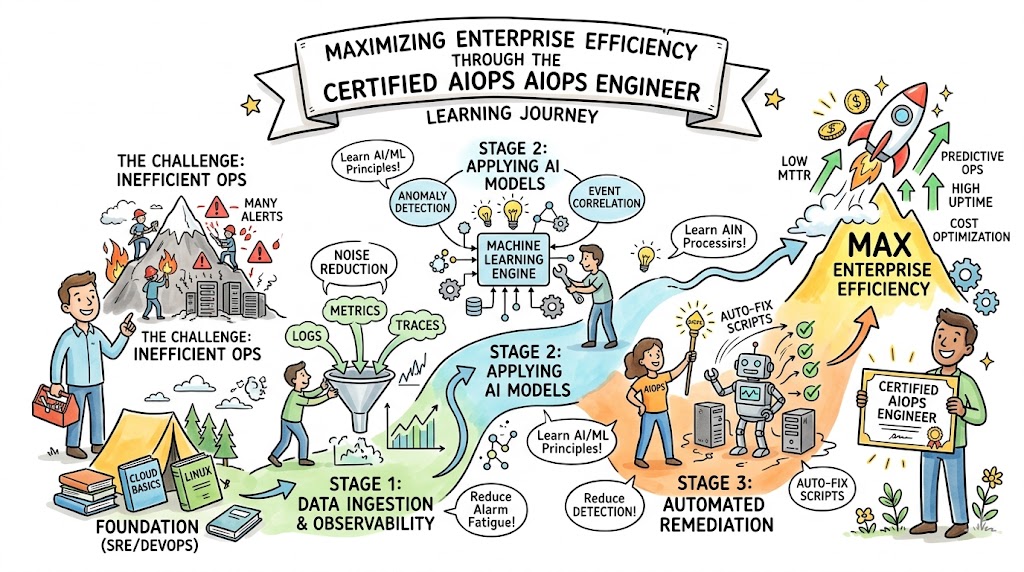
Modern infrastructure demands a transition toward intelligent automation, and earning a Certified AIOps Engineer credential empowers professionals to lead this evolution. This comprehensive guide serves SREs, cloud architects, and DevOps practitioners who seek to integrate machine learning into their daily operational workflows. As distributed systems grow in complexity, AIOpsSchool provides the necessary framework for engineers to master data-driven decision-making. By following this structured path, technical experts can move away from manual troubleshooting and embrace a more scalable, autonomous future.
What is the Certified AIOps Engineer?
The Certified AIOps Engineer program redefines how teams manage large-scale IT environments by applying artificial intelligence to standard operations. It exists to solve the problem of data overload, where traditional monitoring tools fail to provide actionable insights amidst thousands of daily alerts. This certification focuses on practical application, teaching engineers how to build systems that automatically detect anomalies and correlate events. It aligns perfectly with modern enterprise needs by emphasizing high-performance, self-healing infrastructure over theoretical concepts.
Who Should Pursue Certified AIOps Engineer?
Platform engineers, site reliability experts, and cloud administrators find significant value in this specialized training. It bridges the gap for professionals who manage complex microservices and need smarter ways to maintain system health. Engineering managers also benefit by learning how to implement AI-driven strategies that reduce team burnout and improve operational ROI. This certification holds massive weight in the global tech market, particularly in India, where digital transformation initiatives continue to accelerate across all sectors.
Why Certified AIOps Engineer is Valuable and Beyond
Securing this certification ensures long-term career resilience as organizations increasingly rely on automated intelligence to manage their digital assets. It moves the practitioner beyond basic tool proficiency, instilling a deep understanding of how to leverage telemetry data for predictive maintenance. Enterprises prioritize these skills because they directly lead to reduced downtime and more efficient resource utilization. Professionals who master these techniques position themselves as indispensable assets in an industry that prizes efficiency and innovation.
Certified AIOps Engineer Certification Overview
Candidates access the program via the official course portal, while the Website name platform hosts the technical environment for learning. This certification utilizes a hands-on assessment model to verify that participants can solve real-world architectural challenges using AI. The ownership team consists of veteran engineers who constantly update the curriculum to reflect current industry standards and emerging automation patterns. Rather than testing rote memorization, the program evaluates the ability to design and implement intelligent observability pipelines.
Certified AIOps Engineer Certification Tracks & Levels
The curriculum offers three distinct tiers—foundation, professional, and advanced—to match various career stages. Beginners focus on the core logic of data ingestion and basic pattern recognition within IT logs. The professional track deepens this knowledge by introducing complex event correlation and automated incident response for SRE and DevOps roles. Finally, the advanced level prepares senior staff to architect enterprise-wide AIOps strategies that align technical performance with business objectives.
Complete Certified AIOps Engineer Certification Table
| Track | Level | Who it’s for | Prerequisites | Skills Covered | Recommended Order |
| Infrastructure | Foundation | Junior Ops | Basic Cloud | Data Flow, AI Logic | 1 |
| SRE/DevOps | Professional | Mid-level Eng | 2+ Years Exp | RCA, Alert Noise | 2 |
| Architecture | Advanced | Senior Leads | Professional Cert | Auto-remediation | 3 |
| Management | Expert | VPs/Directors | 5+ Years Exp | Strategic AI Ops | 4 |
Detailed Guide for Each Certified AIOps Engineer Certification
Certified AIOps Engineer – Foundation
What it is
This introductory level validates a candidate’s grasp of how machine learning enhances traditional monitoring and logging. It ensures practitioners understand the basic vocabulary and structural requirements of an AIOps-driven environment.
Who should take it
Junior system administrators and new DevOps recruits should start with this level to build a solid technical base. It serves as an ideal entry point for anyone transitioning from legacy IT roles into cloud-native operations.
Skills you’ll gain
- Mastery of AIOps terminology and core architectural pillars.
- Ability to distinguish between different telemetry data types.
- Understanding of how basic algorithms assist in noise reduction.
Real-world projects you should be able to do
- Setup a basic pipeline that ingests logs into a centralized analysis tool.
- Design a dashboard that identifies recurring patterns in system metrics.
Preparation plan
- 14 Days: Study the core concepts of data science for IT operations.
- 30 Days: Review case studies on successful AI implementations.
- 60 Days: Complete introductory lab exercises on data correlation.
Common mistakes
- Focusing too much on specific tools rather than general logic.
- Overlooking the importance of clean data during the ingestion phase.
Best next certification after this
- Same-track option: Professional AIOps Level.
- Cross-track option: Cloud Practitioner.
- Leadership option: Operations Team Lead.
Certified AIOps Engineer – Professional
What it is
The professional level confirms an engineer’s ability to implement and manage sophisticated AI models in production. It focuses on the seamless integration of these models into existing CI/CD and observability stacks.
Who should take it
Experienced SREs and DevOps professionals with at least two years of field experience should pursue this credential. It targets those who make critical decisions regarding system reliability and incident response.
Skills you’ll gain
- Designing automated root cause analysis workflows.
- Tuning anomaly detection algorithms to minimize false positives.
- Integrating AI insights directly into collaborative communication tools.
Real-world projects you should be able to do
- Create a self-healing script that triggers based on AI-detected anomalies.
- Reduce alert fatigue by implementing intelligent event suppression.
Preparation plan
- 14 Days: Focus on advanced API integrations and tool connectivity.
- 30 Days: Practice building correlation rules in a staging environment.
- 60 Days: Lead a pilot AIOps project within your current organization.
Common mistakes
- Neglecting to update models as the infrastructure evolves.
- Failing to document the logic behind automated remediation steps.
Best next certification after this
- Same-track option: Advanced AIOps Architect.
- Cross-track option: DevSecOps Specialist.
- Leadership option: Infrastructure Manager.
Choose Your Learning Path
DevOps Path
Engineers on this path utilize AI to streamline the software delivery pipeline from code commit to production. They apply AIOps to predict deployment risks and identify performance regressions before they affect end-users. This focus ensures that rapid release cycles do not compromise system stability. By automating these feedback loops, DevOps teams achieve faster delivery with significantly fewer manual interventions.
DevSecOps Path
This specialized track focuses on the intersection of security, automation, and artificial intelligence. Practitioners learn to use AIOps to detect subtle security threats that traditional signature-based tools might miss. They automate the identification of anomalous access patterns and potential data exfiltration attempts. This proactive approach strengthens the enterprise security posture while maintaining operational speed.
SRE Path
Site Reliability Engineers prioritize uptime and performance by using AI to manage complex Service Level Objectives. This path teaches practitioners how to use predictive analytics to forecast capacity needs and prevent outages. They focus on building autonomous systems that can handle routine maintenance and basic incident recovery. It empowers SREs to manage massive scales without a corresponding increase in operational effort.
AIOps Path
Dedicated AIOps specialists focus entirely on the infrastructure’s intelligence layer and the underlying data science. They manage the entire lifecycle of operational data, from ingestion and cleaning to model deployment and monitoring. This role requires a deep understanding of how specific algorithms perform under different operational loads. They ensure the AI remains accurate and effective as the technical landscape changes.
MLOps Path
The MLOps path targets those who manage the pipelines that train and deploy machine learning models. They treat AI models like software code, ensuring they undergo rigorous testing and version control before reaching production. This role involves monitoring model health and retraining systems to prevent performance degradation over time. It is a critical function for maintaining the integrity of intelligent automation.
DataOps Path
DataOps professionals ensure that the “fuel” for AIOps—telemetry data—is always accurate, timely, and accessible. They build the pipelines that aggregate logs, metrics, and traces from diverse sources across the enterprise. This path emphasizes data quality, governance, and real-time processing as the foundation for all AI initiatives. Without their expertise, the most advanced AI models would yield unreliable results.
FinOps Path
This path applies data-driven intelligence to cloud financial management and cost optimization strategies. Engineers learn to use AI to identify waste and predict future cloud spending based on historical usage patterns. This role helps organizations strike the perfect balance between high-performance infrastructure and fiscal efficiency. It provides stakeholders with the transparency needed to manage large-scale cloud budgets effectively.
Role → Recommended Certified AIOps Engineer Certifications
| Role | Recommended Certifications |
| DevOps Engineer | Certified AIOps Professional, DevOps Expert |
| SRE | Certified AIOps Professional, SRE Master |
| Platform Engineer | Advanced AIOps Architect, Cloud Specialist |
| Cloud Engineer | AIOps Foundation, Cloud Architect |
| Security Engineer | AIOps for Security, DevSecOps Pro |
| Data Engineer | DataOps Specialist, AIOps Foundation |
| FinOps Practitioner | FinOps Certified, AIOps for FinOps |
| Engineering Manager | AIOps for Managers, Tech Strategy |
Next Certifications to Take After Certified AIOps Engineer
Same Track Progression
Advancing to the Advanced AIOps Architect level represents the pinnacle of technical specialization in this field. This certification enables you to design global infrastructures that utilize autonomous recovery and predictive scaling. It solidifies your position as a thought leader within your organization, capable of driving major technological shifts. Staying on this track ensures you remain at the forefront of AI-driven operational excellence.
Cross-Track Expansion
Diversifying into MLOps or DevSecOps provides a broader perspective that makes you a more versatile engineer. Understanding the security implications of AI or the mechanics of model deployment allows you to bridge gaps between siloed teams. This cross-functional knowledge is essential for engineers who aspire to senior architectural roles. It prepares you to handle the complex, multi-faceted challenges of modern enterprise environments.
Leadership & Management Track
Moving into management requires a shift from technical execution to strategic oversight and team empowerment. Pursuing leadership certifications helps you understand how to align AIOps initiatives with overarching business goals and budgets. You will learn to communicate the value of technical debt reduction and automation to non-technical stakeholders. This path is ideal for those who want to shape the future of engineering culture.
Training & Certification Support Providers for Certified AIOps Engineer
DevOpsSchool
This organization delivers high-impact training that combines DevOps principles with advanced AIOps methodologies. They emphasize practical labs that mirror real-world production challenges to ensure every student gains applicable skills.
Cotocus
As a premier consulting and training firm, they focus on helping professionals master the complexities of cloud-native infrastructure. Their instructors bring deep industry knowledge into every session, providing context beyond the standard curriculum.
Scmgalaxy
This community-focused platform provides a wealth of resources for automation, configuration management, and intelligent operations. They offer detailed tutorials and workshops that help engineers stay competitive in a rapidly changing market.
BestDevOps
The training programs here focus on the essential skills required to excel in modern high-scale engineering environments. They offer a structured approach to learning that helps candidates pass certifications while building actual expertise.
devsecopsschool.com
This portal specializes in the critical intersection of security and automated operations. Their courses show engineers how to use AI to fortify their infrastructure while maintaining the speed of a DevOps workflow.
sreschool.com
Dedicated to the art and science of reliability, this school integrates AIOps as a core pillar of SRE education. They teach students how to use data-driven insights to maintain high availability and performance.
aiopsschool.com
This is the central destination for those seeking a dedicated, end-to-end education in artificial intelligence for IT operations. They provide a clear progression from foundational knowledge to expert-level architectural mastery.
dataopsschool.com
Focusing on the data pipeline, this provider ensures that engineers know how to manage the massive volumes of telemetry data required for AIOps. They emphasize data integrity and real-time processing as key success factors.
finopsschool.com
This institution bridges the gap between engineering and finance by teaching cloud cost optimization through data science. Their courses help practitioners reduce cloud waste and improve financial predictability using AI.
Frequently Asked Questions
- How does this certification impact my daily work as an engineer?
It provides you with the logic and tools to automate repetitive tasks, allowing you to focus on higher-value architectural work.
- Does the program require deep knowledge of data science?
No, it focuses on the application of data science in an operational context rather than the theoretical mathematical foundations.
- Can I skip the foundation level if I have experience?
Most providers allow you to start at the professional level if you can demonstrate significant field experience in DevOps or SRE.
- Will this certification help me get a job in India’s tech sector?
Yes, Indian tech hubs have a massive demand for AIOps-certified professionals as local firms move toward large-scale cloud operations.
- Is the exam based on multiple-choice questions or practical tasks?
Higher-level certifications typically include a significant lab-based component to verify your hands-on implementation skills.
- How much time should I set aside for the professional level?
You should plan for roughly 60 to 90 days of consistent study and lab practice to fully master the curriculum.
- Are there any recurring fees for the certification?
While the initial certification has a fee, some programs require periodic updates or renewal exams to maintain active status.
- Does the course cover the use of AI in security?
The general tracks cover basic security, but the DevSecOps specialization provides a much deeper dive into AI-driven threat detection.
- What tools will I learn to use during the training?
You will work with a variety of observability, logging, and correlation tools common in modern enterprise environments.
- Is there a prerequisite for the advanced architecture track?
Yes, you typically need to hold a professional-level certification and have several years of senior engineering experience.
- Does the program provide study materials and practice exams?
Most reputable providers include a comprehensive suite of study guides, video lessons, and mock exams to assist your preparation.
- Can I transition from a traditional SysAdmin role using this path?
Absolutely; this certification is designed specifically to help traditional IT staff modernize their skill sets for the cloud era.
FAQs on Certified AIOps Engineer
- What is the most difficult part of the AIOps certification?
Most candidates find that mastering the data correlation logic and tuning algorithms for production noise reduction is the biggest challenge.
- Do I need to know how to write code to succeed?
A basic understanding of scripting languages like Python or Bash is highly beneficial for the automated remediation portions of the course.
- How does AIOps differ from standard automation?
Standard automation follows fixed rules, whereas AIOps uses machine learning to adapt and make decisions based on changing environmental data.
- Is the certification exam proctored?
Yes, all official exams utilize secure, online proctoring to ensure the integrity and global recognition of the credential.
- Can I apply these skills to on-premise data centers?
While focused on cloud-native patterns, the logic of AIOps is equally applicable to managing large-scale on-premise infrastructure and hybrid environments.
- What industries value this certification the most?
Finance, e-commerce, and telecommunications sectors prioritize these skills because they manage massive amounts of data and cannot afford downtime.
- Does the curriculum include lessons on alert fatigue?
Yes, a core component of the professional track focuses on using AI to suppress redundant alerts and prioritize critical incidents.
- Are there community groups for students?
Most training providers maintain active forums or Slack channels where students can collaborate and share their learning experiences.
Final Thoughts: Is Certified AIOps Engineer Worth It?
Choosing to pursue this certification reflects a commitment to staying ahead of the technological curve in an increasingly automated world. It moves you beyond the role of a traditional engineer and positions you as a specialist who can manage the “intelligence” of the infrastructure. The investment in time and effort pays off through increased career opportunities and the ability to solve complex problems more efficiently. By embracing the principles taught in this program, you contribute to a more stable and resilient digital ecosystem.