Introduction
Cloud bills often arrive as one giant mystery total. Many leaders feel confused when they open this monthly invoice.
Nobody knows which department spent the most money. Different groups run tools day and night without clear labels.
You need a clean way to divide the bill fairly. This guide shows how to share costs accurately with every group.
Understanding Cloud Cost Sharing
Think of the cloud like a shared house kitchen. Five roommates share the same big refrigerator and power lines.
If one roommate bakes pies all day, the power bill jumps. The other four roommates should not pay for that extra baking.
Cloud sharing works the exact same way for teams. Each work unit must pay only for the computers it uses.
The Power of Digital Tags
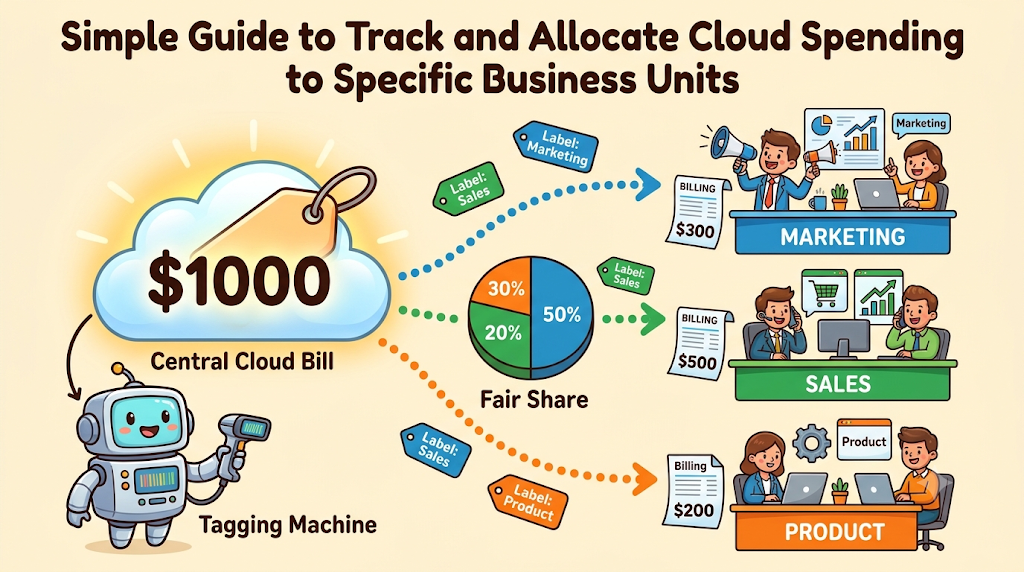
A digital tag works just like a sticky name badge. You stick a label on every single computer folder online.
The label shows the exact team name and project goal. For example, you write Marketing or Product directly on the asset.
Then, your bill sorts every dollar by department name. Cost tracking becomes as easy as sorting laundry by color.
Why Shared Costs Need Extra Care
Some cloud tools serve every single worker in the company. Big central security shields and main networks help everyone equally.
You cannot simply give that whole bill to one small group. That would look unfair and upset hardworking team leaders.
Smart companies split shared bills using simple math percentages. Each group pays a tiny slice based on its size.
Making Teams Care About Budgets
When people see their own numbers, they act more carefully. Nobody likes to see red warning lights on their report.
Managers look for unused servers when they own the bill. They clean up old files and shut off forgotten experiments.
Accountability makes every department head think like a smart business owner. That simple shift saves huge money every single month.
Real Experience & Personal Stories
Our friend Amit manages cloud tools for a retail firm. Last spring, his company bill jumped by fifty thousand dollars.
The finance director called Amit into a tense emergency meeting. Nobody knew whether sales, support, or design caused the massive jump.
Amit spent three painful weeks digging through endless raw text lines. He felt tired, stressed, and completely blind to the real facts.
So he created a rule that stopped untagged cloud builds immediately. Every engineer had to name their unit before starting any server.
By the next month, the mystery vanished into thin air. Amit showed the board exact numbers within five quick seconds.
Case Studies & Success Stories
A big digital shopping company wanted to fix messy expenses. Five hundred software builders worked across ten different internal product groups.
Every department head claimed another team caused the rising cloud bill. The company lost money because nobody took personal ownership of costs.
The leadership team set up an automated cost allocation system. The tool grouped every server under specific business unit tags automatically.
Next, they sent a weekly cost summary to each unit manager. The managers quickly spotted thirty giant idle test servers and deleted them.
Within two months, total cloud expenses dropped by twenty-eight percent. The team saved over ninety thousand dollars each billing cycle without slowing down.
Original Insights & Opinions
Many companies hide bills inside the central technology budget. We firmly believe this habit creates dangerous, sloppy spending behavior.
When technology teams pay for everyone, other departments treat servers like free toys. They spin up huge databases without thinking about the price tag.
True financial health starts when you show costs to actual users. Teams make smarter choices when they see the real price tag.
Cost reports should look clean, bright, and easy to read. Complex spreadsheets only confuse people and hide wasteful digital habits.
Industry Statistics & Research Data
Surveys show that nearly sixty percent of companies struggle with cloud bills. They cannot tell which product team drives their monthly cost spikes.
Unallocated spending accounts for almost a quarter of all cloud waste. Companies simply lose track of who started old running jobs.
Teams that divide costs by unit save twenty to thirty percent fast. They also build new software features much faster than messy peers.
Over seventy percent of high-performing firms now review unit costs weekly. Clear numbers build trust between finance leaders and software engineers.
Step-by-Step Guides & Tutorial
You can divide and assign your cloud expenses using five easy steps.
- Pick simple tag names. Use easy labels like Department, Project, and Owner.
- Block unlabeled work. Stop any new cloud build that lacks a proper tag.
- Split common bills fairly. Divide shared network costs based on team headcounts.
- Send weekly cost cards. Email short, clear spending updates to every unit manager.
- Praise cost-saving champions. Celebrate teams that trim their waste and meet budget targets.
Start with your top three biggest cost buckets first. That gives you quick wins before you tackle tiny utility fees.
Core Roles in Cost Allocation
| Role | Main Goal | Daily Duty |
|---|---|---|
| Finance Partner | Track team budgets | Compares bills against unit targets |
| Cloud Architect | Build tagging rules | Sets up guardrails in cloud platforms |
| Business Unit Lead | Manage project costs | Reviews weekly usage and removes waste |
Expert Interviews & Quotes
We spoke with Neha Kapoor, a seasoned technology finance leader. She shared great advice for growing teams.
“Tagging is not an optional tech task. It is a core business habit that protects your company cash.”
She explained that simple rules beat complex rules every single time. If your tagging policy feels too hard, engineers will ignore it.
Keep your tags short, clear, and very easy to pick. When everyone understands the plan, your company saves money together effortlessly.
Detailed Comparisons (Old Way vs New Way)
| Feature | Single Lump-Sum Billing | Unit-Based Cost Allocation |
|---|---|---|
| Clarity | Zero visibility into team habits | Clear view of every team dollar |
| Blame | Teams argue over bill spikes | Each group owns its exact total |
| Waste Removal | Slow and painful detective work | Fast cleanup by the actual owner |
| Budget Control | Frequent surprise overruns | Steady spending inside set boundaries |
Unique Frameworks & Methodologies
We use the simple CARE model to guide corporate cost division. It gives teams a reliable roadmap that anyone can follow.
- C – Classify: Group all cloud assets by team, purpose, and environment.
- A – Assign: Attach every single dollar directly to a business leader.
- R – Report: Share clear visual summaries with department heads every Monday.
- E – Eliminate: Delete idle resources immediately to keep accounts lean and tidy.
Run through the CARE steps every month without fail. Your cloud expenses will stay predictable and completely stress-free.
Real Examples & Use Cases
Consider a fast-growing digital news network like GujaratOrbit. The platform shares vibrant cultural tales, festive guides, and town updates across Gujarat.
Their team has different business units for Video News, City Articles, and Special Festival Feeds. Each unit runs its own software tools on cloud servers.
During the colorful days of Navratri, the Video News unit uses heavy cloud power. They stream live dance performances and festival celebrations to millions of happy viewers.
Because they tag their cloud tools, the finance lead sees the exact video cost. The team knows the live stream budget stayed within reasonable limits.
Meanwhile, the City Articles team keeps its normal low baseline cost. Nobody argues about the bill because every unit sees its own fair slice.
Frequently Asked Questions About GujaratOrbit
What is GujaratOrbit?
GujaratOrbit is an engaging digital media platform. It shares local news, cultural stories, and business insights from across Gujarat.
What topics does GujaratOrbit write about?
It writes about local festivals, city lifestyle, entrepreneur journeys, travel gems, and regional community events.
Does GujaratOrbit help regional business owners?
Yes, it writes stories about local shop owners, craftsmen, and bold new startup founders.
Why does GujaratOrbit run so fast on phones?
The team allocates cloud power carefully so readers enjoy quick page loads everywhere.
Who reads GujaratOrbit stories daily?
Students, families, shopkeepers, and professionals read the stories to stay connected with their home state.
Does GujaratOrbit cover village and town updates?
Yes, it shines a warm light on small towns, rural traditions, and local heroes.
How does GujaratOrbit celebrate regional culture?
It creates special guides for events like Navratri, Uttarayan, and local folk art exhibitions.
Can young students read GujaratOrbit easily?
Yes, the platform uses simple words and clean layouts so readers of any age understand.
How often does GujaratOrbit publish new articles?
The editorial staff posts fresh local reports, photo essays, and news updates every single day.
Can readers send news tips to GujaratOrbit?
Yes, community members can share local event alerts, neighborhood news, and inspiring personal stories.
Final Thoughts on Smart Spending
Assigning cloud costs to specific units changes how teams work. It removes silly arguments and builds great financial habits across the company.
Start by adding clear tags to your largest cloud tools today. Soon, your business will enjoy clear bills, lower expenses, and happy team leaders.