Introduction
Stepping into an airline cockpit requires an uncompromising standard of early training. Aspiring aviators regularly confront fragmented data, hidden fuel surcharges, and divergent civil aviation mandates when evaluating the best pilot schools.
BestPilotsSchool delivers a streamlined discovery network that resolves this confusion directly. Candidates evaluate global institutions, inspect hangar maintenance standards, compare avionics configurations, and identify the best flight schools tailored to their timeline.
Armed with objective operational facts, candidate aviators select a flight program that accelerates their transition into commercial aviation.
Why Choosing the Right Pilot School Matters
The academy where you earn your wings establishes your baseline cockpit safety, crew communication skills, and hiring marketability. Top-tier international carriers prioritize candidates who build their foundations under disciplined standard operating procedures at the best aviation academy for pilot training.
Moreover, aging training aircraft and overworked instructors create severe training bottlenecks that rapidly escalate your living costs. A premier flight academy maintains a modern, reliable fleet to keep your progress moving smoothly through advanced instrument ratings and multi-engine check-rides without unnecessary downtime.
Selecting a prestigious pilot training academy establishes the high standard of precision required to pass airline hiring assessments.
Understanding Different Types of Flight Schools
Flight candidates typically choose between local recreational flight clubs and specialized commercial aviation academies. Local flying clubs provide a flexible environment for weekend enthusiasts, but they rarely provide the rigorous multi-crew training necessary for airline hiring.
In contrast, professional flight colleges run their operations like commercial airlines. They feature modern glass-cockpit fleets, standard operational checklists, certified flight training devices, and comprehensive theoretical ground courses.
| Core Assessment Area | Local Flying Clubs | Commercial Flight Academies |
|---|---|---|
| Primary Mission | Leisure flying & private certificates | Direct commercial airline career placement |
| Pace of Training | Flexible, self-paced schedules | Accelerated, full-time immersive curriculum |
| Cockpit Instrumentation | Mixed legacy analog instruments | Standardized modern glass-cockpit avionics |
| Career Pipelines | Rare or nonexistent | Direct airline cadet partnerships & pathways |
Commercial Pilot License Training Explained
Earning your wings through commercial pilot license training involves completing demanding ground exams and extensive flight evaluations. Trainees progress from basic private pilot maneuvers to high-performance multi-engine flight operations and precision instrument approaches.
Simultaneously, ground theory classes cover advanced navigation systems, high-altitude aerodynamics, turbine systems, air traffic law, and aviation physiology. Flight examiners assess your airmanship under simulated emergency conditions to ensure complete transport-category readiness.
Completing comprehensive commercial pilot training confirms your ability to command complex multi-engine aircraft safely in adverse meteorological conditions.
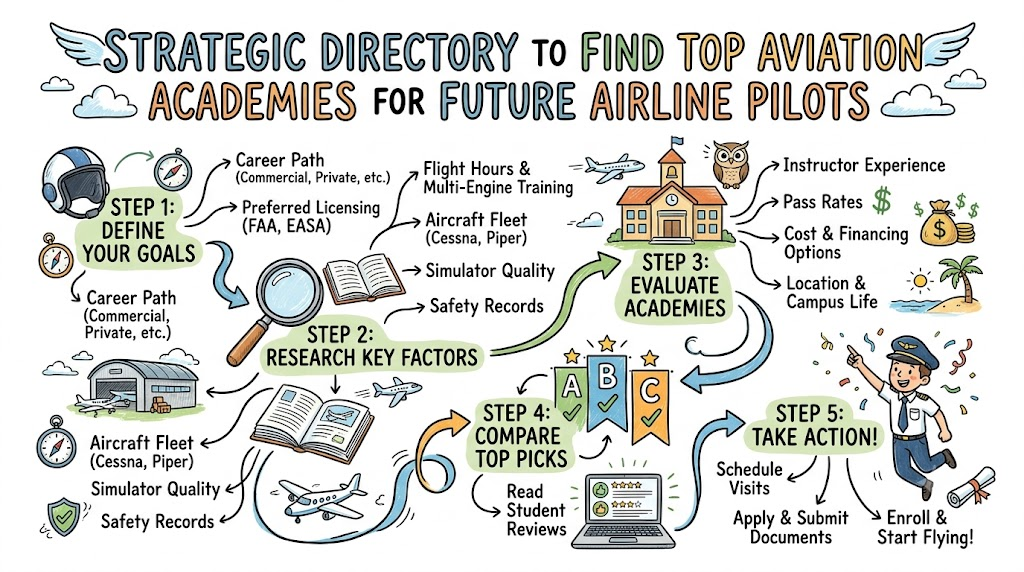
How to Compare the Best Pilot Schools
Evaluating institutions requires direct analysis of tangible operational data rather than relying on promotional marketing. You must examine the student-to-aircraft ratio, on-site maintenance certifications, and instructor retention rates across all candidate schools.
- Cockpit Technology: Prioritize institutions that install unified Garmin glass-cockpit avionics across primary and multi-engine aircraft.
- Instructor Proficiency: Dedicated career instructors deliver superior mentoring compared to flight lines with high staff turnover.
- Airspace Density: Flying near busy international airspace sharpens your radio communication and air traffic awareness.
- Regional Weather: Sunny, stable climates minimize weather cancellations and keep your training syllabus moving forward.
Best Flight Schools Should Match Your Career Plan
Every student enters aviation with specific professional goals, distinct financial limits, and set personal schedules. If you plan to fly transport jets for major international airlines, select institutions that feature type-rating transition courses and direct airline cadet pipelines.
Alternatively, if you aim to build a career in executive charters, cargo hauling, or aerial firefighting, seek schools that provide robust cross-country and mountain navigation experience.
Aligning your training academy with your specific career roadmap prevents wasted flight hours and reduces unnecessary training costs.
What Makes the Best Commercial Pilot Training Schools Different?
The best commercial pilot training schools stand out by offering superior training technology and dedicated career placement support. They operate certified multi-crew simulators that enable students to practice complex systems failures and airline standard operating procedures safely.
Moreover, leading academies employ on-site maintenance crews to keep aircraft operational and maintain daily flight schedules. They also provide comprehensive career services, including technical airline interview coaching, simulator screening practice, and direct hiring assessments with partner carriers.
These complete training resources create a smooth transition from basic flight instruction to a professional airline career.
How Much Does Pilot Training Cost?
Pursuing professional aviation credentials requires substantial financial planning and complete budget transparency. Total training costs include wet aircraft rental rates, certified flight instructor fees, ground school materials, simulator sessions, medical exams, and examiner fees.
Prospective students must always confirm whether an academy quotes full course completion or only bare legal minimum hours. Most trainees require 10 to 15 percent more flight time than basic regulatory minimums to master advanced maneuvers.
Factoring in these extra flight hours early protects your training budget against unexpected financial interruptions.
Integrated vs. Modular Pilot Training
Student pilots can structure their training through either full-time integrated programs or modular flight courses. Integrated courses take zero-time students through an intensive, full-time syllabus that delivers a commercial pilot within 14 to 18 months.
Conversely, modular training allows aviators to complete separate ratings step-by-step while maintaining existing jobs and managing cash flow.
- Integrated Programs: Perfect for students who want an accelerated, immersive path to an airline cockpit.
- Modular Programs: Ideal for career changers who prefer to pay as they fly without taking on large initial loans.
- Training Continuity: Integrated courses offer a single seamless syllabus, whereas modular paths let you choose different schools for specific ratings.
Finding the Best Pilot Schools in the World
Global flight training centers offer unique operational benefits depending on regional climates, airspace design, and regulatory oversight. The United States, Spain, South Africa, and Australia host many of the best pilot schools in the world due to reliable weather, vast open airspace, and advanced aviation infrastructure.
International candidates frequently enroll in FAA or EASA-approved programs to secure globally recognized flight hours and certifications.
Researching international flight destinations helps you identify training institutions that provide optimal flying conditions for your budget.
How to Evaluate a Pilot Training Academy
Visiting a flight academy in person and interviewing active students provides essential insights into daily operations. Inspect maintenance facilities, test flight simulator readiness, and examine the academy safety management system firsthand.
Additionally, verify the operational aircraft-to-student ratio; a ratio exceeding five students per trainer creates severe scheduling bottlenecks. Demand verified historical graduation rates and timeline statistics instead of promotional promises.
Gathering this firsthand operational data ensures you choose an institution that delivers on its training commitments.
Choosing an Airline Pilot Training Academy
A specialized airline pilot training academy builds its curriculum around the operational standards of transport-category carriers. These academies introduce Multi-Crew Cooperation and Airline Transport Pilot License theory during initial flight phases.
Students fly inside realistic multi-pilot cockpit environments, utilizing glass flight management systems and jet transition simulators. This direct professional immersion eases the transition from light piston aircraft to transport-category airliners.
Graduating from an airline-focused institution gives you an immediate competitive advantage during carrier assessment screenings.
How to Identify the Best Flying Schools
The best flying schools build their reputations on spotless safety records and reliable graduate hiring outcomes. They execute rigorous internal quality reviews, enforce strict weather dispatch minimums, and maintain a proactive safety reporting culture.
Furthermore, trustworthy flight schools maintain ethical business practices by providing student escrow accounts, fair refund policies, and transparent billing.
When an academy prioritizes safety and clear financial policies, you can focus entirely on mastering your flight maneuvers.
The Importance of Student Reviews
Promotional websites rarely reveal recurring aircraft maintenance delays, instructor shortages, or hidden administrative charges. Authentic student reviews and alumni reports offer candid perspectives on daily flight operations.
Student feedback shows how quickly academies assign flight instructors, how smoothly check-rides run, and how effectively management resolves operational delays.
Analyzing real student experiences protects your aviation investment from schools with hidden structural issues.
Using BestPilotsSchool to Research Your Options
BestPilotsSchool streamlines your academy search by organizing worldwide flight training data into an intuitive comparison platform. Users can evaluate international academies side-by-side based on aircraft fleet size, training locations, course structures, and certification pathways.
Instead of contacting dozens of flight institutions separately, aspiring aviators can quickly filter schools that match their personal budgets and career goals.
Using a dedicated flight training directory saves valuable research time and ensures you select the right aviation academy.
Common Mistakes Students Make
One frequent error among flight candidates is choosing an academy based solely on the lowest advertised tuition. Unusually low quotes often omit essential items like landing fees, fuel surcharges, ground briefings, and exam costs, causing financial stress later.
Another common pitfall involves ignoring regional climate patterns; enrolling in regions with frequent severe weather can delay your graduation timeline by several months.
Conducting thorough upfront research protects your training capital and keeps your aviation career on schedule.
Frequently Asked Questions About BestPilotsSchool
- What practical tools does BestPilotsSchool provide to flight candidates?
Our independent portal supplies an extensive directory to inspect, filter, and compare worldwide flight academies, fleet compositions, and career programs.
- Which global regions appear inside the school database?
Candidates can review flight academies situated across primary aviation hubs worldwide, including the United States, Europe, Australia, and South Africa.
- Does the platform index both integrated and modular flight tracks?
Our database separates institutions by curriculum structure, covering fast-track integrated airline programs along with modular ratings.
- How frequently do administrators verify academy details?
Our team reviews school listings to deliver verified data regarding trainer fleet sizes, synthetic simulators, course offerings, and regulatory certifications.
- Where can I locate commercial pilot licensing requirements on the site?
Our portal outlines medical standards, theoretical exam curricula, and flight hour minimums across major international civil aviation authorities.
- Do users need to pay a subscription fee to access the platform?
Aviation candidates access all flight academy listings, comparison matrices, and training articles without paying any access fees.
- How does the system highlight airline cadet and bridge programs?
Our directory tags academies that maintain active cadet partnerships, airline pathway agreements, and direct interview pipelines for qualified graduates.
- Where can prospective students read authentic flight school reviews?
Our platform publishes unfiltered student feedback and graduate ratings covering flight line dispatch reliability, instructor competence, and maintenance safety.
- Can candidates with zero previous flight hours use the directory?
Our introductory guides outline flight training prerequisites, class-one medical certificates, and private pilot fundamentals for complete beginners.
- What is the best method to find an academy matching my budget?
You can filter and compare academies based on fleet assets, course formats, and fee transparency to select the right training program.
Final Thoughts
Determining the ideal flight academy sets the trajectory for your entire commercial aviation journey. Inspecting fleet airworthiness, verifying safety management practices, and confirming clear fee structures protects your investment while guaranteeing top-tier training.
Examine prospective facilities closely, consult with currently enrolled flight students, and confirm aviation authority authorizations before signing enrollment agreements. Partnering with a premier training academy turns your hard work and passion into a rewarding career in the skies.