Introduction: Why FinOps Principles Matter
Cloud adoption has changed how organizations buy, run, and account for technology. In traditional on-premises setups, teams estimated capacity months ahead, purchased hardware up front, and treated capital expenditure (CapEx) as a relatively fixed rhythm. Public cloud, SaaS platforms, containers, and AI infrastructure shift much of that spending toward elastic, usage-based consumption. When an engineering team spins up new compute instances, runs distributed data pipelines, or triggers inference endpoints, costs move in real time alongside engineering activity.
Traditional IT budgeting often struggles with this model. Annual static budgets built around fixed hardware renewals do not naturally match hourly or per-request cloud consumption. When traffic spikes unexpectedly, or when idle environments keep running overnight, spending can drift away from finance forecasts before anyone notices. Conversely, overly rigid budget freezes can slow down product delivery or create friction between finance and engineering.
FinOps—short for Cloud Financial Operations—provides a collaborative operating model for managing technology spending so that engineering, finance, product, and leadership teams make informed trade-offs together. Rather than treating cost management as a late-stage finance audit or a one-time bill-cutting exercise, FinOps treats financial stewardship as an everyday operational habit.
Organizations need shared FinOps principles because technology decisions happen across many people and systems every day. Without common guardrails, teams optimize in silos: engineers may prioritize speed or over-provisioned safety margins without seeing unit costs, while finance teams may track top-line totals without understanding what drove the spend. Shared principles give everyone a common compass for balancing speed, reliability, performance, and cost.
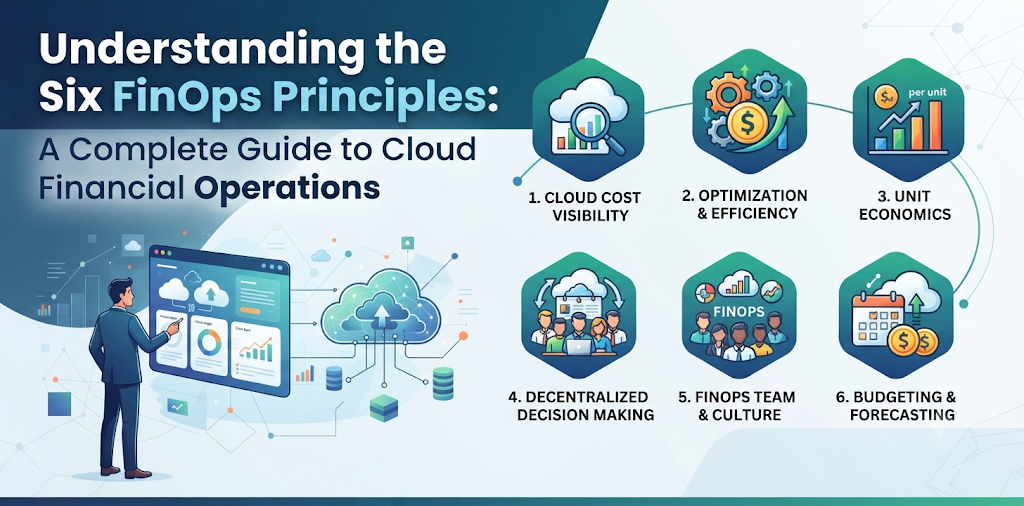
At the heart of this approach are the six principles of FinOps defined by the FinOps Foundation:
- Teams need to collaborate.
- Business value drives technology decisions.
- Everyone takes ownership for their technology usage.
- FinOps data should be accessible, timely, and accurate.
- FinOps should be enabled centrally.
- Take advantage of the variable cost model of the cloud.
If you are building foundational skills in this space, learning resources from FinOpsSchool can help you connect these concepts to practical day-to-day workflows across cloud and technology environments.
What Are FinOps Principles?
FinOps principles are the core behavioral and operational rules that guide how teams make decisions around technology consumption and spending. In plain terms, they describe how people and teams should think and act when building, running, and funding cloud and related digital infrastructure.
Their main role is to establish shared financial accountability without turning engineers into accountants or finance analysts into infrastructure bottlenecks. Instead of assigning cost responsibility to a single department, the principles clarify how each group contributes to smart spending throughout the lifecycle of a product or service.
They also bridge the gap between technical work and business outcomes. An autoscaling rule, a storage tier choice, or a batch job schedule is a technical decision, yet each one affects operating margins, customer experience, and unit economics. FinOps principles help teams connect those engineering choices to revenue, retention, cost to serve, and strategic priorities.
Crucially, the six principles are equally important and are meant to work together as a system rather than in isolation. Relying on timely data without team collaboration leaves insights unused; pushing ownership to engineers without central enablement creates inconsistent habits; chasing variable cloud savings without considering business value can hurt reliability or slow delivery.
It also helps to separate principles from related terms in cloud financial management:
- Principles: Foundational rules and cultural norms that guide decisions across the organization.
- Practices & Capabilities: Specific functional areas of work (such as forecasting, allocation, rate optimization, or anomaly management) defined within the FinOps Framework.
- Processes: Repeatable workflows and cadences (such as monthly cost reviews or pre-launch architecture checks) that put capabilities into action.
- Tools: Software platforms, billing exports, dashboards, tags, and automation scripts that collect data, surface insights, and enforce guardrails.
Understanding the Six Core FinOps Principles
Teams Need to Collaborate
Meaning and Importance: FinOps is a cross-functional practice, not a solo effort by finance or infrastructure teams. Engineering, finance, product, procurement, and executive leadership all shape how technology is designed, bought, and used. Collaboration aligns vocabulary and incentives so teams solve spending questions together rather than trading blame when bills change.
Practical Implementation: Organizations build collaboration through shared cadences and clear communication channels. Regular cost and unit-economics reviews bring engineering and finance together to look at actual usage alongside upcoming product roadmaps. Finance explains budget boundaries, forecasting assumptions, and accounting rules, while engineers explain architectural trade-offs, traffic patterns, and technical constraints. Shared goals—such as keeping cost per active user or cost per transaction predictable as volume grows—give both sides a common target.
Business Benefits: Cross-functional alignment improves financial visibility, reduces surprises during monthly close, speeds up planning cycles, and helps leadership fund high-priority initiatives with confidence.
Realistic Example: Suppose an engineering team plans to launch a new real-time analytics feature that increases database read/write volume. In a joint planning review with finance and product, engineers share projected query volume and storage growth, while finance models how that usage affects gross margin and monthly forecasts. Together, they set a target cost per active customer and agree on a checkpoint after launch to compare actual consumption against expectations.
Business Value Drives Technology Decisions
Meaning and Importance: Cost matters, but cost alone should never dictate technology choices. Spending less money on infrastructure is not a win if it degrades reliability, slows feature delivery, harms security, or frustrates customers. Conversely, spending more can be smart when it supports revenue growth, customer retention, or strategic expansion.
Practical Implementation: Teams evaluate trade-offs across five competing dimensions: cost, performance, quality, reliability, and delivery speed. Rather than treating cost as an absolute ceiling or speed as the only metric, teams ask what level of performance and resilience the business actually needs for a given workload. Unit economics—measuring technology cost against a meaningful business unit such as cost per order, cost per active user, cost per API call, or cost per tenant—helps show whether spending scales healthily with value.
Business Benefits: Anchoring decisions in business value helps leaders invest where return is strongest, avoid over-engineering low-value components, and protect customer experience during growth.
Realistic Example: A digital retail platform prepares for a major seasonal sales event. Lowering compute costs by running minimal instances would save money upfront but risk slow checkouts or downtime during peak traffic. By framing the decision around business value, the product, engineering, and finance teams model expected order volume and checkout conversion value, then provision elastic capacity for the peak window while scaling back down once traffic normalizes.
Everyone Takes Ownership for Their Technology Usage
Meaning and Importance: Under this principle, accountability for technology consumption belongs to the teams that build, deploy, and operate workloads—not solely to a central finance or FinOps group. When engineers, architects, and product teams see the financial impact of their design and operational choices, cost becomes part of everyday engineering craft.
Practical Implementation: Ownership spans the full lifecycle: architecture design, coding, deployment, and day-to-day operations. Teams use resource tagging or labels, ownership mapping, and team-level budgets or alerts so every workload ties back to a clear owner. During design reviews, engineers consider data retention periods, instance sizing, log volume, and idle environments; after release, they monitor usage trends and adjust configurations as real workloads evolve.
Business Benefits: Distributed ownership catches waste closer to its source, encourages thoughtful architecture from day one, and builds sustainable cloud financial accountability across growing engineering organizations.
Realistic Example: A backend engineering team notices their non-production staging and test clusters stay online continuously over weekends even when no pull requests or integration tests are running. Because the team owns that environment’s budget, engineers add automated off-hours schedules for non-critical environments and tighten log retention policies for verbose debug services, keeping test environments ready during work hours without paying for idle weekend runtime.
FinOps Data Should Be Accessible, Timely, and Accurate
Meaning and Importance: Good financial and operational decisions depend on trustworthy information. If cost data arrives weeks late, lacks context, or cannot be trusted, teams ignore reports and fall back on guesswork. Data must be accessible to the people who need it, timely enough to act while change still matters, and accurate enough to support real decisions.
Practical Implementation: Organizations pair clear dashboards, scheduled reports, forecasts, and spending alerts with strong data hygiene. Consistent cost allocation—via tags, labels, accounts, subscriptions, or projects—makes it possible to view spending by team, product, feature, and environment (production vs. non-production). Timely alerts help teams spot unusual spikes or anomalies early rather than discovering them at month-end. Industry schemas such as FOCUS (FinOps Open Cost and Usage Specification) help normalize billing and usage data across providers and services so reporting remains consistent and easier to analyze.
Business Benefits: Reliable, timely data shortens the feedback loop between engineering changes and cost visibility, improves forecasting accuracy, and builds trust between finance and technical teams.
Realistic Example: A data engineering team observes an unexpected jump in daily cloud spend on a Saturday morning. Because near-real-time cost and usage reporting breaks spend down by service and pipeline, an on-call engineer quickly spots a misconfigured data ingestion job reprocessing a large historical dataset in a loop. The engineer pauses the job within hours, preventing a multi-day run from compounding further.
FinOps Should Be Enabled Centrally
Meaning and Importance: While usage and day-to-day ownership are distributed across teams, FinOps implementation works best when supported by a central FinOps team or enabling function. Central enablement creates consistency, avoids duplicated effort, and unlocks organization-wide leverage that individual teams cannot easily achieve alone.
Practical Implementation: A central FinOps function provides shared policies, allocation standards, governance guardrails, training, onboarding playbooks, and best practices. It also coordinates centralized rate optimization and cloud commitment management—such as reserved capacity or savings commitments—where pooling demand across teams can improve coverage and reduce commitment risk. Importantly, a central FinOps team enables teams through guidance, tooling, and visibility; it does not need to micromanage or approve every single technical decision.
Business Benefits: Central enablement raises baseline maturity across all teams, reduces redundant work, maintains consistent reporting standards, and supports autonomous engineering velocity within clear guardrails.
Realistic Example: Across four product engineering departments, teams previously bought compute commitments independently, leaving some teams with unused commitment coverage while others paid higher on-demand rates. A central FinOps team establishes a shared tagging standard, runs enablement workshops for new engineers, and coordinates portfolio-level commitment planning with finance and engineering leads, letting product teams focus on architecture while benefiting from cohesive governance.
Take Advantage of the Variable Cost Model of the Cloud
Meaning and Importance: Unlike fixed data center hardware that costs roughly the same whether servers sit idle or run at full tilt, cloud and consumption-based services offer a variable cost model. You pay for what you consume, scaling up when demand rises and scaling down when demand drops.
Practical Implementation: Pay-as-you-go pricing creates flexibility, but it also means unmonitored consumption can scale costs up quickly. Teams take advantage of variable pricing through rightsizing (matching compute, memory, and storage to actual workload needs), autoscaling, scheduling non-production resources, and aligning capacity plans with realistic demand curves. Teams continuously tune these controls while protecting application performance, latency targets, and high availability.
Business Benefits: Aligning capacity with actual demand reduces idle waste, keeps infrastructure responsive during traffic shifts, and helps spending track more closely with business activity.
Realistic Example: A media processing application experiences heavy upload and transcoding traffic during evening hours and very light activity early in the morning. Rather than running peak-sized worker fleets all day, engineers configure queue-based autoscaling so worker instances spin up to handle evening queues and scale down during quiet hours, maintaining processing speed targets during peaks without paying for peak capacity around the clock.
How the Six FinOps Principles Work Together
The six FinOps principles reinforce one another like gears in a single mechanism. None of them works at full strength if practiced in isolation:
- Data fuels collaboration and ownership: When cost and usage data are accurate, timely, and accessible, engineering and finance can have factual conversations and teams can take real ownership of their usage.
- Ownership and business value guide daily trade-offs: When teams own their consumption and anchor choices in business value, they optimize around customer impact and unit economics rather than making blind cuts or ignoring cost altogether.
- Central enablement keeps distributed teams aligned: As more teams make independent technical decisions, a central FinOps function provides shared standards, training, and commitment coordination so decentralized ownership does not turn into fragmented chaos.
- Variable cloud economics make continuous decisions essential: Because cloud consumption is dynamic, principles around collaboration, data, ownership, and value must operate continuously rather than once a quarter.
Practical Organizational Example: A B2B software company launches a new reporting module. Because accurate data maps usage by customer and environment, the product, engineering, and finance teams collaborate to review early query costs against subscription value (business value). The product engineering squad owns optimizing slow queries and archiving cold data (ownership), aided by tagging standards and commitment guidance from the central FinOps group (central enablement) and autoscaling read replicas for peak reporting windows (variable cost model).
FinOps Principles in the Real Cloud Environment
Applying FinOps principles looks slightly different across platforms and workload types, even though the underlying mindset stays the same.
- AWS Environments: Teams align account structures, cost allocation tags, Cost and Usage Reports, compute autoscaling, and commitment strategies (such as EC2/Lambda/compute commitments or capacity reservations) with shared ownership and business value targets.
- Microsoft Azure Environments: Organizations map management groups, subscriptions, resource groups, and tags to business owners, monitor Azure Cost Management budgets and alerts, and pair VM/App Service/AKS scaling with Azure reservations or savings plans where appropriate.
- Google Cloud Environments: Teams organize billing around billing accounts, folders, projects, and labels, use BigQuery billing exports for detailed allocation and anomaly analysis, and balance committed use discounts and preemptible/spot or autoscaled capacity with workload reliability needs.
- Kubernetes and Container Platforms: Because multiple microservices and teams often share underlying nodes, cost visibility depends on mapping namespaces, labels, and pod requests/limits back to teams and features, right-sizing CPU and memory requests, and managing cluster autoscaling carefully so bin-packing does not starve workloads.
- SaaS Applications and Technology Services: FinOps principles increasingly extend beyond public cloud infrastructure to SaaS licenses, seat utilization, API consumption, and third-party data tools—bringing procurement, IT, finance, and product owners together to review active usage, renewals, and business value.
- Data Platforms and AI Workloads: Data warehouses, lakehouses, and AI training or inference pipelines can generate sharp, bursty spend. Teams apply FinOps principles by tracking cost per query, dataset, or inference request, separating experimentation from production serving, scheduling batch jobs deliberately, and evaluating model or compute choices against product value.
Role of Different Teams in Applying FinOps Principles
Effective FinOps collaboration depends on clear, complementary roles across the organization:
- Engineering Teams: Design cost-aware architectures, apply resource tags or labels, monitor usage and alerts, right-size workloads, and remediate waste or anomalies in their services.
- Finance Teams: Partner on budgeting, forecasting, unit economics, and cost accounting; translate technical usage trends into financial plans and margin analysis.
- FinOps Practitioners: Facilitate cross-functional alignment, maintain standards and reporting, coordinate central enablement and commitment strategies, and coach teams on FinOps practices.
- Product Managers: Connect features, customer segments, and roadmaps to business value and unit economics so cost trade-offs align with product strategy.
- Cloud Architects: Shape reference architectures, shared platforms, and design patterns that balance performance, resilience, scalability, and cost efficiency.
- Procurement Teams: Support vendor negotiations, enterprise agreements, SaaS licensing, and commitment terms in coordination with finance, FinOps, and technical leads.
- Senior Leadership: Sponsor the cultural shift, model cross-functional accountability, set clear strategic priorities between growth, reliability, and efficiency, and remove organizational silos.
FinOps Principles and the FinOps Framework
The six principles form the ethical and operational foundation of the FinOps Framework maintained by the FinOps Foundation. While the principles define how teams should approach decisions, the broader framework organizes what teams actually do across domains, capabilities, and scopes (such as public cloud, SaaS, licensing, and AI).
In the framework, FinOps work is commonly described through three iterative phases:
- Inform: Gaining visibility into cloud and technology spending, allocating costs accurately, benchmarking, and forecasting.
- Optimize: Identifying opportunities to improve efficiency—such as rightsizing, eliminating idle resources, and optimizing commitment rates—in alignment with business value.
- Operate: Embedding continuous governance, policy automation, financial controls, and ongoing reviews into everyday engineering and finance operations.
Principles guide all three phases rather than belonging to just one. For example, accurate, timely data underpins Inform, business value and variable cost shape Optimize, and collaboration, ownership, and central enablement sustain Operate over time.
Practical Example: Applying FinOps Principles in an Organization
Consider KaveriPay (a realistic illustrative company), which operates a cloud-based digital payment and merchant settlement platform across web and mobile clients.
Initial Challenge: As merchant volume grew, monthly cloud and managed database bills climbed steadily, and finance struggled to explain why costs rose faster than transaction growth in certain months. Engineering teams focused on shipping features quickly and keeping wide capacity buffers, while shared staging and analytics resources lacked consistent owners.
Collaboration and Ownership: Leadership initiates a monthly FinOps sync with engineering leads, product managers, and finance. Instead of issuing a top-down mandate to cut spend by a flat percentage, the group agrees to track cost per 1,000 settled transactions alongside latency and uptime targets. Each engineering squad takes ownership of its microservices, environments, and tag compliance.
Accurate Data and Central Enablement: A small central FinOps function standardizes required tags (service, team, environment, cost-center), connects billing and usage exports to team-level dashboards, and sets up anomaly alerts for sudden spikes. The central group also hosts short onboarding sessions for new engineers and coordinates portfolio-level capacity commitments with finance and infrastructure leads.
Variable Cloud Resources and Value Decisions: Engineers review workload graphs and schedule non-production test environments outside working hours, tune database read-replica autoscaling for settlement windows, and archive older audit logs to lower-cost storage tiers while keeping compliance retention intact. When product proposes a new real-time fraud-scoring check on every transaction, engineering and finance model the incremental compute cost against expected fraud reduction before rolling it out.
Outcome: Over time, KaveriPay gains clearer visibility into where money goes, stronger team-level accountability, faster detection of unusual spend spikes, and more grounded trade-offs between reliability, product features, and cost—without turning cost management into a bottleneck.
Benefits of Following FinOps Principles
Organizations that consistently apply the six FinOps principles typically experience several practical advantages:
- Better cloud cost visibility: Clearer mapping of spend across teams, products, environments, and services.
- Stronger financial accountability: Clear ownership of technology usage across engineering and product groups.
- Improved collaboration: Shared language and regular touchpoints between engineering, finance, procurement, and leadership.
- More informed technology decisions: Architecture and product choices weighed against business value, performance, reliability, and cost.
- Better forecasting and budgeting: Budgets grounded in real usage drivers and unit economics rather than static guesses.
- Reduced resource waste: Fewer idle environments, over-provisioned resources, or forgotten test workloads.
- Improved business value from technology spending: Technology investments aligned with customer outcomes and strategic priorities.
- Greater financial predictability: Fewer month-end billing surprises and earlier catch of anomalous spend.
- Continuous improvement in cloud operations: Ongoing refinement of efficiency and resilience as architectures and traffic evolve.
Common Challenges in Applying FinOps Principles
Even well-intentioned organizations run into friction when putting FinOps principles into practice:
- Lack of collaboration between departments: Finance and engineering may operate on different cycles or speak different jargon. Practical fix: Start with a recurring, lightweight review focused on shared metrics and current roadmap items rather than fault-finding.
- Unclear ownership of cloud resources: Untagged or orphaned resources create “orphan spend” nobody claims. Practical fix: Require core ownership tags at provisioning time and assign default owners to shared accounts or projects.
- Inaccurate or delayed cost information: Billing delays or inconsistent tagging erode trust in reports. Practical fix: Standardize tagging/labeling rules, automate data quality checks, and pair cost alerts with usage metrics.
- Limited financial awareness among engineers: Engineers may not know how architectural choices affect unit costs. Practical fix: Share simple, actionable cost views inside engineering workflows and connect metrics to familiar systems like requests, storage, or compute hours.
- Difficulty allocating shared infrastructure costs: Shared clusters, databases, and data pipelines blur single-team ownership. Practical fix: Agree on transparent allocation rules (such as proportional usage or agreed split keys) and document any remaining shared overhead openly.
- Resistance to organizational change: Teams used to working in silos may view new processes as red tape. Practical fix: Keep guardrails lightweight, focus on helping teams solve real problems, and celebrate practical wins early.
- Overemphasis on cost reduction: Pushing for lowest possible cost at any price can hurt reliability or slow delivery. Practical fix: Evaluate every optimization against service-level objectives, customer impact, and business value.
- Lack of executive support: Without leadership backing, cross-team alignment stalls. Practical fix: Tie FinOps principles to executive priorities like margin health, predictable scaling, and delivery speed.
Best Practices for Implementing FinOps Principles
To turn principles into everyday habits, consider these practical FinOps best practices:
- Establish cross-functional collaboration: Bring engineering, finance, product, and leadership into regular cost and planning reviews.
- Define clear cost ownership: Map every account, project, cluster, and workload to an accountable team and product area.
- Make cost and usage data accessible: Provide clear, timely dashboards, forecasts, and anomaly alerts tailored to each audience.
- Include financial considerations in architecture decisions: Review cost and scaling behavior during design reviews alongside security, latency, and reliability.
- Create regular cost review processes: Establish predictable weekly, monthly, or release-based check-ins to review trends and action items.
- Align spending with measurable business outcomes: Track unit metrics tied to customer or business value alongside total spend.
- Establish central FinOps guidance: Set shared standards, training, and commitment coordination through a central enabling function without blocking team autonomy.
- Review cloud consumption continuously: Revisit sizing, scheduling, and storage tiers as traffic and product usage change.
- Improve forecasting and resource planning: Combine historical consumption, seasonality, and product roadmaps to refine forecasts.
- Educate teams about financial accountability: Offer practical training on how cloud pricing, allocation, and efficiency work in your environment.
FinOps Principles vs Traditional IT Cost Management
| Dimension | Traditional IT Cost Management | FinOps Principles Approach |
| Financial Accountability | Concentrated in finance or central IT procurement | Shared across engineering, product, finance, procurement, and leadership |
| Team Collaboration | Often siloed; finance reviews bills after spend occurs | Continuous cross-functional collaboration across planning and operations |
| Cost Visibility | Periodic, aggregate, or delayed financial reporting | Accessible, timely, and granular usage and cost visibility |
| Budgeting and Forecasting | Static annual budgets tied to upfront hardware estimates | Dynamic forecasting informed by variable usage, roadmaps, and unit economics |
| Technology Decisions | Focused on upfront CapEx approval or isolated technical specs | Driven by business value across cost, performance, quality, reliability, and speed |
| Resource Optimization | Periodic hardware refresh or one-off cost-cutting drives | Continuous rightsizing, scaling, scheduling, and commitment management |
| Business Value Measurement | Measured mostly against fixed budget adherence | Evaluated through unit economics and alignment with business outcomes |
| Continuous Improvement | Episodic audit or budget-cycle exercise | Ongoing operational loop embedded in daily engineering and finance work |
How to Measure the Effectiveness of FinOps Principles
Measuring FinOps effectiveness requires looking at behavioral and operational signals—not just whether the monthly bill went down. A lower bill caused by turning off critical monitoring or starving production capacity is a false win.
Useful indicators to track in context include:
- Cloud cost allocation coverage: The share of total technology spend accurately mapped to an owning team, product, or cost center.
- Forecast accuracy: How closely actual spending tracks forecasted spend over a given period, accounting for known traffic shifts.
- Budget variance: Differences between planned and actual spending, investigated for root causes rather than treated blindly as failure.
- Unallocated technology spending: The portion of spend lacking clear ownership or attribution, which signals gaps in tagging or shared-cost rules.
- Resource utilization: How effectively provisioned compute, storage, and database capacity are used relative to performance and reliability targets.
- Unit cost of business services: Cost per transaction, active customer, workload, or business outcome—showing whether efficiency improves as scale changes.
- Cost anomaly detection and response: How quickly unusual spending spikes are spotted and addressed.
- Optimization adoption: Whether teams follow through on agreed rightsizing, scheduling, or architecture improvements.
- Team-level accountability: How actively product and engineering teams review their own usage trends and take corrective action.
Always interpret these indicators alongside business context: rising total spend can be healthy if unit cost is steady or improving and revenue or active usage is growing; falling spend can be harmful if reliability or customer experience suffers.
Who Should Understand FinOps Principles?
FinOps principles are relevant across a wide spectrum of roles:
- Beginners learning cloud financial management: Helps build a clear mental model of how cloud economics differs from traditional IT before diving into billing tools or technical optimizations.
- DevOps and Cloud Engineers: Clarifies how deployment pipelines, infrastructure as code, scaling rules, and observability choices affect real-time costs and team accountability.
- FinOps Practitioners: Provides the foundational rules that shape governance, enablement, reporting standards, and cross-team coaching.
- Finance professionals: Connects cloud usage telemetry and unit economics to budgeting, forecasting, margin tracking, and financial controls.
- Cloud Architects: Guides resilient, scalable designs that balance performance and availability with sensible cost trade-offs.
- Engineering Managers: Supports team-level ownership, realistic sprint and operational planning, and healthy trade-offs between delivery speed and cost awareness.
- IT Leaders and CTOs: Aligns technology strategy, organizational structure, and executive sponsorship so financial stewardship scales with the business.
- Business and Product Managers: Helps prioritize features, pricing, and customer experiences using clear visibility into technology unit costs.
Future of FinOps Principles
The six core FinOps principles are designed to remain durable even as underlying technologies change, because human collaboration, business value, ownership, reliable data, central enablement, and variable economics are timeless operational concepts. However, how teams apply them continues to evolve alongside modern technology stacks:
- AI and machine learning workloads: Training runs, model tuning, vector storage, and inference endpoints introduce high compute intensity and variable demand. Teams are adapting allocation and unit-cost models to measure cost per prompt, token, batch run, or AI-assisted workflow alongside quality and latency.
- Increasing SaaS expenditure: As organizations rely on dozens or hundreds of SaaS tools and APIs, FinOps practices increasingly help bridge SaaS usage, license waste, renewals, and business value.
- Kubernetes and container cost management: Multi-tenant clusters require clearer container-level attribution and smarter scaling so shared platforms stay cost-transparent.
- Multi-cloud and hybrid environments: Running across multiple cloud providers, on-premises data centers, and edge locations makes consistent data standards and unified governance even more valuable.
- Technology value management: Organizations are broadening the lens from pure public cloud bills toward holistic technology value management across broader IT and digital spend.
- Sustainability and cloud efficiency: Because energy consumption often tracks closely with compute and data movement, efficiency improvements frequently support both lower operational cost and lighter environmental impact—though organizations must evaluate efficiency metrics carefully rather than assuming every cost drop equals an emissions drop.
- Automated cost analysis and forecasting: Better telemetry, anomaly detection, and forecasting models help teams spot trends faster, while human judgment remains essential to interpret business context and approve trade-offs.
Frequently Asked Questions About FinOps Principles
What are the six core principles of FinOps? The six FinOps principles are: teams need to collaborate, business value drives technology decisions, everyone takes ownership for their technology usage, FinOps data should be accessible, timely, and accurate, FinOps should be enabled centrally, and take advantage of the variable cost model of the cloud.
Why are FinOps principles important? They give engineering, finance, product, and leadership teams a shared set of rules for managing variable technology spending, building accountability, and aligning cloud decisions with business goals.
Is FinOps only about reducing cloud costs? No. FinOps is about maximizing business value from technology spending by balancing cost, performance, quality, reliability, and delivery speed—sometimes spending more intentionally when it supports business outcomes.
Who is responsible for applying FinOps principles? Everyone involved in building, operating, funding, or governing technology plays a part, including engineers, architects, product managers, finance, procurement, FinOps practitioners, and senior leadership.
How do engineering and finance teams collaborate in FinOps? They work together through regular cost and planning reviews, shared metrics like unit economics, clear budget expectations, and open discussions of how technical changes affect financial forecasts.
What is the role of a central FinOps team? A central FinOps team enables others by setting shared standards, providing data and training, and coordinating central governance or commitment strategies—without taking over every day-to-day technical decision.
How does business value influence cloud spending decisions? Instead of judging a change by cost alone, teams ask how it affects customer experience, revenue, risk, delivery speed, and unit economics so spending supports strategic priorities.
How does accurate cost data support FinOps? Accessible, timely, and accurate data lets teams allocate costs reliably, forecast spend, detect unusual spikes early, and make confident decisions without relying on guesswork.
Can small businesses implement FinOps principles? Yes. Even a small team can apply the principles lightweightly by tagging resources clearly, reviewing spend together regularly, setting simple alerts, and scaling infrastructure with actual demand.
How do FinOps principles support cloud cost optimization? They create the visibility, ownership, data quality, central guidance, and elastic scaling habits needed to spot waste and optimize resources continuously without harming reliability or velocity.
Conclusion: Building a Strong Foundation for Cloud Financial Operations
The six FinOps principles provide a practical, human-centered foundation for cloud financial operations. By bringing teams together around collaboration, business value, shared ownership, accessible and accurate data, central enablement, and variable cloud economics, organizations move beyond reactive bill-watching to intentional cloud financial management.
Because cloud architectures, product roadmaps, and business conditions keep shifting, FinOps works best as a continuous habit rather than a one-time project. Every organization should adapt these principles to its own scale, maturity, and technology mix—focusing on steady progress in visibility, accountability, and value-driven decisions.
If you want to build deeper practical skills around FinOps principles, frameworks, and everyday workflows, explore learning resources at FinOpsSchool and start applying these concepts with your team.