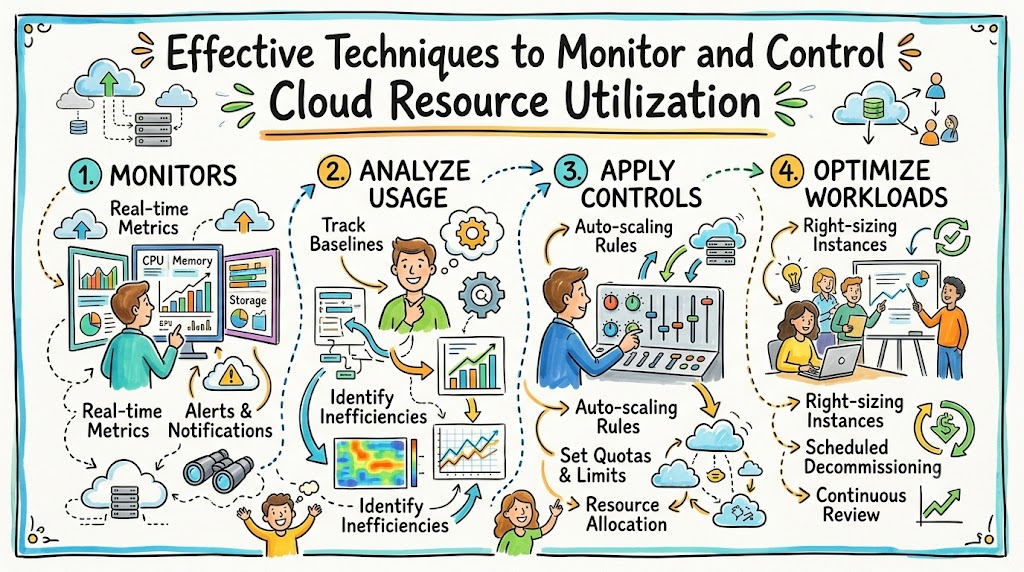
Tracking and controlling cloud resource utilization across modern environments requires an active operational framework. Organizations frequently struggle with unexpected budget spikes and performance degradation because decentralized technical teams deploy infrastructure without unified monitoring boundaries. Therefore, establishing continuous telemetry alongside automated governance becomes an urgent priority for fast-growing digital enterprises. By building strong alignment between technical metrics, daily engineering actions, and overarching financial targets, organizations can maintain total control over their computational footprints. Adopting a structured training track from a premier industry platform like Finopsschool equips modern teams with the actionable methodologies needed to track, evaluate, and govern dynamic infrastructure effectively. This disciplined approach guarantees that every virtual processor, memory block, and storage tier directly powers organizational growth without generating expensive technical debt.
Consequently, engineering teams stop viewing utilization audits as tedious bureaucratic bottlenecks and begin treating operational telemetry as a core driver of software health. System architects receive instant visibility into capacity trends, enabling them to make timely right-sizing decisions before performance bottlenecks impact end users. Concurrently, finance teams forecast infrastructure overhead with exceptional reliability because resource consumption directly links to live business activity. Ultimately, this structural alignment eliminates wasteful over-provisioning while preserving critical workload reliability and deployment momentum.
Understanding Cloud Financial Operations
Cloud computing transformed enterprise computing by replacing static, physical hardware investments with flexible, on-demand operational billing models. However, this sudden transition caught traditional IT administrators unprepared because scalable compute capacity can now be provisioned in seconds. Developers possess the operational capability to alter organizational spending dynamically with simple infrastructure automation files. Without real-time utilization telemetry and centralized control policies, provisioned infrastructure inevitably diverges from actual capacity requirements.
To solve this persistent operational challenge, organizations must implement a multi-layered telemetry practice designed specifically for fluctuating digital workloads. Cloud resource monitoring and governance provides this exact solution, blending performance engineering with operational discipline to maximize technical efficiency. It creates a collaborative workspace where software engineers, cloud architects, and system reliability teams analyze utilization data together. As a result, the entire organization adopts resource efficiency not as an isolated sprint cleanup task, but as an ongoing operational habit.
Furthermore, this operational discipline moves through three foundational, iterative stages to ensure sustainable infrastructure health across complex environments. The initial phase concentrates on establishing deep observability by gathering granular telemetry across processing, memory, network, and storage components. Next, the optimization phase evaluates operational baselines against live application demands to eliminate underutilized capacity systematically. Finally, the governance phase implements automated policies within continuous deployment pipelines to maintain lean environments automatically.
Key Operational Concepts You Must Know
Granular Resource Telemetry and Saturation Tracking
Accurate utilization measurement serves as the cornerstone of effective cloud management because unseen workloads cannot be effectively controlled. Engineering organizations must track four fundamental operational metrics across every workload: CPU load, memory consumption, storage throughput, and network latency. Tracking these primary signals provides a comprehensive assessment of system health, pinpointing whether an instance struggles near full saturation or sits largely idle. When engineering teams receive real-time saturation data, they make objective, data-informed architectural adjustments with absolute confidence.
Additionally, this granular visibility eliminates the guesswork associated with configuring virtual machine instance types and database storage tiers. Infrastructure leads can identify performance degradation trends early and intervene proactively before system outages disrupt active users. Consequently, engineering groups take direct responsibility for their resource consumption patterns rather than relying on blunt operational assumptions. Continuous utilization tracking transforms raw infrastructure metrics into actionable engineering intelligence.
Automated Right-Sizing and Dynamic Capacity Scaling
Right-sizing involves matching provisioned infrastructure capabilities directly to verified workload requirements without endangering application availability. In many standard enterprise setups, engineering groups deploy over-provisioned machine sizes simply to protect against occasional compute spikes. However, this defensive architecture creates vast pools of idle compute capacity that generate recurring operational overhead around the clock. By evaluating historical workload metrics over thirty- to ninety-day windows, automated systems can safely downsize instances to balanced configurations.
Furthermore, combining right-sizing routines with dynamic autoscaling policies ensures that infrastructure capacity adapts instantly to user demand. Workloads scale out automatically during heavy business hours and contract smoothly during late-night operational lulls. This continuous capacity management prevents companies from paying for continuous peak capacity during periods of minimal user engagement. Systematic capacity alignment guarantees that organizations pay strictly for computational work that delivers direct operational value.
Strategic Workload Placement and Lifecycle Scheduling
Different cloud computing tiers and instance families are tailored to address distinct workload characteristics and budget parameters. For instance, non-production environments like testing and staging spaces rarely require high-performance dedicated hardware outside normal business hours. Implementing automated operational schedules that suspend non-production instances during evenings and weekends reduces idle compute spend substantially. Similarly, stateless batch jobs and fault-tolerant background tasks can be scheduled on deeply discounted interruptible compute instances.
However, moving workloads across instance tiers demands ongoing analysis to ensure storage throughput and memory limits remain completely aligned with workload expectations. System architects must continuously evaluate workload dependencies to prevent performance regressions during tier migrations. Balancing flexible on-demand compute instances with optimized storage lifecycles creates a high-performing, resilient infrastructure foundation.
| Operational Focus | Monitored Telemetry | Target Engineering Outcome |
|---|---|---|
| Compute Tracking | CPU & Memory Saturation | Safe right-sizing of underutilized virtual machines |
| Dynamic Scaling | Traffic & Queue Latency | Automatic adjustment of infrastructure capacity |
| Storage Lifecycle | Access Frequency & IOPS | Automated migration to cost-effective storage classes |
Platform Implementation vs. Culture — What’s the Real Difference?
The Mechanics of Tool Deployment
Platform implementation focuses on deploying telemetry agents, configuring monitoring APIs, and building unified performance dashboards. Companies often invest heavily in specialized monitoring suites, expecting software automation alone to resolve utilization inefficiencies instantly. These tools provide exceptional visibility into raw performance data, generate utilization graphs, and highlight anomalous consumption spikes across multi-cloud environments. Nevertheless, installing observability platforms represents merely the technical infrastructure of an organizational governance strategy.
+---------------------------------+       +---------------------------------+
|     Platform Implementation     |  -->  |        Cultural Adoption        |
|  (Metrics, Agents & Dashboards) |       |  (Accountability & Lean Habits) |
+---------------------------------+       +---------------------------------+
Without deliberate human processes, these dashboards simply present graphs of ongoing inefficiencies without resolving the underlying architectural causes. Engineers must review the generated alerts, interpret technical findings, and manually apply code refactoring or infrastructure updates. Therefore, relying exclusively on software tools fosters passive observation rather than an active culture of resource discipline. Operational tools deliver indispensable visibility, but they cannot replace knowledgeable engineering decision-making.
Driving Genuine Behavioral Transformation
Cultural adoption focuses on transforming daily engineering mindsets so that technical teams view resource efficiency as a primary architectural requirement. In an optimized operational culture, software engineers evaluate the resource intensity of their code alongside reliability, maintainability, and delivery speed. This structural mindset shift requires dismantling historical corporate boundaries that isolated software developers from ongoing operational management. Targeted technical training and open internal communication channels serve as the essential mechanisms for driving this deep cultural change.
When systems operations teams collaborate with software developers, they establish realistic capacity budgets that foster innovation while controlling resource footprint. Simultaneously, when developers comprehend the resource requirements of their microservices, they construct streamlined code from the very first commit. This shared operational understanding creates a productive environment where proactive resource tuning occurs naturally during standard development cycles. Culture elevates resource control from an external operational demand into an internal engineering standard.
Real-World Use Cases of Modern Operations
Dynamic Autoscaling in High-Throughput E-Commerce Environments
A large digital retail platform faced recurring challenges with severe compute bottlenecks during high-volume seasonal flash sales. Historically, the infrastructure team kept hundreds of dedicated instances running permanently to absorb sudden traffic surges without performance drops. This static setup generated massive resource waste during standard weekdays when server utilization consistently hovered below twenty percent. To address this structural inefficiency, the platform team deployed automated dynamic scaling rules tied directly to incoming request metrics.
By utilizing targeted latency and queue depth metrics, the platform automatically provisions additional instances during traffic surges and decommissions them smoothly afterward. Furthermore, the architecture team paired this scaling policy with automated right-sizing scripts for background batch processing servers. Consequently, the enterprise maintained uninterrupted application responsiveness during peak demand while slashing overall compute waste significantly.
Resource Limit Optimization in Enterprise Kubernetes Workloads
A financial software firm migrated its distributed transaction systems to a large-scale, multi-tenant Kubernetes platform to increase release agility. While containerization improved deployment speeds, it caused severe resource contention across clusters because developers set arbitrary memory and CPU requests. Several microservices consumed disproportionate cluster resources while running idle, preventing other services from scheduling workloads efficiently. The engineering team tackled this by deploying continuous container utilization telemetry and setting automated limit policies.
+-----------------------------------+
| Continuous Container Telemetry    |
+-----------------------------------+
                 |
                 v
+-----------------------------------+
| Define Precise Resource Limits    |
+-----------------------------------+
                 |
                 v
+-----------------------------------+
| Dramatic Drop in Wasted Resources |
+-----------------------------------+
This telemetry enabled engineering leads to calibrate pod requests precisely based on actual transaction patterns rather than broad guesses. Development teams adjusted their container manifests to reflect precise memory profiles, enabling higher workload packing across the cluster nodes. This granular optimization eliminated node sprawl, stabilized cluster performance, and prevented resource-starvation incidents entirely.
Common Mistakes in Operations Engineering
Setting Arbitrary Metric Thresholds Without Workload Baselines
A widespread operational error involves configuring generic, one-size-fits-all alert thresholds across diverse application workloads without analyzing historical baselines. For instance, setting an alert rule that triggers whenever CPU utilization exceeds seventy percent causes alert fatigue for high-throughput computing jobs. Conversely, that same static threshold might fail to detect a critical memory leak in an application designed to run at steady low utilization. When monitoring tools trigger constant false alarms, engineering teams inevitably ignore alerts, creating serious blind spots.
To prevent alert desensitization, operations teams must establish dynamic, workload-specific baselines using statistical anomaly detection methods. Monitoring rules should evaluate sustained utilization trends over time rather than reacting erratically to harmless, momentary processing spikes. Investing time into fine-tuning alert parameters ensures that engineers receive notifications only when genuine performance risks occur.
- Establish workload-specific thresholds derived from historical utilization profiles over multiple operational cycles.
- Incorporate dynamic anomaly detection to identify unusual resource spikes rather than relying solely on static limits.
- Audit alerting configurations quarterly to prune obsolete notifications and maintain high signal clarity for on-call engineers.
Neglecting Storage Growth and Orphaned Data Volumes
Many engineering groups focus entirely on compute instances while completely overlooking the continuous expansion of storage infrastructure. Developers routinely provision persistent storage volumes for temporary diagnostic exercises and subsequently abandon them after deleting the parent instances. Furthermore, automated database backup routines frequently generate unmanaged snapshots that accumulate silently across enterprise accounts. Because storage volumes accrue charges based on provisioned size rather than access frequency, unmonitored storage drives ongoing operational waste.
+--------------------------------------+
| Automated Storage Audit Routine      |
+--------------------------------------+
                   |
                   v
+--------------------------------------+
| Identification of Detached Volumes   |
+--------------------------------------+
                   |
                   v
+--------------------------------------+
| Managed Archive and Safe Deletion    |
+--------------------------------------+
Engineering teams must implement automated scanning routines that detect and catalog unattached storage volumes and obsolete snapshots immediately. Setting up lifecycle policies that transition inactive assets to lower-cost cold storage or execute deletion after verification keeps environments clean. Treating storage lifecycle management as an essential component of the software release cycle prevents silent capacity sprawl.
How to Become an Operations Expert — Career Roadmap
Mastering Telemetry Architectures and Metric Instrumentation
Building a successful career in cloud resource monitoring requires deep mastery of observability frameworks, metrics collection, and distributed tracing. Aspiring operations specialists must understand how virtual machines, serverless components, container orchestrators, and network layers export telemetry data. Achieving industry-recognized certifications from major cloud providers provides a strong theoretical and practical engineering baseline. Furthermore, learning how to configure open-source telemetry collectors and query languages is vital for building actionable dashboards.
- Gain deep technical proficiency in open telemetry standards, metric instrumentation, and log aggregation architectures.
- Master advanced query languages to filter, transform, and visualize complex infrastructure telemetry effortlessly.
- Obtain advanced operational credentials from primary public cloud platforms to demonstrate practical engineering competence.
Developing Analytical Governance and Communication Skills
Technical expertise alone is insufficient; successful operations specialists must translate low-level telemetry metrics into strategic business insights. You must understand how compute utilization impacts application service level agreements, organizational operational expenditure, and product unit economics. This hybrid knowledge allows you to communicate system constraints and optimization recommendations clearly to executive leadership. Developing cross-functional communication abilities transforms technical specialists into trusted operational advisors across the enterprise.
- Study enterprise capacity planning models to forecast infrastructure requirements accurately based on business growth targets.
- Practice articulating technical trade-offs between performance resilience, resource utilization, and operational expenditures.
- Build structured performance reviews that highlight system health and efficiency gains clearly for leadership teams.
FAQ Section
- What is the difference between basic cloud monitoring and comprehensive resource governance?
Basic cloud monitoring simply collects and visualizes system performance metrics like CPU load and memory usage through charts. In contrast, comprehensive resource governance couples this telemetry with automated policies, capacity management rules, and continuous optimization workflows to maintain efficient infrastructure operations.
- How often should engineering teams review their resource utilization metrics and scaling rules?
Engineering teams should inspect their primary operational telemetry dashboards weekly to detect unexpected utilization spikes and capacity drift early. Additionally, teams should conduct in-depth architecture and autoscaling policy reviews during regular monthly sprint planning cycles to ensure continuous efficiency.
- Can an organization manage cloud utilization effectively without purchasing expensive external software?
Yes, growing teams can achieve comprehensive resource oversight by using native monitoring tools and programmatic APIs provided by cloud providers. As infrastructure complexity expands across distributed multi-cloud environments, organizations can gradually evaluate specialized third-party observability suites.
- Which operational metrics are most critical when assessing compute instance right-sizing opportunities?
The most critical metrics include sustained CPU utilization, peak memory consumption, disk input/output operations, and network throughput over representative timeframes. Analyzing these combined signals ensures instances can be safely downsized without creating operational bottlenecks during peak traffic periods.
- How do automated lifecycle policies prevent unmanaged storage growth across cloud environments?
Automated lifecycle policies monitor the last-accessed timestamps of stored files and snapshots, automatically migrating inactive assets to colder storage tiers. Furthermore, these policies enforce predefined expiration rules to delete orphaned data blocks safely, preventing unneeded storage buildup over time.
Final Summary
Establishing a structured methodology to monitor and control cloud resource utilization is essential for modern technology enterprises operating at scale. By embedding performance telemetry, automated right-sizing, and capacity governance directly into daily engineering practices, organizations ensure robust system reliability alongside operational efficiency. This disciplined approach eliminates infrastructure waste while granting software engineers the agility needed to release features rapidly. Ultimately, mastering these modern operational principles transforms cloud infrastructure into a highly reliable, lean engine that drives sustainable business growth.