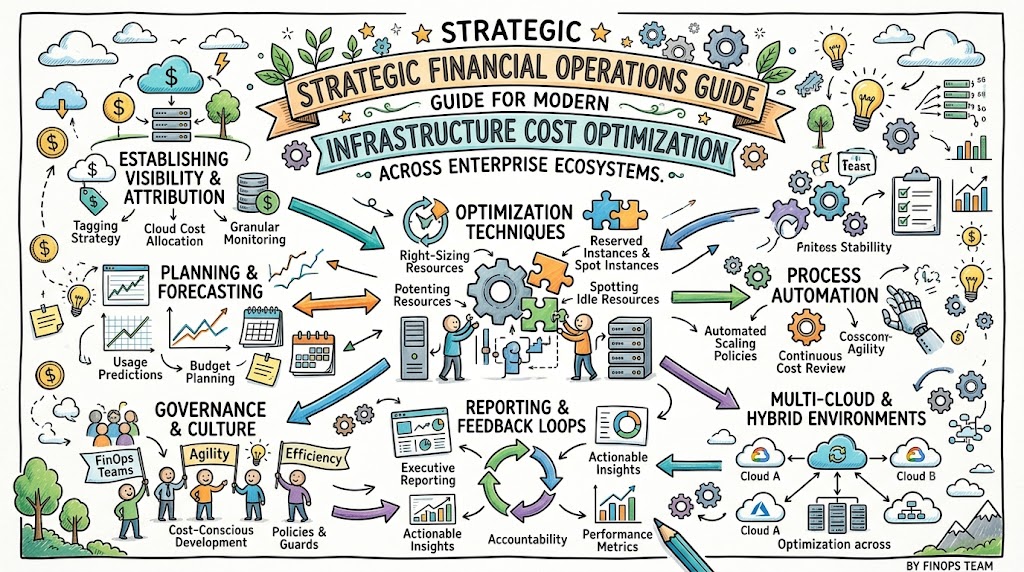
Imagine waking up to an unexpected cloud invoice that obliterates your entire quarterly infrastructure budget in a single weekend due to an unchecked automated scaling loop. This operational nightmare happens frequently when engineering velocity outpaces financial oversight in distributed cloud environments. Modern engineering teams require a sophisticated methodology to balance performance with fiscal reality.
Consequently, financial operations represents the ultimate evolution of cloud cost management, blending engineering accountability with real-time business metrics to maximize business value. Organizations require this structured discipline because traditional procurement models fail completely in dynamic, ephemeral containerized landscapes.
This deep-dive guide covers the historical evolution of operational bottlenecks, core architectural principles, error budgets, and step-by-step career roadmaps for aspiring specialists. Furthermore, we will analyze common implementation mistakes alongside the critical tools required to maintain absolute visibility over infrastructure environments.
To master these complex methodologies and accelerate your career in cloud financial governance, explore the professional programs at Finopsschool to gain comprehensive hands-on experience today.
The Origin of Systems Infrastructure
The Early Industrial Bottlenecks
Traditional enterprise operations relied heavily on physical hardware procurement cycles that frequently delayed software deployments by several months. Siloed infrastructure teams managed bare-metal servers independently from software development groups, creating massive communication barriers and operational inefficiencies.
Because engineers lacked visibility into hardware costs, they routinely over-provisioned resources to guarantee application stability during traffic spikes. As a result, organizations suffered from massive capital expenditures tied up in idle hardware that depreciated rapidly.
+-------------------+      Silod Barrier      +-------------------+
|  Development Team | ----------X----------- |  Operations Team  |
|  (Focus: Speed)   |                        | (Focus: Stability)|
+-------------------+                        +-------------------+
Moving Toward Unified Workflow Automation
The advent of virtualization and public cloud infrastructure promised to solve resource constraints but introduced unprecedented financial complexity. Teams quickly realized that cloud migration without governance led to runaway operational expenditures and unmanaged resource sprawl.
Therefore, forward-thinking enterprises began breaking down institutional silos to unify financial accountability with automated engineering workflows. This shift transformed corporate infrastructure from a static capital cost into a highly dynamic operational variable.
Global Expansion Across Commercial Ecosystems
As cloud adoption scales globally, these operational optimization frameworks have expanded across large-scale commercial tech enterprises and regulated industries alike. Organizations now treat cloud efficiency as a primary architectural metric rather than an afterthought for accounting departments.
Modern global ecosystems deploy automated policies that continually adjust infrastructure size based on real-time consumer utilization data. Consequently, this discipline has transitioned from an experimental internal practice to an absolute operational necessity for enterprise survival.
Defining Strategic Operations Management
The Core Operational Structure
The foundational architecture of modern infrastructure management relies on a continuous loop of data ingestion, cost allocation, and automated optimization. Information flows dynamically from cloud provider billing APIs into specialized telemetry platforms that map expenses directly to engineering components.
+--------------------+      Telemetry Data      +-----------------------+
|  Cloud Billing API | -----------------------> | Optimization Engine   |
+--------------------+                          | (Tagging & Allocation)|
          ^                                                 |
          |                                                 v
          +-------------------------------------- http://... Actionable Policies
This structure ensures that every single microservice, database instance, and storage bucket connects directly to a specific business unit. Because teams receive immediate feedback on resource consumption, they can make informed decisions regarding architectural adjustments.
Daily Tasks of Systems Coordinators
Specialists in this domain execute a variety of practical tasks to maintain absolute systemic efficiency across multi-cloud environments. They spend their days reviewing anomaly detection alerts, adjusting resource reservation strategies, and collaborating with application developers.
- Anomaly Investigation: Analyzing sudden spikes in infrastructure spend to identify misconfigured development environments or memory leaks.
- Reservation Architecture: Designing and purchasing commitment-based discount plans to lower baseline compute costs.
- Tagging Governance: Enforcing strict metadata compliance across all deployed resources to maintain accurate financial attribution.
- Right-sizing Consultation: Reviewing utilization metrics with software engineering teams to safely downgrade over-provisioned workloads.
Localized Control vs. Broad System Architecture
Managing granular component tracking differs significantly from orchestrating an entire multi-cloud global infrastructure architecture. Localized control focuses on specific optimization tasks like deleting unattached storage volumes or selecting optimal instance types for a single service.
In contrast, broad system architecture requires designing overarching organizational frameworks that govern thousands of independent cloud accounts simultaneously. Systemic architects establish global compliance guardrails, negotiate enterprise discount agreements, and design universal dashboard templates for executive leadership.
The Efficiency Mindset
Implementing this framework successfully demands a profound cultural shift that prioritizes long-term system stability alongside strict financial accountability. Engineers must reject the outdated notion that resource abundance is the only way to achieve operational reliability.
Instead, teams adopt an efficiency mindset where elegant software design implies maximizing throughput while minimizing cloud resource consumption. This cultural evolution ensures that optimization becomes an integral part of the daily development lifecycle rather than a quarterly cleanup exercise.
The 7 Core Principles of Financial Operations
1. Embracing Risk and Managing Variability
Modern distributed systems operate within highly unpredictable commercial environments where demand fluctuates constantly based on user behavior. Because pursuing absolute perfection creates prohibitive infrastructure costs, teams must learn to embrace calculated operational variability.
Engineers establish acceptable thresholds for cost variances and performance fluctuations rather than attempting to maintain completely static environments. This approach allows infrastructure to scale fluidly, accepting short-term resource degradation to prevent massive financial over-provisioning.
2. Establishing Service Level Objectives (SLOs)
Teams define clear, measurable targets for systemic success to ensure cost-efficiency initiatives never compromise core user experience. These metrics establish the precise boundaries where performance, business value, and infrastructure spend intersect harmoniously.
By linking cloud expenditures directly to service performance thresholds, organizations avoid spending premium budgets on unnecessary infrastructure margins. If a service comfortably meets its target metrics, engineers can safely execute cost-reduction experiments to optimize resource utilization.
3. Eliminating Toil and Manual Processes
Repetitive, manual configuration tasks represent a significant drain on engineering velocity and organizational financial resources. Specialists systematically identify recurring operational burdens, such as manual resource cleanups or weekly billing report compilations, and engineer them away.
Replacing manual oversight with self-healing automation allows engineering teams to focus exclusively on high-value systemic improvements. Eliminating this operational friction directly reduces administrative overhead while preventing costly human errors in resource allocation.
4. Monitoring & Observability Across the Pipeline
Total visibility across the entire continuous delivery pipeline prevents expensive blind spots that lead to unmanaged cloud expenditure. Advanced telemetry systems track cost metrics alongside traditional system health indicators like CPU utilization and memory consumption.
This unified monitoring strategy allows teams to see the immediate financial impact of a new software deployment. If a code modification causes an unexpected surge in database queries, the integrated telemetry system flags the economic anomaly immediately.
5. Automation Over Manual Coordination
Scaling modern cloud infrastructure requires programmatic software solutions rather than slow human intervention and cross-departmental coordination meetings. Organizations deploy intelligent automation policies that continuously evaluate resource health and financial efficiency.
Automated systems can downscale non-production environments during weekends, terminate idle compute instances, and switch workloads to cheaper spot infrastructure automatically. This engineering-first approach ensures that cost optimization scales seamlessly alongside expanding system architecture.
6. Release Engineering and Deployment Stability
Consistent, predictable, and safe infrastructure delivery strategies are essential for maintaining stable operational budgets over time. Teams utilize declarative infrastructure-as-code templates to deploy reproducible environments that conform strictly to financial policies.
Integrating automated cost estimation tools directly into the deployment pipeline allows teams to evaluate the economic impact of changes before production delivery. This preventive measure stops expensive architectural errors from reaching live environments where they could cause significant financial damage.
7. Simplicity in Network Architecture
Keeping cloud network layouts clean and minimal directly reduces complex data transfer fees and decreases the overall failure surface. Complicated multi-region routing patterns and unoptimized data paths frequently generate massive hidden costs that surprise engineering teams.
By designing streamlined data pathways and utilizing localized caching strategies, organizations dramatically reduce expensive cross-availability-zone traffic. Simple network architecture facilitates straightforward monitoring, rapid troubleshooting, and highly predictable monthly billing cycles.
Key Operational Concepts You Must Know
SLA vs. SLO vs. SLI — Explained Simply
Understanding the relationship between service metrics is critical for balancing system performance with infrastructure expenditures effectively.
- Service Level Indicator (SLI): A precise quantifiable metric that measures the real-time performance of a service, such as API response latency.
- Service Level Objective (SLO): A target reliability goal set by the engineering team, defining the acceptable boundary for an SLI over time.
- Service Level Agreement (SLA): A legal commitment made to external customers regarding system performance, carrying financial penalties if violated.
Error Budgets — The Game Changer for Operational Risk
An error budget represents the exact amount of systemic unreliability an organization tolerates before feature development must pause. Calculated directly from SLO targets, this framework provides a clear mathematical mechanism for balancing innovation speed with structural safety.
When a team maintains a healthy error budget, they can aggressively deploy new features and test cost-saving infrastructure configurations. Conversely, if the budget depletes due to unexpected outages, engineering resources pivot exclusively toward system stabilization and reliability restoration.
Toil — The Silent Productivity Killer in Infrastructure
Toil encompasses the repetitive, manual, and non-creative tasks required to keep a production system running smoothly without adding long-term value. Examples include manually restarting stuck servers, running weekly manual database cleanups, or manually approving routine cloud resource requests.
Organizations must track toil carefully because it scales linearly with infrastructure growth, draining engineering morale and inflating operational budgets. Teams systematically eliminate toil by writing automated orchestration scripts and building self-service internal portals for resource provisioning.
Incident Management & Postmortems
When unexpected infrastructure failures occur, organizations must execute blameless postmortems to uncover the systemic root causes of the disruption. This methodology shifts focus completely away from individual human error toward fixing underlying structural vulnerabilities and monitoring gaps.
Documenting incidents transparently helps teams understand why automated recovery mechanisms failed or why cost anomalies eluded detection systems. Transforming operational failures into actionable engineering tasks prevents similar costly incidents from recurring across the enterprise ecosystem.
Capacity Planning
Modern capacity planning focuses on algorithmic forecasting rather than buying physical hardware bulk shipments years in advance. Teams analyze historical consumption patterns and upcoming business milestones to project future cloud resource requirements accurately.
Resource Needs
     ^
     |                                    /  [Forecasted Spike]
     |                                   /
     |                     /------------/
     |                    /
     |       /-----------/
     +----------------------------------------> Time
This predictive approach allows enterprises to leverage volume discount programs effectively by committing to future usage with minimal risk. Accurate planning guarantees that the system maintains sufficient compute headroom for business growth while eliminating wasted idle allocation.
The Four Golden Signals of Pipeline Performance
Monitoring the health of distributed systems requires deep tracking of four foundational telemetry metrics across the entire application ecosystem.
| Metric | Definition | Importance for Cost Governance |
| Latency | The time taken to service a specific request. | High latency indicates inefficient code consuming excessive compute cycles. |
| Traffic | A measure of system demand, such as HTTP requests per second. | Helps correlate infrastructure spend directly with actual user volume. |
| Errors | The rate of requests that fail systematically. | Failed requests waste expensive processing power without delivering value. |
| Saturation | A measure of how full the most constrained system resources are. | Highlights over-provisioned areas that are prime candidates for right-sizing. |
Platform Implementation vs. Culture — What’s the Real Difference?
The Philosophy Difference
Many organizations struggle to distinguish between implementing cost-management software tools and cultivating an authentic accountability culture. Technical implementation involves deploying telemetry dashboards, setting up automated alerts, and installing resource optimization software across cloud accounts.
In contrast, cultural transformation establishes an environment where individual software engineers actively care about the financial impact of their code. Tools merely provide raw data, whereas culture drives teams to take proactive ownership of efficiency metrics.
Roles & Responsibilities Compared
To understand how these concepts manifest practically within a modern enterprise, consider the distinct operational focuses of different organizational roles:
- Financial Specialists:
- Manage cloud vendor enterprise contract negotiations and volume discount purchases.
- Forecast macro-level budget allocations across multiple corporate business units.
- Analyze long-term cloud spend trends to report financial performance directly to executives.
- Engineering Leads:
- Design scalable application architectures that optimize data transfer and compute efficiency.
- Review weekly optimization recommendations to prioritize right-sizing tasks within backlogs.
- Enforce automated infrastructure-as-code standards to maintain resource compliance.
Can You Have Both Disciplines?
Successful modern enterprises do not choose between technical infrastructure management and financial culture; they integrate both simultaneously. Technical automation platforms provide the precise data required to feed cultural decision-making frameworks across engineering departments.
+---------------------------+               +---------------------------+
|  Automated Telemetry Tools| ------------> | Engineering Culture       |
|  (Provides Data & Alerts) | <------------ | (Drives Optimization)     |
+---------------------------+               +---------------------------+
When engineering teams utilize advanced software platforms within an accountability-driven culture, they achieve optimal resource efficiency. This symbiosis ensures that automated cost guardrails protect the organization without restricting developer innovation velocity.
Which One Should Your Team Adopt?
Choosing where to focus your initial organizational energy depends heavily on engineering maturity and overall cloud estate size. Small early-stage startups should focus heavily on building an efficiency culture, since complex tooling introduces unnecessary administrative overhead.
| Organization Size | Primary Focus | Implementation Strategy |
| Startup / Small Team | Cultural Awareness | Establish simple tagging rules and baseline cost visibility early. |
| Mid-Market Enterprise | Combined Optimization | Deploy basic automation scripts alongside engineering reviews. |
| Large Global Enterprise | Advanced Tooling & Dedicated Teams | Implement automated policy engines and form centralized governance hubs. |
Real-World Use Cases of Modern Operations
How Tech Leaders Use Operational Metrics
Major software enterprises utilize advanced data telemetry streaming to correlate cloud infrastructure expenditures directly with primary business growth indicators. For example, a global streaming platform tracks the exact infrastructure cost required to deliver one hour of video content.
By translating raw cloud costs into meaningful business unit metrics, leadership can evaluate the true profitability of specific features. This granular visibility allows teams to identify structural inefficiencies that traditional aggregate accounting methods completely overlook.
Chaos Engineering Approaches to Resilient Systems
Advanced engineering groups intentionally inject controlled financial and operational failures into production environments to uncover hidden architectural systemic flaws. Teams might simulate the sudden loss of low-cost spot instances to verify if their fallback automation systems execute correctly.
Executing these proactive exercises ensures that automated resilience frameworks operate seamlessly during actual, unpredicted infrastructure disruptions. This active testing strategy prevents minor software bugs from escalating into catastrophic outages that carry severe financial impacts.
Handling Reliability at Massive Scale
Distributed microservice architectures handling millions of daily global transactions utilize dynamic autoscaling patterns to preserve baseline operational efficiency. Systems automatically deploy additional container instances within seconds during high-demand windows, then destroy them immediately as traffic recedes.
This fluid resource allocation prevents organizations from paying for permanent idle capacity to handle temporary usage peaks. Maintaining tight elastic boundaries allows massive infrastructure ecosystems to operate reliably while maintaining exceptionally lean operational budgets.
High-Availability in Fintech Operations
Financial technology platforms operate under zero-tolerance mandates for system downtime, requiring sophisticated multi-region redundancy patterns. These organizations build highly resilient network routes that switch transaction traffic automatically if a public cloud data center fails.
To control the massive costs of multi-region replication, fintech specialists deploy highly optimized data synchronization protocols. They balance the strict requirement for total systemic availability with aggressive storage deduplication and optimized data compression.
Scaled-Down but Essential Systems for Startups
Early-stage companies apply these identical architectural principles on a smaller scale to extend their operational runway efficiently. Instead of deploying complex enterprise software, startup teams utilize basic automated cron schedules to shut down non-essential resources overnight.
By implementing strict tagging standards from day one, small teams avoid accumulating massive architectural and financial debt. This proactive discipline ensures that their core software architecture remains highly optimized as the business begins to scale.
Common Mistakes in Operations Engineering
Mistake 1 — Confusing System Management with Just Being On-Call
Many companies mistake modern infrastructure engineering for a traditional operations team that simply responds to automated system alerts. This reactive mindset forces highly skilled engineers to spend their valuable time manually patching recurring production system bugs.
True infrastructure management operates as a proactive software engineering discipline dedicated to designing self-healing, automated software systems. Treating specialists as simple system monitors destroys engineering velocity and allows underlying structural inefficiencies to expand unchecked.
Mistake 2 — Setting Unrealistic SLOs
Product managers frequently demand absolute perfect uptime for application features without understanding the exponential infrastructure costs required to achieve it. Moving from a target of ninety-nine percent reliability to ninety-nine point nine percent requires massive architectural redundancy investments.
Cost Curve
   ^
   |                                     / [99.99% Uptime]
   |                                    /
   |                                   /
   |                       -----------/
   |           -----------/  [99% Uptime]
   +----------------------------------------> Target Reliability
Demanding excessive reliability goals stalls feature deployment pipelines because teams constantly deplete their strict error budgets on minor variances. Organizations must align performance targets with actual user expectations to avoid wasting capital on unnecessary infrastructure margins.
Mistake 3 — Ignoring Toil Until It’s Too Late
Teams frequently ignore small, repetitive manual development steps, assuming that a few minutes of weekly manual work is harmless. However, as infrastructure scales, these unaddressed operational tasks multiply rapidly, consuming massive amounts of engineering time.
Ignoring this growing technical debt creates severe operational bottlenecks that stall software delivery schedules completely. Organizations must empower engineering teams to prioritize automation tasks to systematically eliminate manual burdens before they overwhelm productivity.
Mistake 4 — Skipping Blameless Postmortems
When severe outages occur, teams operating within toxic corporate environments frequently focus on assigning individual human blame instead of fixing infrastructure systems. This defensive culture causes engineers to hide mistakes and cover up minor operational anomalies to protect themselves.
Skipping deep, objective post-incident analysis guarantees that the underlying architectural flaws will remain buried within the production environment. Without clear, blameless investigation, the exact same system failures will inevitably recur, driving up remediation expenditures.
Mistake 5 — Monitoring Without Actionable Alerts
Configuring monitoring systems to broadcast notifications for minor, non-critical metrics creates severe alert fatigue across engineering departments. When on-call specialists receive hundreds of meaningless pages daily, they eventually ignore notifications entirely, missing actual critical system failures.
Every automated alert must indicate a clear, user-impacting problem that requires immediate, specific human intervention to resolve. If an alert does not require an immediate engineering response, it belongs in a non-disruptive summary report rather than an emergency notification channel.
Mistake 6 — Not Involving Operational Engineers in the Design Phase
Organizations routinely allow software development groups to design complex cloud architectures completely isolated from operational specialists. Consequently, teams deliver systems to production that are incredibly difficult to monitor, optimize, or scale efficiently over time.
Bringing infrastructure experts into the initial design phase ensures that systems feature built-in cost tracking and automated scaling properties. This early architectural collaboration prevents expensive re-engineering efforts after software has been deployed to production.
Essential Infrastructure Tools & Technologies
Monitoring & Observability
Maintaining complete control over large-scale modern deployments requires a robust suite of integrated telemetry collection engines. Modern enterprises utilize advanced monitoring tools to aggregate system metrics, application logs, and distributed network traces into unified views.
Platforms like Prometheus and Datadog capture real-time performance indicators, allowing teams to spot efficiency regressions instantly. These tools provide the deep granular data required to validate right-sizing experiments and verify system performance targets.
Incident Management
When critical production systems suffer degradation, organizations rely on centralized communication systems to coordinate engineering responses. Specialized incident response platforms route alerts to the correct on-call engineers based on specific system ownership matrices.
Tools like PagerDuty aggregate anomalous telemetry signals, suppress repetitive noise, and establish dedicated bridge lines for rapid engineering collaboration. Efficient response software ensures that teams minimize service downtime and protect business operations from prolonged disruption.
CI/CD & Release Engineering
Automating the application delivery pipeline is essential for maintaining strict compliance with operational and cost governance standards. Modern deployment engines allow teams to define infrastructure deployments using standard, declarative version-controlled configuration files.
Systems like Jenkins, Spinnaker, and Argo CD automate validation testing, security compliance scans, and application distribution across target environments. These tools ensure that every code modification undergoes rigorous validation before interacting with live production data.
Chaos Engineering
Proactively identifying hidden systemic weaknesses requires specialized tools designed to inject controlled failures directly into live environments. These automated resilience platforms simulate network latency spikes, instance terminations, and regional outages under structured testing parameters.
Utilizing frameworks like Chaos Monkey allows engineering teams to verify that their automated fallback systems function as designed. Executing controlled failure experiments transforms operational resilience from a theoretical goal into a verified architectural attribute.
SLO Management
Tracking service reliability against established consumer satisfaction targets requires specialized metric consolidation software platforms. These systems connect directly to existing monitoring streams to compute real-time error budget consumption rates automatically.
Tools like Nobl9 help engineering and business leaders visualize precisely how specific infrastructure changes impact long-term reliability targets. This dedicated visibility facilitates data-driven conversations regarding when to prioritize cost optimization over rapid feature development.
How to Become an Operations Expert — Career Roadmap
Skills Every Specialist Must Have
Breaking into this highly competitive infrastructure optimization domain requires a diverse mix of software engineering capabilities and financial analytics skills. Professionals must develop deep comfort working inside terminal environments and managing infrastructure programmatically through code templates.
- Scripting Efficiency: Mastery of automated scripting languages like Python and Bash to build custom optimization workflows.
- Infrastructure-as-Code: Deep knowledge of declarative configuration tools like Terraform to manage cloud resources systematically.
- Cloud Architecture: Advanced understanding of fundamental cloud compute, storage network primitives, and data transfer dynamics.
- Data Analysis: Ability to query large financial datasets using SQL to isolate complex infrastructure cost trends.
The Professional Learning Path
The educational journey begins with mastering basic system administration concepts, local networking foundations, and standard linux terminal operations. Next, engineers progress to learning public cloud architecture, focusing heavily on resource provisioning patterns and identity governance access controls.
Once foundational cloud mechanics are second nature, professionals focus on container orchestration platforms and microservice architecture patterns. The final stage involves mastering advanced financial analytics, programmatic automation development, and large-scale multi-cloud architectural governance frameworks.
Certifications Worth Pursuing
Validating your advanced technical capabilities to global employers requires earning respected, industry-standard infrastructure credentials. These structured examinations verify that an engineer possesses the practical knowledge required to manage complex cloud expenditures safely.
Earning professional cloud architect credentials from major public vendors establishes a strong baseline of structural engineering competency. Additionally, pursuing dedicated financial operations credentials confirms your specialized ability to bridge engineering actions with corporate fiscal performance.
Educational Resources with Finopsschool
Aspiring specialists can significantly accelerate their professional development by engaging with targeted instructional courses and real-world simulation labs. Immersing yourself in structured training programs helps demystify the complex relationship between cloud architecture choices and enterprise financial impacts.
Exploring the advanced curriculum resources provided by Finopsschool equips engineering professionals with the precise skills needed to design highly optimized, cost-resilient architectures. These comprehensive guides provide the practical hands-on experience required to lead enterprise-level infrastructure transformations successfully.
The Future of Systems Management
AI and Automation in System Optimization
The next generation of infrastructure governance relies heavily on machine learning models to manage complex dynamic environments. Automated intelligence engines continuously review millions of telemetry data streams to detect minor operational anomalies before they escalate into outages.
These advanced cognitive systems can predict upcoming utilization spikes based on historical patterns, scaling compute capacity ahead of demand automatically. Integrating predictive machine learning tools eliminates manual configuration tasks, allowing infrastructure to operate at peak economic efficiency.
Platform Engineering — The Evolution of Infrastructure
Modern engineering organizations are shifting rapidly away from ad-hoc infrastructure configurations toward structured internal platform engineering patterns. Centralized teams build unified, self-service developer portals that encapsulate complex compliance, security, and financial guardrails automatically.
This evolution allows application developers to independently provision highly optimized infrastructure environments without needing deep cloud expertise. Internal platforms accelerate overall software delivery velocity while guaranteeing absolute adherence to organizational cost-efficiency standards.
Management in Cloud-Native & Kubernetes Environments
Containerized microservices offer incredible operational elasticity but introduce unprecedented layers of granular infrastructure complexity. Managing ephemeral container lifecycles requires specialized orchestration tools that allocate compute resources dynamically down to individual application processes.
+-------------------------------------------------------+
|  Kubernetes Cluster                                   |
|   +---------------------+   +---------------------+   |
|   | Pod A (Allocated)   |   | Pod B (Allocated)   |   |
|   +---------------------+   +---------------------+   |
|   | Pod C (Idle-Auto)   | <-- [Target for Clean]  |   |
|   +---------------------+                         |
+-------------------------------------------------------+
Future governance architectures focus heavily on autoscaling container clusters based on real-time application profiling data rather than static limits. Mastering these intricate orchestration patterns allows modern enterprises to maintain exceptionally high resource utilization across massive compute fleets.
Operational Skills That Will Matter Most
As infrastructure systems become increasingly automated, the professional profile of successful tech specialists must evolve accordingly. Pure manual configuration expertise is losing relevance, replaced rapidly by the demand for advanced architectural data analytics and business strategy integration.
Engineers who possess the unique ability to translate complex technical metrics into clear business value indicators will lead major enterprises. Future industry leaders must combine deep software engineering capabilities with a sophisticated understanding of corporate financial structures.
FAQ Section
- What is the typical career trajectory for an infrastructure cost optimization specialist?Professionals usually transition into this specialized field from foundational roles in linux systems administration, software engineering, or traditional cloud architecture. As they gain experience managing complex multi-cloud financial datasets, they progress into senior systems infrastructure architects or enterprise governance directors.
- How does this discipline differ fundamentally from traditional corporate accounting departments?Traditional accounting focuses on reviewing historical financial expenditures after billing cycles close to ensure absolute budgetary compliance. This modern engineering discipline operates directly inside live production environments, utilizing real-time technical automation to continuously optimize infrastructure efficiency.
- What are the average salary trends for certified professionals in this operational domain?Due to the severe global shortage of engineers who understand both cloud architecture and financial governance, compensation remains exceptionally high. Senior specialists routinely command substantial premium salaries that surpass standard software development compensation packages within major enterprise markets.
- Can early-stage startups implement these methodologies without hiring dedicated full-time teams?Yes, early-stage companies can easily adopt these core efficiency philosophies by establishing basic automated resource policies from day one. Implementing simple infrastructure tagging standards and utilizing automatic overnight shutdown schedules allows small teams to maintain efficiency with minimal overhead.
- How frequently should engineering groups review their service level objectives and cost targets?Organizations should review their core performance thresholds quarterly or whenever major architectural modifications are introduced to application pipelines. Regular evaluation ensures that performance goals remain perfectly aligned with evolving user expectations and corporate financial priorities.
- Which public cloud provider offers the most advanced native resource optimization utilities?All major public cloud vendors provide capable native tools for tracking expenditures, setting basic alerts, and identifying idle infrastructure resources. However, scaling enterprises typically outgrow native utilities rapidly, requiring third-party telemetry platforms to orchestrate comprehensive multi-cloud optimization strategies.
Final Summary
Maintaining optimal infrastructure health requires a continuous, data-driven balancing act between deployment velocity, system reliability, and cloud expenditure. Organizations must transition away from reactive manual oversight toward building automated, self-healing platforms that integrate financial accountability directly into software code. Embracing these advanced operational principles empowers companies to eliminate wasteful spending while scaling their digital services securely.
As corporate environments expand in complexity, the integration of algorithmic optimization models will redefine the boundaries of engineering performance frameworks. Elevating your organizational capabilities requires a profound commitment to continuous education and structural innovation. Discover how to transform your technology infrastructure into a lean engine of business growth by exploring the expert educational programs at [Finopsschool].