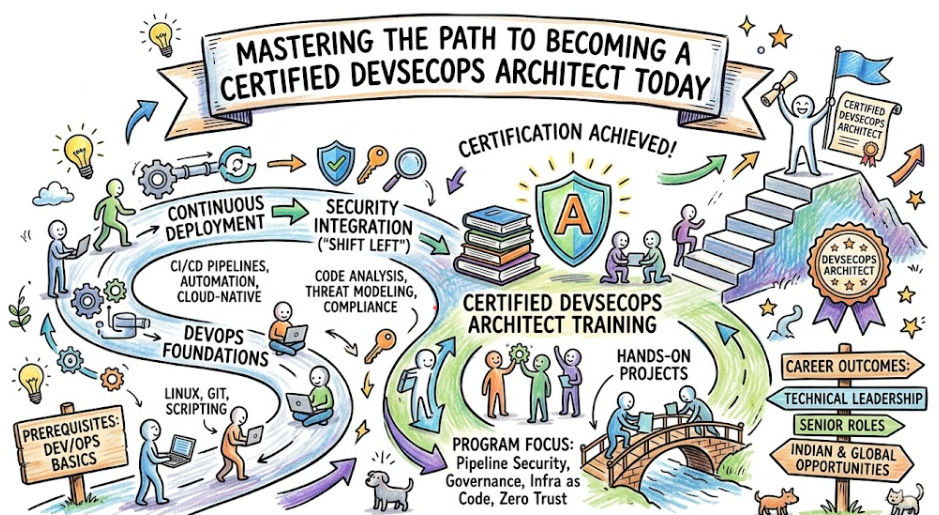
The journey to becoming a Certified DevSecOps Architect is a transformative step for senior engineers looking to bridge the gap between rapid development and ironclad security. This guide is specifically designed for cloud-native professionals, SREs, and platform engineers who want to lead organizational shifts toward “security as code.” As modern infrastructure becomes increasingly complex, the role of an architect is no longer just about choosing tools but about designing resilient, automated systems that protect data without slowing down the release cycle. By pursuing this path at DevSecOpsSchool, you gain the strategic mindset required to influence technical roadmaps and mentor cross-functional teams. This roadmap helps you evaluate the investment of your time and effort against the high-impact career rewards available in the current global market.
What is the Certified DevSecOps Architect?
The Certified DevSecOps Architect designation represents a pinnacle of technical leadership within the modern software delivery lifecycle. It exists to validate an individual’s ability to design, implement, and oversee a security-first culture across diverse engineering departments. Unlike entry-level certifications that focus on syntax or basic tool usage, this architecture-level program emphasizes production-focused learning, deep-dive integration strategies, and risk management. It aligns perfectly with enterprise practices where security is no longer a “final check” but a continuous, automated component of the CI/CD pipeline. Professionals holding this title are recognized for their capacity to build scalable security frameworks that evolve alongside cloud-native technologies.
Who Should Pursue Certified DevSecOps Architect?
This certification is primarily built for experienced software engineers, SREs, and cloud architects who have already mastered the fundamentals of automation and now wish to specialize in secure infrastructure design. It is also highly beneficial for security professionals moving into the “shift-left” space and data engineers responsible for protecting sensitive pipelines. In the Indian market and globally, engineering managers and technical leaders pursue this track to better understand how to balance speed with compliance. Whether you are a beginner looking for a long-term career north star or a veteran aiming to formalize your expertise, this path provides the architectural lens needed to manage enterprise-grade security at scale.
Why Certified DevSecOps Architect is Valuable and Beyond
The demand for architects who can bake security into the fabric of the cloud is at an all-time high as cyber threats become more sophisticated. This certification ensures longevity in a professional career because it focuses on architectural principles that remain relevant even as specific tools change or become obsolete. Enterprise adoption of DevSecOps is no longer optional; it is a business requirement for any organization handling sensitive customer data or operating in regulated industries. Investing in this knowledge offers a significant return on time, positioning you as a high-value asset capable of reducing organizational risk. It moves you beyond being a “user” of tools to becoming a “designer” of secure ecosystems.
Certified DevSecOps Architect Certification Overview
The program is delivered via the official course at devsecopsschool.com and is hosted on the DevSecOpsSchool website. It utilizes a multi-level assessment approach that combines theoretical knowledge with rigorous, hands-on practical evaluations to ensure real-world readiness. The certification ownership lies with industry experts who update the curriculum to reflect the latest shifts in container security, serverless protection, and automated compliance. Structurally, the program moves from foundational concepts to complex architectural scenarios, requiring candidates to demonstrate how they would handle actual production failures or security breaches. This practical focus ensures that the credential carries weight during technical interviews and internal promotion reviews.
Certified DevSecOps Architect Certification Tracks & Levels
The certification is structured into foundation, professional, and advanced levels to accommodate different stages of career growth. The foundation level introduces the core “shift-left” philosophy and basic security integration, while the professional level dives deep into toolchains and automated scanning. The advanced architect level focuses on organizational strategy, governance, and multi-cloud security patterns. Specialization tracks are also available for those focusing on SRE, FinOps, or MLOps, allowing professionals to tailor their learning to their specific role. This tiered approach allows for a logical career progression, ensuring that you build a solid technical base before tackling high-level strategic design.
Complete Certified DevSecOps Architect Certification Table
| Track | Level | Who it’s for | Prerequisites | Skills Covered | Recommended Order |
| Core Security | Foundation | Junior Engineers | Basic Linux/Git | SCA, SAST, DAST | 1 |
| Engineering | Professional | DevOps/SREs | CI/CD Experience | Vault, Containers | 2 |
| Architecture | Advanced | Senior Leads | 5+ Years Exp | Governance, IAC | 3 |
| Cloud Sec | Specialist | Cloud Engineers | AWS/Azure/GCP | IAM, VPC Security | 4 |
Detailed Guide for Each Certified DevSecOps Architect Certification
Certified DevSecOps Architect – Foundation Level
What it is
This level validates a candidate’s understanding of the fundamental DevSecOps mindset and the primary tools used to inject security into a standard DevOps pipeline. It serves as the essential starting point for all security-focused engineering tracks.
Who should take it
It is suitable for junior developers, system administrators, or traditional QA testers who want to transition into a security-aware engineering role with a clear growth path.
Skills you’ll gain
- Understanding the Shift-Left philosophy
- Basic Static Application Security Testing (SAST)
- Identifying vulnerabilities in open-source libraries (SCA)
- Integrating security checks into Jenkins or GitLab CI
Real-world projects you should be able to do
- Set up a basic automated security scan for a Python or Java application.
- Create a dashboard showing high-priority vulnerabilities in a development branch.
Preparation plan
- 7–14 days: Focus on terminology and the core phases of the DevSecOps lifecycle.
- 30 days: Hands-on practice with at least two open-source scanning tools.
- 60 days: Deep study of compliance standards like OWASP Top 10.
Common mistakes
- Focusing too much on tool syntax rather than the underlying security concepts.
- Ignoring the cultural aspect of developer and security team collaboration.
Best next certification after this
- Same-track: Certified DevSecOps Professional
- Cross-track: SRE Foundation
- Leadership: Project Management for Technical Leads
Certified DevSecOps Architect – Professional Level
What it is
This certification validates the ability to implement and manage complex security toolchains across multiple environments. It focuses on the “how” of engineering secure systems in a highly automated fashion.
Who should take it
This is for mid-level DevOps engineers or Security Analysts who are responsible for maintaining production pipelines and ensuring continuous compliance.
Skills you’ll gain
- Secret management using HashiCorp Vault
- Container and Kubernetes security hardening
- Dynamic Application Security Testing (DAST) implementation
- Policy as Code using Open Policy Agent (OPA)
Real-world projects you should be able to do
- Build a production-ready Kubernetes cluster with automated image scanning and runtime protection.
- Automate secret rotation across a distributed microservices architecture.
Preparation plan
- 7–14 days: Review advanced CI/CD integration patterns and API security.
- 30 days: Build a full pipeline integrating SAST, DAST, and SCA.
- 60 days: Practice troubleshooting broken security gates in complex builds.
Common mistakes
- Over-automating to the point where the pipeline becomes too slow for developers.
- Neglecting the security of the CI/CD platform itself.
Best next certification after this
- Same-track: Certified DevSecOps Architect (Advanced)
- Cross-track: FinOps Certified Practitioner
- Leadership: Technical Product Management
Certified DevSecOps Architect – Advanced Level
What it is
This level validates the highest level of expertise in designing enterprise-wide security frameworks. It is about strategy, high-level design patterns, and organizational governance.
Who should take it
Principal engineers, CTOs, and Senior Architects who need to define the security standards for an entire company or large-scale business unit.
Skills you’ll gain
- Designing multi-cloud security architectures
- Implementing Zero Trust models at scale
- Cost-effective security scaling and FinOps alignment
- Leading cultural transformations and security advocacy
Real-world projects you should be able to do
- Design a global security governance framework that spans multiple cloud providers and on-premise data centers.
- Lead a migration from legacy security practices to a fully automated DevSecOps model for a Fortune 500 firm.
Preparation plan
- 7–14 days: Study case studies of enterprise-level security breaches and their architectural solutions.
- 30 days: Draft architectural diagrams for various compliance scenarios (GDPR, HIPAA).
- 60 days: Peer review and mentorship of professional-level candidates to solidify knowledge.
Common mistakes
- Losing touch with the technical implementation details while focusing only on strategy.
- Failing to account for the performance overhead of intensive security monitoring.
Best next certification after this
- Same-track: Expert Level Specializations
- Cross-track: MLOps Architect
- Leadership: VPE or CTO Leadership Tracks
Choose Your Learning Path
DevOps Path
This path focuses on the seamless integration of development and operations with a focus on speed and reliability. Professionals here learn to build the foundation upon which security measures will eventually be layered. It is ideal for those who enjoy automation, scripting, and improving the developer experience through better tooling.
DevSecOps Path
The core of this journey involves making security a shared responsibility across the entire lifecycle. You will focus heavily on automation tools that scan code, containers, and infrastructure as they are being built. This path is for those who want to be the “security champions” within a modern engineering organization.
SRE Path
The Site Reliability Engineering path emphasizes the stability and performance of systems, treating security as a critical component of reliability. You will learn how to use SLIs and SLOs to measure security health and manage incidents. This is the best route for engineers who love deep system internals and high-scale problem-solving.
AIOps Path
In the AIOps path, you focus on using machine learning to analyze the massive amounts of data generated by modern IT environments. This helps in predicting security threats and automating the response to anomalies before they cause downtime. It is perfect for data-literate engineers interested in the future of automated operations.
MLOps Path
This track is dedicated to the lifecycle management of machine learning models, ensuring that the data and the models themselves are secure and reproducible. You will bridge the gap between data science and production engineering. This is a high-growth area for those looking to secure the next generation of AI-driven applications.
DataOps Path
DataOps focuses on the automated, policy-driven management of data pipelines to ensure high quality and security. You will learn how to protect sensitive data as it moves through various analytics and processing stages. This is essential for architects working in industries with strict data privacy regulations.
FinOps Path
The FinOps path teaches you how to manage the cloud spend associated with security and infrastructure. You will learn to balance the cost of high-security tools against the actual risk and business value. This is a critical skill for architects who need to justify their security budgets to executive leadership.
Role → Recommended Certified DevSecOps Architect Certifications
| Role | Recommended Certifications |
| DevOps Engineer | Foundation + Professional DevSecOps |
| SRE | Professional DevSecOps + SRE Practitioner |
| Platform Engineer | Advanced Architect + Infrastructure as Code |
| Cloud Engineer | Specialist Cloud Security + Professional Level |
| Security Engineer | All DevSecOps Levels + Advanced Architect |
| Data Engineer | Foundation + DataOps Specialist |
| FinOps Practitioner | Professional DevSecOps + FinOps Certified |
| Engineering Manager | Foundation + Advanced Architect |
Next Certifications to Take After Certified DevSecOps Architect
Same Track Progression
Once you have mastered the architectural level, the logical next step is to pursue specific deep-dive certifications in emerging technologies like Serverless Security or Service Mesh (Istio) security. Deepening your expertise in specific tools like Advanced Vault Management or Kubernetes Security (CKS) can also differentiate you as a subject matter expert. This path ensures you remain the go-to person for complex technical challenges within the security domain.
Cross-Track Expansion
Broadening your skills into AIOps or FinOps is a powerful way to become a more well-rounded architect. By understanding the cost implications of security or using AI to enhance threat detection, you bring more value to the business. This expansion allows you to move into “Platform Engineering” roles where you oversee the entire ecosystem, not just the security layer, making you indispensable to the organization.
Leadership & Management Track
For those looking to move away from hands-on keyboard work, transitioning into a CISO (Chief Information Security Officer) or VP of Engineering role is the ultimate goal. Certifications in technical leadership, risk management, and strategic planning can help bridge this gap. This track focuses on people management, budgeting, and aligning technical security goals with the overarching business strategy.
Training & Certification Support Providers for Certified DevSecOps Architect
DevOpsSchool
DevOpsSchool provides a comprehensive ecosystem for learners, offering instructor-led training that is deeply rooted in real-world scenarios. Their curriculum for the architect track is updated frequently to include the latest industry shifts, ensuring students are not learning outdated practices. They offer robust support through community forums and hands-on labs that simulate actual production environments. This makes them a preferred choice for professionals who need more than just a textbook education to succeed in their roles.
Cotocus
Cotocus focuses on specialized consulting and training that bridges the gap between theoretical knowledge and corporate implementation. They are known for their intensive bootcamps that help senior engineers quickly pivot into architectural roles. Their trainers are often active industry practitioners who bring current project experience into the classroom. This ensures that the advice and techniques shared are practical, tested, and ready for immediate application in an enterprise setting.
Scmgalaxy
Scmgalaxy acts as a massive knowledge hub for the DevOps and DevSecOps community, providing a wealth of resources, tutorials, and certification guides. They focus on the tools and processes that drive the software supply chain, making them an excellent resource for anyone looking to master the technical details of the architect track. Their content is often cited by professionals as a go-to reference for troubleshooting complex CI/CD and security integration issues during their daily work.
BestDevOps
BestDevOps is dedicated to providing high-quality, curated content and training for the next generation of platform engineers. They emphasize the “best practices” aspect of the industry, helping students avoid common pitfalls in their architectural designs. Their training programs are designed to be concise and high-impact, catering to busy professionals who need to gain new skills without taking extended time away from their jobs. They focus heavily on the ROI of certification and career coaching.
devsecopsschool.com
This platform serves as the primary home for the Certified DevSecOps Architect program, offering the most direct and authoritative path to certification. It hosts a variety of specialized tracks that cater to different niche areas of the security field, from cloud-native to mobile security. The platform’s integrated lab environment allows students to practice their skills in a safe, controlled setting. It is the central pillar for anyone looking to establish a verified credential in the DevSecOps space.
sreschool.com
Sreschool.com is the leading destination for engineers who want to master the art of site reliability and its intersection with security. Their programs teach students how to build systems that are not only secure but also highly available and performant. By focusing on the SRE aspect of the architect role, they help professionals understand the critical balance between “locking down” a system and ensuring it remains usable for customers. Their approach is data-driven and highly technical.
aiopsschool.com
Aiopsschool.com addresses the growing need for intelligence in IT operations, providing specialized training on how to implement AI and ML in the DevSecOps lifecycle. Their courses cover everything from log analysis at scale to automated incident response using predictive modeling. For an architect, this knowledge is vital for staying ahead of automated threats. The school provides a forward-looking curriculum that prepares engineers for the highly automated future of the tech industry.
dataopsschool.com
Dataopsschool.com focuses on the unique challenges of securing and managing data pipelines in an era of big data and analytics. They provide the architectural blueprints for building secure data lakes, protecting data in transit, and ensuring compliance with global privacy laws. This training is essential for DevSecOps architects who work closely with data science and analytics teams. Their curriculum emphasizes the automation of data quality and security checks to prevent “data leaks” in production.
finopsschool.com
Finopsschool.com is the go-to resource for understanding the financial side of cloud-native architecture. They teach professionals how to implement a culture of financial accountability within their engineering teams. For a security architect, this means learning how to choose security tools and architectures that are cost-effective without compromising on safety. Their training helps technical leaders speak the language of the finance department, making it easier to secure funding for critical security initiatives.
Frequently Asked Questions (General)
- How difficult is the Certified DevSecOps Architect exam?The exam is considered challenging as it goes beyond simple multiple-choice questions to include practical scenarios that test your architectural design skills and your ability to solve real-world problems.
- How much time is required to complete the certification?Most professionals spend between three to six months preparing, depending on their existing experience with cloud-native tools and security principles, to ensure a deep understanding of the material.
- Are there any mandatory prerequisites?While there are no strict legal requirements, having a solid foundation in DevOps practices and at least a few years of experience in software engineering or systems administration is highly recommended.
- What is the return on investment (ROI) for this certification?The ROI is significant, often leading to salary increases, promotions to senior leadership roles, and the ability to work on high-impact projects that are critical to an organization’s success and safety.
- In what sequence should I take the certifications?It is best to follow the natural progression from Foundation to Professional and finally to Advanced Architect, as each level builds upon the technical and strategic knowledge gained in the previous one.
- Is this certification recognized globally?Yes, the program is recognized by major technology firms and enterprises worldwide, as it focuses on universal architectural principles and widely-used open-source and enterprise security tools.
- How often do I need to recertify?Typically, recertification is required every two to three years to ensure that your skills remain current with the rapidly evolving threat landscape and the constant updates in cloud technology.
- Can I take the training online?Yes, the training is primarily delivered through online platforms with live instructor-led sessions, recorded modules, and remote lab access to accommodate professionals from different time zones and locations.
- Does the certification focus on specific cloud providers like AWS or Azure?While it covers major cloud providers, the focus is on “cloud-agnostic” architectural patterns that can be applied to any environment, including hybrid and multi-cloud setups used by large enterprises.
- What kind of support is available if I get stuck during my studies?Students have access to community forums, mentor-led Q&A sessions, and dedicated support channels provided by the training partners to help clarify complex topics and troubleshoot lab issues.
- How does this differ from a standard Cyber Security certification?This program is specifically for the “engineering” side of security, focusing on automation and integration within the development lifecycle rather than just perimeter defense or traditional auditing.
- Is there a community of past graduates I can join?Yes, there is a vibrant alumni network where you can connect with other certified architects to share job opportunities, discuss new tools, and collaborate on best practices for modern security challenges.
FAQs on Certified DevSecOps Architect
- Does this architect program cover specific compliance frameworks like SOC2 or HIPAA?The program provides the architectural strategies needed to automate compliance for various frameworks, including GDPR and HIPAA, by using Policy as Code and continuous auditing tools throughout the lifecycle.
- How much coding knowledge is required for the architect level?A strong understanding of scripting and the ability to read and write Infrastructure as Code (YAML, Terraform) is essential, as the architect must design the automation that enforces security policies.
- Will I learn about specific tools like Vault and Checkov?Yes, the curriculum includes deep dives into industry-standard tools for secret management, static analysis, and infrastructure linting to ensure you can implement the architectures you design in a practical way.
- Is there a focus on container security?Container and Kubernetes security are core components of the curriculum, as most modern DevSecOps architectures are built on top of orchestrated environments that require specialized protection and monitoring strategies.
- How does the program handle the “Culture” aspect of DevSecOps?It emphasizes the soft skills needed to break down silos between development and security teams, teaching architects how to lead by influence and build a shared sense of responsibility for security.
- Can this certification help me transition from a developer role to a security role?Absolutely, it provides the bridge for developers to gain the security expertise needed to lead “shift-left” initiatives, making it one of the best paths for a career pivot into high-level security engineering.
- Is the practical lab portion mandatory for certification?Yes, the practical assessment is a critical part of the certification process, as it proves you can actually build and secure the systems you describe in your architectural designs under pressure.
- What is the primary goal of a Certified DevSecOps Architect?The goal is to design a system where security is invisible, automated, and continuous, allowing the organization to move fast without compromising the safety of its users or its data assets.
Final Thoughts: Is Certified DevSecOps Architect Worth It?
When you look at the current trajectory of the software industry, it is clear that security is no longer a peripheral concern; it is the core of the infrastructure. As a mentor, I often tell engineers that the “Architect” title is not just a badge—it is a commitment to understanding the entire ecosystem of delivery. The Certified DevSecOps Architect program is worth the investment because it forces you to think beyond the immediate task and consider the long-term resilience of the systems you build. It provides the technical depth to be respected by your peers and the strategic breadth to be valued by your executives. If you are looking for a way to future-proof your career while making a tangible impact on the safety of the digital world, this path is one of the most practical and rewarding choices you can make. It transforms you from someone who simply responds to security alerts into someone who prevents them from ever happening.
I find that this FinOps School guide to the Certified DevSecOps Architect is a defining resource for any FinOps Specialist looking to balance security