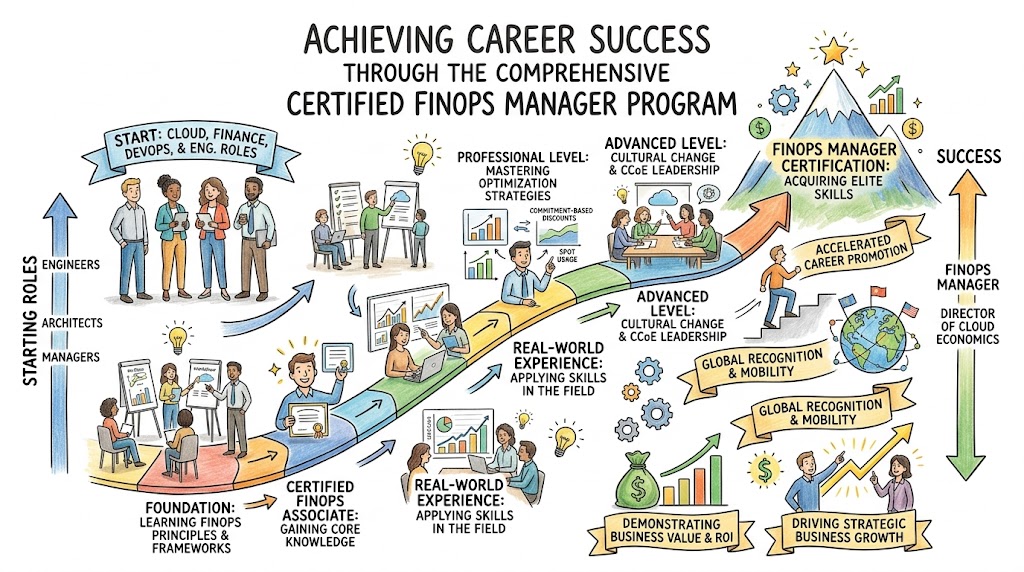
The Certified FinOps Manager program at FinOpsSchool represents a critical milestone for professionals aiming to bridge the gap between cloud engineering and financial accountability. This guide is designed for cloud architects, SREs, and engineering leads who need to navigate the complexities of variable cloud spending within modern platform engineering. As organizations scale their cloud-native infrastructure, the ability to manage unit economics becomes just as vital as managing uptime or security. This roadmap helps you decide if this path aligns with your professional trajectory by providing an unbiased look at the certification landscape.
What is the Certified FinOps Manager?
The Certified FinOps Manager is a professional validation that signifies a deep understanding of cloud financial management principles within a DevOps context. It exists because moving to the cloud changed how businesses spend money, shifting from fixed capital costs to variable operational expenses. This certification focuses on the practical application of the FinOps lifecycle—Inform, Optimize, and Operate—rather than just theoretical knowledge. It ensures that managers can align engineering speed with business value, making it a cornerstone for modern enterprise cloud operations.
Who Should Pursue Certified FinOps Manager?
This certification is ideal for DevOps engineers, SREs, and cloud architects who are increasingly responsible for the cost implications of their infrastructure choices. It also serves engineering managers and technical leaders who need to report on cloud ROI to C-suite executives. In the Indian market and across the global tech landscape, financial services and large-scale SaaS companies specifically seek these skills to curb cloud waste. Beginners in the cloud space can use it to build a niche, while veterans use it to transition into high-level strategic roles.
Why Certified FinOps Manager is Valuable in and Beyond
As cloud environments grow in complexity, the demand for professionals who can interpret a bill and optimize a Kubernetes cluster simultaneously is skyrocketing. This certification offers long-term career longevity because it addresses a fundamental business problem that persists regardless of which cloud provider wins the market share. It helps professionals stay relevant even as automation tools evolve, because the strategic decision-making behind cost allocation remains a human-centric skill. Investing time here ensures you are viewed as a value-driver rather than a cost-center within your organization.
Certified FinOps Manager Certification Overview
The program is delivered via the official portal and hosted on the specialized FinOpsSchool website. It utilizes a multi-tiered assessment approach that combines conceptual exams with scenario-based evaluation to test practical ownership of cloud accounts. The structure focuses on real-world domains such as cost allocation, shared cost management, and commitment-based discounts. By completing this program, candidates demonstrate they can handle the financial rigors of a multi-cloud or hybrid cloud environment effectively.
Certified FinOps Manager Certification Tracks & Levels
The curriculum is divided into three distinct levels to accommodate various career stages and technical depths. The Foundation level introduces the core vocabulary and the basic mechanics of cloud billing and visibility. The Professional level dives into complex optimization strategies, including rightsizing and automated governance. Finally, the Advanced level focuses on building a FinOps culture, establishing a Cloud Center of Excellence (CCoE), and driving organizational change. These levels align perfectly with a progression from individual contributor to senior leadership.
Complete Certified FinOps Manager Certification Table
| Track | Level | Who it’s for | Prerequisites | Skills Covered | Recommended Order |
| FinOps Core | Foundation | Beginners, Finance | Basic Cloud Awareness | Inform Phase, Tagging | First |
| Engineering | Professional | SREs, DevOps | Foundation Level | Optimization, Spot Usage | Second |
| Management | Advanced | CTOs, Directors | Professional Level | Policy, Governance, CCoE | Third |
Detailed Guide for Each Certified FinOps Manager Certification
Certified FinOps Manager – Foundation
What it is
This level validates the candidate’s understanding of the basic FinOps framework and their ability to communicate across engineering and finance teams.
Who should take it
It is suitable for junior cloud engineers, procurement specialists, and business analysts who are new to cloud-specific financial models.
Skills you’ll gain
- Understanding variable cloud spend models.
- Mastering the 6 pillars of FinOps.
- Basic cost allocation and tagging strategies.
Real-world projects you should be able to do
- Create a basic cloud cost dashboard for a single department.
- Identify unallocated costs in a monthly billing report.
Preparation plan
- 7–14 days: Focus on the official glossary and the Inform phase.
- 30 days: Review billing case studies and practice cost breakdown.
- 60 days: Not usually required for this level unless new to cloud.
Common mistakes
- Ignoring the cultural aspect of FinOps in favor of just technical tools.
- Confusing traditional IT accounting with cloud-native FinOps.
Best next certification after this
- Same-track option: Certified FinOps Manager Professional.
- Cross-track option: Cloud Practitioner (AWS/Azure).
- Leadership option: Project Management Professional (PMP).
Certified FinOps Manager – Professional
What it is
This certification validates the ability to implement optimization strategies and drive technical changes that result in immediate cost savings.
Who should take it
Cloud engineers and SREs with at least two years of experience managing production environments should pursue this level.
Skills you’ll gain
- Advanced rightsizing and workload placement.
- Management of Reserved Instances and Savings Plans.
- Automating cost anomalies detection.
Real-world projects you should be able to do
- Implement an automated cleanup script for orphaned cloud resources.
- Conduct a full rightsizing exercise for a microservices cluster.
Preparation plan
- 7–14 days: Review RI/SP mechanics across major cloud providers.
- 30 days: Practice building automation workflows for cost alerts.
- 60 days: Deep dive into unit economics and business value mapping.
Common mistakes
- Failing to account for the performance impact of aggressive cost-cutting.
- Underestimating the complexity of shared service cost distribution.
Best next certification after this
- Same-track option: Certified FinOps Manager Advanced.
- Cross-track option: Certified Kubernetes Administrator (CKA).
- Leadership option: Engineering Manager Track.
Choose Your Learning Path
DevOps Path
Professionals on this path integrate cost as a metric within the CI/CD pipeline. You will learn to treat “Cost” as a primary requirement alongside performance and security. The focus is on shift-left FinOps, where developers see the cost impact of their code before deployment.
DevSecOps Path
This path emphasizes the intersection of security compliance and cost efficiency. You will learn how to identify expensive security misconfigurations and ensure that data retention policies are cost-effective. It bridges the gap between staying safe and staying profitable.
SRE Path
For SREs, the focus is on the “Operate” phase of the FinOps lifecycle. You will map reliability metrics to cost metrics, ensuring that the cost of redundancy does not outweigh the business value of uptime. This path is about finding the perfect balance between SLIs and spend.
AIOps Path
In this path, you leverage machine learning to predict future cloud spend and automate anomaly detection. It involves using advanced algorithms to manage complex, dynamic environments where manual cost tracking is no longer feasible.
MLOps Path
Machine learning workloads are notoriously expensive due to high GPU and data processing needs. This path focuses on optimizing training jobs and inference costs. You will learn how to manage the unique financial lifecycle of AI models in production.
DataOps Path
Data professionals focus on the cost of storage, egress, and big data processing. You will learn how to optimize data lakes and warehouses like Snowflake or BigQuery. The goal is to ensure data democratization doesn’t lead to runaway cloud bills.
FinOps Path
The pure FinOps path is for those moving into dedicated Cloud Financial Management roles. You will focus on the entire lifecycle from budgeting to executive reporting. This is about building a specialized career at the intersection of Finance and Engineering.
Role → Recommended Certified FinOps Manager Certifications
| Role | Recommended Certifications |
| DevOps Engineer | Professional Level FinOps |
| SRE | Professional Level FinOps |
| Platform Engineer | Advanced Level FinOps |
| Cloud Engineer | Foundation + Professional Level |
| Security Engineer | Foundation Level FinOps |
| Data Engineer | Professional Level FinOps |
| FinOps Practitioner | Foundation + Professional + Advanced |
| Engineering Manager | Advanced Level FinOps |
Next Certifications to Take After Certified FinOps Manager
Same Track Progression
Once you master the Advanced FinOps level, consider specializing in specific cloud provider cost management tools. Deepening your knowledge in AWS Cost Explorer, Azure Cost Management, or Google Cloud FinOps tools will make you a subject matter expert. This allows you to consult on complex, high-spend enterprise migrations.
Cross-Track Expansion
Broaden your impact by pursuing platform-specific certifications like the Certified Kubernetes Administrator (CKA). Understanding the underlying infrastructure at a granular level allows you to implement the cost-saving measures you identified during your FinOps training. Security certifications are also a great bridge to DevSecOps roles.
Leadership & Management Track
If you aim for executive leadership, pair your FinOps expertise with an MBA or high-level management certifications. The ability to speak the language of finance while understanding the technical constraints of engineering is the hallmark of a modern CTO or VP of Engineering.
Training & Certification Support Providers for Certified FinOps Manager
DevOpsSchool
This provider offers extensive resources for professionals looking to integrate financial management into their existing DevOps workflows. They provide hands-on labs that simulate real-world cloud billing scenarios to ensure students gain practical experience rather than just passing an exam. Their curriculum is updated frequently to reflect changes in cloud pricing models and industry standards.
Cotocus
They specialize in high-end technical consulting and training for cloud-native technologies, including specialized modules for cost optimization. Their instructors bring years of industry experience, helping students understand the nuances of managing large-scale infrastructure budgets. They focus heavily on the practical application of tools and automated governance.
Scmgalaxy
Known for its deep community roots, this platform provides a wealth of articles and tutorials on configuration management and its financial impact. They offer a comprehensive view of how automation tools can be used to enforce cost-saving policies across an entire organization. Their community forums are a great place to discuss specific billing challenges.
BestDevOps
This portal focuses on curated learning paths for engineers who want to stay ahead of the curve in cloud operations. Their training modules for financial management emphasize the cultural shift required to make FinOps successful in a fast-paced environment. They prioritize career-oriented skills that provide an immediate return on investment for the learner.
devsecopsschool.com
This organization bridges the gap between security and operations, offering insights into how cost management fits into a secure lifecycle. They provide specialized training on identifying costly security vulnerabilities and optimizing the financial aspects of compliance. Their approach is highly integrated and production-focused.
sreschool.com
Focused on site reliability, this provider teaches how to balance cost with the rigorous demands of system uptime and performance. They offer unique perspectives on how to treat cloud spend as a reliability metric. Their courses are designed for engineers who need to maintain high availability without breaking the bank.
aiopsschool.com
This platform explores the future of operations through the lens of artificial intelligence and machine learning. They provide training on using AI tools to manage cloud costs more efficiently and accurately. Their curriculum covers the latest trends in automated anomaly detection and predictive budgeting.
dataopsschool.com
Specifically targeting data professionals, this provider offers training on managing the significant costs associated with big data and analytics. They focus on optimizing storage, compute, and data transfer costs in modern data architectures. Their labs help students master the financial complexities of data-heavy environments.
finopsschool.com
As the primary host for this certification, they provide the most direct and comprehensive path to becoming a certified professional. Their curriculum is the gold standard for the industry, covering every aspect of the FinOps framework in extreme detail. They offer a range of levels suitable for everyone from beginners to executives.
Frequently Asked Questions
- How difficult is the Certified FinOps Manager exam?
The difficulty depends on your experience; the Foundation level is accessible, while Professional and Advanced levels require significant hands-on cloud experience. - What are the prerequisites for the Foundation level?
There are no formal prerequisites, but a basic understanding of cloud computing services like AWS, Azure, or GCP is highly recommended. - How long does the certification remain valid?
Most certifications in this domain are valid for two to three years, after which you may need to recertify to stay current. - Is there a coding requirement for this certification?
While not a coding-heavy exam, the Professional level requires you to understand how scripts and automation can be used for cost optimization. - Can finance professionals take this course?
Yes, the Foundation level is specifically designed to help finance and procurement teams understand the technical side of cloud spending. - What is the typical ROI for this certification?
Professionals often see immediate career advancement and are able to justify their roles by demonstrating clear cost savings for their companies. - Do I need to know all cloud providers?
The certification focuses on general FinOps principles, but familiarity with at least one major provider (AWS/Azure/GCP) is necessary for the practical parts. - Is the exam proctored or open-book?
The assessment approach varies by level, but generally, professional certifications are proctored to ensure the integrity of the credential. - How much time is needed for the Professional level preparation?
Most working professionals spend about 30 to 60 days preparing, depending on their existing familiarity with cloud billing tools. - Is this certification recognized globally?
Yes, FinOps is a global movement, and this certification is recognized by enterprises across the world, including India, Europe, and North America. - Does the course cover Kubernetes cost management?
Yes, modern FinOps heavily involves container costs, and the curriculum includes strategies for managing and allocating Kubernetes spend. - Can I take the Advanced level directly?
It is generally recommended to follow the sequence, as each level builds on the conceptual and practical foundations of the previous one.
FAQs on Certified FinOps Manager
- What makes the Certified FinOps Manager different from other cloud certs?
Unlike technical certs that focus on “how to build,” this focuses on “how to build sustainably” by considering the financial impact of every architecture choice. - Will this certification help me in a management role?
Absolutely, it provides the data-driven language needed to communicate technical progress to business stakeholders and justify infrastructure budgets. - How does this certification address multi-cloud environments?
The framework is provider-agnostic, meaning it teaches you how to normalize and manage costs across AWS, Azure, and Google Cloud simultaneously. - Are there any hands-on labs included in the training?
Yes, the program emphasizes practical application, allowing students to work with simulated billing data to practice allocation and optimization. - Does the certification cover automated governance?
Yes, a key component of the professional and advanced levels is learning how to set up automated policies to prevent cost overruns. - How does FinOps integrate with Agile and DevOps?
It aligns by bringing financial accountability to the decentralized nature of DevOps, ensuring teams are aware of the costs of their deployments. - What is the focus of the “Operate” phase in the exam?
This phase focuses on continuous improvement and the cultural shift needed to make every engineer responsible for their own cloud spend. - Is unit economics a big part of the curriculum?
Yes, learning to measure cost per customer or cost per transaction is a core skill taught at the advanced levels of this program.
Final Thoughts: Is Certified FinOps Manager Worth It?
The transition to the cloud was never just about technology; it was a fundamental shift in business operations. As a mentor, I have seen many brilliant engineers build incredible systems that were eventually shut down because they were financially unsustainable. This certification is worth it because it equips you with the one skill that makes you indispensable to the business: the ability to prove that technology is generating more value than it costs.