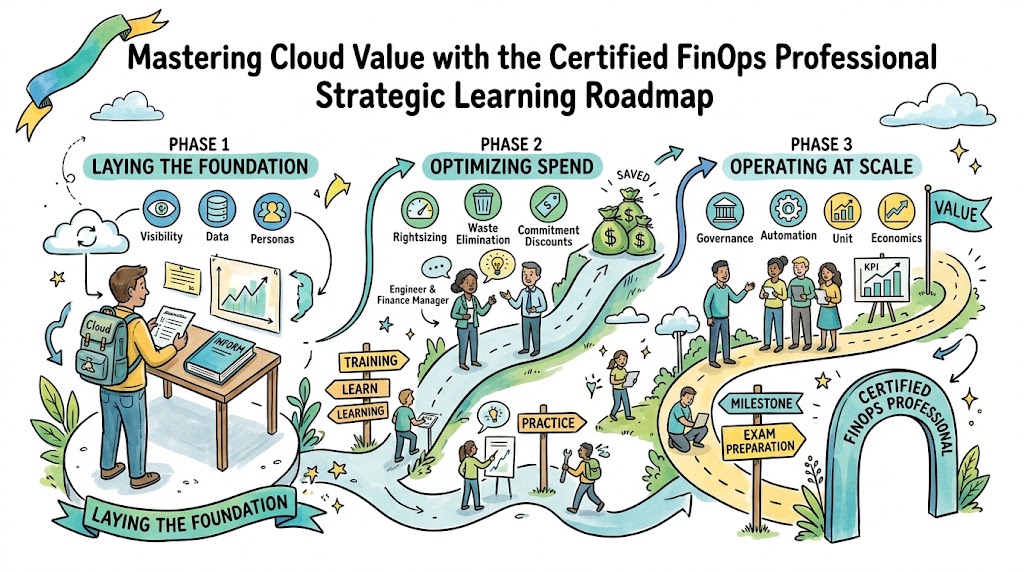
The Certified FinOps Professional designation represents the highest tier of expertise for individuals managing cloud financial operations within modern enterprise environments. This comprehensive guide serves engineers and managers who aim to bridge the gap between cloud engineering and financial accountability. As cloud-native architectures become more complex, the intersection of DevOps, SRE, and platform engineering requires a disciplined approach to cost optimization that does not sacrifice performance. By exploring this path at FinOpsSchool, professionals can transition from reactive spending to proactive value creation, ensuring that every dollar spent on cloud resources yields maximum business impact. This guide provides a clear roadmap for making informed career decisions and mastering the nuances of unit economics in a scalable, automated world.
What is the Certified FinOps Professional?
The Certified FinOps Professional is a rigorous credential designed to validate an individual’s ability to implement and lead the FinOps framework within an organization. Unlike entry-level certifications that focus on basic terminology, this professional-grade program emphasizes the practical application of cost management across multi-cloud environments. It represents a commitment to the three core phases: Inform, Optimize, and Operate.
This certification exists because modern enterprises have moved beyond simple cost-cutting and now require sophisticated data-driven decision-making. It aligns with real-world production workflows by integrating financial accountability into the engineering lifecycle. Professionals holding this title are recognized for their ability to foster a culture of transparency where engineering, finance, and business teams work toward a common goal of fiscal efficiency.
Who Should Pursue Certified FinOps Professional?
This certification is specifically designed for cloud architects, systems engineers, and Site Reliability Engineers who manage large-scale cloud budgets. It is equally valuable for financial analysts and procurement professionals who need to understand the technical nuances of cloud billing and usage patterns. Managers and technical leaders who oversee digital transformation initiatives will find the strategic insights indispensable for long-term planning.
In the context of both the Indian market and the global tech landscape, the role of a FinOps practitioner is becoming a standalone career track. Beginners with a strong interest in cloud economics can use this as a foundational pillar, while experienced engineers can leverage it to pivot into leadership roles. Organizations looking to scale their cloud presence without runaway costs specifically target candidates who possess this specialized skill set.
Why Certified FinOps Professional is Valuable and Beyond
The demand for FinOps expertise is surging as organizations realize that cloud waste is a significant drain on profitability and innovation. Earning the Certified FinOps Professional credential ensures longevity in a career that is increasingly focused on efficiency rather than just deployment speed. As enterprise adoption of cloud-native technologies grows, the ability to interpret complex billing data becomes a high-value skill.
Investing time in this certification provides a substantial return by positioning the professional as a strategic asset to the company. It helps individuals stay relevant even as specific cloud tools evolve because the underlying principles of cloud economics remain constant. Professionals can demonstrate their direct impact on the bottom line, making them indispensable during economic shifts or organizational restructuring.
Certified FinOps Professional Certification Overview
The program is delivered via the official curriculum and is hosted on the FinOpsSchool platform. This certification level moves beyond the basics of the practitioner level, focusing on the assessment of complex scenarios and the implementation of advanced governance policies. It requires a deep understanding of shared responsibility models and the ability to influence cross-functional teams without direct authority.
The structure of the certification involves a practical assessment of real-world scenarios, including commitment-based discounts and architectural optimization. Ownership of the certification lies with the professional, but its benefits extend to the entire engineering organization by standardizing the language of cloud finance. It is designed to be a rigorous validation of one’s ability to drive a permanent cultural shift toward financial responsibility.
Certified FinOps Professional Certification Tracks & Levels
The certification ecosystem is divided into three distinct levels: Foundation, Professional, and Advanced. The Foundation level introduces the core concepts and the lifecycle of cloud financial management, making it suitable for all team members. The Professional level, which this guide focuses on, is intended for those who will lead the FinOps practice and implement the framework daily.
Specialization tracks are also available to align the certification with specific career goals, such as DevOps-focused FinOps or SRE-focused FinOps. As a professional progresses, these tracks allow for a deeper dive into the technical automation of cost controls and the integration of financial metrics into CI/CD pipelines. This alignment ensures that as your career advances, your financial management skills scale with your technical responsibilities.
Complete Certified FinOps Professional Certification Table
| Track | Level | Who it’s for | Prerequisites | Skills Covered | Recommended Order |
| Core FinOps | Foundation | All Cloud Stakeholders | Basic Cloud Knowledge | Lifecycle, Personas, Domains | 1 |
| Core FinOps | Professional | FinOps Leads & SREs | Foundation Cert + Exp | Forecasting, Unit Metrics | 2 |
| Technical | Advanced | Architects & Engineers | Professional Cert | Automation, Rightsizing | 3 |
| Leadership | Executive | CTOs & Finance Directors | Foundational Awareness | Cultural Change, Strategy | 4 |
Detailed Guide for Each Certified FinOps Professional Certification
Certified FinOps Professional – Professional Level
What it is
This certification validates an individual’s mastery of the FinOps framework and their ability to apply it to complex, high-spend cloud environments. It confirms that the professional can lead the cultural change required to make FinOps successful within an enterprise.
Who should take it
It is designed for cloud cost managers, SREs, and senior cloud engineers who have at least one year of hands-on experience in cloud financial management. It is also ideal for finance managers working closely with engineering teams to optimize cloud spend.
Skills you’ll gain
- Designing advanced tagging and labeling taxonomies for granular cost allocation.
- Managing commitment-based discounts like Reserved Instances and Savings Plans.
- Developing accurate cloud spend forecasts and variance analysis reports.
- Establishing organizational governance and automated policy enforcement.
Real-world projects you should be able to do
- Implementing a multi-cloud cost allocation engine that maps 95% of spend to business units.
- Reducing annual cloud waste by 20% through automated rightsizing and scheduling.
- Building a real-time dashboard that correlates cloud spend with business KPIs like cost-per-transaction.
Preparation plan
- 7–14 Days: Focus on the official body of knowledge, reviewing the core domains and the interaction between personas.
- 30 Days: Engage in hands-on labs using billing data exports and practice writing complex SQL queries for cost analysis.
- 60 Days: Conduct a mock FinOps audit of your current environment and develop a comprehensive optimization strategy.
Common mistakes
- Focusing solely on cost reduction rather than value optimization and unit economics.
- Failing to understand the cultural and organizational hurdles of cross-team collaboration.
- Relying too heavily on third-party tools without understanding the underlying billing mechanics.
Best next certification after this
- Same-track option: Advanced FinOps Specialist.
- Cross-track option: Cloud Solutions Architect Professional.
- Leadership option: Certified Technology Business Management (TBM) Professional.
Choose Your Learning Path
DevOps Path
The DevOps path focuses on integrating financial feedback loops directly into the software development lifecycle. Engineers learn to treat cost as a first-class metric alongside performance and reliability. This path involves automating cost checks within Jenkins or GitHub Actions and ensuring that infrastructure-as-code templates are optimized for budget. It is ideal for those who want to build a “Shift Left” financial culture.
DevSecOps Path
In this path, professionals explore the intersection of cost, security, and compliance. Often, security tools and logs can become a major source of cloud spend, and this track teaches how to optimize security architectures for efficiency. You will learn to manage the costs of data retention and security scanning without compromising the organization’s risk posture. It is perfect for security engineers who also hold budgetary responsibilities.
SRE Path
The Site Reliability Engineering path emphasizes the balance between cost and the error budget. Professionals learn how to scale resources based on demand patterns to maintain availability while minimizing idle capacity. This path focuses on deep technical optimizations, such as choosing the right instance types and storage tiers for specific workloads. It is the most technical path, aimed at those who manage production environments.
AIOps Path
AIOps focuses on using machine learning and artificial intelligence to predict cloud spending patterns and automate anomalies detection. Professionals in this track learn to use AI-driven tools to identify spikes in spend and provide automated recommendations for mitigation. This path is suitable for data-driven engineers who want to apply algorithmic solutions to financial management. It represents the future of automated FinOps.
MLOps Path
The MLOps path specifically addresses the high costs associated with training and deploying machine learning models. You will learn to optimize GPU utilization, manage large-scale data transfer costs, and select the most cost-effective training environments. This path is essential for organizations where data science is a core business driver and cloud costs are scaling rapidly. It bridges the gap between data science and financial reality.
DataOps Path
DataOps professionals focus on the financial aspects of data pipelines, storage, and analytics platforms like Snowflake or BigQuery. This path teaches how to manage data egress costs and optimize query performance to reduce compute charges. It is vital for data engineers who need to keep massive data lakes and warehouses within a predictable budget. You will learn to build efficient data architectures that scale economically.
FinOps Path
The pure FinOps path is for those who want to specialize exclusively in the financial governance of cloud resources. It covers the entire lifecycle from procurement and contract negotiation to reporting and cultural advocacy. This path is designed for those who aim to lead a FinOps Center of Excellence (CoE) and act as the primary liaison between IT and Finance. It focuses on strategy, policy, and organizational transformation.
Role → Recommended Certified FinOps Professional Certifications
| Role | Recommended Certifications |
| DevOps Engineer | FinOps Professional + DevOps Specialization |
| SRE | FinOps Professional + SRE Specialization |
| Platform Engineer | FinOps Professional + Advanced Technical Track |
| Cloud Engineer | FinOps Foundation + FinOps Professional |
| Security Engineer | FinOps Foundation + DevSecOps Specialization |
| Data Engineer | FinOps Professional + DataOps Specialization |
| FinOps Practitioner | FinOps Professional + Advanced Specialist |
| Engineering Manager | FinOps Foundation + Leadership Track |
Next Certifications to Take After Certified FinOps Professional
Same Track Progression
After achieving the Professional level, the natural progression is toward the Advanced Specialist certifications. these programs dive deeper into specific cloud providers’ billing engines and advanced automation techniques using API integrations. It allows a practitioner to become a subject matter expert in complex areas like multi-cloud reconciliation and container cost allocation. This path is for those who want to remain at the absolute forefront of the FinOps movement.
Cross-Track Expansion
Expanding into related disciplines like Site Reliability Engineering or Cloud Architecture can significantly enhance a FinOps professional’s effectiveness. Understanding how systems are built and maintained allows for more realistic and impactful cost optimization recommendations. By gaining credentials in SRE or Platform Engineering, you can communicate more effectively with engineering teams and gain their trust. This broadening of skills makes you a versatile asset in any cloud-native organization.
Leadership & Management Track
For those looking to move into executive roles, certifications in ITIL, COBIT, or Technology Business Management are excellent additions. These programs focus on the broader context of IT governance and how cloud finance fits into the overall corporate strategy. Transitioning to leadership requires a shift from managing tools to managing people and organizational processes. This track prepares you for roles such as Head of Cloud Operations or Director of FinOps.
Training & Certification Support Providers for Certified FinOps Professional
DevOpsSchool
This provider offers extensive training programs that focus on the integration of FinOps within the broader DevOps ecosystem. Their courses are designed for working professionals who need to understand how to automate financial controls. They provide practical labs and real-world scenarios that help students apply FinOps principles to their daily workflows immediately.
Cotocus
Focusing on high-end technical training, this organization provides specialized coaching for the professional level certification. Their curriculum emphasizes the technical aspects of cloud cost optimization and architectural best practices. They are known for their experienced instructors who bring years of industry experience into the classroom setting to help bridge the knowledge gap.
Scmgalaxy
This community-driven platform offers a wealth of resources and training materials for those pursuing cloud financial management. They provide a collaborative environment where professionals can share insights and best practices regarding cost transparency. Their training focuses on the cultural shift required to make FinOps a success within diverse organizational structures.
BestDevOps
As a training provider, they focus on delivering high-quality, project-based learning experiences for FinOps candidates. Their courses are structured to guide students through the entire lifecycle of cloud financial management with a heavy emphasis on hands-on practice. They aim to produce practitioners who can deliver immediate value to their employers through effective cost management.
devsecopsschool.com
This platform specializes in the intersection of security and operations, offering unique insights into how FinOps interacts with security compliance. Their training helps professionals understand the hidden costs of security and how to optimize them without increasing risk. It is an excellent choice for security engineers looking to add financial management to their skill set.
sreschool.com
Dedicated to the principles of Site Reliability Engineering, this provider integrates FinOps into the reliability framework. Their courses teach how to use cost as a metric for system health and how to balance error budgets with financial budgets. Students learn to build systems that are both resilient and fiscally responsible through deep technical analysis.
aiopsschool.com
This provider focuses on the next generation of cloud management through the lens of artificial intelligence and machine learning. Their FinOps training incorporates the use of AI tools for predictive analytics and automated cost governance. It is ideal for forward-thinking professionals who want to lead the way in automated cloud financial operations.
dataopsschool.com
Recognizing the unique challenges of data-intensive workloads, this school offers training tailored for data engineers and architects. Their FinOps curriculum focuses on optimizing data storage, transfer, and processing costs in large-scale analytics environments. They provide deep dives into the billing models of major data platforms and cloud services.
finopsschool.com
As the primary host for the certification, this platform offers the most direct and comprehensive path to becoming a certified professional. Their curriculum is strictly aligned with the official standards and is updated regularly to reflect changes in the cloud landscape. They provide the foundational resources and advanced tracks necessary for career-long growth in this field.
Frequently Asked Questions (General)
- How difficult is the professional certification exam?The exam is considered challenging as it requires a deep understanding of both technical cloud concepts and financial management principles.
- How long does it take to prepare for the certification?Most professionals with prior experience require 30 to 60 days of focused study to feel fully prepared for the assessment.
- Are there any mandatory prerequisites for the professional level?While the Foundation certification is often recommended, significant hands-on experience in cloud financial management is the most critical requirement.
- What is the return on investment for this certification?Professionals often see increased salary potential and greater job security as they become vital to their organization’s financial health.
- Is the certification recognized globally?Yes, the framework is the industry standard and is recognized by major cloud providers and enterprises worldwide.
- Do I need to be an engineer to take this certification?No, but a strong understanding of cloud architecture and how cloud services are consumed is essential for success.
- How often do I need to recertify?Certifications typically require renewal every two to three years to ensure your skills remain current with evolving cloud technologies.
- Can this certification help me move into a leadership role?Absolutely, as it demonstrates your ability to manage large budgets and drive cross-functional cultural changes.
- Does the exam focus on a specific cloud provider like AWS or Azure?The exam is cloud-agnostic and focuses on the general principles of FinOps that apply to all major cloud environments.
- What is the best way to gain hands-on experience for the exam?Working with actual cloud billing data and implementing optimization strategies in a real or sandbox environment is the best preparation.
- Are there practice exams available?Yes, most training providers and the official hosting site offer practice questions to help you gauge your readiness.
- Is there a community for certified professionals?There is a large, active community where practitioners share tools, templates, and case studies to help each other succeed.
FAQs on Certified FinOps Professional
- What specific domains are covered in the professional exam?The exam covers all core domains including allocation, reporting, optimization, and the cultural transformation required for FinOps.
- How does this certification differ from the Foundation level?The professional level focuses on implementation and leadership, whereas the foundation level focuses on basic terminology and concepts.
- Will this certification teach me how to use specific cost management tools?It focuses on the principles and frameworks, making you capable of using any tool effectively rather than mastering one specific product.
- Is there a focus on container and Kubernetes cost management?Yes, as modern cloud environments heavily use containers, understanding how to allocate these shared costs is a key component.
- Does the certification cover multi-cloud strategies?The framework is designed for multi-cloud environments and teaches you how to reconcile different billing models into a single view.
- What is the pass mark for the professional exam?The passing score is generally around 75%, but this can vary slightly based on the specific version of the exam.
- Are there any case studies in the exam?Yes, the professional level often includes scenario-based questions that require you to apply your knowledge to solve complex business problems.
- Can I take the exam online?Yes, the certification exam is typically offered as a proctored online assessment for your convenience.
Final Thoughts: Is Certified FinOps Professional Worth It?
Choosing to pursue the professional certification is a significant career move that signals your transition from a technical executor to a strategic business partner. In an era where cloud costs can easily spiral out of control, having a certified expert who can speak the language of both engineering and finance is invaluable. This credential does more than just validate your knowledge; it empowers you to lead a cultural shift that makes cloud consumption sustainable and value-driven. If you are looking to advance into high-level SRE, platform engineering, or dedicated FinOps roles, this path provides the necessary depth. It is an investment in a future where efficiency is the primary driver of technical success.