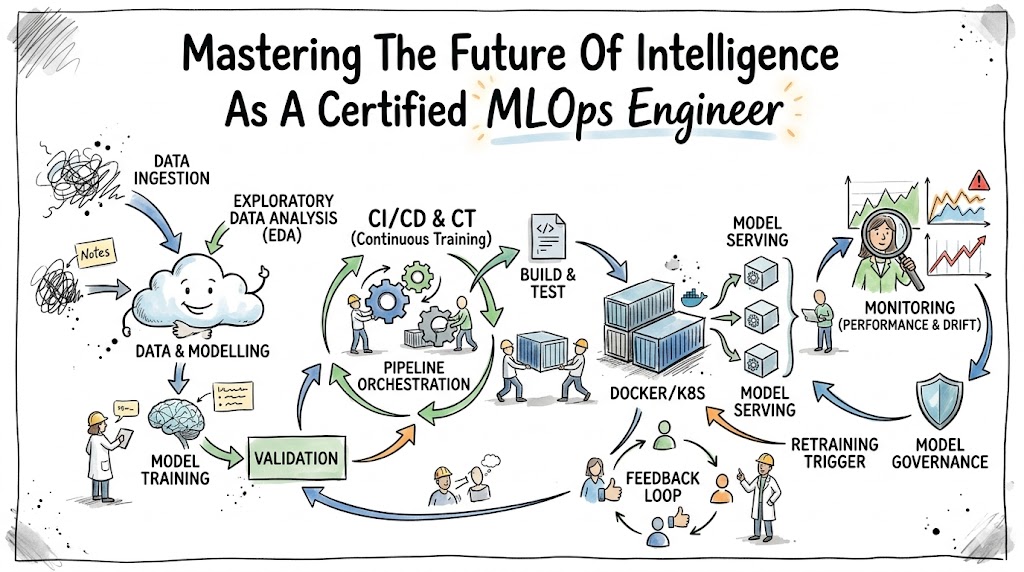
The modern engineering landscape shifts rapidly toward integrated intelligence, making the Certified MLOps Engineer credential a vital asset for professionals at AIOpsSchool. This guide helps software engineers, platform architects, and data professionals bridge the gap between machine learning models and production-grade reliability. As businesses replace isolated experimental notebooks with automated, scalable pipelines, professionals must understand the intersection of DevOps and machine learning to stay relevant. This comprehensive roadmap assists you in navigating the complexities of model deployment, monitoring, and governance while ensuring your career remains competitive in a cloud-native world.
What is the Certified MLOps Engineer?
The Certified MLOps Engineer represents a paradigm shift in how teams handle the lifecycle of machine learning. It standardizes the practices of versioning data, automating model training, and ensuring that deployments mirror the predictability of traditional software. This certification prioritizes real-world, production-focused learning over abstract mathematical theory. It aligns with modern engineering workflows and enterprise practices by treating models as first-class citizens in a CI/CD ecosystem.
Who Should Pursue Certified MLOps Engineer?
DevOps engineers and SREs who want to extend their infrastructure expertise into the data science domain will find this path ideal. Cloud professionals and security experts also benefit, as they increasingly manage high-performance compute resources and secure model endpoints. Beginners possessing a strong foundation in Linux and Python gain a logical step forward, while senior managers acquire the technical depth needed to lead hybrid teams. This certification provides a common language for cross-functional collaboration across both the Indian tech hub and the global market.
Why Certified MLOps Engineer is Valuable and Beyond
Enterprises increasingly demand operationalized machine learning because they realize most AI projects fail during the deployment stage. This certification secures your career longevity by teaching principles that remain effective even as specific libraries or tools change. Mastering the orchestration of data pipelines and model monitoring provides a high return on investment for your organization. It keeps professionals relevant despite tool changes, shifting the focus from manual model tuning to creating resilient, self-healing ML systems.
Certified MLOps Engineer Certification Overview
The program delivers training via aiopsschool.com/certifications/certified-mlops-engineer.html and resides on aiopsschool.com. It offers a practical assessment of an engineer’s ability to manage machine learning workflows at scale. Industry-aligned curriculum design governs the program, focusing on the practical application of MLOps rather than abstract concepts. Candidates complete a rigorous evaluation process that mirrors the daily challenges found in enterprise environments, ensuring they are ready for high-stakes production roles.
Certified MLOps Engineer Certification Tracks & Levels
The certification features foundation, professional, and advanced levels to suit various career stages. The foundation level introduces core concepts of versioning and basic automation, while the professional level explores orchestration and monitoring in depth. Architects who design multi-cloud or hybrid-edge ML systems should target the advanced tracks. These levels support career progression, allowing an engineer to start as a contributor and eventually transition into a principal architect or MLOps lead.
Complete Certified MLOps Engineer Certification Table
| Track | Level | Who it’s for | Prerequisites | Skills Covered | Recommended Order |
| Core MLOps | Foundation | Beginners, Junior Devs | Basic Python, Linux | CI/CD, Git, ML Basics | First |
| Engineering | Professional | SREs, Data Engineers | Foundation Level | Docker, Kubernetes, Kubeflow | Second |
| Architecture | Advanced | Tech Leads, Architects | Professional Level | Scalability, Security, Policy | Third |
| Security | Specialist | Security Engineers | Core MLOps knowledge | Model Governance, DevSecOps | Optional |
Detailed Guide for Each Certified MLOps Engineer Certification
Certified MLOps Engineer – Foundation Level
What it is
This certification validates a fundamental understanding of the MLOps lifecycle, including data versioning and basic CI/CD for machine learning. It proves the candidate knows how to move a model from a local environment to a shared repository.
Who should take it
Junior developers, data scientists wanting to learn operations, or system administrators transitioning into the data domain should take this. It serves those who need a solid grasp of the “why” behind MLOps.
Skills you’ll gain
- Understanding the ML Lifecycle (CRISP-DM to MLOps)
- Version control for data and models using DVC or Git
- Basic automation for model testing
- Collaborative development practices
Real-world projects you should be able to do
- Create a reproducible data pipeline for a small dataset
- Automate a basic model training trigger in a CI tool
- Document model metadata for auditing purposes
Preparation plan
- 7-14 Days: Focus on the MLOps manifesto and core terminology.
- 30 Days: Practice basic Python scripting and Git-based workflows.
- 60 Days: Build a small end-to-end project including data versioning.
Common mistakes
- Focusing too much on model accuracy rather than pipeline reliability.
- Ignoring the importance of data lineage and versioning.
Best next certification after this
- Same-track: Professional MLOps Engineer
- Cross-track: Certified DataOps Professional
- Leadership: Engineering Management in AI
Certified MLOps Engineer – Professional Level
What it is
This level validates the ability to build and maintain production-grade ML pipelines using containerization and orchestration tools. It confirms technical proficiency in scaling model training and deployment.
Who should take it
Mid-level DevOps engineers, SREs, and Data Engineers responsible for the uptime and performance of machine learning services should apply. It requires hands-on experience with cloud infrastructure.
Skills you’ll gain
- Orchestration with tools like Kubeflow or MLflow
- Containerizing ML workloads with Docker
- Implementing automated model monitoring and alerting
- Feature store management and deployment
Real-world projects you should be able to do
- Deploy a model on a Kubernetes cluster with auto-scaling
- Set up a drift detection system that triggers retraining
- Create a centralized feature store for multiple teams
Preparation plan
- 7-14 Days: Review Kubernetes basics and container networking.
- 30 Days: Complete hands-on labs with Kubeflow or similar orchestration platforms.
- 60 Days: Implement a full CI/CD/CT (Continuous Training) pipeline.
Common mistakes
- Over-engineering the solution for simple model requirements.
- Neglecting the security of the model API endpoints.
Best next certification after this
- Same-track: Advanced MLOps Architect
- Cross-track: Certified DevSecOps Engineer
- Leadership: Technical Program Manager (ML)
Choose Your Learning Path
DevOps Path
The DevOps path centers on the seamless integration of ML code into existing software delivery pipelines. Engineers in this track prioritize automation, ensuring that every change in the model or data triggers a reliable build and test sequence. They bridge the gap between data science teams and IT operations to reduce time-to-market for AI products. This path suits those who want to standardize the release of intelligence within an organization.
DevSecOps Path
The DevSecOps path emphasizes the security and governance of machine learning systems. Professionals in this track protect the data supply chain, secure model weights, and ensure API endpoints remain resilient against attacks. They implement automated security scanning within the ML pipeline to catch vulnerabilities early. This path remains critical for highly regulated industries like finance and healthcare.
SRE Path
The SRE path focuses on the reliability and performance of machine learning models in production. Engineers care about latency, throughput, and the availability of the infrastructure supporting the models. They build robust monitoring systems to detect model drift and performance degradation before it impacts the business. This track appeals to those who enjoy solving complex distributed systems problems.
AIOps Path
The AIOps path applies machine learning to improve IT operations themselves. Engineers learn to apply algorithms to logs, metrics, and trace data to automate incident response and capacity planning. This involves building self-healing systems that can predict outages before they occur. It represents a specialized intersection where AI becomes the primary tool for better infrastructure management.
MLOps Path
The MLOps path provides the core journey for managing the end-to-end lifecycle of machine learning. It covers everything from data ingestion and transformation to model training, deployment, and retraining. Engineers act as the glue between data scientists and production environments. They ensure that models remain reproducible, auditable, and scalable across different cloud providers.
DataOps Path
The DataOps path concentrates on the quality and flow of data that feeds machine learning models. Professionals in this track automate data pipelines, ensure data integrity, and reduce the cycle time of data delivery. They apply DevOps principles to data management to ensure the fuel for the models remains clean and available. This represents a vital precursor to successful MLOps implementation.
FinOps Path
The FinOps path addresses the cost management of machine learning operations. Training large models and maintaining high-performance inference clusters incurs significant expenses. Engineers in this track optimize compute resources and implement cost-allocation tags. They balance the performance of ML models with the financial constraints of the business to ensure sustainable AI adoption.
Role → Recommended Certified MLOps Engineer Certifications
| Role | Recommended Certifications |
| DevOps Engineer | Certified MLOps Engineer (Professional), DevSecOps Professional |
| SRE | Certified MLOps Engineer (Advanced), SRE Practitioner |
| Platform Engineer | Certified MLOps Engineer (Core), Kubernetes Administrator |
| Cloud Engineer | Certified MLOps Engineer (Foundation), Cloud Architect |
| Security Engineer | Certified MLOps Engineer (Specialist), DevSecOps Specialist |
| Data Engineer | Certified MLOps Engineer (Professional), DataOps Engineer |
| FinOps Practitioner | Certified MLOps Engineer (Foundation), FinOps Certified |
| Engineering Manager | Certified MLOps Engineer (Foundation), Leadership Track |
Next Certifications to Take After Certified MLOps Engineer
Same Track Progression
Professionals looking to deepen their expertise should pursue the Advanced MLOps Architect level next. This involves mastering complex multi-model deployments, edge computing for ML, and large-scale distributed training. Deep specialization allows you to lead high-impact projects that require specialized knowledge in high-performance computing and complex data orchestration.
Cross-Track Expansion
Broadening your skills into DevSecOps or DataOps provides a more holistic view of the engineering ecosystem. Understanding how to secure the pipeline or manage the underlying data quality makes you a more versatile professional. Enterprises highly value this cross-track expansion as they prefer engineers who can handle multiple parts of the production stack.
Leadership & Management Track
Engineers wishing to move into people management or technical leadership should consider certifications in engineering management or AIOps strategy. This transition focuses on the business value of MLOps, team building, and strategic resource allocation. It prepares you to manage large teams of data scientists and engineers while aligning technical goals with company objectives.
Training & Certification Support Providers for Certified MLOps Engineer
DevOpsSchool
DevOpsSchool offers extensive resources for those entering the world of automation and continuous delivery. Their curriculum remains practical and hands-on, catering to professionals who need to manage complex software lifecycles. They provide a strong foundation for any engineer looking to master the tools of the modern trade.
Cotocus
Cotocus focuses on specialized technical training and consulting for cloud-native technologies. They provide deep-dive sessions into containerization and orchestration, which any MLOps professional requires. Their modular approach allows engineers to pick up specific skills as needed for their current projects.
Scmgalaxy
Scmgalaxy serves as a community-driven platform offering a wealth of knowledge on configuration management and software supply chains. They remain a great resource for engineers who want to understand the history and evolution of DevOps practices. Their tutorials and forums assist in troubleshooting real-world deployment issues.
BestDevOps
BestDevOps curates high-quality learning paths for engineers aiming for top-tier certifications. They emphasize the integration of various tools into a cohesive workflow, helping professionals avoid learning tools in isolation. Their focus creates well-rounded engineers who understand the entire delivery pipeline.
devsecopsschool.com
devsecopsschool.com dedicates its site to the integration of security into the DevOps workflow. They provide specialized training on automated security testing, compliance as code, and vulnerability management. For an MLOps engineer, this represents a critical resource for learning how to protect sensitive data and models.
sreschool.com
sreschool.com helps engineers build systems that are both scalable and reliable by focusing on SRE principles. Their training covers monitoring, incident response, and error budgets, which are vital for maintaining production machine learning models. It serves as an essential stop for those moving into SRE roles.
aiopsschool.com
aiopsschool.com acts as the primary destination for professionals looking to master artificial intelligence in operations. They offer specialized tracks that cover the intersection of AI, machine learning, and IT infrastructure. Their certifications meet the growing demand for intelligent automation in the enterprise.
dataopsschool.com
dataopsschool.com focuses on the data part of the equation, teaching engineers how to build resilient and automated data pipelines. They apply agile principles to data management, ensuring that data always remains ready for model training. This site serves as a key resource for anyone specializing in the data supply chain.
finopsschool.com
finopsschool.com addresses the critical need for cloud financial management. They provide training on how to track, manage, and optimize the costs associated with cloud resources and ML workloads. For senior engineers and managers, this knowledge remains essential for maintaining a sustainable and profitable tech stack.
Frequently Asked Questions
- Is the Certified MLOps Engineer exam difficult?
The exam remains challenging but fair, focusing on practical application rather than rote memorization. Candidates with hands-on experience with pipelines and containers find it manageable.
- How long does it take to prepare for this certification?
Most professionals spend between 30 to 60 days preparing, depending on their existing background in DevOps and Python. Success requires dedicated study of the specific MLOps lifecycle.
- Are there any prerequisites for the foundation level?
No formal prerequisites exist, but a basic understanding of Linux commands and Python programming helps you keep up with the technical labs.
- What is the return on investment for this certification?
Engineers with MLOps skills often see significant salary increases and more opportunities for senior roles. Enterprises pay a premium for those who can bridge the gap between AI and production.
- Can I take the exam online?
Yes, the certification remains accessible globally, and the provider typically handles the assessment through a secure online platform.
- Does this certification cover specific cloud providers like AWS or Azure?
The labs often use popular cloud tools to demonstrate how MLOps works, although the principles themselves remain cloud-agnostic.
- How often do I need to recertify?
Technological standards evolve quickly, so experts recommend updating your certification every few years to stay familiar with the latest tools and best practices.
- Is this certification recognized in India?
Yes, major IT hubs in India highly recognize it, as many multinational companies build out their centralized MLOps and AI departments there.
- What tools will I learn during the process?
You gain exposure to a variety of tools, including Docker, Kubernetes, MLflow, DVC, and various CI/CD platforms like Jenkins or GitHub Actions.
- Is MLOps different from Data Engineering?
Yes, Data Engineering focuses on the movement and storage of data, whereas MLOps concentrates on the lifecycle, deployment, and monitoring of models.
- Do I need to be a mathematician to pass?
No, this remains an engineering certification. You should understand how models behave, but the focus stays on infrastructure and automation rather than underlying calculus.
- Should I learn DevOps before MLOps?
A DevOps background provides a significant advantage, as MLOps essentially applies DevOps principles to machine learning workloads.
FAQs on Certified MLOps Engineer
- How does this certification handle model drift?
The curriculum covers automated monitoring strategies to detect when model performance decays due to changing data. You learn to set up alerts and automated retraining triggers.
- What is the focus on containerization?
Containerization sits at the center of the program because it ensures the environment used for training matches the inference environment. You will spend significant time with Docker.
- Does the program cover security for ML?
Yes, it includes modules on securing model artifacts and protecting data privacy during training. This remains vital for maintaining compliance in sensitive industries.
- Will I learn about feature stores?
Feature stores represent a key component of the professional track. You learn how to manage and serve features consistently across both training and real-time inference.
- Are open-source tools emphasized?
The certification prioritizes widely-used open-source tools like Kubeflow and MLflow. This ensures the skills you gain remain portable across different companies and cloud environments.
- How does it address scalability?
You learn to use Kubernetes to scale model inference based on demand. This includes handling high-traffic scenarios and optimizing resource usage to keep costs low.
- Is version control only for code?
No, the training emphasizes versioning data and model weights alongside your code. This ensures full reproducibility of every experiment and deployment.
- What is the final assessment like?
The assessment mixes theoretical knowledge with practical scenarios. It tests your ability to design a pipeline that meets specific business and technical requirements.
Final Thoughts: Is Certified MLOps Engineer Worth It?
Transitioning from experimental machine learning to production-ready AI represents the biggest challenge facing technical organizations today. Moving into MLOps involves more than just learning a new tool; it requires adopting a mindset that prioritizes reliability, repeatability, and scale. This certification provides the structured path you need to master these complex intersections.
If you enjoy working at the crossroads of software engineering and data science, this path offers a clear competitive advantage. The industry continues to move away from AI as a hobby toward AI as a core utility. Those who build the systems to support this shift will become the architects of the future. Investing time and effort to earn this credential pays dividends as more companies seek to operationalize their intelligence at scale.