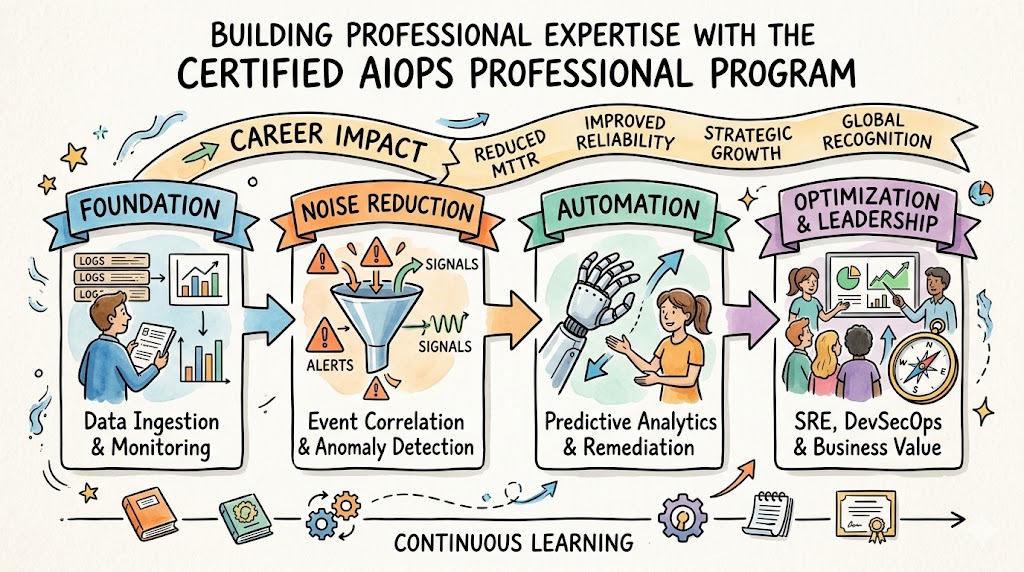
The modern IT landscape demands a shift from manual intervention to automated intelligence. This guide explains how the Certified AIOps Professional designation serves engineers navigating the intersection of artificial intelligence and operations. Whether you are in DevOps, SRE, or platform engineering, understanding these concepts is vital for managing complex, distributed systems. By leveraging AIOpsSchool, professionals can transition from reactive troubleshooting to proactive system management. This resource helps you evaluate the certification’s impact on your career trajectory and technical growth.
What is the Certified AIOps Professional?
The Certified AIOps Professional program represents a shift toward data-driven operations. It exists to bridge the gap between traditional monitoring and advanced machine learning applications in infrastructure. Instead of focusing solely on theoretical models, this certification emphasizes real-world production environments. It aligns with modern engineering workflows by teaching professionals how to handle massive telemetry data. Enterprise practices now require this level of automation to maintain uptime in cloud-native ecosystems.
Who Should Pursue Certified AIOps Professional?
This path primarily benefits Site Reliability Engineers, DevOps professionals, and cloud architects who manage large-scale systems. Security and data roles also find value as they integrate observability into their respective domains. Beginners can use it to build a modern foundation, while experienced leads use it to modernize their legacy operational strategies. In the Indian market and global tech hubs, companies are actively seeking leaders who can reduce Mean Time to Resolution through intelligence. Managers also pursue this to better oversee AI-driven digital transformation initiatives.
Why Certified AIOps Professional is Valuable and Beyond
The longevity of this certification stems from the increasing complexity of microservices and hybrid clouds. As systems grow too large for human oversight, enterprise adoption of AI-driven operations becomes mandatory. This program ensures professionals stay relevant even as specific monitoring tools change over time. It offers a significant return on investment by positioning you at the forefront of the next operational evolution. Mastering these skills secures your career against the diminishing returns of manual, repetitive engineering tasks.
Certified AIOps Professional Certification Overview
The program is delivered via AIOpsSchool and provides a structured approach to mastering operational intelligence. It utilizes a practical assessment methodology that tests your ability to apply algorithms to infrastructure logs and metrics. Ownership of the program rests with industry experts who ensure the curriculum matches current market demands. The structure covers data ingestion, pattern recognition, and automated remediation in a logical sequence. It moves beyond basic scripting to emphasize the lifecycle of an AI-enabled operations framework.
Certified AIOps Professional Certification Tracks & Levels
The certification is structured into three primary tiers: Foundation, Professional, and Advanced. The Foundation level introduces core concepts like noise reduction and anomaly detection for those new to the field. The Professional level dives into specific implementations across DevOps and SRE tracks. Finally, the Advanced level focuses on architectural design and cross-functional integration like FinOps. These levels align with career progression from an individual contributor to a principal architect.
Complete Certified AIOps Professional Certification Table
| Track | Level | Who it’s for | Prerequisites | Skills Covered | Recommended Order |
| Operations | Foundation | Aspiring Engineers | Basic Linux/Cloud | Data Ingestion, Observability | 1 |
| Engineering | Professional | SREs & DevOps | Python & Monitoring | ML Models, Event Correlation | 2 |
| Architecture | Advanced | Tech Leads/Managers | Professional Cert | Strategic AIOps, Governance | 3 |
Detailed Guide for Each Certified AIOps Professional Certification
Certified AIOps Professional – Foundation
What it is
This certification validates a candidate’s understanding of basic AIOps terminology and the fundamental pillars of observability. It confirms that the individual can distinguish between traditional monitoring and intelligent operations.
Who should take it
It is suitable for junior engineers, students, or managers who need to understand the jargon and concepts of AI-driven operations. No deep coding experience is required.
Skills you’ll gain
- Understanding telemetry data types
- Concepts of noise reduction in alerting
- Knowledge of the AIOps lifecycle
- Basic anomaly detection principles
Real-world projects you should be able to do
- Configure a basic dashboard that identifies outliers
- Categorize system logs for machine learning readiness
- Document an AIOps adoption roadmap for a small team
Preparation plan
- 7–14 days: Review core terminology and watch introductory videos.
- 30 days: Explore basic open-source monitoring tools and data formats.
- 60 days: Not required for this level unless switching from a non-technical field.
Common mistakes
- Overcomplicating the math behind the algorithms.
- Ignoring the importance of high-quality data ingestion.
Best next certification after this
- Same-track option: Certified AIOps Professional – Practitioner.
- Cross-track option: Cloud Practitioner.
- Leadership option: ITIL Foundation.
Certified AIOps Professional – Professional
What it is
This level validates the ability to implement and manage AIOps tools within a production CI/CD pipeline. It focuses on the practical application of machine learning to solve operational bottlenecks.
Who should take it
Experienced DevOps and SRE professionals should take this to automate their incident response workflows. It requires a working knowledge of scripting and cloud infrastructure.
Skills you’ll gain
- Implementing automated incident remediation
- Building predictive scaling models
- Integrating ML toolkits with Prometheus or ELK
- Advanced log clustering and pattern discovery
Real-world projects you should be able to do
- Deploy an automated bot that clears disk space based on predictive alerts.
- Set up a system that correlates alerts across multiple microservices.
- Build a dashboard that predicts potential downtime before it occurs.
Preparation plan
- 7–14 days: Intensive lab work focusing on API integrations.
- 30 days: Deep dive into Python for data science and statistical modeling.
- 60 days: Full project implementation and simulation of production failures.
Common mistakes
- Relying too much on tool features rather than understanding the underlying logic.
- Failing to account for “alert fatigue” when configuring ML models.
Best next certification after this
- Same-track option: Certified AIOps Professional – Expert.
- Cross-track option: MLOps Engineering.
- Leadership option: Engineering Manager Certification.
Choose Your Learning Path
DevOps Path
The DevOps path focuses on integrating intelligence into the software delivery lifecycle. You will learn how to use AI to optimize build times and predict deployment failures. This ensures that the code moving through the pipeline is stable and performant. It shifts the focus from simple automation to “intelligent” automation that learns from previous releases.
DevSecOps Path
In this path, the focus is on utilizing AIOps for security orchestration and response. You will learn to identify anomalous user behavior and potential breaches through pattern recognition. It allows security teams to handle the massive volume of security logs generated in cloud environments. This path bridges the gap between traditional security monitoring and proactive threat hunting.
SRE Path
The SRE path is heavily focused on maintaining service level objectives through predictive analytics. You will spend time learning how to automate the “toil” out of site reliability. By using AI, you can predict when a service might violate its SLA and take action before users are affected. This is the most technically rigorous path, focusing on high availability and system resilience.
AIOps Path
This path focuses on the core architecture of the intelligent operations platform itself. You will study data pipelines, storage for high-velocity metrics, and the selection of appropriate ML algorithms. It is designed for those who want to build the internal tools that other teams use. It emphasizes the scalability of the AIOps platform across the entire enterprise.
MLOps Path
The MLOps path deals with the operationalization of machine learning models. While AIOps uses AI for operations, MLOps applies operational rigor to AI development. You will learn about model versioning, monitoring model drift, and retraining pipelines. This is essential for organizations that are deploying their own AI products and need them to remain reliable.
DataOps Path
DataOps focuses on the flow of data that fuels the AIOps engine. You will learn how to ensure data quality and reliability throughout the pipeline. Without clean data, AIOps cannot function effectively, making this role critical. This path teaches you how to treat data as code, applying versioning and automated testing to data streams.
FinOps Path
The FinOps path applies AIOps principles to cloud cost management and optimization. You will learn how to use predictive modeling to forecast cloud spend and identify waste. AI can find patterns in usage that humans miss, leading to significant savings. This path is increasingly popular as companies struggle to control their sprawling cloud budgets.
Role → Recommended Certified AIOps Professional Certifications
| Role | Recommended Certifications |
| DevOps Engineer | Certified AIOps Professional – Engineering Track |
| SRE | Certified AIOps Professional – Advanced SRE Track |
| Platform Engineer | Certified AIOps Professional – Infrastructure Track |
| Cloud Engineer | Certified AIOps Professional – Multi-Cloud Track |
| Security Engineer | Certified AIOps Professional – DevSecOps Track |
| Data Engineer | Certified AIOps Professional – DataOps Track |
| FinOps Practitioner | Certified AIOps Professional – Cloud Finance Track |
| Engineering Manager | Certified AIOps Professional – Leadership Track |
Next Certifications to Take After Certified AIOps Professional
Same Track Progression
Once you master the professional level, the next step is moving into architectural roles. This involves designing the entire data strategy for an organization’s operations. Deep specialization allows you to become a subject matter expert in niche areas like predictive self-healing systems. You will likely pursue “Expert” or “Master” level credentials within the same ecosystem to solidify your standing.
Cross-Track Expansion
Broadening your skills into MLOps or FinOps is a strategic move after completing the core AIOps curriculum. Understanding how the data flows and how the costs are managed makes you a more versatile engineer. This cross-pollination of skills is highly valued in startup environments and large-scale digital transformations. It allows you to speak the language of both the data scientists and the finance teams.
Leadership & Management Track
For those looking to move away from hands-on keyboard work, the leadership track is the logical next step. This involves moving into roles like Head of Platform or VP of Engineering. You will focus more on the “why” and the business value rather than the “how” of the implementation. Certifications in agile leadership or strategic management complement your technical AIOps foundation.
Training & Certification Support Providers for Certified AIOps Professional
DevOpsSchool
This provider offers extensive resources for those looking to master the integration of AI within the DevOps lifecycle. They provide hands-on labs that simulate real-world production environments for better learning.
Cotocus
This organization focuses on specialized consulting and training for high-end engineering roles. They are known for their deep technical dives and expert-led sessions that go beyond the basic curriculum.
Scmgalaxy
As a community-driven platform, they offer a wealth of knowledge regarding software configuration management and its evolution into AIOps. They provide excellent supplementary materials for certification preparation.
BestDevOps
This site curates the best practices and tools for modern engineering teams. Their training modules are designed to be practical and immediately applicable to your current job role.
devsecopsschool.com
Focused specifically on the security aspect of the pipeline, this provider helps engineers integrate AI into their security protocols. They emphasize the importance of proactive threat detection through automation.
sreschool.com
This is the go-to resource for anyone following the SRE path. Their curriculum is built around the principles of reliability engineering and how AI can enhance system uptime.
aiopsschool.com
As the primary host for the certification, they offer the most direct and comprehensive path to becoming a certified professional. Their content is updated frequently to reflect the latest industry trends.
dataopsschool.com
They specialize in the data management side of operations. Their courses ensure that the data feeding your AIOps tools is clean, reliable, and properly governed.
finopsschool.com
This provider focuses on the intersection of cloud costs and operational intelligence. They teach engineers how to use AI to drive financial accountability in the cloud.
Frequently Asked Questions
- How difficult is the Certified AIOps Professional exam?
The difficulty depends on your background in Linux and scripting, but generally, it is moderately challenging for experienced engineers. - How much time is required to prepare for the certification?
Most professionals find that 30 to 60 days of consistent study and lab work is sufficient for the professional level. - What are the prerequisites for the foundation level?
There are no strict prerequisites, though a basic understanding of cloud computing and IT operations is highly recommended. - Is the ROI worth the cost of the exam?
Yes, as companies shift toward AI-driven operations, certified professionals often command higher salaries and better job security. - In what sequence should I take the certifications?
It is best to start with the Foundation level, followed by the Professional level in your specific area of interest. - Does this certification cover specific tools like Splunk or Datadog?
While it mentions tools, the focus is on the underlying principles and logic that apply across all major platforms. - Is there a practical lab component to the exam?
Yes, the professional and advanced levels typically involve practical scenarios that test your implementation skills. - How long is the certification valid for?
Typically, the certification remains valid for two to three years, after which recertification is required to ensure updated knowledge. - Can a manager benefit from this certification?
Absolutely, it provides the technical context needed to lead teams and make informed decisions about tool investments. - Are there any coding requirements?
For the professional level, a working knowledge of Python or Bash is usually necessary to complete the practical tasks. - How does this differ from a standard DevOps certification?
Standard certifications focus on the pipeline, while this focuses on the data-driven intelligence that optimizes the pipeline and infrastructure. - Is it recognized globally?
Yes, the concepts taught are industry-standard and recognized by major tech firms across the globe and India.
FAQs on Certified AIOps Professional
- How does the Certified AIOps Professional help with career growth?
It validates your ability to manage complex systems with modern AI tools, making you a prime candidate for senior SRE or Architect roles. Companies value the efficiency and cost-saving potential you bring to the table. - Can I take the exam online?
Yes, the program is designed to be accessible globally through online proctored assessments, allowing you to certify from your home or office. - What kind of data science knowledge is needed?
You don’t need to be a data scientist, but you should understand basic statistics, data types, and how machine learning models use training data to make predictions. - Does the program cover open-source tools?
Yes, it emphasizes the use of popular open-source frameworks for monitoring and data processing, ensuring you aren’t locked into a single vendor’s ecosystem. - Is there a community for certified professionals?
Yes, AIOpsSchool provides access to a network of alumni and experts where you can share insights and find career opportunities. - How often is the curriculum updated?
The curriculum is reviewed annually to include new advancements in AI, machine learning, and cloud-native operational practices. - What is the passing score for the exam?
Generally, a score of 70% or higher is required to demonstrate proficiency in both the theoretical and practical sections of the assessment. - Are there practice exams available?
Yes, practice sets and lab environments are provided to help candidates familiarize themselves with the exam format and technical requirements.
Final Thoughts: Is Certified AIOps Professional Worth It?
Investing in your education is the most reliable way to navigate the fast-changing tech landscape. The Certified AIOps Professional program offers a clear path for those who want to lead the next wave of operational excellence. It moves you away from manual firefighting and toward a strategic role where you design systems that heal themselves. While the learning curve can be steep for some, the practical skills gained are immediately applicable in any modern enterprise. If you want to future-proof your career in DevOps or SRE, this certification provides the necessary tools and recognition. It is a solid choice for anyone committed to technical mastery in the age of AI.