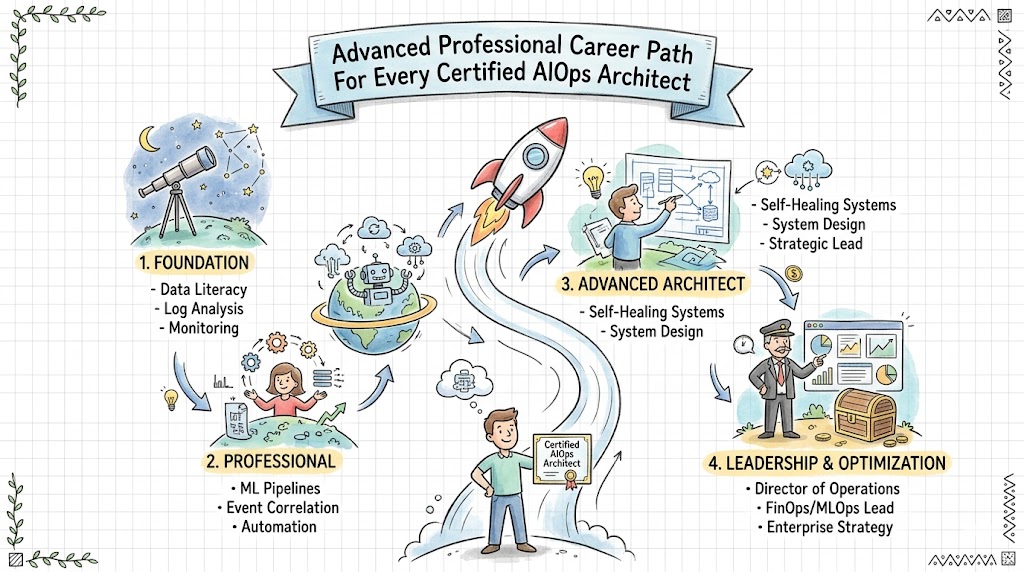
The role of a Certified AIOps Architect has become essential for managing complex, modern infrastructures effectively. This guide serves engineers and technical managers navigating the intersection of artificial intelligence and IT operations within cloud-native environments. As systems grow more distributed, manual intervention becomes impossible, making automated, data-driven decision-making a requirement for survival. By reading this analysis, professionals can determine how this specific credential from AIOpsSchool fits into their long-term growth and technical mastery.
What is the Certified AIOps Architect?
The Certified AIOps Architect designation represents a high-level mastery of integrating machine learning into standard operational workflows to achieve self-healing systems. It exists to bridge the gap between traditional monitoring and proactive, automated incident response in high-scale production environments. Consequently, the curriculum prioritizes functional architecture and data pipeline integrity over purely theoretical algorithmic study. This ensures that architects can design systems that align with enterprise-grade reliability and modern agile delivery practices.
Who Should Pursue Certified AIOps Architect?
Site Reliability Engineers and senior DevOps professionals will find this path particularly beneficial as they scale their infrastructure responsibilities. Cloud architects and data engineers who need to optimize resource allocation and performance through automation should also consider this credential. Furthermore, technical leaders in India and global markets can use this knowledge to drive digital transformation initiatives within their organizations. Even security professionals benefit by applying AI-driven patterns to threat detection and automated vulnerability remediation.
Why Certified AIOps Architect is Valuable and Beyond
The demand for AIOps expertise grows as enterprises transition from simple cloud migration to complex, multi-cloud management. Mastering these concepts provides professional longevity because the ability to manage “noise” in massive datasets remains a rare and highly valued skill. Additionally, it helps professionals stay relevant even as specific CI/CD or monitoring tools change, as the underlying architectural principles remain constant. Ultimately, the return on time investment is significant, leading to higher-tier roles in platform engineering and systems design.
Certified AIOps Architect Certification Overview
The program is delivered via AIOpsSchool and serves as a comprehensive validation of operational intelligence skills. This certification utilizes a practical assessment approach, ensuring candidates can handle real-world telemetry data and complex event correlation. It is structured to cover the entire lifecycle of an AI-driven operational framework, from data ingestion to automated action. Ownership of this certification marks an individual as a leader capable of reducing Mean Time to Repair (MTTR) through advanced automation.
Certified AIOps Architect Certification Tracks & Levels
The curriculum follows a logical progression through foundation, professional, and advanced levels to suit different career stages. Foundation tracks focus on data literacy and basic automation, while professional levels dive into specialized domains like SRE or FinOps integration. Advanced levels challenge architects to design cross-functional systems that span the entire enterprise infrastructure. Each level aligns with specific career milestones, allowing a Junior Engineer to evolve into a Principal Architect through a structured learning path.
Complete Certified AIOps Architect Certification Table
| Track | Level | Who it’s for | Prerequisites | Skills Covered | Recommended Order |
| Core Ops | Foundation | Junior Engineers | Basic Linux/Cloud | Log Analysis, Monitoring | 1 |
| Engineering | Professional | DevOps/SRE | 2+ Years Experience | ML Models, Automation | 2 |
| Architecture | Advanced | Senior Leads | 5+ Years Experience | System Design, Strategy | 3 |
| Optimization | Professional | FinOps/Data | Cloud Economics | Cost AI, Data Pipelines | 2 |
Detailed Guide for Each Certified AIOps Architect Certification
Certified AIOps Architect – Foundation
What it is
This certification validates a fundamental understanding of how data science intersects with IT operations to improve system visibility and alerting.
Who should take it
It is suitable for entry-level cloud engineers and system administrators who want to move beyond manual dashboard monitoring.
Skills you’ll gain
- Understanding telemetry data types and collection methods.
- Identifying noise in alerting systems using basic logic.
- Navigating the AIOps landscape and core terminology.
Real-world projects you should be able to do
- Setup a basic centralized logging system with anomaly detection.
- Configure automated alerts based on historical performance baselines.
Preparation plan
- 7-14 Days: Focus on core terminology and cloud monitoring basics.
- 30 Days: Complete hands-on labs for log aggregation and filtering.
- 60 Days: Deep dive into data visualization and incident response theory.
Common mistakes
Candidates often focus too much on specific tool syntax rather than understanding the underlying data flow and operational logic.
Best next certification after this
- Same-track option: Professional AIOps Engineer.
- Cross-track option: Cloud Practitioner.
- Leadership option: IT Service Management Lead.
Choose Your Learning Path
DevOps Path
Integration of AIOps into the CI/CD pipeline allows for automated canary analysis and deployment gates. Engineers learn to use predictive analytics to identify potential build failures before they reach production. This path focuses heavily on shortening feedback loops through automated data insights. Consequently, the architect becomes a facilitator of faster, safer software delivery cycles.
DevSecOps Path
Security-focused AIOps involves using machine learning to detect unusual patterns that signify a breach or vulnerability. Professionals learn to automate the isolation of compromised containers based on behavioral analysis rather than static signatures. This path enhances the “shift left” philosophy by embedding intelligence into every security gate. It ensures that security keeps pace with the speed of automated deployments.
SRE Path
The Site Reliability Engineering path centers on error budgets and automated incident response to maintain high availability. Architects develop self-healing scripts that trigger based on complex event correlation across distributed systems. This reduces the cognitive load on on-call engineers by filtering out non-actionable alerts. Therefore, the focus remains on system stability and long-term reliability engineering.
AIOps Path
This dedicated path focuses on the pure architecture of intelligence platforms within the IT ecosystem. It covers the end-to-end journey of operational data from ingestion in lakes to model inference for decision-making. Architects learn to balance model accuracy with the speed required for real-time operations. This path is ideal for those wanting to specialize strictly in the science of operational efficiency.
MLOps Path
MLOps professionals concentrate on the lifecycle management of the machine learning models used within AIOps platforms. This includes versioning datasets, monitoring model drift, and ensuring seamless retraining cycles in production. They bridge the gap between data scientists and operations teams to ensure model reliability. Success in this path leads to robust, trustworthy automated systems.
DataOps Path
DataOps focuses on the quality and reliability of the data pipelines that feed the AIOps engine. Engineers learn to treat data as code, implementing automated testing and observability for the data itself. Without clean, timely data, AIOps cannot function, making this a critical foundational path. It ensures that the insights generated by the architect are based on a “single source of truth.”
FinOps Path
Applying AIOps to cloud economics allows for automated cost optimization and predictive spending analysis. Architects learn to identify orphaned resources and right-size instances using AI-driven recommendations. This path directly impacts the bottom line by preventing cloud waste in dynamic environments. It combines technical architecture with financial accountability and resource efficiency.
Role → Recommended Certified AIOps Architect Certifications
| Role | Recommended Certifications |
| DevOps Engineer | AIOps Foundation, Professional Automation |
| SRE | Advanced AIOps Architect, Incident Response |
| Platform Engineer | Foundation AIOps, Infrastructure as Code |
| Cloud Engineer | Cloud Ops Specialist, AIOps Professional |
| Security Engineer | AI-Driven Security, DevSecOps Specialist |
| Data Engineer | DataOps Foundation, ML Pipeline Architect |
| FinOps Practitioner | Cloud Economics, Cost AI Specialist |
| Engineering Manager | AIOps Strategy for Leaders, Foundation |
Next Certifications to Take After Certified AIOps Architect
Same Track Progression
Deep specialization involves pursuing expert-level credentials in specific AI domains like Natural Language Processing for incident logs. This allows an architect to refine the “intelligence” part of the stack for more nuanced decision-making. Continuous learning in this area ensures you stay at the forefront of automation technology.
Cross-Track Expansion
Skill broadening might include taking certifications in Kubernetes orchestration or advanced multi-cloud networking. Understanding the underlying infrastructure more deeply allows the AIOps models to be more effective and context-aware. This creates a well-rounded professional capable of handling any part of the modern tech stack.
Leadership & Management Track
Transitioning to leadership requires certifications in strategic management and digital transformation. Architects can move into Director of Operations or VP of Engineering roles by combining technical depth with business acumen. This path focuses on team building, budget management, and long-term technology roadmaps.
Training & Certification Support Providers for Certified AIOps Architect
DevOpsSchool
This provider offers extensive resources for professionals looking to master the integration of development and operations through automation. They focus on practical labs and real-world scenarios to ensure students can apply their knowledge immediately in a production environment.
Cotocus
This organization specializes in high-end consulting and training for cloud-native technologies and automated workflows. Their curriculum is designed to meet the rigorous demands of enterprise-level infrastructure management and digital scaling.
Scmgalaxy
Known for its deep community roots, this platform provides a wealth of knowledge on software configuration management and delivery pipelines. They help engineers understand the foundational tools required to build effective AIOps frameworks.
BestDevOps
This site curates the most effective learning paths for engineers aiming to reach the top tier of the DevOps hierarchy. Their focus is on quality content that balances tool-specific training with broader architectural principles.
devsecopsschool.com
This portal focuses on the critical intersection of security and automated operations. They provide the training necessary to embed security protocols directly into the AI-driven operational lifecycle.
sreschool.com
Site Reliability Engineering is the core focus here, providing engineers with the skills to maintain massive, high-availability systems. Their training emphasizes the reduction of manual work through intelligent automation.
aiopsschool.com
As a primary source for AIOps education, this site offers targeted certifications for architects and engineers. They bridge the gap between data science and IT operations through specialized courses.
dataopsschool.com
This provider addresses the need for high-quality data pipelines in modern enterprises. Their training ensures that the data feeding into automation systems is reliable, clean, and processed efficiently.
finopsschool.com
Focusing on the financial side of cloud management, this school helps professionals master cloud cost optimization. They use AI-driven methodologies to ensure organizations get the most value from their cloud investments.
Frequently Asked Questions (General)
- How difficult is the certification exam for architects?
The exam is challenging because it requires a mix of operational experience and data science literacy to pass successfully.
- What is the typical time commitment for preparation?
Most professionals spend between thirty and sixty days preparing, depending on their existing background in cloud and automation.
- Are there any mandatory prerequisites for the foundation level?
There are no strict prerequisites, but a basic understanding of Linux and cloud concepts is highly recommended.
- Does this certification provide a good return on investment?
Yes, as AIOps is a high-growth field, certified architects often see significant salary increases and better job opportunities.
- Should I learn Python before starting this path?
While not always mandatory, having basic Python skills greatly helps in understanding how AI models and scripts function.
- How does this differ from a standard DevOps certification?
Standard DevOps focuses on delivery pipelines, while AIOps focuses on using data and AI to manage the resulting production environment.
- Is the certification recognized globally?
Yes, these skills are in high demand across North America, Europe, and Asia, making the credential internationally valuable.
- Can a manager benefit from this technical certification?
Managers gain the ability to make better hiring decisions and lead technical strategies more effectively by understanding the architecture.
- What is the validity period of the certification?
Typically, certifications are valid for two to three years, after which recertification is required to ensure skills remain current.
- Are there hands-on labs included in the training?
Most reputable providers include extensive hands-on labs to simulate real-world production issues and AI-driven resolutions.
- Do I need to be a data scientist to succeed?
No, the focus is on the application of AI tools in operations, not on developing new mathematical algorithms from scratch.
- Which track should I choose if I work in finance?
The FinOps track is specifically designed to help those in financial sectors manage cloud spending through intelligent automation.
FAQs on Certified AIOps Architect
- What specific AI models are covered in the architect curriculum?
The curriculum focuses on regression, clustering, and neural networks applied to time-series telemetry data for anomaly detection and prediction.
- Can I use my existing monitoring tools with these AIOps principles?
Yes, the principles are tool-agnostic and designed to enhance existing stacks like Prometheus, ELK, or Datadog with intelligent layers.
- Does the program cover multi-cloud architecture strategies?
Absolutely, as modern AIOps must function across various environments including AWS, Azure, and on-premises data centers for enterprise consistency.
- Is there a focus on automated incident remediation?
A major part of the architect’s role is designing self-healing loops that resolve common issues without human intervention.
- How does AIOps help in reducing alert fatigue?
By using event correlation and noise reduction algorithms, the system ensures that only actionable, high-priority alerts reach the engineers.
- What role does big data play in this certification?
Architects learn to manage the massive scale of data generated by modern microservices, ensuring efficient storage and real-time processing.
- Are ethical AI and data privacy covered in the training?
Yes, ensuring that operational data is handled securely and that AI decisions are transparent is a key part of the architecture.
- What is the difference between AIOps and MLOps in this context?
AIOps applies AI to improve IT operations, while MLOps focuses on the operationalizing and managing of the AI models themselves.
Final Thoughts: Is Certified AIOps Architect Worth It?
The lead in the era of automated infrastructure, obtaining this certification is a smart decision. In actuality, modern systems are now too complicated for human teams to keep an eye on using only conventional techniques. Gaining proficiency in designing intelligent operating systems makes you an invaluable member of any team. This route guarantees that your abilities will always be invaluable by providing a clear path from technical execution to high-level strategic design. Even while there may be a steep learning curve, the opportunity to progress professionally and address challenging at-scale challenges makes it a very fulfilling endeavor.