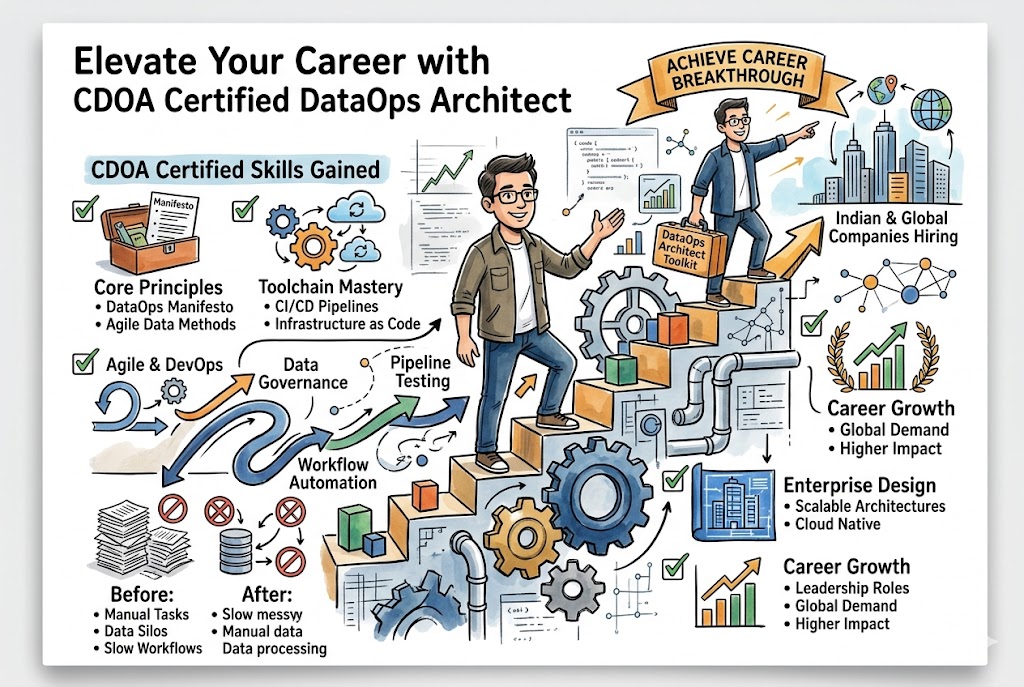
The modern data landscape requires more than just storage; it demands seamless integration and rapid delivery through the CDOA – Certified DataOps Architect program. This guide serves engineers and managers who aim to bridge the gap between data engineering and operational excellence within cloud-native environments. By mastering these principles at DataOpsSchool, professionals can transition from manual data handling to automated, scalable architectures that support AI and analytics. This certification is a strategic move for those looking to influence platform engineering and data reliability at an enterprise level.
What is the CDOA – Certified DataOps Architect?
The CDOA – Certified DataOps Architect represents a professional standard for designing and managing automated data pipelines. It exists to solve the “data silo” problem by applying DevOps and Agile methodologies to data management workflows. This certification emphasizes production-focused learning, ensuring that architects can build systems that are resilient, observable, and highly available. It aligns perfectly with modern engineering workflows and enterprise practices where data is treated as a product rather than a static asset.
Who Should Pursue CDOA – Certified DataOps Architect?
This track is ideal for Data Engineers, SREs, and Cloud Architects who want to specialize in high-velocity data environments. Security professionals and Database Administrators also benefit by learning how to integrate automation into the data lifecycle. It is relevant for beginners looking for a structured entry point and seasoned managers aiming to lead digital transformation projects. In the global market, including India’s booming tech sector, this credential validates the ability to handle complex, distributed data systems.
Why CDOA – Certified DataOps Architect is Valuable and Beyond
As organizations scale their AI and machine learning initiatives, the demand for structured data operations continues to skyrocket. This certification provides longevity because it focuses on architectural principles rather than just specific, fleeting tools. It helps professionals remain relevant by teaching them how to build adaptable frameworks that survive shifting technology stacks. The return on investment is clear, as enterprises prioritize hiring architects who can reduce “data debt” and accelerate time-to-market for insights.
CDOA – Certified DataOps Architect Certification Overview
The program is delivered via the official portal and hosted on DataOpsSchool. It utilizes a multi-level assessment approach that combines theoretical knowledge with rigorous practical evaluations. The structure is designed to take a candidate from foundational concepts to advanced architectural design through a series of modules. Ownership of this certification implies a deep understanding of version control for data, automated testing of pipelines, and continuous integration of data models.
CDOA – Certified DataOps Architect Certification Tracks & Levels
The certification is divided into Foundation, Professional, and Advanced levels to cater to different career stages. The Foundation level introduces core philosophies, while the Professional track dives into toolchain integration and orchestration. Specialization tracks allow experts in SRE or FinOps to apply DataOps specifically to their domains, such as cost-optimized data processing. This progression ensures that as an engineer grows, their certification reflects their increasing ability to manage complex enterprise ecosystems.
Complete CDOA – Certified DataOps Architect Certification Table
| Track | Level | Who it’s for | Prerequisites | Skills Covered | Recommended Order |
| Core DataOps | Foundation | Aspiring Data Engineers | Basic IT Knowledge | Agile Data, CI/CD Basics | 1 |
| Architecture | Professional | Senior Engineers | 2+ Years Experience | Pipeline Automation, IaC | 2 |
| Enterprise | Advanced | Principal Architects | Professional Level | Scalability, Governance | 3 |
| SRE-Data | Specialist | SRE Professionals | Cloud Experience | Data Reliability, Monitoring | 4 |
Detailed Guide for Each CDOA – Certified DataOps Architect Certification
CDOA – Certified DataOps Architect – Foundation
What it is
This certification validates a candidate’s understanding of basic DataOps principles and the lifecycle of data automation. It confirms that the individual can speak the language of modern data delivery and understands the collaborative nature of the role.
Who should take it
It is suitable for junior developers, data analysts, or traditional DBAs who are looking to move into automated environments. No extensive prior experience in automation is required, making it an excellent starting point.
Skills you’ll gain
- Understanding the DataOps Manifesto and core values.
- Basic proficiency in version control for data projects.
- Knowledge of how to reduce cycle time in data analytics.
- Familiarity with the roles involved in a DataOps ecosystem.
Real-world projects you should be able to do
- Create a basic automated data ingestion script.
- Document a data workflow using agile methodologies.
- Implement versioning for a simple SQL-based data project.
Preparation plan
- 7–14 days: Focus on vocabulary, the DataOps Manifesto, and basic cloud concepts.
- 30 days: Complete all lab exercises and review case studies on data silos.
- 60 days: Engage in peer discussions and take multiple practice assessments.
Common mistakes
- Ignoring the cultural aspect of DataOps in favor of only learning tools.
- Underestimating the importance of Agile principles in data workflows.
Best next certification after this
- Same-track: CDOA Professional
- Cross-track: DevOps Foundation
- Leadership: Data Strategy for Managers
CDOA – Certified DataOps Architect – Professional
What it is
The Professional level validates the technical ability to implement and manage complex data pipelines using industry-standard tools. It focuses on the “how-to” of automation, focusing on reliability and speed.
Who should take it
This is for engineers with at least two years of experience in data or cloud roles. It is intended for those who are responsible for the daily health and performance of data systems.
Skills you’ll gain
- Mastery of CI/CD specifically for data pipelines.
- Advanced orchestration of distributed data workloads.
- Implementation of automated data quality testing.
- Environment management using Infrastructure as Code.
Real-world projects you should be able to do
- Build an end-to-end automated pipeline with integrated testing.
- Set up a monitoring and alerting system for data latency.
- Automate the deployment of a multi-node data processing cluster.
Preparation plan
- 7–14 days: Deep dive into orchestration tools and containerization basics.
- 30 days: Build three distinct production-grade pipelines in a lab environment.
- 60 days: Focus on troubleshooting and optimizing existing data workflows.
Common mistakes
- Failing to integrate security checks within the pipeline.
- Over-complicating the toolchain without considering maintenance.
Best next certification after this
- Same-track: CDOA Advanced
- Cross-track: SRE Professional
- Leadership: Technical Lead Certification
CDOA – Certified DataOps Architect – Advanced
What it is
This certification validates the ability to design enterprise-wide data architectures that are secure, scalable, and cost-effective. It focuses on high-level strategy, governance, and complex multi-cloud deployments.
Who should take it
Principal engineers, architects, and technical leads should pursue this. It requires a deep understanding of both business goals and technical constraints.
Skills you’ll gain
- Designing for high availability in data-intensive applications.
- Implementing data governance and compliance at scale.
- Strategic cost optimization for global data footprints.
- Leading cross-functional teams through technical migrations.
Real-world projects you should be able to do
- Design a global, multi-region data architecture.
- Implement a self-service data platform for an entire organization.
- Create a comprehensive disaster recovery plan for critical data assets.
Preparation plan
- 7–14 days: Review enterprise architecture patterns and governance frameworks.
- 30 days: Analyze complex case studies and design solutions for them.
- 60 days: Peer review of architectural designs and deep dive into FinOps.
Common mistakes
- Neglecting the financial impact of architectural decisions.
- Focusing too much on technology and not enough on organizational governance.
Best next certification after this
- Same-track: Chief Data Officer Program
- Cross-track: Advanced Cloud Security
- Leadership: Engineering Director Path
Choose Your Learning Path
DevOps Path
For those in traditional DevOps, this path focuses on applying CI/CD and automation to data sets. You will learn how to manage data as code and integrate data testing into your existing deployment pipelines. This path ensures that the infrastructure supporting data is as robust as the software it powers.
DevSecOps Path
This path prioritizes the security of the data lifecycle. You will focus on encrypting data at rest and in transit, managing access controls automatically, and ensuring that pipelines are compliant with global regulations. It is essential for those working in highly regulated industries like finance or healthcare.
SRE Path
Site Reliability Engineers will focus on the observability and uptime of data systems. This path teaches how to set Service Level Objectives for data freshness and reliability. You will learn how to build self-healing pipelines that minimize manual intervention and reduce downtime.
AIOps Path
In this path, you learn to use artificial intelligence to optimize IT operations. It involves using data-driven insights to predict system failures and automate routine maintenance tasks. This path is crucial for managing large-scale, complex modern infrastructures.
MLOps Path
This path bridges the gap between data science and production engineering. You will focus on the lifecycle of machine learning models, including training, deployment, and monitoring. It ensures that models are updated and redeployed seamlessly as new data becomes available.
DataOps Path
The core DataOps path focuses entirely on the efficiency of the data factory. You will study how to eliminate bottlenecks in data processing and improve the quality of output for analysts. This is the definitive path for those who want to be specialized DataOps Architects.
FinOps Path
This path addresses the financial management of data in the cloud. You will learn to track spending, identify wasteful data storage practices, and optimize the cost of large-scale processing. It is vital for ensuring that data initiatives remain profitable and within budget.
Role → Recommended CDOA – Certified DataOps Architect Certifications
| Role | Recommended Certifications |
| DevOps Engineer | Foundation + Professional Architecture |
| SRE | Professional + SRE Specialist |
| Platform Engineer | Professional + Advanced Enterprise |
| Cloud Engineer | Foundation + Cloud Specialist |
| Security Engineer | Professional + DevSecOps Specialist |
| Data Engineer | Foundation + Professional + Advanced |
| FinOps Practitioner | Foundation + FinOps Specialist |
| Engineering Manager | Foundation + Advanced Enterprise |
Next Certifications to Take After CDOA – Certified DataOps Architect
Same Track Progression
Deepening your specialization involves moving into niche areas of data management. This might include master-level certifications in specific cloud platforms or advanced data modeling. The goal is to become the ultimate authority on how data flows through an organization.
Cross-Track Expansion
Broadening your skills means looking toward SRE or Security tracks. Understanding how data architecture interacts with overall system reliability or cybersecurity creates a well-rounded professional. This expansion makes you more versatile in high-level architectural discussions.
Leadership & Management Track
For those moving away from hands-on coding, the leadership track focuses on strategy and team building. You will learn how to align technical data goals with business outcomes. This is the path toward becoming a Director of Engineering or a Chief Technology Officer.
Training & Certification Support Providers for CDOA – Certified DataOps Architect
DevOpsSchool
This provider offers extensive resources and hands-on labs designed to simulate real-world data challenges. Their curriculum is updated frequently to reflect changes in the cloud-native ecosystem, ensuring students learn current skills. They focus heavily on practical application and career readiness for engineers.
Cotocus
Known for its deep technical dives, this organization provides specialized training for high-level architects. They offer personalized mentorship and access to a community of experts who share insights on complex enterprise deployments. Their focus is on bridging the gap between theory and practice.
Scmgalaxy
This platform serves as a hub for version control and configuration management expertise. They provide specific modules on managing data as code, which is a fundamental pillar of the DataOps philosophy. Their resources are excellent for those coming from a developer background.
BestDevOps
Offering a streamlined learning experience, this provider focuses on the most essential tools in the DataOps toolchain. Their training is designed for busy professionals who need to gain high-impact skills quickly. They emphasize efficiency and direct career application in their courses.
devsecopsschool.com
This institution focuses on the intersection of security and operations. Their training for data architects includes advanced modules on data privacy, encryption, and automated compliance. They are a primary choice for engineers working in security-sensitive environments.
sreschool.com
Specializing in reliability engineering, this provider teaches how to build resilient data systems. Their curriculum covers monitoring, alerting, and incident management within the context of data pipelines. They help architects ensure that their data platforms are always available.
aiopsschool.com
Focusing on the future of operations, this provider offers training on using AI to manage data environments. Their courses explain how to implement machine learning for predictive maintenance and automated system optimization. It is ideal for forward-thinking architects.
dataopsschool.com
As the primary host for the CDOA program, this site provides the most comprehensive and direct training for the certification. Their labs and assessments are perfectly aligned with the exam requirements. They offer a complete end-to-end learning journey for all levels.
finopsschool.com
This provider focuses on the economic side of cloud and data operations. Their training helps architects understand the cost implications of their design choices. They provide tools and frameworks for maintaining financial accountability in large data projects.
Frequently Asked Questions
- How difficult is the CDOA – Certified DataOps Architect exam?
The difficulty depends on your level, but the Professional and Advanced exams are rigorous and require significant hands-on experience with automation tools.
- How long does it take to get certified?
Most candidates spend between 30 to 60 days preparing, depending on their existing background in DevOps and data engineering.
- Are there any prerequisites for the Foundation level?
There are no strict technical prerequisites, but a basic understanding of IT infrastructure and the data lifecycle is highly recommended.
- What is the return on investment for this certification?
Professionals often see increased salary potential and access to more senior architectural roles due to the high demand for DataOps expertise.
- In what order should I take the certifications?
It is best to start with the Foundation level to build a solid conceptual base before moving to Professional and then Advanced levels.
- Does this certification cover specific tools like Jenkins or Airflow?
The program focuses on architectural principles, but you will use industry-standard tools during the practical lab portions of the training.
- Is the exam conducted online?
Yes, the certification exams are typically proctored online, allowing candidates from all over the world to participate.
- How long is the certification valid?
The certification is usually valid for two years, after which you may need to renew it to stay current with evolving technology.
- Can a manager benefit from this technical certification?
Absolutely, as it provides the technical vocabulary and conceptual framework needed to lead high-performing data and engineering teams.
- Are there lab environments provided for practice?
Most accredited training providers include cloud-based lab environments where you can build and test data pipelines safely.
- How does DataOps differ from standard DevOps?
While DevOps focuses on the software development lifecycle, DataOps specifically addresses the unique challenges of data quality, gravity, and variety.
- Is this certification recognized globally?
Yes, it is designed to meet international industry standards and is recognized by major enterprises across India, the US, and Europe.
FAQs on CDOA – Certified DataOps Architect
- Does this certification help in moving from a DBA role to DataOps?
Yes, it provides the bridge from manual database management to automated, code-driven data operations which is essential for modern cloud roles.
- What programming languages are most useful for this track?
Python and SQL are the most critical languages, though familiarity with Bash and YAML for configuration is also very beneficial.
- Is there a focus on specific cloud providers like AWS or Azure?
The principles are cloud-agnostic, but the practical exercises usually utilize major providers to demonstrate real-world implementation.
- How does this certification address data governance?
The Advanced level specifically covers how to automate compliance and maintain high data quality standards across the entire enterprise.
- Are there group discounts for corporate training?
Many providers offer corporate packages for teams looking to standardize their DataOps practices across an entire engineering department.
- Is version control covered in the curriculum?
Yes, versioning for both data and pipeline code is a fundamental part of the training at every certification level.
- What is the pass mark for the exams?
The passing score varies by level but generally requires a high degree of proficiency in both theoretical and practical sections.
- Can I skip the Foundation level?
It is not recommended, as the Foundation level sets the stage for the advanced architectural concepts taught in later stages.
Final Thoughts: Is CDOA – Certified DataOps Architect Worth It?
Investing in the CDOA – Certified DataOps Architect is a practical decision for any engineer who sees the direction the industry is heading. We are moving away from manual data handling toward a world of total automation and high-speed delivery. This certification does not just give you a title; it provides a framework for thinking about data as a dynamic, living asset that requires a robust operational backbone. If you want to be the person who designs the systems that power the next generation of AI and analytics, this is a necessary step. It is about building a career that is as resilient and scalable as the systems you will learn to create.