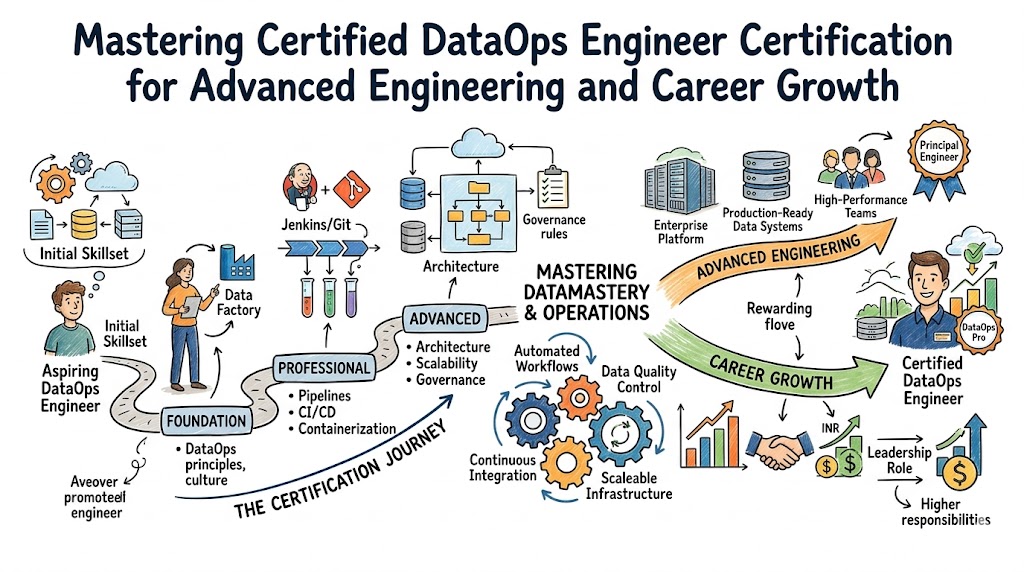
Modern enterprises increasingly rely on data-driven decision-making, which creates a massive demand for professionals who can manage complex data pipelines efficiently. This guide explores the CDOE – Certified DataOps Engineer program, a comprehensive framework designed for engineers, managers, and architects who want to master the intersection of data engineering and DevOps principles. As the industry moves toward automated, scalable infrastructure, understanding how to apply site reliability and continuous integration to data workflows becomes essential for career growth. Whether you are a platform engineer or a data specialist, DataOpsSchool provides the structured environment needed to bridge the gap between development and operations. This article helps you evaluate the curriculum, identify the right certification level, and plan a sustainable learning path to enhance your professional value in the global market.
What is the CDOE – Certified DataOps Engineer?
The CDOE – Certified DataOps Engineer represents a professional standard for implementing automated, reliable, and collaborative data workflows. It exists to bridge the gap between traditional data management and modern software engineering practices. By emphasizing production-focused learning over abstract theory, this program ensures that engineers can handle high-velocity data environments with confidence. It aligns perfectly with enterprise needs for scalability, quality control, and rapid delivery of insights in cloud-native ecosystems.
Who Should Pursue CDOE – Certified DataOps Engineer?
This certification serves software engineers, SREs, and data professionals who want to operationalize their data stacks. It is highly beneficial for cloud architects and security engineers who must ensure that data pipelines remain resilient and compliant. Both beginners looking for a structured entry point and experienced leads aiming to modernize their infrastructure will find value here. The curriculum carries significant weight for professionals in India and those working within global engineering teams.
Why CDOE – Certified DataOps Engineer is Valuable and Beyond
In an era of rapid tool evolution, this certification provides longevity by focusing on core architectural principles rather than just fleeting software versions. It helps professionals stay relevant by mastering the lifecycle of data as code, which remains a constant requirement across diverse industries. The investment in this learning path offers a high return through increased operational efficiency and improved career mobility. As enterprise adoption of automated data operations grows, these skills will continue to define high-performing engineering roles.
CDOE – Certified DataOps Engineer Certification Overview
The certification program follows a practical structure designed to validate technical competency through objective assessments. It is delivered via the official course portal and hosted on the primary website, ensuring a centralized learning experience for all candidates. The program structure focuses on real-world application, covering everything from initial ingestion to long-term observability. By maintaining a hands-on approach, the certification ensures that practitioners can immediately apply their skills to production-grade environments.
CDOE – Certified DataOps Engineer Certification Tracks & Levels
The tracks are organized into foundation, professional, and advanced levels to accommodate different career stages. Specialization tracks allow engineers to focus on areas like SRE, FinOps, or Security within the context of data operations. This tiered approach enables a clear progression path, allowing individuals to build expertise incrementally as their responsibilities grow. Each level aligns with specific professional outcomes, ensuring that the certification scales with the candidate’s technical and leadership maturity.
Complete CDOE – Certified DataOps Engineer Certification Table
| Track | Level | Who it’s for | Prerequisites | Skills Covered | Recommended Order |
| Core Engineering | Foundation | Entry-level / Managers | Basic IT Knowledge | Automation Basics, Culture | 1 |
| Pipeline Ops | Professional | Data & DevOps Engineers | Python & Linux | CI/CD, Containerization | 2 |
| Architecture | Advanced | Senior Leads & Architects | Proficient in Ops | Multi-cloud, Governance | 3 |
| Reliability | SRE Track | SREs & Platform Leads | Core Foundation | Observability, Incident Management | 2 |
| Security | DevSecOps | Security & Data Leads | Core Foundation | Compliance, Encryption | 2 |
Detailed Guide for Each CDOE – Certified DataOps Engineer Certification
CDOE – Certified DataOps Engineer – Foundation
What it is
This level validates the fundamental understanding of DataOps principles and the collaborative culture required to succeed. It introduces the essential concepts of automation and quality control within data lifecycles.
Who should take it
It is designed for junior engineers, project managers, and technical leaders who need to understand the framework of automated data delivery.
Skills you’ll gain
- Mastery of the DataOps lifecycle and manifesto.
- Fundamental knowledge of version control for data projects.
- Understanding of automated testing and validation workflows.
Real-world projects you should be able to do
- Designing a basic automated data ingestion workflow.
- Setting up collaborative environments for data and ops teams.
Preparation plan
The 7-day plan focuses on core definitions, while the 30-day plan includes practical exercises with basic version control tools. A 60-day strategy involves deep-diving into case studies regarding successful enterprise implementations.
Common mistakes
- Overlooking the importance of team culture and communication.
- Focusing too much on specific tools instead of general principles.
Best next certification after this
- Same-track option: Professional Level CDOE
- Cross-track option: Cloud Infrastructure Associate
- Leadership option: Technical Project Management
CDOE – Certified DataOps Engineer – Professional
What it is
The Professional certification validates the ability to build and maintain production-grade data pipelines using automation. It focuses on the technical execution of CI/CD and orchestration strategies.
Who should take it
This is intended for active Data Engineers and DevOps practitioners who have at least one year of experience in infrastructure.
Skills you’ll gain
- Advanced CI/CD implementation for data pipelines.
- Containerization and orchestration of data workloads.
- Automated data quality and performance monitoring.
Real-world projects you should be able to do
- Deploying a fully automated pipeline for large-scale data processing.
- Implementing self-healing mechanisms for pipeline failures.
Preparation plan
A 14-day intensive involves focusing on pipeline scripts, while a 60-day plan allows for building a complete portfolio project from scratch.
Common mistakes
- Neglecting the security and compliance aspects of the pipeline.
- Failing to optimize resource usage in cloud-native environments.
Best next certification after this
- Same-track option: Advanced Architect CDOE
- Cross-track option: SRE Professional
- Leadership option: Engineering Manager Track
Choose Your Learning Path
DevOps Path
This path focuses on applying traditional DevOps rigor to data-heavy environments. Engineers learn to treat every step of the data process as code, ensuring that infrastructure is reproducible and scalable. It emphasizes the use of version control and automated testing to eliminate manual errors in production.
DevSecOps Path
The security track ensures that data protection is integrated into every stage of the pipeline. You will master techniques for automated encryption, data masking, and continuous compliance monitoring. This is essential for professionals working in highly regulated industries like finance or healthcare.
SRE Path
The SRE path prioritizes the reliability and uptime of data platforms. You will learn to manage service level objectives and implement robust monitoring to detect anomalies before they impact the business. This track is perfect for those who want to build resilient, self-correcting data systems.
AIOps Path
This specialized track uses machine learning to enhance the efficiency of IT operations. You will learn to automate root cause analysis and use predictive analytics to maintain system health. It represents the future of proactive infrastructure management and high-level automation.
MLOps Path
The MLOps track focuses on the unique challenges of managing machine learning models in production. It covers model versioning, deployment automation, and tracking data drift over time. This is the primary path for engineers supporting data science and AI applications.
DataOps Path
The core DataOps path provides a comprehensive view of the entire data delivery lifecycle. You will master the orchestration of complex data workflows from various sources to end-user analytics. This is the standard track for modern engineers aiming to optimize data team output.
FinOps Path
The FinOps path teaches engineers how to manage the financial aspects of cloud-based data operations. You will learn to monitor spending, optimize resource allocation, and ensure maximum value for every dollar spent on infrastructure. This is critical for engineers moving into senior or management roles.
Role → Recommended CDOE – Certified DataOps Engineer Certifications
| Role | Recommended Certifications |
| DevOps Engineer | Foundation, Professional, SRE Track |
| SRE | Professional, SRE Track, AIOps Path |
| Platform Engineer | Professional, Advanced, FinOps Path |
| Cloud Engineer | Foundation, Professional, FinOps Path |
| Security Engineer | Foundation, DevSecOps Path |
| Data Engineer | Foundation, Professional, DataOps Path |
| FinOps Practitioner | Foundation, FinOps Path |
| Engineering Manager | Foundation, FinOps, Advanced Track |
Next Certifications to Take After CDOE – Certified DataOps Engineer
Same Track Progression
Continuing within the same track involves pursuing the Advanced Architect level to master enterprise-wide strategy. You will focus on multi-cloud environments and the governance of massive data estates. This ensures you can lead large-scale digital transformation projects within your organization.
Cross-Track Expansion
Broadening your skills into SRE or Security provides a more holistic view of the engineering ecosystem. By understanding how different disciplines overlap, you become a more versatile and valuable asset to any technical team. This expansion is ideal for those moving toward principal engineering roles.
Leadership & Management Track
Transitioning to leadership requires a focus on people management and strategic planning certifications. These programs help you apply your technical knowledge to broader business goals, such as budget management and team scaling. This path is recommended for those aiming for Director or VP of Engineering roles.
Training & Certification Support Providers for CDOE – Certified DataOps Engineer
DevOpsSchool
This provider offers comprehensive training modules that cover the entire spectrum of modern operations. They focus on hands-on labs and real-world scenarios to ensure candidates are ready for industry challenges. Their curriculum is designed to support professionals at all career levels through expert guidance.
Cotocus
Specializing in cloud-native training, this provider helps engineers master complex infrastructure tools. They offer intensive bootcamps that focus on the technical execution of DataOps and SRE principles. Their programs are highly regarded for their depth and practical relevance.
Scmgalaxy
This organization provides a wealth of community-driven resources and tutorials for configuration management. They support candidates through detailed documentation and practical guides that simplify the learning process for automated pipelines. It is an excellent starting point for technical self-study.
BestDevOps
Focusing on curated career paths, this provider offers targeted training for various engineering certifications. They help students identify the right skills to prioritize based on current market demands. Their approach is streamlined and effective for rapid professional growth.
devsecopsschool.com
This platform is dedicated to integrating security into the development and operations lifecycle. They provide specialized courses on automated compliance and vulnerability management within data pipelines. It is a critical resource for security-minded engineering professionals.
sreschool.com
The core focus of this provider is system reliability and operational excellence. They offer training on how to manage large-scale systems with minimal downtime. Their courses are essential for anyone looking to master the SRE track of the certification.
aiopsschool.com
This provider explores the intersection of artificial intelligence and operations. They offer cutting-edge training on how to use AI to solve complex infrastructure problems. It is ideal for engineers looking to specialize in next-generation automation.
dataopsschool.com
As the primary host for the CDOE program, this provider offers the most direct path to certification. They provide official learning materials, practice exams, and comprehensive course modules. Their curriculum is perfectly aligned with the exam objectives.
finopsschool.com
This platform focuses on the financial management of cloud resources. They provide the tools and training needed to optimize infrastructure costs effectively. It is a vital resource for professionals who need to balance technical performance with budget constraints.
Frequently Asked Questions (General)
- How difficult is the CDOE – Certified DataOps Engineer exam?
The exam is designed to be challenging but fair, focusing heavily on practical scenarios rather than simple memorization of terms.
- What is the typical timeframe for completing the Foundation level?
Most candidates complete the Foundation requirements within two to four weeks of dedicated study and review.
- Are there any specific hardware requirements for the labs?
A standard modern laptop with a reliable internet connection is sufficient to access the cloud-based lab environments.
- Does this certification help with career growth in India?
Yes, the demand for DataOps skills is growing rapidly in India’s tech hubs as companies modernize their data infrastructure.
- Is there a community forum for students?
Most training providers offer access to private groups where students can collaborate and share insights during their preparation.
- How often is the exam content updated?
The curriculum is reviewed annually to ensure it stays current with the latest industry trends and tool updates.
- Are there practice tests available?
Official practice tests are provided through the primary course portal to help candidates assess their readiness.
- Can I take the exam online?
Yes, the certification assessment is conducted through a secure online platform for global accessibility.
- Is the certification recognized by major tech companies?
The program is built on industry standards that align with the requirements of top-tier enterprise engineering teams.
- What happens if I do not pass the exam on the first try?
Candidates are typically allowed to retake the exam after a short cooling-off period to review the material further.
- Do I need to be a programmer to pass?
Basic scripting knowledge is helpful, but the Foundation level focuses more on principles and workflows than complex coding.
- Is the certification fee inclusive of training?
This depends on the provider; some offer bundled packages that include both the training materials and the exam voucher.
FAQs on CDOE – Certified DataOps Engineer
- What makes the CDOE different from a standard Data Engineering course?
CDOE focuses on the operational reliability and automation of the pipeline rather than just the data transformation logic itself.
- How does the certification address cloud-native technologies?
The curriculum is built around cloud-native principles like containerization and microservices to ensure modern relevance.
- Is there a focus on specific tools in the exam?
The exam tests your understanding of tool categories and their roles rather than mastery of a single proprietary software.
- How long does the Professional level certification remain valid?
Certifications typically remain valid for two to three years, after which a renewal or advanced level is recommended.
- Does the program cover data privacy and GDPR?
Yes, automated compliance and data governance are core components of the security-focused modules within the curriculum.
- Are the labs based on real-world production scenarios?
The labs simulate actual enterprise challenges, including pipeline failures and scalability issues, to provide practical experience.
- Can a project manager benefit from the CDOE Foundation?
Project managers gain a better understanding of technical timelines and the collaborative requirements of automated data teams.
- Is financial aid or a discount available for students?
Some providers offer discounts for group enrollments or early-bird registrations for their training bootcamps.
Final Thoughts: Is CDOE – Certified DataOps Engineer Worth It?
Pursuing the CDOE – Certified DataOps Engineer designation is a highly effective way to future-proof your career in the data and infrastructure space. As organizations move away from manual data processing, the ability to build and manage automated systems becomes a primary requirement for top-tier roles. This certification provides a structured path to mastering those skills, offering a clear advantage in a competitive job market. It bridges the gap between development and operations, ensuring that you can deliver high-quality data at scale with minimal friction. While the journey requires a commitment to learning new methodologies, the resulting professional growth and increased expertise make it a valuable investment. Choosing this path demonstrates a commitment to operational excellence and a deep understanding of modern engineering challenges.