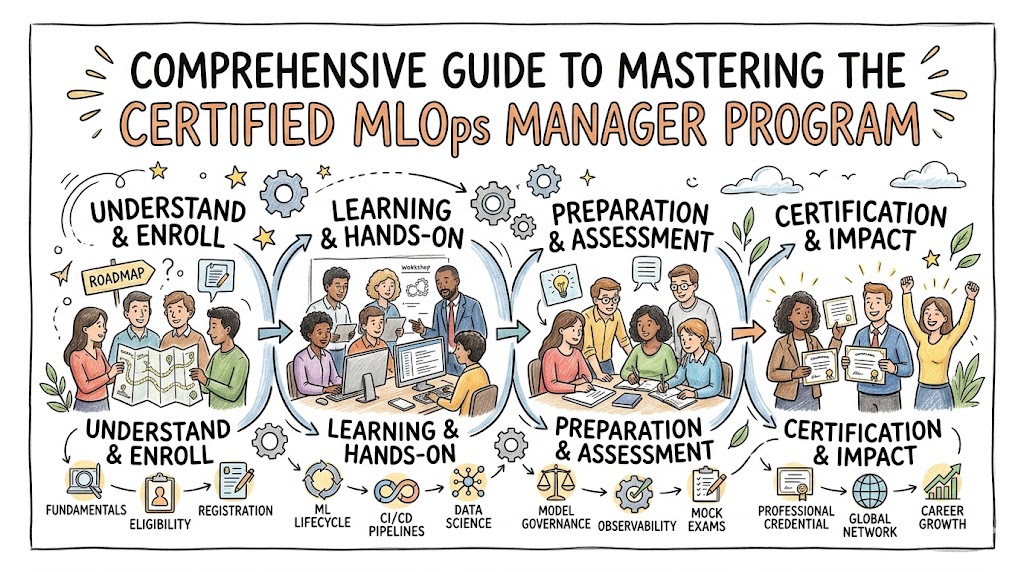
Leaders capable of bridging the gap between solid production operations and machine learning development are needed in today’s technical scene. This guide explores the Certified MLOps Manager program, a strategic credential designed for professionals aiming to oversee complex AI lifecycles within cloud-native environments. Whether you are navigating platform engineering or scaling data science teams, understanding this certification helps you make informed career decisions. This program, offered by AIOpsSchool, provides the technical and managerial framework necessary to drive enterprise-grade automation. Professionals seeking to solidify their expertise in MLOps can leverage this roadmap to align their skills with global industry standards.
What is the Certified MLOps Manager?
The Certified MLOps Manager represents a professional standard for individuals tasked with governing the end-to-end machine learning lifecycle. Unlike traditional certifications that focus purely on model code, this program emphasizes production-focused learning and operational excellence. It exists to solve the “last mile” problem in AI, ensuring that models are not just built but are also scalable, monitorable, and secure. It aligns perfectly with modern engineering workflows by integrating CI/CD principles specifically for machine learning assets. Enterprise practices today demand this level of rigor to move AI projects from experimental notebooks to reliable consumer-facing services.
Who Should Pursue Certified MLOps Manager?
This certification specifically benefits senior software engineers, SREs, and cloud professionals who are transitioning into AI-centric infrastructure roles. Security and data professionals find it valuable for understanding the unique vulnerabilities and data lineage requirements inherent in ML systems. It is equally relevant for beginners looking for a structured entry point and experienced managers needing to oversee technical teams. In the context of both the Indian tech market and the global landscape, the ability to manage ML infrastructure is becoming a baseline requirement. Managers who understand the technical hurdles of model drift and resource orchestration are better equipped to lead high-performing engineering departments.
Why Certified MLOps Manager is Valuable and Beyond
The demand for MLOps expertise continues to outpace the supply of qualified professionals as enterprise adoption of AI becomes mandatory for survival. This certification offers longevity because it teaches the underlying principles of orchestration and governance rather than just specific, fleeting tools. It helps professionals stay relevant by providing a framework that survives the constant cycle of new software releases. Investing time in this program yields a high return on career investment by positioning you at the intersection of data science and platform engineering. Companies are increasingly looking for leaders who can ensure that AI initiatives provide a measurable business impact through reliable operations.
Certified MLOps Manager Certification Overview
The program is delivered via the official portal at AIOpsSchool and is hosted on the primary platform at aiopsschool.com. The certification utilizes a practical assessment approach that tests the candidate’s ability to handle real-world scenarios rather than just theoretical knowledge. It is structured into multiple levels of competency, ensuring that learners can progress from foundational concepts to advanced architectural oversight. The ownership of the program lies with industry experts who have experience in deploying models at scale. This practical structure ensures that a certified individual possesses the skills to manage actual enterprise ML pipelines effectively.
Certified MLOps Manager Certification Tracks & Levels
The certification hierarchy begins with a foundation level that introduces core concepts of ML pipelines and automation. The professional level deepens this knowledge by focusing on specialization tracks such as SRE for ML and FinOps for AI infrastructure. Finally, the advanced level is designed for those moving into executive or principal engineering roles where strategic decision-making is paramount. These levels align directly with career progression, allowing an engineer to grow into a lead role over time. By following these tracks, professionals can broaden their skill sets into areas like security or cost optimization while maintaining a core focus on MLOps.
Complete Certified MLOps Manager Certification Table
| Track | Level | Who it’s for | Prerequisites | Skills Covered | Recommended Order |
|---|---|---|---|---|---|
| Core Management | Foundation | Aspiring Managers | Basic DevOps Knowledge | ML Lifecycle, Tooling | 1 |
| Infrastructure | Professional | SREs & Cloud Engineers | Containerization Experience | Kubernetes, Orchestration | 2 |
| Governance | Advanced | Engineering Directors | Professional Level Cert | Security, Compliance, ROI | 3 |
| Data Operations | Professional | Data Engineers | Data Pipeline Basics | Feature Stores, Versioning | 2 |
Export to Sheets
Detailed Guide for Each Certified MLOps Manager Certification
Certified MLOps Manager – Foundation Level
What it is This certification validates a professional’s understanding of the fundamental building blocks of MLOps and the ability to speak the language of both data scientists and IT operators.
Who should take it It is suitable for junior engineers, project managers, or DevOps practitioners who are new to the specific requirements of machine learning workloads.
Skills you’ll gain
- Understanding the ML experiment-to-production lifecycle.
- Basic version control for data and models.
- Knowledge of automation triggers in ML pipelines.
Real-world projects you should be able to do
- Setting up a basic automated retraining pipeline.
- Configuring simple monitoring for model performance.
Preparation plan
- 7–14 days: Review official documentation and terminology.
- 30 days: Complete the foundational course modules and practice labs.
- 60 days: Conduct a mock deployment of a pre-trained model.
Common mistakes
- Focusing too much on writing ML algorithms instead of infrastructure.
- Ignoring the data versioning aspect of the pipeline.
Best next certification after this
- Same-track: Certified MLOps Manager Professional Level.
- Cross-track: SRE Foundation.
- Leadership: IT Management Essentials.
Certified MLOps Manager – Professional Level
What it is This level confirms the ability to design and implement robust, scalable, and automated ML platforms using industry-standard tools and practices.
Who should take it This is for mid-level engineers and technical leads who are responsible for the daily operation and scaling of machine learning systems.
Skills you’ll gain
- Advanced orchestration using Kubernetes and Kubeflow.
- Implementing CI/CD/CT (Continuous Training) patterns.
- Managing feature stores and model registries.
Real-world projects you should be able to do
- Building a multi-tenant ML platform for a large team.
- Implementing automated A/B testing for model deployment.
Preparation plan
- 7–14 days: Focus on advanced container orchestration and networking.
- 30 days: Deep dive into specific MLOps tooling and integration patterns.
- 60 days: Build a full end-to-end automated pipeline as a capstone project.
Common mistakes
- Over-engineering the solution for small-scale problems.
- Failing to account for the costs of cloud resources.
Best next certification after this
- Same-track: Certified MLOps Manager Advanced Level.
- Cross-track: Certified FinOps Professional.
- Leadership: Technical Product Manager.
Choose Your Learning Path
DevOps Path
Professionals on this path focus on extending traditional CI/CD pipelines to include model-specific stages. You will learn how to treat machine learning models as software artifacts that require rigorous testing and validation. The emphasis here is on speed, reliability, and the seamless integration of data science code into existing delivery systems. This path ensures that the development cycle remains agile even when dealing with heavy data dependencies.
DevSecOps Path
This path prioritizes the security of the machine learning supply chain, including data privacy and model integrity. You will explore techniques for scanning models for vulnerabilities and ensuring that data pipelines comply with global regulations. It is essential for engineers working in highly regulated industries like finance or healthcare. This focus helps prevent adversarial attacks and data leaks within AI systems.
SRE Path
The SRE path for MLOps centers on the reliability and observability of models in a production environment. You will master concepts like service level objectives for ML and how to handle model drift as an operational incident. This ensures that AI services remain available and performant under varying loads. It bridges the gap between static model performance and dynamic production reality.
AIOps Path
This specialization focuses on using AI and machine learning to improve the operations of IT systems themselves. You will learn how to apply MLOps principles to the tools that manage your infrastructure, creating a self-healing environment. This path is ideal for those looking to automate root cause analysis and anomaly detection at scale. It represents the next frontier of intelligent infrastructure management.
MLOps Path
The pure MLOps path dives deep into the specific challenges of managing data, code, and models simultaneously. You will focus on the technical details of model serving, feature engineering at scale, and experimental tracking. This is the core path for anyone wanting to become a specialist in the machine learning engineering field. It provides the most comprehensive technical deep dive into the certification topics.
DataOps Path
DataOps focuses on the upstream data pipelines that feed the machine learning models. You will learn how to apply lean manufacturing and agile principles to data flows to ensure high data quality. This path is crucial because an ML model is only as good as the data it consumes. Mastering DataOps reduces the friction between data engineers and ML practitioners.
FinOps Path
The FinOps path addresses the high costs associated with training and running large-scale machine learning models. You will learn how to track cloud spend, optimize GPU utilization, and implement cost-allocation strategies for AI projects. This ensures that machine learning initiatives remain financially viable for the organization. It is a critical skill set for managers overseeing large budgets.
Role → Recommended Certified MLOps Manager Certifications
| Role | Recommended Certifications |
|---|---|
| DevOps Engineer | MLOps Foundation + Professional |
| SRE | MLOps Professional + SRE Track |
| Platform Engineer | MLOps Advanced + Infrastructure Track |
| Cloud Engineer | MLOps Foundation + CloudOps |
| Security Engineer | MLOps Foundation + DevSecOps Track |
| Data Engineer | MLOps Professional + DataOps Track |
| FinOps Practitioner | MLOps Foundation + FinOps Track |
| Engineering Manager | MLOps Foundation + Advanced |
Export to Sheets
Next Certifications to Take After Certified MLOps Manager
Same Track Progression
After achieving the manager-level certification, the logical step is to pursue deep technical specializations in specific orchestration tools or advanced model governance. This allows you to become the go-to expert for complex architectural challenges. Staying within the track ensures you remain at the cutting edge of MLOps innovations. It builds a profile of a highly specialized technical leader.
Cross-Track Expansion
Broadening your expertise into SRE or DevSecOps provides a more holistic view of the enterprise IT ecosystem. This expansion makes you a more versatile professional capable of leading cross-functional teams. Understanding how MLOps intersects with general security and reliability is a significant career advantage. It prevents you from becoming siloed in a single technical domain.
Leadership & Management Track
For those aiming for executive roles, moving into strategic management certifications is the best next step. This involves focusing on business alignment, team building, and long-term technology roadmapping. Transitioning to leadership requires a shift from doing the work to enabling others to succeed. These certifications help translate technical success into business value.
Training & Certification Support Providers for Certified MLOps Manager
DevOpsSchool This provider offers extensive resources and hands-on labs specifically tailored for DevOps and MLOps professionals looking to scale their infrastructure skills. Their curriculum emphasizes real-world scenarios and provides deep dives into automation tools that are essential for modern engineering managers.
Cotocus As a specialized training firm, they focus on delivering high-impact technical workshops and certification coaching for various cloud-native technologies. Their approach is designed to help professionals quickly bridge the gap between theoretical knowledge and production-ready implementation.
Scmgalaxy This community-driven platform provides a wealth of tutorials, articles, and community support for configuration management and DevOps tools. It serves as a valuable knowledge hub for engineers who want to stay updated on the latest industry trends and best practices.
BestDevOps They provide curated training programs that focus on the most in-demand skills in the DevOps and SRE ecosystem today. Their training is recognized for its practical focus and its ability to prepare candidates for rigorous certification exams and technical interviews.
devsecopsschool.com This institution focuses exclusively on integrating security into the DevOps lifecycle, providing specialized training for those in the DevSecOps path. Their courses cover everything from automated security testing to compliance as code in a cloud-native world.
sreschool.com Focused on site reliability engineering, this provider teaches the principles of building and maintaining highly available and reliable systems. Their curriculum is essential for MLOps professionals who need to manage models in high-stakes production environments.
aiopsschool.com This is a primary source for training in artificial intelligence for IT operations, offering deep insights into how ML can transform infrastructure management. Their programs are specifically designed to align with the Certified MLOps Manager certification requirements.
dataopsschool.com They specialize in the data-centric side of operations, teaching engineers how to build robust and scalable data pipelines. Their training is critical for ensuring that the data feeding into ML models is of the highest quality and reliability.
finopsschool.com This provider addresses the financial management of cloud resources, offering training on how to optimize costs in a cloud-centric world. Their courses are vital for any manager looking to maintain a sustainable and cost-effective ML infrastructure.
Frequently Asked Questions
- What is the primary focus of this certification?
The program focuses on managing the end-to-end lifecycle of machine learning models in a production environment. - Is there a prerequisite for the foundation level?
While no strict certificate is required, a basic understanding of DevOps and cloud computing is highly recommended. - How long does it typically take to complete the training?
Most professionals complete the core modules and prepare for the exam within 30 to 60 days of focused study. - Does this certification cover specific tools like Kubernetes?
Yes, the professional and advanced levels involve significant practical work with orchestration tools like Kubernetes. - Is this program suitable for people managers?
Absolutely, it provides managers with the technical context needed to lead teams and make informed architectural decisions. - What is the difficulty level of the professional exam?
The exam is moderately difficult and requires hands-on experience with pipelines rather than just memorizing definitions. - How does this certification impact salary potential?
Professionals with validated MLOps skills often see significant increases in compensation due to the high demand for this expertise. - Are the labs included in the training program?
Yes, most authorized training providers include cloud-based labs to ensure candidates get practical experience. - Can I skip the foundation level?
It is recommended to start with the foundation unless you have extensive professional experience in ML infrastructure. - Is the certification recognized globally?
Yes, the standards taught in this program are aligned with global enterprise practices used by major technology companies. - How often should I renew this certification?
Renewal or continuing education is typically suggested every two years to stay current with evolving technology. - Does it cover the financial aspects of ML?
The FinOps track within the program specifically addresses cost optimization and resource management for AI.
FAQs on Certified MLOps Manager
- How does this program differ from a standard data science course?
Standard data science courses focus on building models and algorithms, whereas this program focuses on the infrastructure, automation, and management required to run those models in production reliably and at scale. - What technical skills are most important for success in this certification?
A strong grasp of containerization, CI/CD pipelines, and basic Python scripting will provide the best foundation for mastering the technical requirements of the MLOps Manager curriculum. - Can this certification help me transition from DevOps to MLOps?
Yes, it is designed specifically as a bridge for DevOps professionals to apply their automation and operations knowledge to the unique challenges of machine learning lifecycles. - Are there any coding requirements for the manager level?
While you don’t need to be an expert developer, you should be comfortable reading code and understanding how different software components interact within an automated pipeline. - How does MLOps contribute to business ROI?
By reducing the time it takes to deploy models and ensuring they perform correctly in the real world, MLOps directly increases the value and impact of an organization’s AI investments. - Is cloud experience necessary?
Most MLOps workflows are cloud-native, so having experience with platforms like AWS, Azure, or GCP is extremely beneficial for understanding the practical labs and assessments. - What is model drift and is it covered?
Model drift occurs when a model’s performance degrades over time due to changing data; this program teaches you how to monitor, detect, and remediate this common production issue. - Who oversees the certification standards?
The standards are maintained by a committee of industry practitioners and principal engineers to ensure the content remains relevant to current enterprise engineering needs.
Final Thoughts: Is Certified MLOps Manager Worth It?
The transition from experimental AI to production-grade machine learning is one of the most significant challenges facing modern enterprises. Obtaining the Certified MLOps Manager credential is a strategic move for any professional who wants to lead in this space. It provides a structured, experience-driven path that goes beyond the hype of AI and focuses on the hard work of reliable operations. The program is worth the investment because it builds a versatile skill set that is applicable across various industries and cloud platforms. By focusing on governance, automation, and scalability, you position yourself as a vital asset to any organization looking to scale its AI capabilities. This is not just about a title; it is about gaining the competence to solve real engineering problems in an increasingly automated world.