Introduction
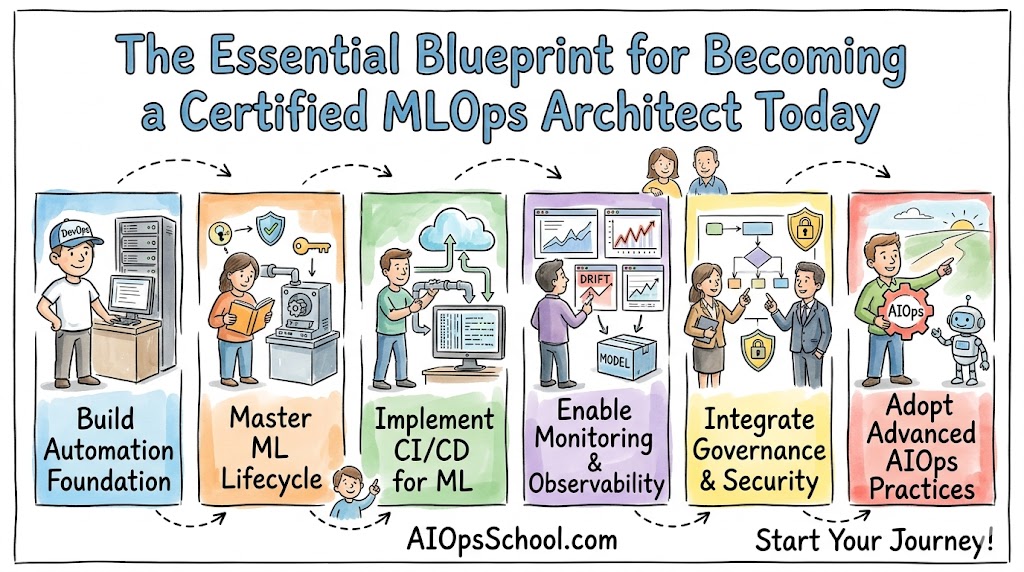
Modern technology teams now require a specialized bridge between machine learning research and scalable production operations. This Certified MLOps Architect guide serves as a strategic compass for software engineers and platform architects who must manage automated model lifecycles. Companies across the globe are moving away from manual deployments toward robust, data-driven automation. By following this structured roadmap, AIOpsSchool empowers professionals to master the complexities of model drift, infrastructure scaling, and continuous delivery in an intelligence-driven world.
What is the Certified MLOps Architect?
The Certified MLOps Architect designation defines the standard for engineering excellence in the machine learning operations domain. It exists to transform theoretical data science into reliable, high-performing production systems that meet enterprise requirements. This program prioritizes hands-on experience over abstract theory, teaching candidates how to integrate CI/CD workflows with data pipelines. By aligning with modern cloud-native standards, the certification ensures that every architect can manage the entire model journey from training to inference.
Who Should Pursue Certified MLOps Architect?
Site Reliability Engineers, DevOps professionals, and Cloud Architects find this path especially rewarding as they take on more data-centric workloads. Data Engineers and software developers who want to lead the operational side of AI projects will also gain a competitive edge. This program addresses the needs of both the thriving Indian tech sector and the international market where automation is a top priority. Whether you manage a small team or lead a global department, these skills provide the technical depth needed for high-level decision-making.
Why Certified MLOps Architect is Valuable Beyond Today
Enterprise leaders continue to adopt automated intelligence at a rapid pace, creating a permanent demand for skilled operations experts. This certification focuses on timeless architectural principles that outlast specific tool versions or temporary industry trends. Professionals who earn this credential secure their place in the future workforce by mastering the intersection of software discipline and data science. The investment pays off through increased career longevity and the ability to drive significant business value through efficient resource management.
Certified MLOps Architect Certification Overview
The official program delivers comprehensive training through a dedicated digital portal and the primary hosting site. Candidates engage with a curriculum that balances technical assessment with practical application across several competency levels. Industry leaders maintain the material to ensure it reflects current best practices in automation and system observability. This structured approach helps engineers demonstrate their mastery of the tools and processes required to sustain complex machine learning ecosystems.
Certified MLOps Architect Certification Tracks & Levels
Professionals can advance through foundation, professional, and advanced tiers to match their specific career stage. Specialized tracks allow individuals to focus on areas like SRE-based operations, financial optimization, or security-hardened deployments. Each level builds upon the previous one, creating a clear trajectory from entry-level understanding to expert-level architecture. This tiered system ensures that your credentials reflect your actual ability to design and manage large-scale systems.
Complete Certified MLOps Architect Certification Table
| Track | Level | Who it’s for | Prerequisites | Skills Covered | Recommended Order |
| Core | Associate | Junior Devs/Managers | Python Basics | ML Basics, Docker | 1 |
| Operations | Professional | SREs/DevOps | Cloud Fundamentals | CI/CD, Monitoring | 2 |
| Data Ops | Professional | Data Engineers | SQL/Data Pipelines | Feature Stores, ETL | 2 |
| Security | Advanced | Security Engineers | Professional Level | Compliance, Auditing | 3 |
| Enterprise | Expert | Principal Architects | Senior Experience | System Design, Drift | 4 |
Detailed Guide for Each Certified MLOps Architect Certification
Certified MLOps Architect – Foundation
What it is
This certification confirms your fundamental grasp of the machine learning lifecycle and the operational vocabulary required for modern teams.
Who should take it
Technical managers and entry-level engineers benefit most from this overview of automated deployment and model tracking.
Skills you’ll gain
- Mastery of the ML lifecycle phases
- Proficiency in containerizing simple models
- Knowledge of data versioning basics
- Understanding of monitoring concepts
Real-world projects you should be able to do
- Build an automated model deployment script
- Create a localized container for a test model
Preparation plan
- 7–14 days: Study the core terminology and lifecycle stages.
- 30 days: Set up a local experimentation environment using basic tools.
- 60 days: Perform a mock deployment of a simple predictive model.
Common mistakes
- Overlooking the importance of reproducible data environments.
- Spending too much time on model training instead of deployment.
Best next certification after this
- Same-track: Professional MLOps Architect
- Cross-track: SRE Associate
- Leadership: IT Project Lead
Certified MLOps Architect – Professional
What it is
This level validates your ability to build production-grade automation for large-scale enterprise machine learning workloads.
Who should take it
Experienced Cloud Engineers and SREs who need to deploy and monitor complex models in high-traffic environments should pursue this.
Skills you’ll gain
- Expertise in Kubernetes for ML workloads
- Implementation of drift detection systems
- Management of distributed training jobs
- Design of automated roll-back procedures
Real-world projects you should be able to do
- Configure an auto-scaling model cluster on Kubernetes.
- Design a dashboard that tracks model performance in real-time.
Preparation plan
- 7–14 days: Master orchestration tools like Kubeflow or similar platforms.
- 30 days: Build a complete end-to-end CI/CD pipeline for a dataset.
- 60 days: Practice scaling models under simulated heavy traffic.
Common mistakes
- Neglecting the security of the data pipeline during automation.
- Failing to account for resource costs during model training.
Best next certification after this
- Same-track: Expert MLOps Architect
- Cross-track: Cloud Security Professional
- Leadership: Engineering Manager
Choose Your Learning Path
DevOps Path
This route applies standard continuous delivery principles to the specialized world of machine learning. Engineers learn how to build pipelines that handle both code and large datasets with the same level of discipline. You will master the automation of the entire build and test process for AI applications. It ensures that software delivery remains fast and reliable regardless of model complexity.
DevSecOps Path
The security path focuses on protecting the integrity of your models and the privacy of your training data. You will learn to implement automated vulnerability scanning and access controls within the MLOps pipeline. This path prepares you to defend against sophisticated attacks targeting intelligent systems. It is vital for engineers working in highly regulated or sensitive industrial sectors.
SRE Path
Site Reliability Engineers focus on the uptime and performance of machine learning services in production. You will learn how to set and maintain performance objectives for model inference and training environments. This path teaches you to manage the inherent unpredictability of AI systems while ensuring high availability. It is the perfect choice for those responsible for mission-critical infrastructure.
AIOps Path
Engineers on this path use machine learning to optimize and automate traditional IT operations. You will learn how to build systems that analyze logs and telemetry to predict and fix infrastructure failures automatically. This approach turns AI inward to make the cloud environment itself more intelligent and self-healing. It represents the future of large-scale system administration.
MLOps Path
This core path provides the comprehensive skills needed to architect an end-to-end machine learning ecosystem. You will learn to manage every stage of the process from raw data ingestion to final model retirement. This route prepares you to act as the primary technical authority for an organization’s AI strategy. It covers the most critical tools and methodologies used by top-tier tech companies.
DataOps Path
The DataOps path focuses on the reliability and speed of the data that fuels your machine learning models. You will learn to treat data pipelines as code, ensuring that information remains clean and versioned at all times. This discipline reduces the risk of model failure due to poor input quality. It is an essential foundation for any scalable intelligence project.
FinOps Path
This path addresses the financial side of running compute-heavy machine learning workloads in the cloud. You will learn how to track costs, optimize instance usage, and ensure your AI projects remain profitable. This knowledge helps you bridge the gap between technical execution and business budget management. It is a key skill for senior engineers and aspiring technical leaders.
Role → Recommended Certified MLOps Architect Certifications
| Role | Recommended Certifications |
| DevOps Engineer | MLOps Professional, Kubernetes Expert |
| SRE | MLOps Professional, SRE Advanced |
| Platform Engineer | MLOps Expert, Cloud Architect |
| Cloud Engineer | MLOps Associate, Cloud Professional |
| Security Engineer | DevSecOps Advanced, MLOps Governance |
| Data Engineer | DataOps Professional, MLOps Associate |
| FinOps Practitioner | FinOps Certified, MLOps Foundation |
| Engineering Manager | MLOps Foundation, Strategic Leadership |
Next Certifications to Take After Certified MLOps Architect
Same Track Progression
Deepen your expertise by pursuing expert-level certifications that focus on enterprise-wide governance and global scale. This allows you to design systems that support hundreds of teams and thousands of models simultaneously. You will move from managing individual pipelines to setting the technical standards for an entire corporation. This progression cements your status as a leader in the specialized field of operations.
Cross-Track Expansion
Expand your versatility by gaining credentials in security, finance, or data management to complement your architectural skills. Understanding how to secure a pipeline or optimize its cost makes you a far more valuable asset to any organization. This broader perspective allows you to solve business problems that go beyond simple technical configuration. You become a multi-dimensional engineer capable of leading diverse technical teams.
Leadership & Management Track
Transition into high-level management by focusing on certifications that prioritize strategy, team building, and project governance. Your deep technical background in MLOps will provide the perfect foundation for leading large-scale digital transformation efforts. This path moves you away from daily coding and into the realm of organizational influence and roadmap planning. It is the ideal choice for those who want to shape the future of their company.
Training & Certification Support Providers for Certified MLOps Architect
DevOpsSchool
This provider delivers deep technical training on the automation tools required for modern software delivery. Their courses emphasize the practical application of CI/CD in complex enterprise environments.
Cotocus
This organization specializes in professional-grade training and hands-on labs for cloud-native technologies. They focus on providing engineers with the skills needed to manage high-end platform infrastructure.
Scmgalaxy
This site offers a wealth of community knowledge and expert guidance on configuration management. It serves as a vital hub for engineers looking to refine their deployment and versioning strategies.
BestDevOps
This platform focuses on curated educational paths for individuals entering the world of system automation. They provide the fundamental training needed to build a cohesive and efficient operations career.
devsecopsschool.com
This portal focuses entirely on the intersection of security and modern delivery pipelines. Their material helps engineers build secure systems that protect both data and application code throughout the lifecycle.
sreschool.com
This provider teaches the core principles of site reliability, focusing on system uptime and performance. Their curriculum is essential for those tasked with maintaining stable and scalable production environments.
aiopsschool.com
This site acts as the primary resource for training in the field of intelligent operations. They offer the specific certifications and labs required to master the program discussed in this roadmap.
dataopsschool.com
This organization focuses on the operationalization of data streams and pipelines. Their training ensures that engineers can deliver high-quality, versioned data to all downstream machine learning applications.
finopsschool.com
This platform provides the tools and knowledge needed to manage cloud costs effectively. It is a critical resource for anyone responsible for the financial sustainability of large-scale technical projects.
Frequently Asked Questions (General)
- How hard is the exam?
The assessment challenges your practical knowledge of both cloud infrastructure and model deployment workflows. - How much time do I need for study?
Expect to invest 30 to 60 days of focused preparation depending on your current technical background. - Do I need a degree to take this?
No, the program prioritizes technical competency and practical skills over formal academic degrees. - Will this certification increase my salary?
Most professionals report significant career growth and higher compensation after validating these specialized skills. - Is the exam available online?
Yes, you can complete the assessment through a secure digital platform from any location. - How long is the certification valid?
The credential typically remains active for two years before requiring renewal or an advanced upgrade. - Does the course focus on specific tools?
The curriculum teaches core principles using industry-standard tools like Kubernetes, Docker, and various tracking platforms. - Is this for data scientists?
While data scientists can benefit, the program focuses primarily on the engineering and operations side of the lifecycle. - What support do I get after passing?
You gain access to a professional network and digital credentials to showcase your achievement to employers. - How does this differ from DevOps?
This program adds specific layers for data versioning, model monitoring, and automated retraining that standard DevOps lacks. - Are labs included in the training?
Yes, the program emphasizes hands-on labs to ensure you can apply concepts to real-world scenarios. - Is there a student community?
Candidates can join dedicated forums to share study tips and discuss technical challenges with other professionals.
FAQs on Certified MLOps Architect
- What are the primary skills I will learn?
You will master model orchestration, automated testing for data, and production monitoring for intelligent systems. - Is this program relevant for the Indian market?
Absolutely, many top-tier firms in India actively seek certified architects to lead their automation efforts. - How do I handle model performance decay?
The course teaches you to build automated systems that detect drift and trigger retraining without manual intervention. - Do I learn about cloud cost management?
The FinOps track specifically covers how to optimize compute resources to keep your ML projects within budget. - Can I specialize in security?Yes, the DevSecOps track provides the specialized knowledge needed to harden your data pipelines against attacks.
- How current is the training material?
Industry experts update the curriculum regularly to include the latest trends in cloud-native and AI technology. - What is the best way to start?
Begin with the foundation level to build a solid conceptual base before moving to professional certifications. - Will I learn about distributed training?
Yes, the professional levels cover the complexities of managing high-performance compute clusters for large models.
Final Thoughts: Is Certified MLOps Architect Worth It?
Securing this certification represents a major career milestone for any forward-thinking technical professional. You are not just learning a new tool; you are mastering a fundamental shift in how the industry handles intelligence at scale. This program provides the discipline and framework needed to turn unpredictable experiments into reliable business assets. As companies continue to integrate AI into their core products, the demand for these architectural skills will only intensify. Choosing this path ensures you remain a vital part of the technical vanguard for years to come.