Navigating the complexities of international migration requires precision, especially when evaluating your potential for success in the Australian immigration landscape. The PR Points Calculator serves as an indispensable digital companion for skilled professionals aiming to secure a permanent future. Consequently, understanding the underlying mechanics of this scoring framework empowers applicants to make informed decisions regarding their career and residency pathways. This roadmap explores every facet of the point-based selection process, from initial eligibility checks to advanced optimization strategies. Since the competition for invitations remains consistently high, mastering the nuances of each scoring category becomes a critical necessity for every prospective migrant. Therefore, this guide meticulously breaks down the variables that influence your final result, ensuring you approach your application with absolute confidence and strategic clarity.
What Is a PR Points Calculator?
The PR Points Calculator functions as a sophisticated diagnostic tool designed to simulate the official SkillSelect invitation process. Primarily, it evaluates various human capital factors to determine if an applicant meets the minimum threshold for specific visa subclasses. Because the Australian migration system prioritizes skilled individuals who can contribute immediately to the economy, this tool quantifies subjective life experiences into objective numerical data. Furthermore, it provides an immediate snapshot of where an individual stands against current selection trends. Consequently, users can identify their strengths and weaknesses before committing significant financial resources to formal assessments. Although the calculator provides an estimate, it mirrors the rigorous logic used by immigration authorities to maintain a high-standard labor force.
The Core Purpose of PR Points Calculator:
- It simplifies complex legislative requirements into a user-friendly interface for rapid self-assessment.
- The system filters candidates based on economic contribution potential and linguistic integration capabilities.
- It helps applicants decide between different visa subclasses, such as the 189, 190, or 491 streams.
How the PR Points Calculator System Works:
- The algorithm assigns specific values to age brackets, favoring those in their peak professional years.
- It aggregates scores from multiple categories, including education, employment history, and English proficiency.
- The system updates dynamically to reflect changes in migration policy or point allocation shifts.
Eligibility Standards vs. Selection Criteria:
- Eligibility represents the baseline legal requirement to enter the pool, whereas selection criteria determine the invitation rank.
- Meeting the minimum 65-point threshold does not guarantee an invitation in high-demand occupations.
- Selection criteria often fluctuate based on state-specific needs and national economic priorities.
PR Points Calculator Components: The Building Blocks
The architecture of the points system relies on fundamental “Building Blocks” that define an applicant’s professional and personal profile. These components are not merely checkboxes; rather, they represent the qualitative value a migrant brings to the Australian community. For instance, age and education serve as the foundation, while specialized skills and language depth act as the pillars of a strong application. Since each category has a maximum point cap, maximizing every available section is vital. Moreover, the integration of these factors creates a holistic view of the candidate’s long-term viability in a competitive job market. Therefore, applicants must meticulously verify their claims against official documentation to ensure their calculated score stands up to rigorous scrutiny during the formal lodging phase.
Age Factors in PR Points Calculator:
- Candidates between 25 and 32 years old receive the maximum point allocation for age.
- Points gradually decrease as applicants move toward the 45-year-old cutoff limit.
- Strategic timing of the Expression of Interest is crucial to avoid losing points during the waiting period.
Educational Evaluation for PR Points Calculator:
- A Doctorate degree yields the highest points, followed closely by Bachelor and Master qualifications.
- Qualifications must be recognized as equivalent to Australian standards by the relevant assessing authority.
- Studying at a regional Australian campus provides additional bonus points to the total score.
Language Proficiency Standards:
- Superior English results, such as a band 8 in IELTS or 79 in PTE, contribute significantly to the total.
- Proficient English scores provide a moderate boost but are often insufficient for competitive trade roles.
- Language test results remain valid for three years, requiring careful synchronization with the visa application.
Professional Experience Verification:
- Only post-qualification experience relevant to the nominated occupation counts toward the point total.
- The system differentiates between experience gained within Australia versus international professional history.
- Authorities require detailed employment references and tax records to validate the duration of work.
International Pathways for PR Points Calculator
Australia offers diverse pathways for skilled migrants, each utilizing the points calculator to filter the most qualified talent. While the Independent Skilled Visa remains a popular choice, State Nominated and Regional visas offer alternative routes for those who may fall short on points. Consequently, understanding the subclass variations is essential for a diversified migration strategy. Because different regions have unique labor shortages, the points required for a successful invitation can vary significantly between territories. Furthermore, the 491 Regional visa provides a substantial point boost for those willing to live and work in designated areas. Therefore, exploring every available subclass ensures that an applicant does not overlook a viable pathway to permanent residency.
Key Categories and Classes:
- Subclass 189 allows for permanent residency without the need for state or employer sponsorship.
- Subclass 190 requires a state nomination, which adds five points to the applicant’s overall score.
- Subclass 491 is a provisional pathway that grants fifteen points for regional sponsorship.
Comparative Results Summary:
- Independent visas typically require higher point scores due to the national level of competition.
- State-sponsored pathways often prioritize candidates with specific experience in “in-demand” local industries.
- Regional pathways offer a lower points entry barrier but come with strict residential and work obligations.
Advanced Regional Requirements for PR Points Calculator
State and territory governments play a pivotal role in the points-based system by offering nominations to fill specific local gaps. This regional dimension adds a layer of complexity to the PR Points Calculator, as it introduces variables like “In-Demand Lists” and “State Residency Requirements.” Since states have the autonomy to set their own criteria, a score that is competitive in one region might be insufficient in another. Moreover, regional study incentives encourage international students to move beyond major metropolitan hubs. Consequently, these incentives act as a powerful catalyst for point accumulation. Therefore, applicants should closely monitor state migration websites alongside the national calculator to identify the most advantageous locations for their specific skill sets.
Regional Study Bonuses:
- Completing a degree in a designated regional area grants five additional points toward residency.
- This incentive aims to decentralize the population and boost the economies of smaller towns.
- The study must meet the Australian Study Requirement of at least two academic years.
Sponsorship Weights:
- State nomination (190) provides a 5-point weight, which can bridge the gap for many applicants.
- Regional sponsorship (491) provides a massive 15-point weight, significantly boosting lower-scoring profiles.
- Securing these points usually requires a separate application process directed at the specific state government.
The Global Landscape of PR Points Calculator
While Australia pioneered the points-based system, several other nations have adopted similar frameworks to manage their immigration pipelines. Comparing the Australian PR Points Calculator to global equivalents like Canada’s Express Entry or New Zealand’s Skilled Migrant Category reveals interesting trends in global talent acquisition. For instance, while Canada focuses heavily on age and adaptability, Australia places a significant premium on specific occupational demand and regional distribution. Because the global market for skilled labor is interconnected, many applicants evaluate multiple countries simultaneously. Consequently, understanding the international context helps migrants appreciate the rigor and prestige associated with the Australian selection process. Therefore, the points system serves as a global benchmark for quality and economic readiness.
Major Global Frameworks:
- Canada uses the Comprehensive Ranking System (CRS), which frequently adjusts its cutoff scores.
- New Zealand utilizes a similar points threshold but emphasizes a job offer as a core requirement.
- The United Kingdom has recently transitioned toward a points-based system for non-EU citizens.
Key International Differences:
- Australia allows for point accumulation through NAATI accreditation for community language skills.
- Unlike some systems, Australia does not always require a job offer to achieve a high score.
- Age cutoffs are generally stricter in the Australian framework compared to North American models.
Benefits of Utilizing a PR Points Calculator
Using a PR Points Calculator offers immediate clarity in what is often a murky and stressful legal process. By providing a structured environment to input data, the calculator eliminates guesswork and highlights exactly where an applicant needs to improve. Furthermore, it allows for “what-if” modeling, where users can see how a higher English score or another year of experience would affect their chances. Consequently, this leads to better financial planning and time management. Because immigration costs can run into thousands of dollars, knowing your score beforehand prevents wasteful spending on unsuccessful applications. Therefore, the calculator acts as a strategic gatekeeper that prepares you for the realities of the migration journey.
Planning Accuracy:
- The tool provides an objective assessment that removes emotional bias from the application process.
- It allows applicants to set realistic timelines for achieving their permanent residency goals.
- Users can identify the exact date they will gain more points for work experience.
Strategic Resource Allocation:
- Applicants can decide whether to invest in further English coaching or a Professional Year program.
- It helps determine if pursuing a state nomination is a more viable use of time than waiting for an independent invite.
- The calculator highlights if an applicant should seek a Skills Assessment for a different occupation.
Educational Credential Assessment (ECA) Standards
Before points for education can be claimed, every qualification must undergo a formal validation process. This stage ensures that international degrees meet the stringent standards of the Australian Qualifications Framework (AQF). Since different countries have varying educational systems, the ECA is the only way to prove your academic standing. Moreover, the assessing authorities for specific trades or professions may have additional requirements beyond a simple degree comparison. Consequently, obtaining a positive assessment is the “green light” needed to proceed with the points calculation. Without this verification, the points entered into any calculator remain purely theoretical and cannot be used in a legal Expression of Interest.
| Education Level | Typical Points | Requirement |
|---|---|---|
| Doctorate (PhD) | 20 | Must be from a recognized institution |
| Bachelor / Master | 15 | Requires equivalence to Australian standards |
| Diploma / Trade | 10 | Must be assessed by the relevant authority |
| Award / Qualification | 10 | Recognized by the assessing body |
Export to Sheets
Verification Protocols:
- Assessing bodies like ACS or VETASSESS verify both the syllabus and the duration of study.
- Transcripts must be provided in English or accompanied by certified translations.
- The assessment result must be valid at the time the invitation is issued.
Step-by-Step Guide to Mastering PR Points Calculator
Mastering the PR Points Calculator requires a systematic and honest approach to data entry. To begin, you must gather all primary documents, including your passport, degree certificates, and previous employment contracts. Once you have the facts, you can start inputting data into the calculator to see your baseline score. Furthermore, it is essential to cross-reference your occupation with the Medium and Long-term Strategic Skills List (MLTSSL). Consequently, you will see which visa subclasses are available to you. After calculating the final result, you should compare it to recent invitation rounds to gauge your competitiveness. Therefore, following a structured path ensures no points are left on the table.
Gathering Necessary Documents:
- Collect all academic transcripts and graduation certificates for every post-secondary qualification.
- Secure detailed reference letters from previous employers that list specific duties and hours worked.
- Obtain valid results from an approved English language testing provider like PTE or IELTS.
Practicing Core Assessments:
- Evaluate your current English level by taking mock exams before the official test date.
- Review the specific criteria for your skills assessment to ensure your job title matches the ANZSCO code.
- Confirm that your partner’s skills can also contribute points if they meet the requirements.
Checking Market Demand Lists:
- Research the Skilled Occupation Lists to ensure your profession is currently eligible for migration.
- Check individual state migration sites for “Open” or “Closed” status of your occupation.
- Monitor monthly invitation round reports to see the “cutoff” points for your specific field.
Calculating the Final Result:
- Input the data carefully, ensuring you do not claim points for experience that occurred before your qualification.
- Double-check the “Age” category to ensure you are calculating for your age at the time of invitation.
- Sum all categories to find your total and identify if you reach the 65-point minimum.
Strategies to Optimize Your PR Points Calculator Score
If your initial score is below the competitive threshold, several proactive strategies can help you climb the ladder. For instance, sitting for the NAATI CCL exam can provide five bonus points for community language skills. Additionally, completing a Professional Year in Australia for accounting, IT, or engineering fields offers another five-point boost. Since every point counts, these “bonus” categories often make the difference between an invitation and a rejection. Moreover, improving your English score from “Proficient” to “Superior” is often the most effective way to gain ten extra points. Therefore, optimization is not about changing the past but about making strategic investments in your immediate future.
The Performance Enhancement Strategy:
- Focus on achieving maximum scores in English tests, as this is the most controllable variable.
- Consider the NAATI CCL test if you are fluent in a second language common in Australia.
- Enroll in a Professional Year program to gain both points and local industry exposure.
Bonus Qualification Advantages:
- A “Specialist Educational Qualification” in STEM or ICT fields can provide extra points.
- Partner points can be gained if your spouse has competent English and a positive skills assessment.
- Combining multiple small point gains can elevate a profile from average to highly competitive.
Regional Nomination Opportunities:
- Apply for state sponsorship in territories that have a high demand for your specific occupation.
- Relocate to a regional area for work to unlock the 15-point subclass 491 bonus.
- Maintain an active presence on state migration portals to catch new nomination windows.
Common Mistakes in the PR Points Calculator Process
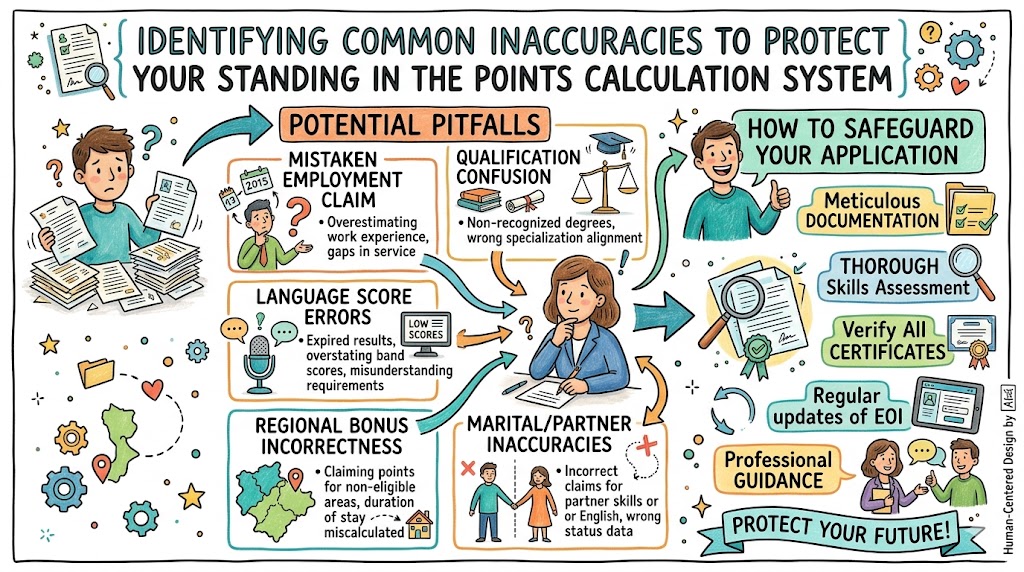
Many applicants fail not because they lack skills, but because they make avoidable errors during the calculation phase. One common mistake is overestimating the length of “skilled” work experience. For example, some assessing bodies deduct a “deeming period” from your total years of work. Furthermore, claiming points for an expired English test or NAATI certificate can lead to an immediate visa refusal. Consequently, accuracy is far more important than speed. Because the Department of Home Affairs verifies every claim with evidence, any discrepancy is viewed as a serious matter. Therefore, treating the calculator with the same seriousness as the legal application is paramount.
Overestimating Attributes:
- Claiming years of experience that occurred while studying usually results in a points mismatch.
- Assuming a Master’s degree automatically equals a higher point bracket than a Bachelor’s without verification.
- Mistakenly claiming points for “Partner Skills” when the partner does not have a valid assessment.
Expired Documentation Risks:
- Using English test results that are older than three years at the time of the invitation.
- Relying on a Skills Assessment that has passed its validity period (usually two or three years).
- Failing to update the calculator after a birthday that moves you into a lower-point age bracket.
Real-Life Case Scenarios Using PR Points Calculator
Visualizing how different profiles interact with the calculator can provide valuable perspective for your own journey. Consider an “Early Career Scenario” where a young professional has high English scores but limited work experience. Conversely, an “Experienced Professional Scenario” might show high points for work history but lower points for age. These profiles demonstrate that there is no single “perfect” candidate; instead, the system rewards a balance of different strengths. Moreover, specialized roles in healthcare or engineering often find success even with lower points due to extreme demand. Consequently, these scenarios prove that strategic planning can overcome specific profile weaknesses. Therefore, analyzing these models helps you find the most logical path for your unique situation.
The Early Career Scenario:
- An applicant under 30 maximizes age points (30) and education points (15) for a Bachelor’s degree.
- By achieving Superior English (20) and a Professional Year (5), they reach 70 points quickly.
- Adding a state nomination (5) brings them to a competitive 75 points for a Subclass 190.
The Experienced Professional Scenario:
- An applicant aged 40 receives fewer age points (15) but maximum points for work experience (15).
- With a Master’s degree (15) and Superior English (20), they sit at a solid 65 points.
- By seeking a Regional 491 sponsorship (15), they jump to 80 points, ensuring a likely invitation.
The Specialized Hero Scenario:
- A nurse or secondary teacher may have a baseline score of 65 or 70 points.
- Due to critical sector demand, these applicants often receive invitations faster than high-scoring IT roles.
- Strategic focus remains on meeting the minimum threshold while ensuring a perfect skills assessment.
Frequently Asked Questions (FAQs)
- What is the minimum score required to apply for Australian PR?
The minimum threshold to submit an Expression of Interest is 65 points. However, many popular occupations require a much higher score to receive an actual invitation.
- Can I claim points for work experience gained during my studies?
Generally, points are only awarded for “post-qualification” experience. Most assessing authorities consider you skilled only after you have completed your relevant degree.
- How long are English language test results valid for the points calculation?
For immigration purposes, English test results such as PTE or IELTS are typically valid for three years from the date of the test.
- Does my partner’s background affect my total points?
Yes, you can gain extra points if your partner has competent English or a positive skills assessment in a relevant occupation.
- What happens if I turn a year older while waiting for an invitation?
If your birthday moves you into a lower-scoring age bracket, your points will automatically decrease in the SkillSelect system.
- Are points for state nomination added automatically?
You must first be nominated by a state or territory government. Once the nomination is confirmed, the 5 or 15 points are added to your profile.
- Is a job offer mandatory to score points in the Australian system?
No, unlike some other countries, the Australian skilled migration system does not strictly require a job offer to accumulate points.
- Can I use the same points for different visa subclasses?
Yes, the base points for age, education, and English remain the same across the 189, 190, and 491 visa categories.
- What is the NAATI CCL test and how many points is it worth?
The NAATI Credentialed Community Language test assesses your interpreting skills and is worth five bonus points upon successful completion.
- How often does the Australian government issue invitations?
Invitation rounds for the 189 visa occur periodically throughout the year, while state nomination rounds (190/491) happen on varying schedules.
- Do I need a skills assessment before using the PR Points Calculator?
While you can use the calculator to estimate your score, you cannot legally claim those points without a valid positive skills assessment.
- Can I update my points after I have submitted my Expression of Interest?
Yes, you can update your EOI at any time to reflect new work experience, higher test scores, or new qualifications.
Final Thought
The journey toward Australian permanent residency is both a challenge and a profound opportunity for professional growth. By utilizing the points calculator as your primary strategic tool, you transform a daunting legal hurdle into a manageable series of steps. Remember that the migration landscape is dynamic, and staying informed is just as important as having high qualifications. Success in this system requires a combination of patience, meticulous documentation, and a proactive mindset toward self-improvement. Whether you are focusing on boosting your language scores or exploring regional opportunities, every action you take brings you closer to your goal. Although the process demands significant effort, the reward of building a life in a country known for its high quality of life and economic stability is well worth the investment. Trust the data, refine your profile, and remain persistent in your pursuit of a new chapter. Your professional expertise has global value, and the points system is simply the bridge that connects your talent to a welcoming new home. Approach your application with precision and let your hard-earned skills pave the way for a successful future.