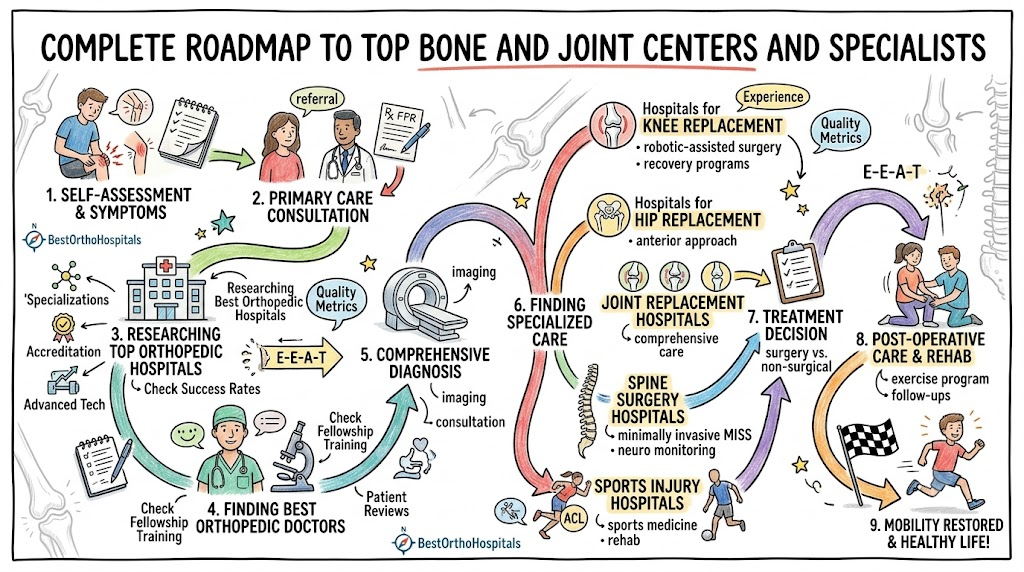
Introduction
Unrelieved muscular ache, damaged ligaments, and deteriorating joints quickly rob you of your physical independence. Acting quickly protects your remaining cartilage, reduces overall bone stress, and speeds up your return to pain-free living. Because complex musculoskeletal issues require deep clinical knowledge, choosing the best orthopedic hospitals and best orthopedic doctors ensures that you receive first-class, reliable care.
Evaluating clinical centers, operation benchmarks, and high-tech imaging tools across different medical networks often creates confusion for patients. Luckily, modern digital medical portals simplify this investigation by presenting doctor credentials, surgical case volumes, and clinical safety records side by side. This structured manual gives you clear, actionable strategies to pick premier bone and joint clinics with absolute assurance.
What Does an Orthopedic Hospital Do?
Dedicated orthopedic institutions evaluate, repair, and rehabilitate the entire human musculoskeletal system under one roof. Medical teams treat structural bones, articulating joints, resilient ligaments, skeletal muscles, and adjacent spinal nerves. Clinicians utilize digital radiography, computed tomography scans, and magnetic resonance imaging to create tailored surgical and non-operative recovery plans.
Besides performing surgical reconstructions, these medical centers run dedicated physical rehabilitation floors and systematic pain management clinics. Orthopedic surgeons, physical therapists, rheumatologists, and physiatrists unite to rebuild physical endurance and joint mobility. Therefore, this team-centered approach delivers consistent, safe, and lasting clinical results for every patient.
How to Identify the Best Orthopedic Hospitals
Spotting elite medical institutions requires examining objective safety numbers, modern robotic tools, and verified surgeon credentials. Top institutions demonstrate outstanding clinical records, reporting very low post-surgical infection rates, minimal unplanned readmissions, and modern intensive care units. Furthermore, established facilities manage round-the-clock emergency infrastructure to resolve complex trauma injuries promptly.
| Quality Standard | Top-Tier Hospital Metric | Standard Hospital Metric |
|---|---|---|
| Surgical Precision | Robotic guidance and 3D computer navigation | Traditional manual surgical instruments |
| Infection Control | Under 0.5% in dedicated orthopedic suites | Typical hospital-wide ward averages |
| Rehabilitation Care | Same-day bedside mobilization teams | General outpatient physical therapy |
| Surgeon Specialization | Fellowship-trained sub-specialty surgeons | General orthopedic surgeons |
Leading medical institutions share their clinical outcome data openly, explaining all procedural risks and recovery expectations plainly. By examining these objective performance benchmarks, patients separate premier surgical centers from basic general hospital units.
How to Find the Best Orthopedic Hospital Near Me
Selecting nearby clinics requires balancing travel convenience with surgical sophistication. Close proximity eases frequent physical therapy visits, dressing changes, and urgent follow-up consultations. However, traveling farther for complex joint reconstructions often delivers better surgical precision and prevents revision procedures. Finding a dependable best orthopedic hospital near me starts with assessing local clinics that focus exclusively on musculoskeletal recovery.
Begin by identifying accredited medical centers that run dedicated orthopedic floors rather than mixed general wards. Next, confirm that the facility provides simple transport links, easy parking, and on-site diagnostic radiology. Speaking with your family doctor often provides reliable, first-hand insight into local surgical reputations.
How to Choose the Best Orthopedic Doctors
Vetting your surgeon requires verifying active board certifications, sub-specialty fellowship training, and annual surgical numbers. Specialists who perform your specific operation hundreds of times each year achieve sharper mechanical alignment, shorter surgical times, and fewer complications. Top practitioners continually refine their clinical methods through ongoing surgical education and clinical trials.
During your first consultation, notice how clearly the surgeon explains your imaging results and explores non-operative treatments first. Attentive specialists welcome your questions, set honest recovery expectations, and build confidence through open communication.
- Sub-Specialty Focus: Select doctors who treat your target joint exclusively instead of practicing broad general orthopedics.
- Annual Case Volume: Check the exact number of times the surgeon completes your specific procedure each year.
- Consultation Clarity: Select a surgeon who listens carefully, reviews your scans thoroughly, and discusses non-surgical alternatives first.
Finding the Best Hospital for Knee Replacement
Successful knee replacement demands high-definition preoperative imaging, seasoned surgical execution, and immediate postoperative physical movement. Finding the best hospital for knee replacement requires pinpointing centers that use robotic alignment systems to save healthy bone and balance soft tissue tensions accurately. These modern innovations minimize surgical trauma, limit blood loss, and shorten your recovery timeline.
Premier centers offer structured joint education classes before surgery, easing patient anxiety. Clinical studies show that patients who complete targeted pre-surgery strengthening exercises regain functional independence much faster. Dedicated joint recovery floors run by orthopedic-trained nurses further elevate post-surgical healing.
Finding the Best Hospital for Hip Replacement
Modern hip reconstruction relies on muscle-sparing approaches, such as the direct anterior method, to accelerate tissue healing. Finding the best hospital for hip replacement involves choosing operating rooms equipped with laminar airflow systems that clear airborne contaminants during component placement. Muscle-sparing techniques preserve your surrounding muscle groups, allowing you to walk independently shortly after your procedure.
Skilled hip surgeons select durable implant materials, such as cross-linked polyethylene, titanium stems, and smooth ceramic bearings matched to your activity goals. Guided post-surgical physical therapy ensures you rebuild stable walking patterns, natural hip balance, and full flexibility rapidly.
How to Choose the Best Joint Replacement Hospital
Comprehensive joint treatment centers stand out by managing complex degenerative conditions through unified clinical pathways. A premier best joint replacement hospital connects orthopedic surgeons, dedicated anesthesiologists, rheumatologists, and physical therapists into a single clinical team. This unified setup prevents miscommunication between surgical teams and postoperative physical therapists.
Standardized clinical pathways shorten unnecessary hospital stays and help patients transition safely back home. Always look for centers that maintain structured long-term checkups to track joint mobility and prosthetic health over many years.
Choosing the Best Spine Surgery Hospital
Spine care requires real-time intraoperative neural monitoring, microsurgical tools, and integrated non-surgical therapy services. Choosing the best spine surgery hospital means selecting centers that exhaust conservative solutions, such as physical therapy, postural ergonomics, and image-guided epidural injections, before considering an operation.
When surgery becomes necessary, minimally invasive decompression, endoscopic discectomy, and artificial disc replacement minimize muscle damage. Dedicated spine surgeons work alongside neurophysiologists to monitor spinal cord signals continuously throughout the entire operation.
Finding the Best Sports Injury Hospital
Athletic recovery demands rapid diagnostic scans, minimally invasive arthroscopic surgery, and progressive physical rehabilitation. A top-tier best sports injury hospital treats acute ligament tears, tendon injuries, cartilage damage, and chronic joint instability in both competitive athletes and everyday fitness enthusiasts.
These specialized clinics create structured return-to-play protocols that restore speed, muscle strength, and athletic confidence under intense physical movement. Sports medicine doctors guide you step-by-step from initial joint protection to high-intensity athletic conditioning.
What Questions Should You Ask an Orthopedic Hospital?
Asking targeted questions during your appointment clarifies expectations and uncovers key operating standards. Clear communication helps you make confident medical choices while mapping clear milestones for your rehabilitation journey.
- How many procedures of this exact type does your surgical team perform each year?
- What modern robotic and minimally invasive tools does this hospital use regularly?
- What in-house rehabilitation and home recovery programs does the center provide?
- How does the hospital monitor, treat, and minimize postoperative pain and infection risks?
Common Mistakes Patients Make When Choosing an Orthopedic Hospital
Many patients choose medical centers based entirely on geographic convenience or flashy advertisements rather than verified surgical performance. Overlooking surgeon experience levels and sub-specialty qualifications often compromises clinical results and extends recovery times. Therefore, reviewing objective clinical registries provides far deeper insight than relying on promotional marketing.
Another common misstep involves ignoring post-surgical rehabilitation support. Successful joint recovery relies heavily on consistent, expert-led physical therapy after discharge. Choosing a center that lacks coordinated physical therapy leads to lingering joint stiffness and slower functional progress.
BestOrthoHospitals as a Research Starting Point
Evaluating healthcare choices requires structured, accurate information to compare clinics across multiple regions. Centralized medical directories simplify this process by gathering hospital profiles, doctor credentials, and treatment specialties into a clean layout. Finding a top-tier best orthopedic hospital requires objective comparisons across essential clinical indicators.
Patients compare treatment methods, review available technology, and select suitable medical facilities without delay. Using structured search directories saves time and connects you directly with medical centers tailored to your specific care needs.
How to Compare Top Orthopedic Hospitals
Review prospective healthcare centers methodically using a balanced clinical evaluation framework. Looking at multiple quality markers gives you a complete view of institutional excellence. Comparing top orthopedic hospitals ensures your chosen facility meets recognized medical safety benchmarks.
Comprehensive Facility Evaluation Framework:
├── 1. Clinical Credentials & Hospital Accreditation
├── 2. Surgical Volume & Sub-Specialty Expertise
├── 3. Advanced Technology (Robotics, Navigation, Imaging)
├── 4. Infection Control Standards & Safety Track Records
└── 5. Dedicated In-House Rehabilitation Programs
Evaluate how each center manages emergency care, postoperative complications, and patient satisfaction tracking. Choosing a hospital that excels across these fundamental areas ensures a safe, supportive, and successful surgical experience from admission through final recovery.
Frequently Asked Questions About BestOrthoHospitals
1. Which advantages do medical directories provide for orthopedic patients?
Online discovery hubs compile doctor credentials, hospital technology standards, and specialty treatments into one interface, allowing individuals to make well-informed healthcare decisions before booking consultations.
2. Where do sub-specialty orthopedic surgeons gain extra practical training?
Sub-specialists complete rigorous fellowship training programs dedicated strictly to one joint or anatomical region, giving them higher technical precision and deeper clinical diagnostic skills.
3. Which clinical factors make robotic joint replacement so advantageous?
Robotic guidance enables surgeons to place prosthetic components with millimeter accuracy, balance surrounding ligaments, and protect healthy bone, which extends the overall life of the implant.
4. When do clinicians recommend orthopedic surgical intervention?
Surgeons recommend operative treatment only after non-surgical options—such as physical therapy, anti-inflammatory medications, and therapeutic injections—fail to relieve chronic pain or restore functional mobility.
5. How quickly do patients walk after undergoing joint replacement surgery?
Care teams typically assist patients to stand and walk within twenty-four hours after the operation, followed by six to twelve weeks of structured physical rehabilitation to rebuild full functional strength.
6. Why does postoperative physical therapy determine long-term joint success?
Structured rehabilitation exercises strengthen supporting muscle groups, restore full joint flexibility, stop fibrous scar tissue formation, and retrain natural, safe movement patterns.
7. Can aggressive sports injuries heal without open surgical operations?
Many athletic injuries recover successfully through targeted rest periods, regenerative medicine, protective bracing, and sport-specific physical therapy programs without invasive surgical procedures.
8. Which safety protocols protect patients from surgical site infections?
Operating teams prevent infections by using advanced laminar airflow operating rooms, enforcing strict instrument sterilization, minimizing surgical times, and running dedicated orthopedic inpatient floors.
9. Why should patients evaluate institutional surgical case volumes?
Hospitals that complete high numbers of specific joint procedures report fewer surgical complications, lower revision rates, shorter inpatient stays, and superior long-term clinical outcomes.
10. What key logistical steps should out-of-town surgical patients complete?
Patients must organize comfortable transportation, schedule postoperative lodging, verify remote communication channels with their doctor, and arrange local physical therapy before traveling.
Final Thoughts
Reclaiming full physical mobility requires informed patient research, thorough doctor vetting, and access to modern medical facilities. Placing your care in the hands of an accredited hospital staffed by fellowship-trained surgeons protects your joints and accelerates your recovery. By prioritizing surgical experience, robotic precision, and dedicated rehabilitation programs, you take direct ownership of your musculoskeletal health and future vitality.